Introduction
You need to fill a critical role quickly, but the last mis-hire cost you months of lost productivity and a painful offboarding process. Sound familiar? This is exactly the problem temp-to-hire was designed to solve.
In plain terms, temp-to-hire means a worker joins a company through a staffing agency for a defined trial period. If both sides are satisfied, the company extends a permanent employment offer at the end of that period. No upfront commitment. No guesswork.
This guide covers both sides of the arrangement. Employers get a clear breakdown of how it works, what it costs, and when it makes sense. Candidates get practical advice on evaluating an offer and turning that trial period into a permanent role.
Key Takeaways
- A temp-to-hire arrangement places a worker with a company through a staffing agency for a fixed trial period — typically 3–6 months — after which the employer can offer permanent employment.
- The staffing agency acts as employer of record during the trial, managing payroll, compliance, and statutory duties.
- At contract end, employers can convert the worker to permanent staff, extend the contract, or end the engagement.
- Employers validate fit before committing to a permanent hire, reducing mis-hire risk.
- Candidates get a structured path to full-time employment — with no blind leap required.
What Is Temp-to-Hire and How Does It Work?
SHRM describes temp-to-hire (or temp-to-perm) hiring as a strategy where contingent workers are evaluated for permanent employment after a structured trial run. The key distinction from direct hire: there's no long-term commitment made at the start.
The Employer-of-Record Structure
During the trial period, the staffing agency — not the client company — is the legal employer. SHRM's contract staffing policy confirms that temporary staff are employees of the staffing agency rather than direct employees of the client. This means:
- The agency handles payroll taxes, statutory deductions, and compliance
- The client company directs the worker's day-to-day tasks
- The worker receives a W-2 from the agency at year-end (not a 1099) — applicable to US-based arrangements
The agency carries all legal and administrative weight during this period.
How the Timeline and Conversion Work
Most contract-to-hire arrangements last 3 to 6 months before a permanent hire decision is made. Duration varies by role complexity and how long the employer needs to evaluate fit.
At the end of that period, three paths are possible:
- Permanent offer — the employer extends a full-time role; a conversion fee is typically paid to the agency per the original staffing agreement
- Contract extension — both parties need more time before committing
- Separation — the engagement ends without a permanent offer
The worker has the right to decline the offer too. This is a two-way evaluation.
What the Contract Should Cover
A well-drafted temp-to-hire agreement typically includes:
- Job title, duties, and reporting structure
- Compensation during the temporary period
- Trial period duration and conditions for conversion
- Conversion or finder's fee terms
- Termination clauses for either party
- Confidentiality and non-solicitation provisions
Non-solicitation terms and conversion triggers carry legal weight — consulting an employment attorney before finalizing the agreement is worth the effort.
Temp-to-Hire vs. Similar Employment Types
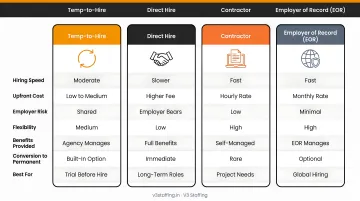
Not all contingent arrangements work the same way. Here's how temp-to-hire compares to the most common alternatives:
| Employment Type | Trial Period? | Employer of Record | Permanent Intent? |
|---|---|---|---|
| Temp-to-hire | Yes (3–6 months) | Staffing agency | Yes — conditional on performance |
| Temporary/seasonal | No | Staffing agency or client | No — fixed term only |
| Independent contractor | No | Self-employed | No — project-based |
| Direct hire | No | Client company | Yes — from day one |
The Classification That Matters Most: W-2 vs. 1099
This is where misclassification risk is highest. A temp-to-hire worker is a W-2 employee of the staffing agency. An independent contractor is self-employed, submits invoices, and pays their own taxes.
The IRS evaluates worker classification based on behavioral control, financial control, and the nature of the relationship. The DOL has been explicit that misclassifying an employee as a contractor can result in back wages, missed FLSA protections, and tax liability. If you're working with a staffing agency and the agency is the employer of record, the worker is a W-2 employee. No exceptions.
Contract-to-Hire = Temp-to-Hire
These terms are interchangeable. Both refer to the same arrangement where a worker is placed temporarily with the intent to evaluate them for permanent employment. The terminology varies by industry and region, but the structure is identical.
Key Benefits of Temp-to-Hire
For Employers
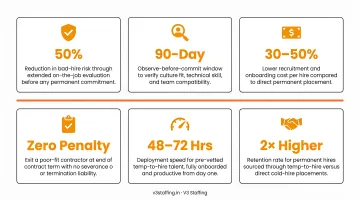
Reduced hiring risk is the core value proposition. Assessing a candidate's real-world performance, communication style, and cultural fit over three to six months is far more reliable than a few hours of interviews. SHRM notes that hiring from a contingent workforce directly reduces the risk of bad hiring decisions.
That risk carries real cost. SHRM has cited the total cost of recruiting, hiring, and onboarding a new employee at up to $240,000 when factoring in all associated expenses — making every avoided mis-hire a measurable financial win.
Additional employer benefits:
- Faster onboarding: Agencies handle sourcing, screening, and compliance — freeing internal HR capacity. V3 Staffing, for example, offers pre-verified talent with onboarding completed within 48–72 hours for temp roles.
- Workforce flexibility: Headcount scales with actual business need rather than forecasts — useful during growth phases, project surges, or budget uncertainty.
- Reduced time-to-productivity: Pre-vetted candidates have already cleared technical and cultural screening, so they contribute from day one rather than week three.
For Candidates
- Two-way evaluation: Candidates assess the company's culture, management approach, and growth opportunities before accepting a permanent offer.
- Faster path to employment: According to SIA benchmarks, professional temp staffing typically reaches offer acceptance in a median of 9 days — a fraction of the 35+ days traditional hiring takes.
- Real resume value: Nearly 9 in 10 staffing employees report that temporary or contract work makes them more employable — regardless of whether the role converts.
The Temp-to-Hire Process: From Placement to Permanent
Step 1 — Engagement
The client company submits role requirements to a staffing agency. The agency sources, screens, and presents pre-vetted candidates. Both parties sign a staffing agreement covering the trial period duration, billing rate, and conversion fee structure.
At V3 Staffing, this stage includes a need assessment and multi-layer screening — covering:
- Skills and technical fit
- Relevant experience
- Attitude and culture alignment
- Background verification
This process targets an 80% shortlist accuracy before a single candidate is presented.
Step 2 — Trial Period
The worker joins the client company under the agency's employment. The client directs daily work and provides performance feedback. The agency remains employer of record for payroll, compliance, and statutory obligations.
This period is a genuine evaluation — for both sides.
Step 3 — Conversion Decision
At the end of the agreed period, the employer decides on one of three paths:
- Extend a full-time offer
- Continue the contract for a longer trial
- End the engagement
If permanent hire proceeds, the client pays a conversion fee to the agency — terms negotiated in the original staffing agreement.
When Temp-to-Hire Makes Sense — And When It Doesn't
When It Works Well
Temp-to-hire fits best when:
- The role is core to operations but the employer wants to validate fit before committing
- The business is scaling quickly and headcount needs may shift — common in GCC build-outs, IT product teams, and manufacturing ramp-ups
- A long-term employee is being replaced and the role needs re-evaluation
- The candidate market is competitive and faster offer turnaround improves conversion
It's especially common in IT and product engineering, BFSI, engineering and manufacturing, finance operations, and GCC-linked shared services.
When It May Not Be the Right Fit
Not every role suits a trial period, though:
- Senior leadership roles — a trial period can signal uncertainty to strong candidates who have other options
- Roles requiring deep institutional knowledge from day one — the ramp-up time defeats the purpose
- Organisations without HR infrastructure to manage agency relationships, conversion timelines, and compliance handoffs
When the priority is securing a candidate quickly rather than evaluating them over time, direct hire is the cleaner path.
Tips for Candidates: How to Turn a Temp Role Into a Permanent Job
The conversion isn't automatic — but it's very much within your control.
Start with the basics: show up on time, follow company norms, and engage with your team. Managers form impressions in the first few weeks, and those impressions tend to stick.
Don't wait until the final month to signal you want to stay. Expressing genuine interest in the company's goals early and often matters — many hiring managers make conversion decisions well before the contract end date.
Document your contributions as you go. Keep a running record of projects completed, problems solved, and improvements made. When the conversion conversation happens, concrete examples carry far more weight than general impressions.
A few practical habits that help:
- Volunteer for additional tasks when your workload allows
- Ask for feedback and act on it quickly
- Learn the company's systems and processes beyond your immediate role
- Build relationships across teams, not just with your direct manager
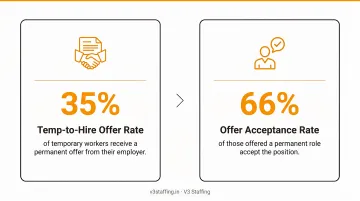
According to ASA data, 35% of temporary and contract employees receive a permanent job offer from a client they worked with — and of those, 66% accept. The odds are reasonable. Showing up with intention every day — not just in the final weeks — is what tips the decision in your favour.
Frequently Asked Questions
What does a temp-to-hire contract mean?
A temp-to-hire contract is a legal agreement between the staffing agency, the client company, and the worker. It covers the assignment duration, job duties, compensation, and the conditions under which a permanent role may be offered.
Can a temp-to-hire contract lead to a permanent job?
Yes — that's the primary purpose. However, conversion isn't guaranteed. It depends on the employer's business needs, budget, and the worker's performance during the trial period. Both sides retain the right to walk away.
What is the 70/30 rule for temp-to-hire?
The 70/30 rule is an informal guideline suggesting roughly 70% of a temp worker's time should be spent on productive role-relevant work, with 30% on onboarding and training. It's not a universal industry standard and isn't formally recognized across the staffing sector.
Do temp-to-hire employees receive a W-2 or 1099?
Temp-to-hire workers are W-2 employees of the staffing agency during the temporary period. The agency withholds payroll taxes and issues a W-2 at year-end — not a 1099-NEC.
How long does a temp-to-hire period typically last?
Most temp-to-hire periods last 3 to 6 months, with this range being the most common guidance from major staffing firms. The exact duration depends on role complexity and what's agreed in the staffing contract.
What is the difference between temp-to-hire and contract-to-hire?
These terms are interchangeable. Both describe the same arrangement — a worker placed temporarily with the intent to evaluate them for permanent employment. The terminology varies by industry or region but the structure is the same.