The problem isn't a shortage of data. It's that candidate information sits scattered across applicant tracking systems, LinkedIn profiles, assessment platforms, and spreadsheets nobody updates consistently. Most recruiting teams simply lack the analytics skills or clean infrastructure to turn that mess into usable insight.
The shift is already underway. In a 2024 SHRM survey of 2,366 U.S. HR professionals, roughly 1 in 4 employers reported using AI to support HR activities, and 64% of those employers applied it specifically to talent acquisition.
This guide skips the theory. It walks through how to apply big data across the real recruiting funnel, from sourcing to retention, without losing the human judgment that keeps hiring fair and accurate.
Key Takeaways
- Big data pays off most in high-volume, repeatable hiring, not one-off executive searches
- Clean, centralized candidate data and defined KPIs come before any modeling starts
- Value compounds across sourcing, screening, assessment, interviews, and onboarding
- Bias audits and compliance checks run alongside every algorithmic step, not afterward
When Should You Use Big Data in Recruiting?
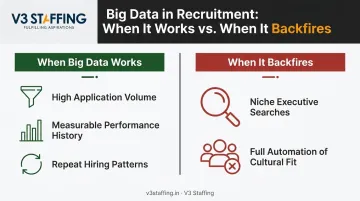
Big data recruiting isn't a universal upgrade for every open role. It works when three conditions line up:
- High application volume — enough candidates flowing through to generate statistically meaningful patterns
- Measurable performance history — past hires with documented outcomes like ratings, retention, or output
- Repeat hiring patterns — the same role type gets filled repeatedly, month over month
Where It Backfires
Two situations tend to break the model:
- Niche executive searches. Sample sizes are too small for the algorithm to learn from. Hiring one VP of Engineering a year gives it nothing meaningful to work with.
- Full automation of cultural fit. Algorithms flag pattern matches. They can't sit across the table and judge whether someone will thrive on a specific team under a specific manager.
Small training samples produce unstable validity estimates and imprecise predictions, according to Society for Industrial and Organizational Psychology (SIOP) guidance on AI-based assessments.
Sectors like IT, Global Capability Centers (GCCs), manufacturing, finance, and automotive generate the hiring volume needed for analytics to hold up statistically. A GCC ramping up 200 data engineers in a quarter has that volume. A boutique firm hiring two accountants a year doesn't.
What You Need Before Using Big Data for Talent Acquisition
Before any dashboard or scoring model goes live, four things need to be in place:
- A centralized ATS/HRIS or data warehouse: fragmented records across spreadsheets, email threads, and standalone tools produce inconsistent candidate data that no algorithm can clean up afterward.
- Clearly defined hiring KPIs (time-to-fill, quality-of-hire, retention), so recruiters know what "good" looks like before any model starts scoring candidates against it.
- A data governance and compliance framework covering EEOC standards and state privacy laws. Skipping this step creates legal exposure the moment an algorithm produces a ranked list.
- Recruiters or analysts trained to interpret model outputs, since a ranked shortlist means little if nobody understands why the model ranked it that way.
Skip any one of these, and the "data-driven" process just becomes a faster way to make the same old mistakes.
How to Use Big Data for Recruiting (Step-by-Step)
Big data only delivers value when applied in sequence across the hiring funnel. Skip a stage, and you typically reintroduce the exact bias or inefficiency it was meant to remove.
Sourcing and Talent Mapping
For scarce skills, such as cloud architects, AI/ML engineers, or VLSI designers, sourcing starts with mapping where the talent actually lives. Recruiting teams pull signals from LinkedIn profiles, GitHub contribution histories, job board activity, and internal talent pools to build a picture of who's qualified and who's likely to move.
The common setup error: treating this like keyword search. A recruiter searching "AWS" and "Python" misses the engineer who lists "cloud infrastructure" and contributes to open-source Kubernetes projects instead.
Behavioral and skill-pattern signals catch passive candidates that keyword matching skips:
- Contribution frequency and project complexity on code repositories
- Career trajectory across similar roles, not just job titles
- Engagement patterns that suggest openness to new opportunities
Talent mapping only works when someone understands the skill taxonomy behind the role. A team hiring automotive embedded systems engineers needs to recognize AUTOSAR and ADAS experience patterns, not just scan for matching titles.
Screening and Predictive Shortlisting
Once candidates are sourced, algorithms score incoming applications against historical high-performer data to generate ranked, prioritized shortlists. This replaces the old model of a recruiter manually reading through hundreds of resumes in the order they arrived.
Staffing partners apply this at scale through SLA-driven, rigorously vetted shortlists. V3 Staffing, for example, uses structured, data-backed vetting to help enterprises and GCCs cut shortlist turnaround time, screening every candidate against skills, career stability, and cultural fit before a shortlist ever reaches the client.
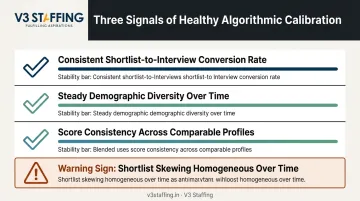
How to tell if calibration is working:
- A healthy shortlist-to-interview conversion rate, converting to first-round interviews at a consistent, predictable pace
- Demographic diversity holding steady within the shortlist, not narrowing as the model learns
- Score consistency across comparable candidate profiles, so equally qualified applicants land in similar ranking tiers
A shortlist that converts well but skews increasingly homogeneous over time is a warning sign, not a success story.
Assessment and Interview Analytics
Skills tests, structured interview scoring, and resume data combine to reduce single-point subjective bias, the kind that creeps in when one interviewer's gut reaction decides an outcome.
The operating limit here matters: no single data point should override the full weighted profile. A strong personality assessment score doesn't offset a weak technical evaluation. A brilliant technical score doesn't excuse a candidate who can't communicate with a team.
Enterprise clients that work with structured vetting partners see this play out directly. Cotiviti's Head of Talent Acquisition, Mohsin Mohammed, noted that V3 Staffing's endorsed candidates were consistently high quality because "the team understands our requirements well." That kind of consistency comes from screening across skills, stability, and culture fit together, not from any single test result.
Onboarding, Productivity, and Retention Feedback
The feedback loop is where most companies drop the ball. Ninety-day performance and attrition data need to feed back into the hiring model to continuously test and improve its predictive accuracy.
SHRM research on people analytics found that 82% of organizations using analytics applied it to retention and turnover, while 71% applied it to recruitment and hiring. That overlap is evidence the two are meant to inform each other, not operate in isolation.
Faster, structured onboarding creates cleaner data for this loop. V3 Staffing's 48-to-72-hour onboarding process for pre-verified temporary talent means early-performance signals show up sooner and with less noise from administrative delays.
Skip this feedback step, and you get model drift: the algorithm keeps repeating past hiring mistakes because nobody's telling it what actually happened after the hire.
Best Practices for Using Big Data Effectively in Talent Acquisition
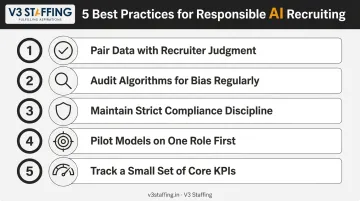
A few disciplines separate teams that get real value from big data from teams that just add complexity:
- Pair data insights with recruiter judgment on cultural fit. Full automation increases mis-hire risk, especially for roles involving team dynamics or client-facing work.
- Audit hiring algorithms for bias regularly. The EEOC's $365,000 settlement with iTutorGroup followed evidence its software auto-rejected women 55+ and men 60+. Algorithmic bias isn't theoretical; it's already been litigated.
- Maintain strict compliance discipline around consent, data retention limits, and alignment with EEOC and state-level hiring regulations.
- Pilot data models on one high-volume role or region before scaling org-wide. A single GCC hiring wave is a better test bed than a company-wide rollout.
- Track a small set of core KPIs (time-to-fill, quality-of-hire, offer-acceptance rate) rather than over-instrumenting every touchpoint in the funnel.
None of these require exotic tools. They require discipline applied consistently.
Conclusion
Success with big data recruiting comes down to sequence: clean data, clear metrics, and human review at every stage. Adding more tools or complexity won't fix a broken process.
Treat data-driven hiring as an ongoing capability that evolves with your hiring needs. Partnering with an experienced talent partner like V3 Staffing can help: with 15+ years hiring for enterprises and GCCs across India's major hubs, V3 Staffing builds compliance and consistency into the hiring process from day one.
Frequently Asked Questions
How is big data used in recruitment?
Big data sources candidates, predicts success by matching applicants against historical performance patterns, screens applications at scale, and reduces bias in shortlisting. It works best layered across the entire hiring funnel rather than applied at just one stage.
What are the 7 stages of recruitment?
Most frameworks describe planning, sourcing, screening, interviewing, assessment, offer, and onboarding. Big data applies most heavily during sourcing, screening, and assessment, where volume and historical patterns give algorithms enough signal to work with.
What are the 5 pillars of recruitment?
Sourcing, screening, assessment, selection, and onboarding form the core pillars that data-driven recruiting strengthens. Each pillar benefits from a different type of data, from social profiles to structured interview scores.
What are examples of big data in HR?
Common sources include ATS records (resumes, applications, candidate movement), social and professional profile data, assessment and skills-test scores, and post-hire performance or retention data. Together, they build the historical baseline that models need to score new candidates.
Is data-driven hiring compliant with U.S. employment law?
Compliance depends on transparent consent, bias audits, and alignment with EEOC guidance and laws like NYC's Local Law 144 or Illinois's AI Video Interview Act. These rules don't ban algorithmic hiring, but they require documentation and oversight.
Can smaller companies use big data in hiring without heavy investment?
Yes. Cloud-based ATS platforms and staffing partners with built-in analytics let smaller teams access data-driven hiring without building infrastructure in-house. This lowers the barrier compared to building a proprietary model from scratch.