Introduction
According to the NASSCOM/Zinnov India GCC Landscape Report, India now hosts 1,700+ GCC companies across 2,975+ centers, employing over 1.9 million professionals and generating $64.6 billion in revenue as of FY2024. By 2030, that figure is projected to reach $99–105 billion. The GIC model has moved well past cost arbitrage — it's now a core part of how global enterprises build engineering, analytics, and product capability.
For US and global enterprises, this represents a genuine strategic opportunity — not just a cost play. But setting one up involves real decisions: which city, which legal structure, which operating model, and how to staff it quickly without regulatory missteps.
This guide covers all of it — what a GIC actually is, how it compares to outsourcing, which cities lead for specific functions, the legal structures available, and what it takes to hire and retain the right talent once you're on the ground.
TLDR: Key Takeaways
- A GIC is a fully owned offshore subsidiary — the parent retains full control over hiring, IP, and operations, unlike third-party outsourcing
- India leads globally due to deep STEM talent, strong cost advantages, and a mature GIC ecosystem with government-backed incentives
- Bengaluru dominates, but Hyderabad, Mumbai, Pune, NCR, and Chennai each serve distinct industries and functions
- Three setup models — DIY, Build-Operate-Transfer (BOT), and Managed/Virtual Captive — carry different risk and cost profiles
- Talent acquisition is the single most critical execution variable; specialist GIC recruiters cut time-to-productivity measurably
What Is a Global In-House Center (GIC)?
GIC, GCC, ODC: Sorting Out the Terminology
A GIC (originally called a "captive center" in the 1990s) is a fully owned offshore subsidiary of a multinational company. The parent organization retains complete authority over hiring decisions, technology stack, IP, and strategic direction. Nothing is delegated to a vendor.
GCC (Global Capability Center) is simply the more current term. Government bodies, NASSCOM, and industry analysts now use GCC almost exclusively. For practical purposes, GIC and GCC are interchangeable.
An ODC (Offshore Development Center) is different. It's typically smaller, tech-focused, and often partially managed by a third-party vendor , meaning the parent exercises less direct control. An ODC can be a stepping stone toward a full GIC, but it isn't one.
From Back-Office to Innovation Hub
The GIC model has gone through a genuine transformation:
- GIC 1.0 (1990s–2000s): IT support, BPO, finance processing, HR administration with cost reduction as the primary driver
- GIC 2.0 (today): R&D, AI/ML, cloud engineering, product development, digital transformation with strategic control and innovation speed now driving decisions
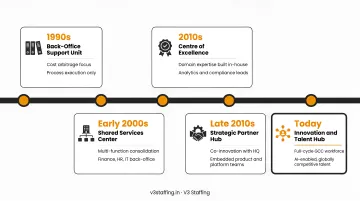
Modern GICs house a broad range of functions: software engineering, data science, finance and accounting, supply chain, HR, customer experience, and product management. The back-office framing no longer applies.
Why GICs Beat Outsourcing for Digital Work
Third-party outsourcing works well for transactional, well-defined work. It struggles with complex engineering for one structural reason: vendors run a labor pyramid model, cycling through junior staff to maximize margin. That creates constant churn.
GICs solve this by building persistent teams: engineers who accumulate deep knowledge of a company's codebase, architecture, and product decisions over years. That institutional depth is what actually accelerates digital transformation — and it can't be replicated through a vendor contract.
Why India Is the Preferred Global Destination for GICs
Talent at Scale
India's higher education system produces engineering and science talent at a volume that no comparable market matches. According to the Ministry of Education's AISHE 2021-22 report, India had:
- 41.3 lakh students enrolled in Engineering and Technology programs
- 57.2 lakh enrolled in Science programs
- 9.3 lakh Engineering and Technology graduates produced in a single academic year
That pipeline feeds a workforce with strong depth in software engineering, data science, finance, and life sciences — all core GIC functions.
The Cost Differential
Salary benchmarks from ERI SalaryExpert (2026) illustrate why the arbitrage is so compelling:
| Role | India (INR/yr) | US (USD/yr) |
|---|---|---|
| Software Engineer | ₹23,18,421 | $128,524 |
| Data Analyst | ₹19,30,321 | $108,979 |
| Financial Analyst | ₹16,62,746 | $111,518 |
Across a team of 100 professionals, that differential compounds into tens of millions of dollars annually — before accounting for real estate, benefits, and other cost advantages.
A Mature Ecosystem
Setting up a GIC in India today is different from what it was 15 years ago. The ecosystem has matured considerably:
- Experienced GIC leaders and operators are abundant
- Specialized legal, tax, and HR advisors understand GIC-specific compliance
- Grade-A tech parks, SEZ-registered office spaces, and co-working options exist across every major city
- Specialist staffing firms maintain pre-verified candidate pipelines for every GIC function
Government and Regulatory Tailwinds
India's policy environment actively supports GIC formation:
- SEZ registration under Section 10AA provides 100% export-income tax exemption for the first 5 years, 50% for the next 5, and 50% on reinvested profits for another 5
- STPI scheme allows 100% foreign equity and duty-free hardware/software imports
- Karnataka's GCC Policy 2024 targets 500 new GCCs by 2029 and $50 billion in economic output
- Telangana's T-AIM initiative supports AI ecosystem development and GIC attraction
- Maharashtra's IT/ITeS Policy 2023 targets financial services and technology GCCs specifically
Operational Advantages
India's 9.5–13.5 hour time zone offset from US cities creates meaningful daily overlap for US-headquartered organizations. A team in Bengaluru or Hyderabad working standard business hours shares roughly 3–4 hours of live overlap with US East Coast teams — enough for standups, escalations, and sprint reviews without anyone working odd hours.
Beyond scheduling, robust digital infrastructure and mature tech park ecosystems across Bengaluru, Hyderabad, Pune, and Chennai make day-to-day coordination with US teams straightforward.
Top GIC Hub Cities in India: Where to Set Up and Why
Bengaluru — The Default Choice for Tech-Heavy GICs
Bengaluru is India's GIC capital. According to Zinnov's 2025 analysis, the city hosts 880+ centers — roughly one in every three new GCCs added nationally lands here. Karnataka as a whole accounts for 35% of India's entire GCC workforce.
Why Bengaluru wins for technology:
- Unmatched AI, cloud, and engineering talent concentration
- IISc and adjacent research institutions feeding the talent pipeline
- 3,200+ tech startups creating a dynamic, skills-rich environment
- Karnataka's proactive GCC policy offering the clearest state-level incentive framework
If your GIC is anchored in software engineering, data science, or product development, Bengaluru is typically the starting point.
Hyderabad — Fast Growth, Lower Costs
Hyderabad now ranks among the top three cities for new GCC setups, alongside Bengaluru and Pune, according to NASSCOM and Zinnov. The city's strengths:
- Strong specialization in Software & Internet, BFSI, and Semiconductor sectors
- Lower commercial real estate costs relative to Bengaluru
- Government support through T-AIM and planned AI City development
- A rapidly expanding digital talent pool drawing professionals from across South India
For GICs prioritizing cost efficiency without sacrificing talent quality, Hyderabad is increasingly the first choice.
Mumbai and Pune — BFSI and Engineering
Mumbai dominates financial services GICs. Standard Chartered's GBS India supports technology and operations across 54 markets from its India base, and Citi's Mumbai presence at BKC is one of its largest global hubs. For BFSI talent depth, no Indian city comes close.
Pune serves a different purpose. It's India's automotive GIC capital, with major centers from ZF, Magna, and Stellantis concentrated there, and its Software & Internet talent pool runs deep as well. Together, the two cities form the west-coast corridor that Zinnov estimates hosts 720+ GCCs. Maharashtra's IT/ITeS Policy 2023 adds further institutional backing.
NCR and Chennai — Scale and Stability
NCR (Delhi/Gurgaon/Noida) offers scale and functional diversity. The region's mix of entry-level and senior IT talent makes it well-suited for GICs that need broad functional coverage across engineering and shared services:
- Major technology and healthcare GICs already operating at scale
- Strong headcount depth for shared services ramp-ups
- Competitive real estate across Gurgaon, Noida, and Greater Noida submarkets
Chennai stands out for workforce stability. Attrition rates here run consistently lower than Bengaluru and Hyderabad, which matters when long-term retention is a strategic priority:
- Deep automotive heritage (the city's "Detroit of India" reputation is well-earned)
- Growing BFSI and EdTech ecosystems adding sector diversity
- Cost profile more favorable than the western and southern metro hubs
The Tier-II Opportunity
Beyond the six major hubs, cities like Ahmedabad, Coimbatore, and Thiruvananthapuram are gaining traction. According to Zinnov's research, these markets offer lower operational costs, improving talent availability, and attrition rates that undercut most Tier-I cities. For GICs looking to diversify after establishing a Tier-I presence, or for specific functions that don't require premium tech-hub talent, Tier-II markets deserve serious consideration.
GIC Business Models: DIY, BOT, and Managed Captive
Do-It-Yourself (DIY)
The parent company independently manages everything: legal incorporation, office leasing, HR, payroll, compliance, and operations. Local specialists may be retained for discrete tasks, but the parent owns the full execution responsibility.
Pros: Full control, no vendor profit share, cleaner governance
Cons: High risk of regulatory and operational missteps without local expertise; typically requires internal bandwidth that most US headquarters don't have available
DIY works best for companies with prior India operations experience or those making a large, long-term commitment where the investment in internal capability makes sense.
Build-Operate-Transfer (BOT)
A BOT partner manages the full lifecycle of GIC setup and operations for a defined term, after which the parent takes over ownership and control. Key considerations:
- Contractual structure: Back-end payout formulas should tie clearly to cost savings and productivity metrics, not just time milestones
- Governance rights: The parent should secure board seats or equivalent oversight from day one, not just at transfer
- Entity structure: If the BOT partner uses an SPV (Special Purpose Vehicle), obtain parent company guarantees to protect against partner-side risk
- Timeline: BOT arrangements typically run multi-year before transfer, so realistic productivity timelines matter more than launch speed
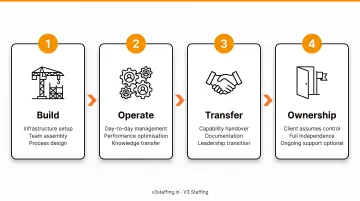
BOT accelerates time-to-productivity. The tradeoff is higher total cost due to the partner's success fee — factor this into your 3-year cost model before committing.
Managed/Virtual Captive
The managed captive model is the default choice for mid-market companies making their first India entry. A specialist partner manages day-to-day operations — HR, payroll, compliance, facilities — while the parent retains strategic control, brand identity, and team direction.
Pros: Fast setup, no need for a dedicated India operations team upfront, lower execution risk
Cons: Ongoing partner dependency; governance boundaries need explicit contractual definition
Most companies transition to full ownership within 2–3 years, once a stable local leadership layer is in place.
Building and Retaining GIC Talent: The Critical Execution Layer
Why Talent Determines GIC Success
Every strategic decision about city, model, and legal structure is secondary to one question: can you hire and keep the right people?
India's tech talent market is genuinely competitive. Top-tier engineers in Bengaluru and Hyderabad receive multiple offers. GICs without compelling career narratives — clear growth paths, global product exposure, meaningful technical work — struggle with attrition in ways that undermine the entire business case.
The three things that separate high-performing GICs from struggling ones:
- Employer branding grounded in the parent's global reputation — candidates want to know they're building something real, not supporting a cost center
- Defined career progression — domain-specific specialization paths matter more to Indian tech professionals than they do in most Western markets
- Upskilling in emerging tech — AI, cloud, and platform engineering programs signal that the GIC invests in its people's futures
Partnering with a Specialist GIC Recruiter
Most GICs — especially in early growth stages — can't afford to staff a large internal TA function while simultaneously trying to hire at speed. That's where specialist staffing partners deliver real value.
V3 Staffing has supported large enterprises and GCC clients across India for over 15 years, with active operations in Bengaluru, Hyderabad, Chennai, Pune, Delhi NCR, and Mumbai — every major GIC hub. Their GCC-specific service model covers:
- Permanent placement for core team roles requiring long-term stability
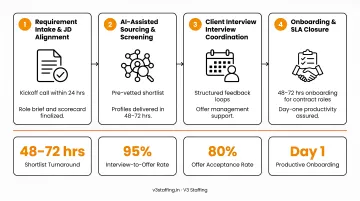
- Contract staffing for flexible ramp-up phases with pre-vetted candidates ready to deploy in 48–72 hours
- RPO for GICs that need an embedded recruitment team functioning as an extension of their internal TA function
- EOR (Employer of Record) for US parent companies that want to hire Indian talent before their legal entity is formally established — V3 handles payroll, compliance, PF, ESIC, and all statutory requirements
Their hiring process runs in four stages: diagnostic review, custom hiring strategy, domain-trained execution, and continuous governance. Shortlists are SLA-driven and typically delivered within 7–15 days. The reported offer-to-join ratio is 90%, and core roles across tech, finance, and analytics are filled within 10–15 days.
For niche roles, V3's pipelines cover the hard-to-fill profiles that generic recruiters consistently miss:
- VLSI design, ASIC verification, and embedded systems
- AUTOSAR, AI/ML, and MLOps engineering
- Senior GIC leadership and program management
Clients including Google, ZF, FactSet, Magna, Johnson Controls, and Dream11 have used this depth to staff roles that took previous partners months to fill — a track record that matters most when a GIC is ramping fast and can't afford gaps.
Frequently Asked Questions
What are global in-house centers (GICs)?
A GIC — also called a captive center or GCC — is a fully owned offshore subsidiary of a multinational company. Unlike outsourcing, the parent company retains complete control over hiring, operations, technology, and strategic direction. GICs deliver technology, analytics, finance, and innovation functions from India.
Which companies have global in-house centers in India?
Major operators include JP Morgan, HSBC, Standard Chartered, Citi, Google, Microsoft, Walmart, Wells Fargo, Bosch, GE, Apple, and Samsung. They span BFSI, technology, healthcare, automotive, and retail — over 1,700 enterprises in total.
How many global in-house centers are there in India?
As of FY2024, India hosts 2,975+ GCC centers operated by 1,700+ companies, employing 1.9 million professionals and generating $64.6 billion in revenue (NASSCOM/Zinnov) — a figure projected to reach 2,100–2,200 companies and 2.5–2.8 million employees by 2030.
Which is the largest global in-house center hub in India?
Bengaluru. It hosts 880+ centers — roughly one-third of India's total GCC count — and Karnataka accounts for 35% of the national GCC workforce. Its AI talent base, IISc-adjacent research culture, and proactive GCC policy set it apart from every other city.
What is the difference between a GCC, a GIC, and an ODC?
GCC and GIC are functionally identical — both refer to a fully owned captive offshore entity, with GCC being the more current industry usage. An ODC is typically smaller and tech-focused, often partially managed by a vendor, with less direct parental control than a true GIC/GCC.