This is a genuine dilemma for software engineers at every experience level. The model shows up constantly across large enterprises, GCCs, and product companies — particularly when headcount approvals are slow or when organisations want to reduce permanent hiring risk. India's formal contract staffing sector covered 5.4 million workers in 2023-img/Indian-Staffing-Federation-Staffing-Employment-Trends-Report-Q3-23-24.pdf), a figure that spans industries but signals just how embedded contract staffing has become in the hiring landscape.
The honest answer to whether contract-to-hire is worth it: it depends entirely on the offer. This article breaks down the real pros, the real cons, how pay works, and a practical framework for deciding whether a specific opportunity is actually worth your time.
Key Takeaways
- Contract-to-hire gives you inside access to evaluate a company before committing — a genuine advantage over direct hire
- Contract rates can run higher than base pay — but only when compared against total compensation (salary + benefits)
- Conversion is not guaranteed, even with strong performance — budget changes and headcount freezes end contracts regularly
- Statutory benefits (PF, ESIC, health coverage) may be managed by your staffing partner — confirm coverage before signing
- It works best when the role aligns with your goals and conversion intent is clearly documented upfront
What Is a Contract-to-Hire Software Engineer Position?
Contract-to-hire sits between freelance and direct employment. You join on a fixed-term contract — typically 3 to 12 months — with a mutual understanding that strong performance may lead to a permanent offer, unlike pure freelance work where no such path exists.
How It Works in Practice
In most arrangements, the engineer is either employed directly by the hiring company or through a staffing agency that serves as the employer of record. Day-to-day, you work alongside full-time employees, follow the same workflows, and contribute to the same projects. The difference is your provisional status — you are being evaluated, and so is the company.
When placed through a staffing partner like V3 Staffing, the agency typically manages onboarding, payroll, statutory compliance (provident fund contributions, tax deductions, and social security), and the contract lifecycle. The hiring company controls your work, your projects, and ultimately the conversion decision.
Why This Model Has Grown
Understanding the mechanics explains why this model has expanded so broadly. Organisations adopt contract staffing because they need workforce flexibility without long-term headcount commitments. GCCs in particular — over 1.9 million professionals work in India's GCC ecosystem according to NASSCOM — frequently use contract staffing to ramp up teams quickly before converting high performers to permanent roles.
One caveat: conversion is not automatic or common. SIA's contingent workforce research found a 10% median temp-to-perm conversion ratio among large North American buyers, with APAC at 8%. Contract-to-hire is a legitimate pathway, not a guaranteed one.
Pros of Contract-to-Hire for Software Engineers
You Can Evaluate the Company Before Committing
An interview gives you a few hours and a carefully managed impression. A 3–9 month contract gives you the real picture. That includes:
- The actual engineering practices in daily use
- The real state of the codebase, not the demo version
- How the team handles pressure and missed deadlines
- Whether tech debt is acknowledged or quietly ignored
- Whether leadership actually backs its engineers
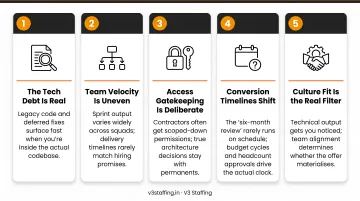
This is a significant advantage over direct hire, where you make a permanent commitment based on limited information. If the environment turns out to be a poor fit, you are not trapped — your contract ends, and you move on with real experience added to your profile.
Your Gross Pay May Be Higher Than Equivalent Full-Time Base Pay
Contract roles often carry a rate premium to offset the lack of offset the lack of benefits. The logic is straightforward: since you are not receiving paid leave, retirement contributions, health insurance, or other statutory benefits, the gross rate should account for that gap.
BLS Employer Cost data shows that in the US information industry, benefits represent 35.6% of total employer compensation — meaning a full-time employee's "real" cost to the employer is substantially above their base salary. Contract rates are meant to partially reflect this. The key word is "partially" — verify whether your specific rate actually covers the gap before assuming it does.
You Get a Foot in the Door at Competitive Companies
Large enterprises, GCCs, and established product organizations often move slowly on permanent headcount. Contract-to-hire is frequently how they bring in talent faster without waiting for full approval cycles.
Getting in on a contract exposes you to real projects, high-quality teams, and recognizable names on your CV — regardless of whether conversion happens. At V3 Staffing, contract placements span clients across GCCs, product companies, and large enterprises, which means engineers in these roles are working in environments that strengthen their profile either way.
You Build Skills Faster Through Varied Exposure
Contract engineers often work across multiple companies over a few years, encountering different codebases, architectures, cloud environments, and team cultures. That breadth compounds quickly in the early-to-mid stages of a career.
Certain specialisations amplify this effect. Dice's 2025 Tech Salary Report found AI expertise commands an almost 18% salary premium. Engineers who use contract assignments to build skills in ML/AI, DevOps, or platform engineering position themselves well for both conversion and future roles.
You Can Walk Away If the Fit Is Poor
The evaluation runs both ways. If the full-time offer is below what your contribution warranted, if the tech stack has stagnated, or if the team culture is not what was implied — you are under no obligation to accept conversion. Either way, the contract tenure appears on your CV, the skills are real, and the next opportunity starts from a stronger baseline.
Cons of Contract-to-Hire for Software Engineers
No Guarantee of Conversion, Even With Strong Performance
Employers have no legal obligation to make a full-time offer at contract end. Budget changes, headcount freezes, restructuring, or shifting business priorities can all end a contract without a permanent role appearing.
Bloomberg reported over 85,000 planned US tech-sector cuts in 2026 through early May — up 33% from the same period in 2025. In volatile hiring conditions, even well-performing contractors are not immune. Enter every contract-to-hire role prepared to complete it without conversion.
Benefits Gap During the Contract Period
Unless your staffing partner covers statutory benefits, you are bearing those costs yourself. For engineers placed in India, this typically means health insurance, PF contributions, and paid leave — costs that add up quickly without employer coverage.
When placed through V3 Staffing's contract staffing model, statutory compliance — including PF, ESIC, PT, TDS, and gratuity — is managed on behalf of contract engineers. But not all arrangements work this way. Before signing any contract, confirm:
- Who is the employer of record?
- Which statutory benefits are covered and by whom?
- Is health insurance provided or your responsibility?
- Are leave days paid or unpaid?
Less Stability, More Performance Pressure
Contract roles can be terminated early if a project is deprioritised or a budget cycle changes. Unlike permanent employees, contractors typically have shorter notice periods and no severance obligations on the employer's side.
The pressure is subtler too. Unlike a new permanent hire who has months to settle in, a contract engineer is under implicit evaluation from week one — with less room for visible mistakes, less latitude for long-term projects, and a clear expectation of quick, demonstrable output.
Contract-to-Hire Pay: What Software Engineers Should Know
Pay structures in contract-to-hire roles vary by market. In India, monthly retainers are the most common format for contract software engineers. In the US, hourly billing is standard. Milestone-based arrangements exist but are less typical for ongoing contract-to-hire roles.
Market Benchmarks
India (full-time salary anchors for reference — contract rates should reflect a premium):
| Role | Average Annual Pay | Monthly Equivalent |
|---|---|---|
| Software Engineer | ₹9.5 lakhs | ~₹78,800/month |
| Full Stack Developer | ₹9.8 lakhs | ~₹81,500/month |
| AI/ML Engineer | ₹19 lakhs | ~₹1.6 lakhs/month |
| Senior DevOps Engineer | ₹20.1 lakhs | ~₹1.7 lakhs/month |
Source: AmbitionBox 2026. These are full-time benchmarks; contract rates for equivalent roles should account for the benefits gap.
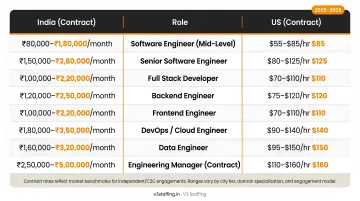
US:
- BLS 2024 data: software developers median pay at $131,450/year (~$63.20/hour)
- Glassdoor 2026: software engineer contractors average $166,195/year in total pay
Negotiating the Conversion Salary
When the full-time offer comes, do not anchor to your contract rate as a ceiling. The company will now be providing benefits — PF, health insurance, paid leave — that you were handling yourself during the contract phase.
Use this three-step check before accepting any conversion offer:
- Calculate your total contract earnings (rate × months worked)
- Subtract the estimated annual value of benefits the company will now provide
- Treat the resulting figure as your full-time equivalent baseline — your permanent salary should meet or exceed it in total compensation terms
Any offer that leaves you with lower take-home than your contract arrangement is a step backward.
If you're unsure how to value your benefits gap, a staffing partner like V3 Staffing can run a role-specific benchmarks comparison against current market data before you respond to the offer.
How to Evaluate a Contract-to-Hire Offer
Before you sign, get answers to these questions:
- What is the contract length, and can it be extended if conversion is delayed?
- Is conversion intent documented in writing, or just a verbal promise?
- What is the notice period if the contract ends early?
- Are you employed directly by the company or through a staffing agency — and what does that mean for your benefits?
- Which statutory benefits are covered during the contract period, and who is responsible for them?
- Is there a defined salary band for the full-time role, or will it be negotiated later?
If any of these questions get vague or evasive answers, that itself is a signal. Look out for these red flags.
Red Flags Worth Walking Away From
- Conversion promise is verbal only, with no documentation
- No defined review timeline or conversion criteria
- The same "contract-to-hire" role has cycled through multiple contractors over years with no conversions
- Contract rate is below the full-time equivalent without any benefit justification
- Vague answers about who the legal employer is during the contract period
The Decision Framework
Contract-to-hire makes sense when:
- The company is established and credible
- The role aligns with where you want your career to go
- The contract rate accounts for the benefits gap
- Permanent headcount has been budgeted and approved — not just flagged as a possibility
- Whoever manages the arrangement — agency or employer — has clear compliance and payroll processes in place
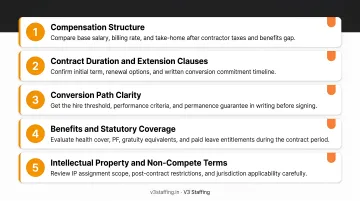
When these conditions aren't all present, the risk sits almost entirely with you. Push for clarity on each point before you commit — or walk away.
Frequently Asked Questions
What does a contract-to-hire software engineer position mean?
It is a temporary role — typically 3 to 12 months — where the employer intends to evaluate the engineer for permanent employment. Conversion depends on performance, business conditions, and available headcount, and is not legally guaranteed by either party.
How much do contract-to-hire software engineers make?
Contract rates vary by experience, specialization, and location. In the US, contractor total pay averages around $166,195/year (Glassdoor) versus a $131,450 median for full-time developers (BLS 2024); in India, contract rates similarly run above full-time equivalents to offset missing benefits.
What is a good hourly rate for a contract-to-hire software engineer?
In the US, the BLS full-time median is $63.20/hour — your contract rate should exceed this to offset the benefits gap. Senior engineers and AI/ML specialists typically command substantially more.
What salary should I expect when converting from contract to full-time?
Your full-time salary should reflect your contract rate minus the value of benefits the employer now provides. Do not accept a permanent offer where your total compensation drops below what you earned on contract — that is a net pay cut regardless of how the numbers look on paper.
Are contract-to-hire software engineer positions legitimate?
Yes. Contract-to-hire is a mainstream hiring model used by large enterprises, GCCs, and product organisations. Verify that the role is offered through a registered employer of record or reputable staffing firm, and that all terms — rate, duration, conversion criteria, and benefits — are documented in a written agreement.
Is a contract-to-hire software engineer position worth it?
It depends on the offer. It is worth it when the company is credible, the pay accounts for the benefits gap, and there is a realistic and documented path to full-time employment. It is less worthwhile when conversion intent is unclear, the rate is below full-time equivalent, or the arrangement has no written terms.