Large enterprises launching new business units, GCCs ramping up operations centres across India, and product organisations scaling engineering teams mid-sprint all face this pressure. The hiring wave arrives before the infrastructure to handle it does. Requisitions pile up, recruiters get buried, and hiring managers start making compromised decisions just to close positions.
The cost of getting this wrong is real. Unfilled roles stall product delivery, delay GCC launches, and push revenue targets back by quarters. Poor-fit hires drive up first-90-day attrition and restart the cycle from scratch.
This article outlines 10 proven tactics that address the full hiring lifecycle — from stakeholder alignment before sourcing begins to post-hire measurement that keeps the program improving over time.
Key Takeaways
- High-volume hiring means filling many roles fast — driven by expansion, seasonality, GCC buildouts, or high attrition
- The most common failure points are poor planning, rushed screening, and candidate drop-off from slow or complex application processes
- Use ATS and AI screening tools — without them, application volume will bury your team
- Build pre-verified talent pools and strong employer branding to cut time-to-fill before sourcing begins
- Track time-to-fill, offer acceptance rate, and 90-day retention — these separate reactive hiring from a scalable program
What Is High-Volume Hiring — And When Does It Apply?
High-volume hiring is the process of filling a large number of positions within a compressed timeframe. There's no single universal threshold — SHRM describes high-volume recruiters as those "consistently under pressure to fill multiple positions per day," while LinkedIn frames it as "always-on" or 24/7 hiring during hyper-growth or surge conditions.
In practice, most TA leaders recognise it when 50+ concurrent requisitions land simultaneously, or when a single role generates 1,000+ applications. The number matters less than the operational reality: standard one-requisition-at-a-time workflows simply cannot absorb the volume.
Where It Shows Up Most
- GCCs building operations centres — India's GCC sector already employs 1.9M+ professionals across 1,700+ centres, with projections reaching 2.5–2.8M employees by 2030. Each new centre buildout triggers a hiring wave
- IT and product organisations scaling engineering, data, or platform teams ahead of product launches
- BFSI and shared services staffing up for regulatory projects or new service lines
- Manufacturing and logistics firms responding to capacity expansions or seasonal demand spikes
Why It's a Fundamentally Different Challenge
High-volume hiring isn't just "more of the same." The coordination complexity multiplies. A single misaligned job description doesn't matter much at normal scale — at high volume, it generates thousands of mismatched applications. A two-day delay in hiring manager feedback in standard hiring is an inconvenience; in a 500-role GCC ramp, it's a programme failure.
Applying a small-scale process to a large-scale problem produces predictable failures:
- Candidate drop-off as slow pipelines push qualified applicants toward faster-moving employers
- Recruiter burnout from unsustainable screening loads across dozens of simultaneous roles
- Inconsistent hiring decisions when screening criteria aren't standardised across the team
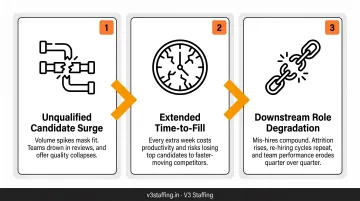
Why High-Volume Hiring Often Goes Wrong
Three failure patterns show up repeatedly in high-volume hiring — and each one compounds the others.
Resource Overload and Coordination Gaps
Internal TA teams are sized for steady-state hiring. When requisitions surge across multiple departments at once, the same team absorbs every additional task:
- Sourcing and pipeline building
- Resume screening and shortlisting
- Interview coordination across hiring managers
- Feedback collection and follow-up
- Offer management and onboarding handoffs
The result is slower screening, inconsistent quality, and recruiter burnout. The average hiring process already takes 42 days across general benchmarks. Without dedicated capacity and structured workflows, high-volume surges stretch that timeline further while pressure mounts from every direction.
Quality-vs-Speed Tension
The pressure to close roles fast creates "checkbox hiring" — moving candidates through screening quickly enough to meet quota, not carefully enough to ensure fit. The downstream cost is predictable: one in three new hires leaves within the first 90 days, and high-volume programs that cut screening corners see that number climb higher.
Rehiring a role consumes time, budget, and productivity. In most cases, it costs more than taking an extra week to hire right the first time.
Candidate Drop-Off at Scale
60% of job seekers abandon online applications due to length or complexity. At high volume, even a 20% drop-off rate means hundreds of qualified candidates never complete their application. The candidates most likely to abandon a long or slow process are often the ones with the most options — exactly the people you need.
10 Proven High-Volume Hiring Strategies
These 10 tactics address the full hiring lifecycle — from pre-recruitment planning to post-hire measurement. They apply whether hiring is managed internally or through a staffing partner.
Tactic 1: Align Stakeholders Before the Hiring Wave Begins
Misalignment between recruiters, hiring managers, HR, and business leaders is one of the most expensive problems in high-volume hiring — and one of the most preventable.
Before sourcing begins, lock in:
- Role requirements and non-negotiable vs. preferred criteria
- Decision authority (who approves offers, who has final say)
- Agreed timelines for each stage of the process
- Success metrics (what does "good hire" look like at 90 days?)
A shared intake document or structured kickoff meeting for every high-volume initiative eliminates the back-and-forth that kills momentum mid-program.
Tactic 2: Build and Maintain Pre-Verified Talent Pools
The single biggest lever for reducing time-to-fill is not sourcing faster — it's not having to source from scratch at all.
A pre-screened, engagement-ready talent bench means that when a hiring surge hits, activation replaces prospecting. Talent pools can be built from:
- Alumni networks and former contractors
- Employee referrals collected between active cycles
- Passive candidates identified during prior searches
- Staffing partner pipelines
V3 Staffing maintains a database of 400,000+ pre-screened professionals across India's major business centres, with AI-powered sourcing and structured vetting built into the pipeline. For GCC clients — including long-term partners like ZF, where V3 has supported India centre buildouts over five-plus years — this means SLA-driven shortlists can be activated within days rather than restarting sourcing from zero each cycle.
Tactic 3: Simplify and Mobilise the Application Process
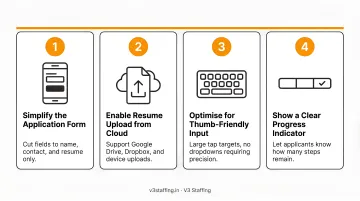
Friction in the application process is a direct tax on candidate volume and quality. Applications taking less than five minutes generate 248% more applicants than those taking more than 15 minutes.
Mobile matters too. In 2025, 79% of applications submitted on Indeed were completed on mobile devices. Employers who don't accept mobile applications receive significantly fewer completed applications than those who do.
Practical fixes:
- Cut the application to role-essential fields only
- Enable mobile-first or one-click apply where possible
- Remove screening questions that belong in the interview, not the application
- Test your own application process periodically — most TA leaders haven't done this recently
Tactic 4: Deploy AI and ATS Tools for Automated Screening
Manual review of thousands of applications is neither scalable nor consistent. AI-powered screening tools automatically score and rank candidates against predefined criteria, ensuring top candidates surface quickly rather than getting buried under volume.
SHRM's 2025 Talent Trends data shows 51% of organizations now use AI to support recruiting, with 89% of HR professionals at those organizations reporting it saves time or increases efficiency.
When evaluating tools, prioritise:
- Bulk action capabilities for application processing
- Automated communication triggers (acknowledgements, status updates, rejections)
- Configurable scoring criteria by role family
- Integration with onboarding systems to avoid data re-entry
V3 Staffing's internal delivery model uses AI-led sourcing and screening to support structured candidate processing at scale — with documented 80% shortlist accuracy reducing unnecessary interview rounds.
Tactic 5: Standardise Job Descriptions and Interview Frameworks
Inconsistent job descriptions attract mismatched applicants. Unstructured interviews produce inconsistent hiring decisions. Both are particularly damaging at high volume, where there's no bandwidth to correct for individual variations across dozens of hiring managers.
Two fixes:
Templated JDs should be clear, concise, and accurate about role expectations — consistent in how they describe seniority, scope, and must-have criteria. Refresh them before each hiring cycle, not annually.
Interview scorecards define a structured set of criteria and rating scales so every candidate is assessed against the same dimensions regardless of who conducts the interview. Without them, two candidates for the same role may be evaluated on entirely different criteria depending on which manager they meet — a quality problem that compounds fast across a high-volume program.
Tactic 6: Use Structured, Scalable Interview Formats
Scheduling is one of the least visible but most time-consuming parts of high-volume hiring. Video-first and asynchronous interview tools remove the scheduling bottleneck entirely — candidates complete structured video responses on their own time, and hiring managers review batches rather than coordinating individual slots.
Additional options:
- Panel interviews compress multiple assessment stages into one session
- Group assessments work well for roles where collaboration or communication can be evaluated collectively
- Batch scheduling (blocking dedicated interview slots by date) reduces the back-and-forth across hiring manager calendars
These formats also create a more consistent candidate experience — something that matters when rejected applicants often become future applicants or referral sources.
Tactic 7: Activate Employee Referral Programmes
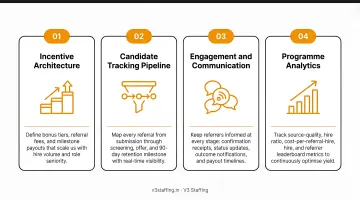
Referrals are among the most cost-effective sourcing channels available. Analysis of 14 million applications across 1,000+ companies found that employee referrals delivered more than 30% of all hires — with better quality-of-hire, faster time-to-hire, and stronger retention compared with job board channels.
For high-volume programs specifically, a well-structured referral initiative can generate a meaningful share of qualified applicants at a fraction of external sourcing costs.
What makes referral programmes work at scale:
- Clear, transparent reward structures (and timely payment)
- Defined timelines so referring employees know when to expect updates
- Role-specific asks (targeted campaigns for specific open positions rather than generic "we're hiring" messaging)
- Manager-level participation, not just individual contributors
Tactic 8: Invest in Employer Branding Before You Need to Scale
Employer brand functions as a volume multiplier. When candidates already recognise and trust a company, application rates rise, passive candidates engage more readily, and drop-off during the process falls.
86% of job seekers research company reviews before applying, and 75% are more likely to apply if the employer actively manages its brand. Half of candidates say they would not join a company with a poor reputation, even for higher pay.
For GCC and enterprise organizations with known hiring surge windows — a new centre launch, a major product initiative, a regulatory buildout — the employer brand investment needs to happen 6–12 months ahead, not during the ramp.
Practical priorities:
- Maintain and actively respond to Glassdoor reviews
- Publish employee testimonials and role-specific content on LinkedIn
- Ensure career page content reflects real team culture, not corporate boilerplate
Tactic 9: Optimise Onboarding to Sustain Hire Quality
Hiring doesn't end at offer acceptance. Onboarding determines whether new hires reach productivity — and whether they stay.
Foundational research from the SHRM Foundation found that employees who go through well-structured onboarding are 69% more likely to remain at a company for three years, and organizations with standard onboarding processes see 50% greater new-hire productivity. Given that one in three new hires leaves within 90 days, structured onboarding is one of the highest-ROI investments in a high-volume program.
For scale, onboarding needs to be:
- Self-paced and digital — modular orientation content that doesn't collapse when one in-person session falls through
- Role-specific from day one — clear on responsibilities, tools, and team context before the first week ends
- Backed by structured check-ins — a buddy or manager touchpoint at 30, 60, and 90 days to surface issues before they become departures
V3 Staffing's contract staffing and EOR models include end-to-end onboarding ownership — coordinating with client HR teams to manage documentation, orientation, and compliance formalities so new hires are integrated and productive from day one.
Tactic 10: Establish a Feedback Loop for Continuous Improvement
A high-volume hiring program that skips post-cycle review will repeat the same bottlenecks at the next ramp — usually at higher cost.
After each hiring wave, collect structured input from:
- Hiring managers — where did quality fall short, where was the process slow?
- Recruiters — where did candidates drop off, which sourcing channels performed?
- New hires at 90 days — what nearly made them decline the offer, what would have made onboarding smoother?
A simple post-cycle retrospective — 60 minutes, a shared document, and three questions (what worked, what didn't, what changes before next time) — is enough to drive meaningful improvement. Treat it as an operating rhythm, not an exception.
How to Measure the Success of Your High-Volume Hiring Program
Without measurement, high-volume hiring is just organised chaos. Tracking the right metrics makes patterns visible and allows TA leaders to make informed decisions about where to invest next.
Core KPIs to Track
| Metric | What It Tells You | Benchmark Reference |
|---|---|---|
| Time-to-fill | Speed from requisition to offer acceptance | 42-day industry average (iCIMS, 2022) |
| Offer acceptance rate | Candidate desirability and process experience | 79% benchmark (iCIMS, 2022) |
| Source-of-hire | Which channels deliver the best ROI | Varies by role and market |
| Interview-to-hire ratio | Screening efficiency | ~25% (iCIMS, 2023) |
| 90-day retention rate | Post-hire quality signal | Industry proxy: ~67% (Jobvite, 2022) |
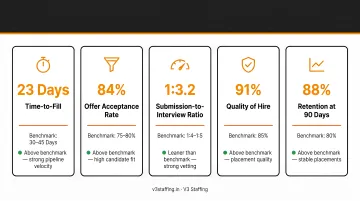
V3 Staffing tracks these metrics across all client engagements — with a reported 90% offer-to-join ratio and 10-day average time-to-hire across high-volume mandates, shared through regular dashboards and SLA reporting cycles.
Connecting Metrics to Continuous Improvement
Each KPI tells a specific story. A declining offer acceptance rate points to compensation misalignment or a poor candidate experience. A high interview-to-hire ratio suggests screening criteria need tightening. A low 90-day retention rate typically signals a problem with onboarding or role clarity, not just hiring selection.
Benchmarking each cycle against the last makes these patterns visible — so teams can act on what's slipping before it compounds into a larger hiring problem.
Conclusion
High-volume hiring doesn't have to mean choosing between speed and quality. The organisations that do it well share a common approach: they build the infrastructure before the wave hits. Pre-verified talent pools, standardised processes, AI-assisted screening, and strong onboarding aren't reactive fixes. They're what makes scale sustainable.
For enterprises, GCCs, and product organisations scaling teams across India's major business centres — from Bengaluru and Hyderabad to Pune and Delhi NCR — V3 Staffing brings 15+ years of high-volume recruitment experience, compliance-first delivery, and deep domain expertise to every engagement.
Whether you're building a 20-member pilot or a 500-member operations hub, the infrastructure to do it right is already in place.
If you're planning a large-scale hiring ramp-up, connect with V3 Staffing to map out your hiring plan, timelines, and team structure.
Frequently Asked Questions
What is considered high-volume hiring?
High-volume hiring refers to filling a large number of roles within a compressed timeframe — commonly triggered by rapid growth, seasonal demand, or GCC buildouts. While there's no universal threshold, many organizations treat 50+ concurrent open roles or 1,000+ applications per role as the entry point. The defining characteristic is that standard recruitment workflows can no longer keep pace.
How do you manage high-volume recruiting?
The core levers are: align stakeholders early on criteria and timelines, deploy an ATS and AI screening tools to manage application volume, activate pre-verified talent pools to reduce sourcing lead time, simplify the application process to reduce drop-off, and track time-to-fill and 90-day retention to iterate each cycle.
What are the 5 C's of recruitment?
The "5 C's" framework comes from onboarding research by Dr. Talya Bauer: Compliance, Clarification, Confidence, Connection, and Culture. High-volume programs that skip these at the onboarding stage consistently see higher early attrition.
What are the biggest challenges in high-volume hiring?
The four most common failure points are:
- Resource overload — internal TA teams overwhelmed by simultaneous requisitions
- Quality deterioration — speed pressure erodes hiring standards
- Candidate drop-off — slow or complex application processes push top candidates away
- Compliance risk — multi-location hiring creates statutory exposure without proper controls
How do you maintain quality when hiring at scale?
Four safeguards consistently protect quality at scale:
- Standardized job descriptions and interview scorecards for consistent assessment
- AI-assisted screening to surface best-fit candidates before manual review
- Pre-verified talent pools to avoid sourcing under pressure
- 90-day retention tracking to validate whether upstream hiring decisions held
When should a company partner with a staffing agency for high-volume hiring?
A staffing partner makes the most sense when internal TA can't absorb surge demand without compromising quality or timelines — especially during GCC buildouts, seasonal ramps, or new facility launches. Compliance complexity around contractor documentation, background checks, and multi-state statutory requirements is another strong trigger for organizations without in-house specialist expertise.