
Introduction
Many enterprises, Global Capability Centers (GCCs), and product organizations face a recurring challenge: critical projects stall because specialized roles remain unfilled for weeks or months, tight deadlines loom while headcount restrictions block traditional hiring, and internal HR teams are stretched too thin to source niche skills fast enough. 80% of Indian employers struggle to find the skilled talent they need, according to the ManpowerGroup 2025 Global Talent Shortage Survey, while the World Economic Forum warns that 63 million workers in India may require retraining by 2030.
Resource staff augmentation addresses this directly. It lets you bring in external professionals on a temporary or contract basis to supplement your existing team, without the cost or time commitment of permanent recruitment. You retain full control over day-to-day work while accessing specialized skills exactly when needed: a three-month cloud migration sprint, a bridge hire while permanent recruitment is underway, or scaling a new GCC from 10 to 100 engineers in six months.
TLDR
- Resource augmentation supplements teams with contract professionals under client management control
- Average time-to-hire in India is 39 days for permanent roles; contract staff deploy in days
- Avoids permanent overhead: 16.25% statutory burden, gratuity, and benefits costs
- Best for skill gaps, capacity crunches, bridge hires, or GCC scaling
- Requires clear role briefs, structured onboarding, and performance KPIs
What Is Resource Staff Augmentation?
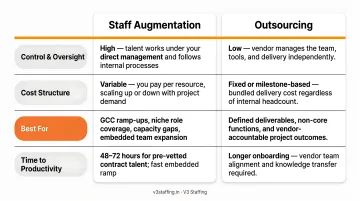
Resource staff augmentation is the practice of hiring external professionals on a temporary or contract basis to supplement—not replace—your existing team. The business retains full management control over day-to-day work, unlike outsourcing or managed services where the vendor owns delivery.
Staffing Industry Analysts defines staff augmentation workers as "typically time-and-material, named resources under the end client's supervision and control." You select specific individuals, direct their work, and pay on a time-and-materials basis (hourly or daily rates).
How Resource Augmentation Differs
The term is often used interchangeably with "staff augmentation," but there's a practical distinction. Resource augmentation focuses specifically on named individuals you select, manage directly, and integrate into your team — as opposed to handing a project brief to a vendor and waiting for outputs.
Here's what it is not:
- Outsourcing: Work is handed off; you wait for deliverables. With augmentation, you stay in control of execution.
- Managed services: The vendor owns delivery and results. Augmentation keeps that ownership with your team.
- Consulting: Advice-only engagements end at recommendations. Augmented resources stay and do the work.
| Feature | Staff Augmentation | Outsourcing/Managed Services |
|---|---|---|
| Supervision | Client supervises workers | Provider supervises workers |
| Primary driver | Input-focused (time and materials) | Output-focused (deliverables) |
| Resource ID | Named individuals | Provider chooses resources |
| Contract type | Individual T&M engagement | B2B Statement of Work (SOW) |
How the Resource Augmentation Process Works
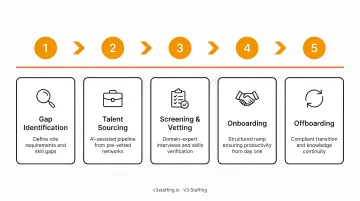
Step 1 — Identify the Gap
Before engaging a provider, assess what's missing. Is it a skill gap (you need cloud expertise your team lacks), a capacity gap (the team is overwhelmed but the work is familiar), or a temporary vacancy (someone is on leave or a role is unfilled during recruitment)? Clarity here determines success downstream—vague briefs lead to mismatched hires.
Common triggers V3 Staffing's enterprise clients flag include critical roles keeping projects stalled for weeks, niche skills like AI or compliance expertise that internal teams can't source quickly, and HR teams stretched thin managing sourcing, interviews, and coordination all at once.
Step 2 — Engage and Brief the Provider
Share comprehensive context with your staffing partner:
- Skills, tools, and core responsibilities for the role
- Start date, duration, and key project milestones
- Seniority level: junior, mid-level, senior, or lead
- Team structure: who they'll work with and who they report to
- Rate expectations or total engagement budget
The more specific your brief, the faster and more accurate the shortlist. V3 Staffing's structured intake process ensures recruiters understand business goals, team dynamics, and role expectations before sourcing begins.
Step 3 — Candidate Shortlist and Selection
Typical vetting process:
- Resume review against role requirements
- Technical screening to validate skills
- Background and reference checks
- Client interviews (typically 1-2 rounds)
Providers who invest in pre-verification—technical assessments, cultural fit evaluation, and background validation—reduce your internal screening effort considerably. V3 Staffing's shortlist accuracy means most candidates presented are job-ready, with contract deployment typically completing in days rather than the weeks a standard permanent hire requires.
Step 4 — Onboarding
Structured onboarding accelerates productivity. Essential components include:
- Grant system access: email, tools, VPN, and project repositories
- Run team introductions with stakeholders, collaborators, and the reporting manager
- Brief on deliverables, timelines, and success metrics
- Set performance expectations: KPIs, review cadence, and communication norms
For temporary roles, pre-vetted talent pools and standardized workflows enable full deployment in 48–72 hours. V3 Staffing handles payroll, compliance, and contractor documentation so your team can focus on integration from day one.
Step 5 — Active Management and Offboarding
Once onboarding is complete, augmented staff work directly under your direction. You assign tasks, provide feedback, and manage performance the same way you would with any internal team member—no intermediary layer needed.
At engagement close, proper offboarding protects continuity:
- Knowledge handover: Documentation, code reviews, process notes
- Access revocation: System credentials, tools, facilities
- Final deliverables review: Ensure all work is completed and transferred
Types of Resource Augmentation Models
Resource augmentation isn't a single model — it spans several engagement types, each suited to different hiring needs, timelines, and team structures.
Skill-Based Augmentation
Bringing in professionals with specific technical skills — cloud engineers, data scientists, QA specialists — for a defined period. Most common in IT and product organizations facing niche expertise gaps. For example, a company might hire a machine learning engineer for a six-month model training project when the internal team lacks ML depth.
Commodity Augmentation
Engaging workers for high-volume, repeatable tasks that don't require advanced expertise. Common in logistics, retail, or operations contexts—think data entry, basic QA testing, or inventory management.
Project-Based Augmentation
Hiring a team or individual tied to the full lifecycle of a specific project, from kickoff to delivery. Suitable for mid-to-long-term engagements with defined scope, such as a new product launch or system migration.
Short-Term vs. Long-Term Models
Short-term augmentation:
- Duration: Days to 3 months
- Use cases: Seasonal spikes, sudden vacancies, sprint-phase capacity
- Pricing: Higher daily rates, minimal commitment
- Contract: Simple T&M agreements
Long-term augmentation:
- Duration: 6-24 months
- Use cases: Extended programs, GCC build-outs, bridge-to-hire arrangements
- Pricing: Negotiated rates, volume discounts
- Contract: Detailed SOWs, governance terms
India now hosts over 2,117 GCCs employing 2.36 million people, with GCCs hiring 4x faster than traditional IT companies. Long-term augmentation supports this rapid scaling.
Remote, Onsite, and Hybrid Delivery
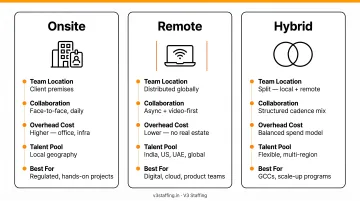
Onsite augmentation:
- Strengthens team cohesion and day-to-day integration
- Required for roles needing physical infrastructure or close supervision
- Higher costs (commute allowances, workspace)
Remote augmentation:
- Broadens talent pool beyond geographic limits
- Reduces overhead (no office space needed)
- Requires strong communication tools and processes
Hybrid delivery:
- Balances in-person collaboration with remote flexibility
- Ideal for roles requiring periodic onsite presence
- Popular for distributed teams or partial GCC setups
Choosing the right delivery model depends on role type, compliance requirements, and how tightly the augmented resource needs to integrate with the core team.
Key Benefits — and Honest Trade-offs
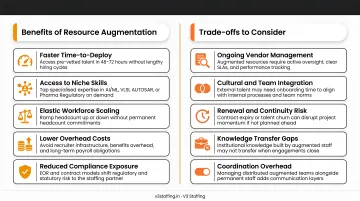
Benefit: Speed to Hire
Traditional permanent hiring in India takes 39 days on average, with IT roles ranging from 35–60 days for mid-level positions and 60–120 days for senior architects, according to industry benchmarks. Contract staffing bypasses this cycle.
Providers maintain pools of pre-vetted professionals ready for deployment, reducing time-to-productivity from months to days. V3 Staffing deploys pre-verified temporary staff in 48–72 hours and achieves a 10-day average time-to-hire for permanent roles through SLA-backed workflows.
Benefit: Access to Specialized Skills on Demand
India faces a shortage of over 1 million AI, ML, and data analytics professionals by 2026, with talent gaps for ML engineers and data scientists estimated at 73%. NASSCOM analysis puts India's demand for digital talent at 8X its current fresh talent pool — projected to reach 20X by 2024.
Staff augmentation lets you access these niche skills for exactly as long as you need them, without the headcount commitment that permanent hiring requires.
Benefit: Cost Efficiency
Permanent employees in India carry substantial statutory overhead:
| Component | Employer Rate |
|---|---|
| EPF (Provident Fund) | 12% of basic wages |
| EDLI (Insurance) | 0.50% |
| EPF Admin Charges | 0.50% |
| ESI (Health Insurance) | 3.25% of wages |
Total statutory burden: 16.25% — before accounting for gratuity (vests after 5 years), training, workspace, equipment, or severance risk.
Contract staffing eliminates these long-term costs. Organized providers charge a markup of approximately ₹650–700 per associate per month for general staffing, with specialized IT staffing margins at 8–10% of billing, per HSIE Research on TeamLease. The overall cost stays lower than full-time equivalents once you factor in benefits, gratuity accrual, and fixed overhead.
Trade-off: Ramp-Up and Knowledge Transfer
New hires take 8 months to one year to reach full productivity on average, according to AIHR research. For technical roles, structured 30-60-90-day plans are standard — software developers typically reach independent productivity in 3 months.
Contract professionals often ramp faster due to prior domain exposure. That said, complex, context-heavy projects still require time to absorb internal systems and processes. Poor onboarding amplifies this — effective onboarding improves productivity by 72%, per The Brandon Hall Group.
Mitigation strategies:
- Provide detailed documentation and process guides
- Assign a dedicated onboarding buddy or mentor
- Schedule knowledge transfer sessions in the first week
- Set clear short-term deliverables to build momentum
Trade-off: Team Cohesion and Dependency Risk
Heavy reliance on augmented staff without a transition plan can create "insider vs. outsider" dynamics — and leave real knowledge gaps when engagements close. SIA research identifies formal knowledge management as the single biggest gap in contingent workforce programs.
Mitigation strategies:
- Draft clear Statements of Work defining deliverables and timelines
- Build overlap periods between contractors and permanent hires
- Require documentation of all work and decisions
- Conduct formal knowledge handovers at engagement close
When to Use Resource Augmentation
Scenarios Where It Fits Well
1. Specialized skill gap with no internal equivalent
You need expertise your team lacks—blockchain development, regulatory compliance, advanced data modeling—and hiring a permanent employee for a 4-6 month project doesn't make sense.
2. Temporary capacity crunch on a time-bound project
Your engineering team is at capacity, but a new product launch requires 3 additional backend developers for Q2. Augmentation scales you up without permanent headcount.
3. Bridge hire while permanent recruitment is underway
A critical role is vacant and recruitment will take 60 days. Contract staff keep the project moving while you search for the right permanent hire.
4. Scaling a GCC or product team faster than traditional hiring allows
GCCs now account for 73% of new IT employment growth and hire 4x faster than traditional IT companies, per Indian Staffing Federation data. Augmentation accelerates this by giving teams immediate access to screened, ready-to-deploy talent.
When It May Not Be the Right Fit
That said, augmentation isn't the right tool for every situation. Avoid it when:
- IP exposure is the primary risk — NDAs may not provide sufficient protection for highly secretive, core-product work where disclosure risk outweighs speed benefits.
- The role demands deep institutional knowledge — legacy system architects or embedded compliance officers who need years of internal context rarely work well with augmentation.
- Your team lacks the bandwidth to manage external staff — without clear task delegation, timely feedback, and performance oversight, augmented staff create friction rather than capacity.
Best Practices for Successful Resource Augmentation
Define the Engagement Before You Begin
Vague briefs lead to mismatched hires. Document before approaching a staffing partner:
- Specific responsibilities, deliverables, and what "done" looks like (features shipped, systems migrated, reports completed)
- Team interfaces — who they'll collaborate with, report to, and depend on
- KPIs, quality standards, and velocity targets that define success
V3 Staffing spends time upfront understanding your business goals, team structure, and role expectations — so the talent delivered is aligned before the first day starts.
Prioritize Structured Onboarding
Augmented staff need a clear first-week plan to become productive quickly. Essential components:
- Day 1: System access, workspace setup, team introductions
- Day 2–3: Role briefing, project context, success metrics
- Day 4–5: Initial assignments, stakeholder meetings, open questions resolved
This is a client responsibility, not just the provider's. Research consistently shows that structured onboarding cuts ramp-up time by weeks — augmented staff who know their context and tools from day one simply deliver faster.
Set KPIs and Review Cadences
Measure augmented staff performance with output-based metrics:
- Sprint velocity — story points completed, tasks closed per cycle
- Code quality — defect rates, review feedback scores, test coverage
- SLA adherence — deliverables on schedule, response times within agreed hours
- Stakeholder feedback — team integration and communication effectiveness
Schedule biweekly or monthly check-ins to catch drift early before small gaps become bigger problems. V3 Staffing's SLA-driven engagements include structured reporting cadences, so both sides stay aligned on performance throughout the contract.
Frequently Asked Questions
How much does staff augmentation cost?
Costs vary by skill level, engagement duration, and delivery model (onsite vs. remote). Pricing covers the professional's fee plus a provider markup — organized providers in India charge approximately ₹650–700 per associate per month for general staffing, with specialized IT staffing margins at 8–10% of billing. Total cost stays below full-time equivalents once you account for benefits, statutory overhead (16.25%), gratuity, and training.
What is a staff augmentation contract?
A formal agreement between client and staffing provider covering scope of work, duration, payment terms, confidentiality obligations (NDA), intellectual property ownership, and termination clauses. Contracts typically follow time-and-material (T&M) structures with defined hourly or daily rates for named resources working under client supervision.
What project agreements are suitable for staff augmentation?
Time-and-material (T&M) agreements work well for flexible or evolving scopes — they allow adjustments to hours and duration as needs change, typically supported by a Statement of Work (SOW) that sets milestones and success criteria. Fixed-duration contracts suit well-defined projects with clear timelines and deliverables.
What is the difference between staff augmentation and project outsourcing?
In staff augmentation, the client manages augmented professionals directly as part of their team, retaining full control over day-to-day work. In project outsourcing, the vendor owns delivery and operates independently, taking accountability for results. Augmentation gives more control; outsourcing offers hands-off convenience.
What are the pros and cons of using a staffing agency vs. hiring directly?
Agencies provide pre-vetted talent, faster turnaround (days vs. weeks), and compliance handling (PF, ESI, labor law) — V3 Staffing, for instance, manages payroll, contractor documentation, and regulatory filings so internal teams stay focused on core priorities. Direct hiring offers more sourcing control but demands significant recruiter time, background checks, and compliance management.
How do you measure staffing effectiveness?
Track time-to-productivity, output against defined KPIs (sprint velocity, deliverables completed), quality metrics (defect rates, delivery accuracy), and team integration feedback. Review these indicators biweekly or monthly to catch misalignment early and address issues before they compound.
Resource staff augmentation delivers results when treated as a deliberate workforce decision. Define your needs clearly, choose providers with SLA-backed quality, and manage augmented staff with the same rigour you apply to permanent hires. That consistency is what turns a temporary engagement into measurable delivery improvement.