Introduction
Demand for specialized IT talent has never been harder to meet. According to ManpowerGroup's 2024 Talent Shortage survey of over 40,000 employers across 41 countries, 76% of IT sector employers reported difficulty finding qualified candidates — the highest scarcity rate of any industry tracked.
Traditional hiring can't keep pace. Specialized roles routinely take 45–90 days to fill through conventional recruitment channels, and by the time a permanent hire joins, project timelines have already slipped.
IT staff augmentation sits between full-time hiring and full outsourcing — it lets organizations add skilled technical professionals exactly when needed, without the commitment of permanent headcount. This guide breaks down how it works, when it makes sense, and how to choose the right partner.
Key Takeaways
- IT staff augmentation embeds external tech specialists into your team temporarily, without permanent hire overhead
- You retain full management control — augmented staff follow your processes, tools, and workflows
- Staffing partners own HR, compliance, and payroll — your team directs the actual work
- Best suited for tight deadlines, niche skill gaps, GCC ramp-ups, and time-bound initiatives
- A strong staffing partner delivers pre-vetted shortlists within 48–72 hours, not weeks
What Is IT Staff Augmentation?
IT staff augmentation is a workforce strategy where organizations extend their internal tech teams by bringing in external professionals — sourced through a staffing partner — on a short-term or long-term basis. The key distinction: you manage the work, the partner manages the employment.
Augmented staff follow your processes, use your tools, join your standups, and are integrated into your team like any internal hire. They are not a vendor delivering a project independently. That's outsourcing. This is an extension of your own team.
The model is particularly well-suited to technology because skill requirements shift fast. Domains like AI/ML, cloud architecture, DevOps, and cybersecurity evolve faster than most organizations can hire internally. By the time a permanent hire clears interviews, completes notice periods, and ramps up, the project window may have closed.
Understanding where augmentation fits — and in what form — starts with knowing the options available.
Main Types of IT Staff Augmentation
By engagement duration:
- Short-term augmentation for sprints, gap coverage, or peak-demand periods
- Long-term augmentation for extended product cycles or ongoing platform support
- Team augmentation to scale an entire squad rather than adding individual specialists
By skill type and location:
- Technical roles: ML engineers, cloud architects, DevOps, full-stack developers, QA specialists
- Non-technical roles: UX designers, business analysts, project managers
- Remote/offshore models, now the default for most engagements, offering the widest talent access across geographies
The IT Staff Augmentation Process
A well-run engagement follows five steps:
- Requirements gathering — define the role, tech stack, number of specialists, and engagement duration
- Candidate search and vetting — the staffing partner sources, screens, and shortlists candidates; a strong partner delivers this in 7–15 days
- Client interviews and selection — you interview shortlisted candidates to validate technical and cultural fit
- Onboarding and integration — selected specialists are onboarded into your tools, workflows, and team rituals
- Ongoing engagement — the staffing partner manages HR, payroll, and compliance; you direct the day-to-day work
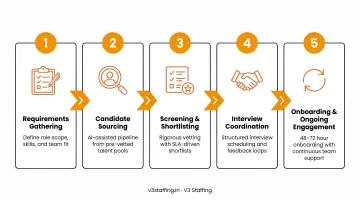
V3 Staffing's structured onboarding process targets 48–72 hours for pre-verified temporary talent, so teams are productive from the first week — not the third.
Key Benefits of IT Staff Augmentation
Flexibility and Scalability
Augmentation lets you dial team size directly to project demand — no long notice periods, no redundancy costs, no re-org required. Need four backend engineers for a three-month sprint, then a full stand-down after go-live? Both are straightforward.
This is especially relevant for GCCs and product organizations running multiple simultaneous initiatives. India's GCC ecosystem already employs over 1.9 million professionals and is projected to reach 2.5–2.8 million by 2030 — much of that growth driven by organizations that need scalable, flexible hiring models rather than fixed headcount commitments.
Cost Efficiency
Permanent hires carry costs that extend well beyond salary. According to the U.S. Bureau of Labor Statistics, benefits alone represent nearly 30% of employer compensation costs in the information industry. Add to that:
- Recruitment agency fees and internal sourcing time
- Onboarding and ramp-up periods
- Training and certification costs
- Infrastructure and tooling provisioning
Staff augmentation eliminates most of this overhead. You pay for the resource, not the surrounding cost structure. Rates are transparent, budgets stay predictable, and there's no trailing cost when the engagement ends.
Faster Time-to-Hire
Specialized IT roles take time to fill through conventional channels. SHRM's 2025 data puts the average at 41 days across all roles — and technical or niche positions typically run longer.
Staffing partners with pre-vetted talent pools compress this significantly. V3 Staffing, for example, delivers shortlists for most tech roles within 7–15 days, with an average time-to-hire of 10 days across all specialist engagements. For urgent requirements, pre-screened candidates can be presented within 48–72 hours.
Access to Niche and Global Talent
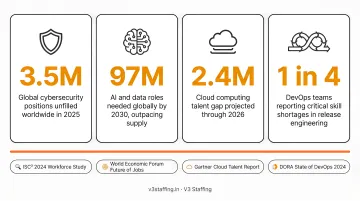
Some skills are hard to source in any single market. The global cybersecurity workforce gap alone stands at 4.8 million unfilled positions. India's AI talent demand is projected to more than double — from 600,000–650,000 professionals to over 1.25 million — between 2022 and 2027, according to a joint Deloitte-NASSCOM report.
Augmentation bypasses local talent constraints. You get immediate access to specialists across:
- AI/ML engineering and data science
- Cloud architecture and DevOps
- Cybersecurity and compliance
- Embedded systems and semiconductor design
No need to build a local hiring presence in every market — the talent comes to you.
Zero Compliance and Regulatory Risk
A capable staffing partner takes full ownership of employment contracts, payroll, statutory filings, and labor law compliance. For enterprises and GCCs operating across multiple Indian states, this matters considerably. PF, ESIC, Professional Tax, TDS, gratuity, maternity provisions — the regulatory surface area is substantial, and it varies by state.
V3 Staffing manages all of this, maintaining audit-ready documentation and ensuring compliance across all operational locations. Clients retain day-to-day control over work and performance; the administrative and legal employment burden stays with the partner.
When Is IT Staff Augmentation the Right Choice?
Not every situation calls for augmentation. Here's where it fits best:
Tight project timelines. When a product launch or platform migration has a fixed deadline and internal capacity falls short, augmentation allows rapid team expansion without stalling the initiative. Needing 4–6 specialists within two weeks to hit a launch window is a textbook use case.
Bridging niche skill gaps. If a project requires a specific tech stack, a regulated-industry specialist, or a cloud migration architect — and that skill isn't available in-house or worth hiring permanently — augmentation fills the gap precisely without over-committing.
Scaling for GCCs and fast-growth phases. Companies establishing a Global Capability Centre benefit from augmentation's speed without locking in fixed headcount they may later need to restructure. Startups post-funding face the same equation: engineering capacity fast, without the overhead that comes from hiring ahead of product-market fit.
De-risking experimental or time-bound initiatives. Piloting an AI engineering function or a data platform build? Contracting specialists first validates scope and ROI before committing to permanent hires. If the initiative proves out, you convert. If it doesn't, you've avoided building structural overhead around an unproven bet.
IT Staff Augmentation vs. Other Models
Staff Augmentation vs. Outsourcing (Managed Services)
| Factor | Staff Augmentation | Outsourcing / Managed Services |
|---|---|---|
| Who manages delivery | You (the client) | The vendor |
| Team integration | Fully embedded in your team | Operates separately |
| Management control | High | Low |
| Best for | Targeted gaps, integrated delivery | Delegating entire functions |
In outsourcing, the vendor owns the outcome — scope, quality, and team management sit with the provider. Augmentation keeps all of that with you; the partner handles HR and administration only.
Staff Augmentation vs. Dedicated Development Team
| Factor | Staff Augmentation | Dedicated Development Team |
|---|---|---|
| Team structure | Individuals embedded in your team | Full self-managed team from the provider |
| Management control | High — you direct day-to-day work | Low — provider manages delivery internally |
| Processes | Your processes, your standards | Provider's own delivery processes |
| Best for | Targeted gaps where integration matters | Long-duration projects with delegated team management |
Staff augmentation gives you individuals who operate inside your existing structure — your sprints, your tools, your direction. A dedicated team runs as its own unit, which suits complex, long-term engagements where you'd rather hand off team management entirely.
Staff Augmentation vs. Direct (Permanent) Hiring
| Factor | Staff Augmentation | Permanent Hiring |
|---|---|---|
| Time to hire | Days to weeks | Months |
| Cost structure | Operational expense | Salary + benefits + overheads |
| Flexibility | Contract duration, scalable | Long-term commitment |
| Best for | Time-bound, skill-specific needs | Core, strategic, long-term roles |
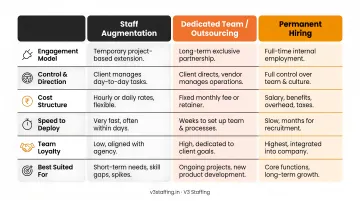
Direct hiring is the right call when the role is strategically important, long-term, and central to the organization's capabilities. Augmentation is the right call when the need is time-bound, the skill is specialized, or the duration is uncertain.
How to Choose the Right IT Staff Augmentation Partner
Three things separate partners who deliver from those who create problems:
Vetting Rigor and Talent Quality
Ask whether the partner conducts live technical assessments, coding tests, reference checks, and cultural fit screening — not just resume matching. Staffing Industry Analysts research found that 78% of contingent labor buyers rank worker quality among their top three partner selection criteria, with 53% calling it the single most important factor.
V3 Staffing's vetting process delivers 80% shortlist accuracy and a 90% offer-to-join ratio through five screening layers:
- Live technical assessments and coding evaluations
- Behavioral checks and cultural fit screening
- Reference validation and background verification
That level of pre-screening means fewer wasted interview rounds and faster time to deployment.
Speed and Onboarding Capability
Get specific numbers: ask for the partner's typical time-to-shortlist and time-to-deploy for roles in your exact stack. Structured onboarding that gets augmented staff productive from day one, rather than ramping over weeks, directly affects both project timelines and ROI.
V3 Staffing delivers shortlists for most specialized tech roles within 7–15 days, with an average time-to-hire of 10 days. Their onboarding process for temporary and augmented staff targets 48–72 hours from confirmation to deployment-ready, covering documentation, payroll setup, and compliance activation.
Compliance and Regulatory Expertise
This is critical for enterprises and GCCs operating across multiple Indian states. Your partner should own employment contracts, statutory filings (PF, ESIC, PT, TDS, gratuity), and labor law compliance with full audit-ready documentation. The compliance risk should stay with them, not revert to you.
V3 Staffing manages the complete employment and compliance lifecycle across all Indian states, with direct presence in Hyderabad, Bengaluru, Chennai, Pune, Delhi NCR, and Mumbai. You direct the work; V3 handles everything behind it.
Frequently Asked Questions
What is staff augmentation in IT?
IT staff augmentation is a model where companies bring external tech specialists into their teams on a temporary or project basis, while retaining full management control over the work. It differs from outsourcing in that the vendor manages employment and compliance, not project delivery.
What is the IT staff augmentation process?
The process runs five steps: defining requirements, sourcing and vetting by the staffing partner, client interviews and selection, onboarding into your tools and workflows, and ongoing HR and compliance management by the partner throughout the engagement.
What is the difference between team augmentation and staff augmentation?
The terms are largely interchangeable. Staff augmentation typically refers to adding individual specialists, while team augmentation describes scaling with a larger group or complete squad. Both operate under the same model — external talent, client-managed.
Is staff augmentation considered outsourcing?
No. Unlike outsourcing — where the vendor owns delivery — staff augmentation keeps management control with the client. The specialists work as integrated team members, not as an external team operating independently.
What are the main benefits of IT staff augmentation?
The core advantages are speed of access to specialized talent, cost efficiency by avoiding permanent hire overhead, flexibility to scale teams with project demand, and the ability to fill niche skill gaps without long-term commitment.
How long does IT staff augmentation typically take to get started?
With a partner that maintains pre-vetted talent pools, shortlists are typically ready within 7–15 days and specialists can be onboarded within days of selection — far faster than traditional hiring cycles, which average 41+ days even for non-specialist roles.