Introduction
HR and procurement leaders at large enterprises and Global Capability Centers (GCCs) in India face a persistent gap: specialized talent demand is outpacing what permanent hiring can deliver. Project timelines are fixed, skill requirements shift quickly, and full-time employment is too slow and rigid for project-driven work — pushing organizations toward contingent staffing solutions.
Yet choosing the wrong partner exposes organizations to compliance risk, poor talent quality, missed delivery timelines, and unnecessary costs. This isn't a transactional decision—it's a strategic one that directly impacts project success, regulatory exposure, and workforce agility.
Key Takeaways
- Contingent staffing involves hiring temporary, contract, or project-based professionals without permanent employment commitments
- India's flexi staffing workforce is projected to reach 9.16 million by FY27, driven by GCC expansion and digital transformation
- Four main models exist: temporary staffing, contract staffing, SOW-based engagement, and payrolling
- The right partner must clear six bars: talent quality, deployment speed, compliance capability, domain specialization, geographic reach, and model flexibility
- Partners with verified talent networks and proven compliance practices consistently reduce time-to-productivity and regulatory risk
What Is Contingent Staffing?
Contingent staffing means hiring professionals on a non-permanent basis — through contracts, temporary assignments, or project-specific engagements — rather than as full-time employees. The distinction from permanent hiring comes down to three things: how long the commitment lasts, what it costs, and which statutory obligations apply.
Where permanent employees receive gratuity, notice periods, and long-term benefits, contingent workers are engaged for defined periods aligned with business needs. Organizations gain workforce flexibility without the fixed costs of permanent headcount.
Types of Contingent Staffing Solutions in India
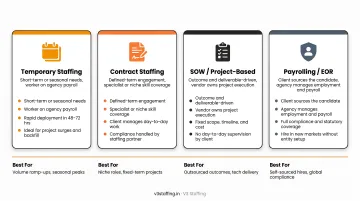
Four primary models dominate India's contingent staffing landscape:
1. Temporary Staffing Short-duration roles filled quickly to address operational gaps or seasonal demand. Ideal when you need immediate workforce support without long-term commitment.
2. Contract Staffing Longer-duration project-based engagements where specialized professionals are deployed for defined periods—typically 3 to 12 months. Used extensively for technology implementations, product launches, or transformation programs.
3. Statement of Work (SOW) Staffing Outcome-driven engagements where a team is accountable for specific deliverables, not just hours worked. The staffing partner manages the team and ensures project milestones are met.
4. Payrolling Services The staffing partner employs the worker on behalf of the client, managing payroll processing, tax deductions, and statutory compliance while the client directs day-to-day work.
Many enterprises run two or three of these models simultaneously — a tech transformation might involve contract staffing for the core team, SOW for a specific deliverable, and payrolling for talent sourced independently. A partner who can handle all four models under one engagement removes the coordination overhead of managing multiple vendors.
Why Enterprises and GCCs in India Are Leaning Toward Contingent Staffing in 2026
India's flexi staffing market is experiencing structural growth, not just tactical adoption. India's flexi staffing workforce stood at 7.2 million in FY25 and is projected to reach 9.16 million by FY27—a 12.6% growth trajectory that reflects fundamental shifts in how organizations think about workforce design.
Several forces are driving this momentum in 2026:
GCC Expansion Across Indian Cities
India had 2,117 GCCs as of FY26, up from 1,600 in FY21—a 32% increase in just five years. GCC revenues grew from USD 61.4 billion to USD 98.4 billion over the same period, with the workforce expanding from 1.7 million to over 2.3 million professionals.
This rapid expansion creates demand for niche tech talent faster than permanent hiring can support. GCCs routinely need:
- AI/ML engineers for model development and deployment cycles
- Cloud architects to build and migrate enterprise infrastructure
- Cybersecurity specialists for compliance and threat management
- Semiconductor designers for chip and embedded systems work
Most of these roles are tied to specific projects with defined timelines—exactly where contingent hiring fits.
Project-Based Digital Transformation Programs
Digital transformation initiatives have fixed timelines and specific skill requirements. Organizations can't afford to wait 45–50 days to fill mid-level roles when project milestones are at stake. Contingent staffing enables immediate deployment of specialized professionals without permanent employment commitments.
Cost Optimization and Workforce Agility
Organizations increasingly prefer variable workforce models to reduce fixed employee costs, avoid unused capacity during slow periods, and stay agile during economic uncertainty. Contingent staffing eliminates long-term liabilities such as gratuity, severance, and retention costs while maintaining output quality.
On the supply side, experienced professionals are actively choosing contract roles. A growing share of senior tech talent in India now prefers project-based engagements for the flexibility and domain variety they offer—making contingent hiring a two-sided shift, not just an employer-driven one.
What to Look for When Choosing a Contingent Staffing Solution in India
Not all contingent staffing providers operate at the same maturity level. Many can source résumés, but few can support enterprise-grade delivery, compliance continuity, and workforce integration at scale. The following six factors separate delivery-ready partners from transactional vendors.
Talent Pool Quality and Vetting Rigor
Talent quality is the factor everything else depends on. A staffing partner's ability to deliver pre-verified, role-ready professionals (not just résumés) directly determines onboarding productivity and project outcomes.
Ask about their screening methodology:
- How many evaluation stages do candidates complete?
- What technical and behavioral assessments are used?
- How are candidates validated for real project environments?
- What is the shortlist accuracy rate?
KPIs influenced: Time-to-productivity, quality-of-hire, rework rates, manager satisfaction scores
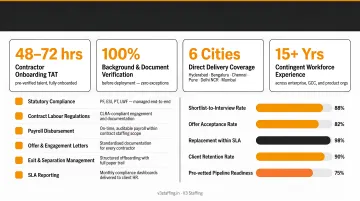
V3 Staffing employs multi-layered evaluation including skill checks, culture-fit screening, reference validation, and domain-specific assessments. Their 80% shortlist accuracy rate ensures most candidates presented meet role requirements.
Deployment Speed and Onboarding Readiness
Deployment speed becomes critical when projects have fixed timelines or workforce gaps create operational risk. Partners with a pre-vetted bench, structured onboarding playbooks, and SLA commitments get professionals contributing from day one — not after weeks of ramp-up.
KPIs influenced: Time-to-fill, time-to-productivity, project milestone adherence, contractor attrition during onboarding
V3 Staffing's 48-to-72-hour onboarding for temporary staffing keeps project timelines on track, while their average 10-day time-to-hire for contract roles outpaces industry benchmarks.
Compliance and Regulatory Expertise
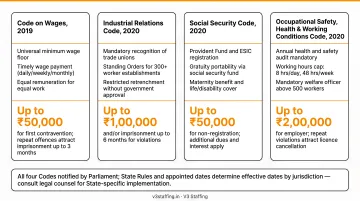
Contingent staffing in India carries significant legal complexity. India's four Labour Codes were implemented on November 21, 2025, replacing 29 older statutes and introducing stricter compliance requirements:
- Wages must constitute at least 50% of total remuneration
- Gratuity eligibility reduced from 5 years to 1 year for fixed-term employees
- Contract labour threshold raised to 50 workers (up from 20)
- Penalties up to ₹10 lakh and imprisonment up to 5 years for severe violations
Misclassification or non-compliance exposes client organizations to financial penalties and reputational risk. Full-service compliance coverage means your partner owns:
- Provident Fund (PF) and Employee State Insurance (ESI) contributions
- Tax Deducted at Source (TDS) filings
- Contract Labour (Regulation and Abolition) Act requirements
- Professional tax, gratuity, and maternity benefits
KPIs influenced: Compliance audit pass rates, zero penalty incidents, vendor risk scores, legal exposure reduction
Industry and Domain Specialization
Staffing for an automotive GCC requires different talent networks, screening criteria, and sector knowledge than recruiting for a fintech product organization. Industry-specific experience directly affects how well a partner can source, assess, and place the right candidates.
Key industries with high contingent staffing adoption include:
- IT and technology (58% YoY hiring growth in 2025)
- BFSI (banking, financial services, insurance)
- Manufacturing and automotive
- Healthcare and pharmaceuticals
- GCCs across all sectors
KPIs influenced: Role-fit accuracy, time-to-shortlist, interview-to-offer conversion rates, contractor performance ratings
V3 Staffing serves multiple verticals including Technology/Digital, BFSI, Engineering & Manufacturing, Healthcare & Pharma, Automotive R&D, and Semiconductor & Telecom—with deeper specialization in domains requiring regulatory knowledge and technical precision.
Geographic Reach Across India
For large enterprises or GCCs operating across multiple cities—including metros and Tier-II centers—a staffing partner's physical presence and local talent networks determine how consistently they can deliver across locations.
Tier-II cities recorded 21% YoY hiring growth, with Coimbatore showing 24% annual gains. Yet many staffing firms lack the infrastructure to serve these markets effectively.
Coverage across both metro and Tier-II markets eliminates the need for multiple regional vendors — and the coordination overhead that comes with them.
KPIs influenced: Fill rates across locations, time-to-fill in non-metro markets, vendor consolidation ratios, workforce continuity across sites
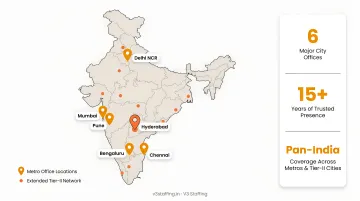
V3 Staffing maintains a presence across Hyderabad, Bengaluru, Chennai, Pune, Delhi NCR, and Mumbai, with an extended network reaching Tier-II cities to support pan-India delivery.
Flexibility Across Workforce Models
Organizational needs evolve. A project starting with temporary staffing may shift to SOW engagement or contract-to-permanent conversion. Working with a partner who supports multiple workforce models prevents mid-engagement vendor changes and keeps institutional knowledge intact.
The ability to transition between models—temporary, contract, payrolling, or permanent—without switching vendors reduces administrative overhead and maintains workforce stability.
KPIs influenced: Workforce model transition time, contractor-to-permanent conversion rates, total workforce program costs
How V3 Staffing Helps Enterprises Navigate Contingent Staffing in India
V3 Staffing has spent over 15 years placing contingent talent for large enterprises, GCCs, and product organizations across India. With offices in Hyderabad, Bengaluru, Chennai, Pune, Delhi NCR, and Mumbai—and reach into Tier-II cities—the firm handles contingent hiring at enterprise scale.
Delivery Model
- SLA-driven shortlists with pre-verified candidates before submission
- 48–72 hour onboarding for temporary roles keeps project timelines intact
- 90% attendance and continuity rate for temporary staffing minimizes disruptions
What Enterprises Get
- 10-day average time-to-hire across roles and locations
- Full compliance ownership covering PF, ESI, TDS, and Labour Code requirements
- Consistent hiring outcomes with no regulatory exposure
- Variable workforce models that reduce fixed headcount costs
- Vetted talent network spanning IT, manufacturing, BFSI, GCC, pharma, and automotive
For multi-location enterprises managing compliance across states, having a single partner handle both talent delivery and regulatory obligations typically cuts administrative overhead significantly—which is where V3 Staffing's integrated model stands apart from traditional staffing vendors.
Conclusion
The right contingent staffing partner in India isn't defined by headcount or speed alone. What separates high-performing programs from fragmented ones is alignment — a partner whose delivery model, compliance practices, and talent networks match your specific workforce priorities and business context.
As the lines between permanent and contingent work continue to blur in 2026, organizations that build structured, partner-led contingent programs will outpace those managing fragmented, ad-hoc hiring. Reviewing those partnerships at least annually matters as much as the initial selection — role profiles shift, compliance requirements tighten, and talent markets move faster than most vendor agreements anticipate. Partners like V3 Staffing, with dedicated coverage across India's major hiring hubs and sector-specific talent networks, are built to adapt alongside those changes rather than lag behind them.
Frequently Asked Questions
What is contingent staffing?
Contingent staffing involves hiring professionals on a non-permanent, project-based, or temporary basis through contracts or staffing agencies rather than as full-time employees. It differs from permanent hiring in employment duration, statutory obligations, cost structure, and labour law exposure.
How is contingent staffing different from permanent staffing in India?
Permanent staffing includes long-term employment with gratuity, PF, ESI, and notice period obligations. Contingent staffing is project-based or temporary, with lower fixed costs and the flexibility to scale headcount up or down as business needs change.
What are the compliance risks of contingent staffing in India?
Key risks include worker misclassification, Contract Labour Act violations, PF/ESI defaults, and gaps under India's Labour Codes (effective November 2025) — with penalties reaching INR 10 lakh and imprisonment up to 5 years. A reliable staffing partner takes full ownership of these obligations.
How quickly can contingent workers be deployed in India?
Deployment timelines vary by partner and role type. With pre-vetted talent pipelines and structured onboarding, experienced partners can deploy contingent professionals within 48 to 72 hours for temporary roles, and within days for specialized contract positions, compared to 45–50 days for traditional recruitment processes.
Which industries in India use contingent staffing the most?
IT and technology, automotive and manufacturing, BFSI, pharma and life sciences, GCCs, retail, and logistics are the largest users. These sectors depend on flexible workforce models to handle project-based work, seasonal surges, and rapid scaling demands.
Can contingent workers be converted to permanent employees in India?
Yes, contract-to-permanent conversion is common and supported by most staffing partners through predefined conversion terms. It's particularly useful when organizations want to assess cultural fit and performance before committing to a full-time hire.