

Introduction
U.S. accounting firms are navigating a dual crisis. Over 300,000 accountants and auditors left the profession between 2020 and 2022—a 17% workforce decline that has reshaped the labor market. At the same time, rising operational costs make it nearly impossible to scale teams without restructuring how talent is acquired. The median accountant salary climbed to $81,680 in 2024, with starting salaries for accounting graduates increasing 11-17% over just two years.
Offshore staffing has become a practical response to these pressures — delivering faster turnaround during tax season, lower overhead costs, and teams that hold up when demand spikes. This article covers the measurable benefits for U.S. accounting firms and the best practices that separate successful programs from ones that stall out.
Key Takeaways
- Offshore staffing allows U.S. accounting firms to hire U.S. GAAP-trained professionals at 40–70% lower cost than equivalent domestic hires.
- It solves two acute problems simultaneously: the domestic accounting talent shortage and seasonal workload spikes that burn out in-house teams.
- Offshore teams handle bookkeeping, tax preparation, financial reporting, payroll, and audit support without requiring physical presence.
- Success depends on the right staffing model, clear processes, and full integration of offshore staff into daily workflows.
- Firms that track KPIs and treat offshore staffing as a long-term strategy consistently lower per-head costs year over year.
What Is Offshore Staffing for Accounting Firms?
Offshore staffing for accounting firms means hiring dedicated accounting professionals from another country—typically India, the Philippines, or Latin America—to work remotely as an extension of your team under your firm's direct supervision.
It applies across core accounting functions:
- Bookkeeping and general ledger maintenance
- Tax return preparation and filing
- Accounts payable and receivable management
- Payroll processing and administration
- Financial statement preparation
- Audit support and documentation review
None of these roles require physical presence in the U.S., which makes them well-suited for remote, offshore delivery.
Think of offshore staffing as a capacity model—one that gives accounting firms the talent flexibility to grow client books, reduce bottlenecks during peak periods, and maintain quality when domestic hiring can't keep pace.
Key Benefits of Offshore Staffing for U.S. Accounting Firms
The advantages below are operational, not theoretical. Each maps to outcomes firm owners track: cost per hire, billable capacity, staff retention, turnaround time, and client satisfaction. The three core benefits—cost reduction, talent access, and elastic capacity—are covered in detail below.
Significant Labor Cost Reduction Without Sacrificing Quality
Hiring offshore accounting professionals—particularly from India—allows U.S. firms to access equivalent or higher skill levels at a fraction of domestic salary costs, typically 40–70% lower across roles like bookkeeper, staff accountant, senior accountant, and controller.
The cost differential comes not from lower quality but from differences in cost of living. Offshore accountants trained in U.S. GAAP earn competitive wages in their home markets while dramatically reducing the firm's loaded cost per hire. Here's the breakdown:
U.S. vs. India Salary Comparison (2024-2026):
| Role | U.S. Median Annual Salary | India Average Annual Salary | Raw Differential |
|---|---|---|---|
| Bookkeeper | $49,210 | $3,600-$9,600 | 80-93% |
| Accountant/Senior Accountant | $81,680 | $5,900-$8,100 | 90%+ |
| Controller-level | $161,700 | ~$31,400 | 80%+ |
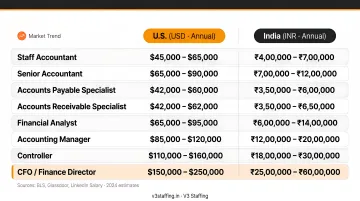
Sources: U.S. Bureau of Labor Statistics, PayScale India, AmbitionBox
The 40–70% savings range accounts for total delivery cost when working through a staffing provider, including overhead, infrastructure, management, quality controls, and profit margin. Factor in that U.S. employer benefit costs represent 29.6% of total compensation—an expense largely absent in offshore arrangements—and the real savings widen further.
A firm hiring three senior accountants offshore instead of domestically can save $150,000–$200,000 annually. That capital can be reinvested in technology upgrades, additional client capacity, or higher partner margins.
This benefit hits hardest for small-to-mid-sized CPA firms that can't match Big Four salary packages locally but need senior-level talent to serve growing client portfolios. The primary metrics that shift: cost per hire, labor cost as a percentage of revenue, profit margin per client, and overall overhead as a share of billings.
Access to U.S. GAAP-Trained Accounting Talent That Is Unavailable Domestically
The U.S. accounting talent pipeline is shrinking. CPA exam candidates fell from 84,980 in 2023 to 74,165 in 2024—a 12.7% decline. More striking, new candidates dropped 32.4% in a single year, from 41,415 to 27,994.
Approximately 75% of the CPA workforce met retirement eligibility as of 2020, creating a retirement cliff that compounds the pipeline shortage from both ends.
Offshore markets, particularly India, produce large volumes of accounting professionals trained in international standards including U.S. GAAP and IFRS. India's Institute of Chartered Accountants (ICAI) has 425,000 members, with 31,946 new Chartered Accountants qualifying in 2024 alone—a deep, annually replenished talent pool.
Offshore staffing providers source and vet candidates specifically for U.S. accounting proficiency, screening for:
- Software expertise (QuickBooks, Xero, NetSuite, Sage)
- U.S. GAAP and regulatory knowledge
- Role-specific experience and certifications
- English language proficiency and communication skills
Firms receive qualified shortlists rather than building a pipeline from zero. While the average U.S. time-to-fill is 36–41 days across industries, offshore staffing compresses this to 7–15 business days for specialized roles.
This access is most critical for firms operating in markets with acute local shortages—and especially for those needing specialists in niche areas like multi-state tax, audit support, and financial analysis where domestic recruiting stalls for months. Metrics that respond directly: time-to-fill, client onboarding speed, capacity utilization of senior onshore staff, and staff turnover rate.
Elastic Capacity for Tax Season and Year-End Close—Without Burnout
Accounting workloads are inherently seasonal. Tax season and year-end close create demand spikes that overload permanent staff, lead to missed deadlines, and increase attrition. Offshore staffing allows firms to scale team size up and down without the commitment, cost, or timeline of domestic hiring cycles.
The burnout numbers from the 2024/25 busy season tell the story plainly:
Nearly 80% of public accountants worked 51+ hours per week during the 2024/25 busy season, with 19.4% logging 61–70 hours and 12% working 71+. Among those surveyed:
- 74% rated work-life balance as "Fair" or "Poor"
- 54.6% described the season as "somewhat" or "extremely" stressful
- Among Seniors specifically, 75% reported the season as stressful
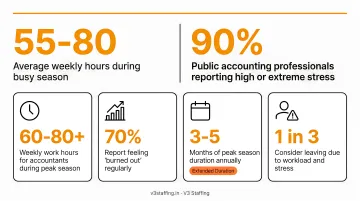
This drives voluntary departures. Average public accounting turnover runs 15–22% annually, with 84% being voluntary. Departure rates spike 40–60% above baseline during post-busy-season months (April–June)—nearly half of all annual voluntary departures occur in this window.
With access to pre-vetted offshore professionals, firms can add capacity weeks before peak periods rather than months—no long-term employment obligations required. This protects onshore teams from overload and keeps client deliverables on track during the highest-volume periods.
Offshore capacity absorbs transactional workload, freeing senior onshore staff to focus on client advisory, review, and high-value services.
The cost of inaction: Replacing a staff accountant costs $40,000–$58,000. A 50-person firm with 20% turnover loses $400,000–$600,000 annually. Reducing turnover by just 5 percentage points saves $100,000–$150,000 per year.
Peak impact lands in Q1 (tax season) and Q4 (year-end close), and is most visible for firms that have already absorbed client complaints or quality issues driven by an overloaded in-house team. The metrics that shift: staff retention rate (especially post-tax season), on-time filing rate, volume of clients served per quarter, and overtime hours logged by onshore staff.
What Happens When Offshore Staffing Is Ignored or Done Poorly
Firms that delay offshore staffing in a tight domestic talent market find themselves turning away new clients—not because they lack demand, but because they lack the people to deliver.
Consequences include:
- Inconsistent output and error rates climb when a small onshore team is stretched across too many engagements, especially with no overflow capacity during peak periods.
- Firms scramble to hire temporary domestic help at premium rates during tax season, then let them go afterward—an expensive, disruptive cycle that doesn't build capacity.
- Overtime, contractor premiums, and turnover replacement costs routinely exceed what structured offshore staffing would have cost, without the quality or scalability benefits.
- Firms that go the DIY route—freelancers, unvetted outsourcing providers, or platforms without accounting-specific screening—face output quality issues, communication gaps, and data security exposure that reinforce skepticism and prevent scale.
The firms that get this right treat offshore staffing as a permanent capacity layer—not a backup plan activated when things get tight.
How to Get the Most Value from Offshore Staffing
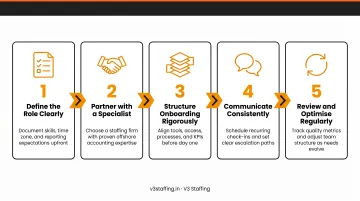
Offshore staffing delivers compounding returns when applied as a consistent operating model. Define the roles, workflows, and performance standards before hiring rather than after, so offshore staff integrate without disruption.
Five practices make the difference between offshore programs that scale and those that stall:
Document before you hire. Map workflows, approval hierarchies, and quality checkpoints before onboarding. Cloud-based platforms like QuickBooks Online, Xero, and NetSuite support real-time collaboration and eliminate version control issues.
Treat offshore staff as team members, not contractors. Structured onboarding, inclusion in communication channels, and regular alignment on U.S. regulatory changes reduce turnover and improve output quality.
Track KPIs on a regular cadence. Turnaround time, accuracy rate, volume processed, and client satisfaction should inform process refinements—not just sit in a report.
Schedule overlapping hours. Even 2-3 hours of daily overlap between U.S. and offshore teams dramatically reduces bottlenecks and keeps feedback loops short.
Choose staffing partners that reduce setup friction. V3 Staffing's SLA-driven shortlists, pre-vetted accounting professionals, and structured onboarding protocols are built to get offshore teams productive from day one—without the trial-and-error that derails early-stage programs.
Conclusion
Offshore staffing gives U.S. accounting firms something domestic hiring alone rarely delivers: predictable costs, access to qualified talent, and the capacity flexibility to absorb busy seasons without burning out your onshore team.
The advantages compound over time. Firms that start with one or two offshore hires and build a repeatable model find themselves with higher margins, stronger capacity, and onshore teams focused on higher-value work rather than volume processing.
That compounding effect only holds if the model is maintained. Firms that see the strongest results treat offshore staffing as an ongoing practice — reviewing performance regularly, refining processes over time, and working with staffing partners who understand the accounting talent market. V3 Staffing has spent over 15 years placing verified professionals across India's major business centers, including Hyderabad, Bengaluru, Chennai, Pune, Delhi NCR, and Mumbai, giving U.S. firms a direct path to the qualified accounting talent they need.
Frequently Asked Questions
Are accounting jobs being offshored?
Yes, offshore hiring of accounting professionals is growing among U.S. firms, driven by the domestic talent shortage and rising costs. This means hiring dedicated professionals who extend the firm's capacity — not replacing domestic roles, but filling gaps the local market can't supply.
What are offshore staffing services?
Offshore staffing services are provided by agencies that source, vet, and place accounting professionals from overseas (typically India, Philippines, or Latin America) to work for U.S. firms remotely. These services include talent sourcing, technical screening, onboarding support, and ongoing HR and compliance management.
What accounting tasks can be handled by an offshore team?
Common functions include bookkeeping, accounts payable and receivable, tax preparation and return processing, payroll administration, financial statement preparation, and audit support. Any accounting work not requiring physical presence can be managed offshore.
How much can U.S. accounting firms save with offshore staffing?
U.S. firms typically save 40–70% per hire annually when hiring offshore accounting professionals, particularly from India. For example, a senior accountant costing $81,680 in the U.S. may cost $5,900-$8,100 in India. Savings extend beyond salaries to include reduced overhead, office space, and benefits costs.
How do I ensure data security when working with offshore accounting staff?
Work with providers that hold SOC 2 Type II or ISO 27001 certifications, use encrypted file-sharing, restrict data access by role, and conduct staff background checks. Reputable providers treat security as standard practice and support compliance with IRS Section 7216, the AICPA Code of Professional Conduct, and the FTC Safeguards Rule.
What are the best practices for onboarding an offshore accounting team?
A structured start makes the biggest difference. Before day one, document workflows and process standards. Then:
- Use cloud-based platforms (QuickBooks Online, Xero, NetSuite) for real-time collaboration
- Schedule overlapping working hours for daily check-ins and reviews
- Assign a dedicated internal point of contact for the first 60–90 days