
This is where IT resource augmentation becomes essential. 72% of employers globally report difficulty filling roles, with the information industry facing the steepest challenges at 75%. For engineering leaders and HR heads at large enterprises and GCCs, traditional hiring timelines no longer match business velocity.
This article answers two core questions: what IT resource augmentation actually is, and how to know when it's the right move for your organization.
Key Takeaways
- IT resource augmentation embeds external IT professionals into your team under your direction—no permanent hire required
- You retain full project control—augmented staff integrate into your workflows, tools, and sprints
- Best suited for skill gaps, hard deadlines, fixed-scope projects, or rapid scaling without long-term headcount
- Ideal for enterprises and GCCs that have the leadership to direct talent but not the bandwidth to hire full-time
What Is IT Resource Augmentation?
IT resource augmentation is an engagement model where a third-party provider supplies skilled IT professionals who embed into your existing team and work under your management, not the vendor's. Typical roles include developers, QA engineers, data specialists, and DevOps engineers.
Clearing Up the Terminology
"IT resource augmentation" and "IT staff augmentation" are often used interchangeably. Resource augmentation typically focuses on engineering and delivery roles—software development, infrastructure, data, and DevOps. Staff augmentation can span broader functions including HR, admin, and marketing.
Both terms describe the same engagement model for IT roles.
How It Differs from Outsourcing
The key distinction lies in control:
In outsourcing:
- The vendor owns the deliverable
- The vendor manages the team
- You receive a finished product
In resource augmentation:
- You manage the professionals directly
- You retain full project control
- You own all intellectual property
- The team follows your processes and uses your tools
Three Defining Characteristics
- You stay in control: Assign tasks, set priorities, run sprint planning, and conduct performance reviews — just like a permanent hire.
- You scale on demand: Add three cloud engineers for a six-month migration, then roll off when it's done. No long-term headcount commitment.
- You hire faster: V3 Staffing delivers SLA-driven shortlists and onboards pre-vetted candidates within 48–72 hours for most IT roles — a fraction of the time a standard recruitment cycle takes.
Side-by-Side Comparison
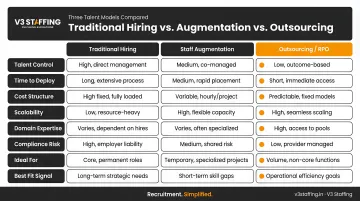
| Dimension | Traditional Hiring | IT Resource Augmentation | Full Outsourcing |
|---|---|---|---|
| Time-to-Hire | Weeks to months | 48–72 hours onboarding | Varies by vendor |
| Commitment Duration | Permanent or long-term | Project-based or flexible | Contract-based |
| Cost Structure | Salary + 30–40% benefits overhead | Hourly/monthly rate, no benefits burden | Fixed fee or milestone-based |
| Level of Control | Full management control | Full management control | Vendor-managed |
| IP Ownership | Company owns 100% | Company owns 100% | Negotiated, often shared |
When Should You Use IT Resource Augmentation?
Trigger #1: Skill Gap That Cannot Be Filled Internally
When your team lacks expertise in a specific technology stack—AI/ML, cloud architecture, DevSecOps, embedded systems—and internal mobility or training won't close the gap fast enough, augmentation gives you access to specialists without a lengthy search.
63% of employers identify skill gaps as the biggest barrier to business transformation over the 2025–2030 period. AI-related skills have overtaken traditional IT as the most difficult to find, with AI model development and AI literacy ranking #1 and #2 in global talent shortage surveys.
For GCCs and large enterprises, niche technology hiring through traditional pipelines typically takes months. Augmentation cuts that timeline to weeks.
Trigger #2: Hard Deadlines and Fixed Project Scopes
When you have a defined deliverable—product launch, platform migration, regulatory compliance implementation—with a non-negotiable deadline, augmentation adds capacity exactly when needed.
Common examples:
- Launching a new product module before a major industry event
- Migrating legacy systems to the cloud within a regulatory window
- Scaling QA capacity for a critical release cycle
- Building a proof-of-concept for investor demos
The engagement exits cleanly when the project closes, avoiding permanent overhead.
Trigger #3: Rapid Team Scaling Without Long-Term Hiring Commitments
Growth spurts demand flexibility. Startups scaling after funding rounds or GCCs expanding delivery capacity need headcount to grow in weeks, not months—and shrink again without layoffs.
India now hosts 1,760+ GCCs employing 1.9 million professionals, with 110 new centers established in 2024–2025 alone. That pace of expansion puts enormous pressure on hiring timelines—traditional GCC setup takes 3–6 months. Augmentation lets you scale teams in parallel while permanent infrastructure catches up.
Trigger #4: Bridging a Hiring Gap During Transitions
This trigger applies across several situations:
- An internal expert leaves mid-project, creating an urgent knowledge gap
- Recruitment is underway but will take 6–8 weeks; work cannot stall
- Your organization is entering a new technology domain and needs expertise to guide internal teams
Augmentation serves as a bridge, preventing projects from stalling while permanent solutions take shape.
When NOT to Use IT Resource Augmentation
If you need a core long-term team that must develop deep product ownership, institutional knowledge, and cultural alignment over years, augmentation is not the right model.
Avoid augmentation when:
- Foundational platform teams need multi-year continuity and deep product context
- Leadership roles will shape company strategy and culture over the long term
- Proprietary IP work requires permanent, exclusive ownership from day one
How IT Resource Augmentation Works: A Step-by-Step Process
Step 1: Define the Gap Precisely
Vague requirements produce poor-fit hires. Before approaching any provider, define:
- Specific technology stack (React, Python, Kubernetes, Salesforce, etc.)
- Seniority level (junior, mid-level, senior, architect)
- Scope of responsibilities (feature development, testing, infrastructure management)
- Duration of engagement (3 months, 6 months, ongoing)
- Success metrics (sprint velocity, deployment frequency, defect rates)
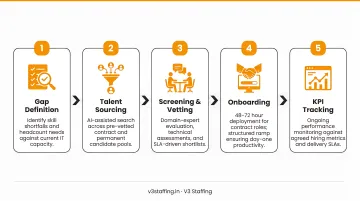
Step 2: Select a Reliable Augmentation Partner
Evaluate partners on these criteria before committing:
- Domain expertise: Do they have a track record in your specific technology stack and industry?
- Vetting process: Can they demonstrate how they screen candidates technically and for team compatibility?
- Deployment speed: What are their documented turnaround times from shortlist to start date?
- Compliance coverage: Do they handle NDAs, IP agreements, payroll, and access controls end to end?
- Pricing transparency: Are rates fixed and documented, with no hidden fees?
V3 Staffing, for instance, operates on SLA-driven shortlists with pre-verified talent pools — enabling deployment-ready placements for large enterprises and GCCs within 48–72 hours. That kind of defined SLA is a useful benchmark when comparing any shortlisted partner.
Step 3: Vet Candidates and Retain Final Approval
A strong partner narrows the field — but the final call stays with your team. Your internal tech leads should conduct the final technical interview to confirm both technical fit and team compatibility.
Skipping this step risks:
- Misalignment with internal coding standards
- Poor cultural fit that disrupts team dynamics
- Communication gaps that slow delivery
Step 4: Structured Onboarding from Day One
Treat augmented staff as integrated team members, not external contractors.
Day one checklist:
- Grant access to tools (Jira, Slack, GitHub, AWS, etc.)
- Pair them with an internal buddy or team lead
- Clearly define their role to prevent overlap or confusion
- Include them in daily stand-ups, sprint planning, and retrospectives
The faster augmented staff feel like part of the team, the faster they contribute. Minimizing ramp-up time is directly tied to how deliberately you run day one.
Step 5: Manage Performance with Clear KPIs
Success is measured by outcomes, not hours logged.
Track metrics such as:
- Sprint velocity and story point completion
- Code quality (test coverage, review feedback, defect rates)
- Deployment success rates and uptime
- Milestone completion against project timeline
Regular feedback loops and check-ins prevent drift and keep the engagement productive.
Key Benefits of IT Resource Augmentation
Speed of Access to Specialized Talent
Traditional tech hiring timelines have lengthened. The average time to hire a tech worker reached 5.4 months in 2024, up from 4.7 months in 2023.
Augmentation partners deliver qualified candidates within 7–14 days for contract roles. V3 Staffing typically presents pre-vetted candidates within 7–10 business days, reducing hiring timelines by up to 50%.
This speed advantage enables:
- Meeting hard project deadlines on time
- Reducing strain on internal HR teams
- Capturing time-sensitive market opportunities
Cost Efficiency Without Sacrificing Quality
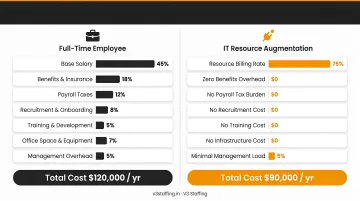
Augmentation eliminates overhead costs associated with full-time employees:
Avoided costs include:
- Benefits (health insurance, retirement contributions, paid leave)
- Payroll taxes and statutory compliance burden
- Equipment and office space
- Training and development programs
- Severance packages
The total cost of a full-time employee typically runs 1.25x to 1.4x their base salary. For large firms, the labor burden rate can reach 52.9% on top of base wages.
Beyond ongoing overhead, a bad hire compounds the problem. The cost of replacing a mis-hire can reach at least 30% of first-year earnings—roughly ₹24 lakh for a role paying ₹80 lakh annually. Pre-vetted augmentation candidates reduce that risk at the sourcing stage.
Full Project Control and IP Protection
Cost efficiency matters, but so does control. Unlike outsourcing models, augmented staff work within your systems and follow your processes — all output, including code, documentation, and designs, remains 100% your intellectual property.
Protection mechanisms include:
- NDAs signed before engagement begins
- Work-for-hire clauses ensuring IP ownership
- Role-based access controls limiting data exposure
- Direct oversight of all deliverables and commits
Common Challenges to Watch Out For
Challenge 1: Onboarding Friction and Integration Time
Even pre-vetted professionals need time to learn internal tools, processes, and team dynamics.
Tips to minimize ramp-up:
- Create dedicated onboarding documentation covering your tech stack, workflows, and coding standards
- Assign an internal buddy who can answer questions and provide context
- Include augmented staff in team rituals (stand-ups, retrospectives, demos) from day one
- Schedule early check-ins to address blockers before they compound
Challenge 2: Management Overhead
Unlike fully outsourced teams, augmented staff require active management from internal leads. If your organization lacks available leadership bandwidth to provide direction and performance feedback, augmentation can strain the team rather than support it.
Assess before engaging:
- Do you have a technical lead with capacity to manage additional team members?
- Can you provide clear priorities and unblock issues quickly?
- Is your existing team stable enough to absorb new members?
Challenge 3: Data Security and Compliance Exposure
Internal risks are manageable with the right processes. External exposure is a different matter. Augmented staff often need access to sensitive codebases, databases, or client data—and for organizations in regulated sectors like BFSI, healthcare, and automotive, that access introduces real compliance risk.
Mitigation strategies:
- Implement role-based access controls limiting exposure to necessary systems only
- Require signed NDAs and IP agreements before granting access
- Work with augmentation partners who have documented compliance frameworks
These controls matter even more under India's Digital Personal Data Protection Act (DPDP) 2023. The Act requires data processors to act only under documented instructions and notify breaches immediately. For BFSI organizations specifically, non-compliance can result in penalties up to ₹250 crore.
Frequently Asked Questions
What is IT resource augmentation?
IT resource augmentation is an engagement model where external IT professionals embed into your existing team, working under your direction to fill skill gaps or add capacity without the long-term commitment of permanent hiring.
What is the IT resource augmentation process?
The process typically follows five steps:
- Define the skill gap and project scope
- Select an augmentation partner
- Vet and interview candidates
- Onboard them into existing workflows
- Track performance against defined KPIs
When should I use staff augmentation?
Use staff augmentation when you face a niche skill gap, a hard project deadline, rapid scaling needs, or a transitional gap while permanent hiring is in progress.
What are the benefits of staff augmentation?
Key benefits include faster access to specialized talent, lower total cost than full-time hiring when you factor in benefits and overhead, and full project control with retained IP ownership.
What is an example of staff augmentation?
A GCC needs three cloud engineers for a six-month data migration project. Through an augmentation partner like V3 Staffing, they receive pre-vetted candidates within 10 days, complete the migration on schedule, and add zero permanent headcount.
How much does staff augmentation cost?
Costs vary based on role, seniority, technology stack, engagement duration, and geography. Augmentation typically costs less than full-time hiring once you factor in benefits, overhead, and time-to-productivity.