
According to Mercer Mettl's 2024 Global Talent Acquisition Insights report, 61% of companies hired at least one remote worker and 58% prioritised shortening the hiring time cycle — yet most recruiting infrastructure hasn't caught up with that reality.
Outsourcing talent acquisition is one of the most direct ways to close that gap. This article covers the five core models for outsourcing remote team hiring, the key benefits each unlocks, and how to choose a partner worth trusting with your headcount plan.
Key Takeaways
- Remote hiring demands screening for self-management, async communication, and virtual collaboration — gaps that standard hiring processes rarely catch.
- The five outsourcing models are RPO, remote staffing agencies, staff augmentation, EOR-linked recruitment, and fully managed talent teams.
- Outsourcing reduces time-to-hire, lowers recruitment overhead, and removes compliance exposure without expanding internal HR headcount.
- Choose partners based on vetting rigor, SLA commitments, compliance coverage, and domain depth — not on price alone.
Why Remote Teams Need a Different Talent Acquisition Strategy
Remote hiring isn't just office hiring with video calls substituted in. The role requirements are structurally different: candidates need self-direction, asynchronous communication discipline, and the ability to operate without the ambient accountability that comes with a shared workspace.
Standard screening processes — structured around in-person culture reads and manager gut checks — aren't built to surface those traits reliably.
Internal HR teams feel this pressure acutely. Remote hiring adds layers that on-site processes never had to account for:
- Evaluating candidates across multiple time zones
- Coordinating multi-round interviews with distributed panel members
- Managing onboarding logistics that vary by location
- Navigating multi-jurisdiction compliance requirements
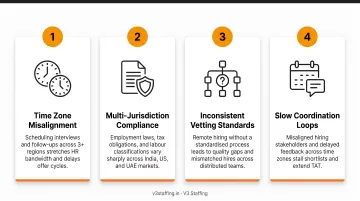
Each layer compounds the bandwidth drain — and pulls internal teams away from higher-value work.
The compliance dimension alone is significant. Deloitte's Global Remote Work Survey found that 46% of organisations cited policy and regulation as the most significant barrier to enabling remote work — and 30% had no remote-work guidelines in place at all. That's an operational risk embedded directly in the hiring function — and most internal teams aren't resourced to manage it.
The result: longer cycles, inconsistent candidate quality, and internal teams pulled away from strategic work to manage process overhead that a specialist partner could handle faster and more reliably.
The Best Ways to Outsource Talent Acquisition for Remote Teams
Recruitment Process Outsourcing (RPO)
RPO transfers part or all of the recruitment function to a specialist provider. The provider manages sourcing, screening, interview coordination, and pipeline reporting — embedded inside the client's workflows rather than operating as a separate vendor handing over CVs.
The key distinction from traditional agency hiring: RPO operates on defined SLAs, structured governance, and hiring metrics. The provider measures success against time-to-fill targets, offer acceptance rates, and pipeline conversion — not just placements made.
RPO works best when:
- Hiring volume is continuous or high across multiple roles
- The organisation needs consistent candidate quality, not one-off fills
- Internal HR capacity can't sustain requisition management at scale
- Multi-location hiring requires coordinated sourcing infrastructure
For GCCs and large enterprises running simultaneous hiring across functions, RPO provides the operational backbone that keeps hiring moving without adding headcount to the HR team.
Remote Staffing Agencies
RPO suits high-volume, ongoing hiring. Remote staffing agencies solve a different problem: speed of access to qualified professionals, without the overhead of building sourcing infrastructure or waiting for inbound flow.
These agencies maintain pre-screened candidate pools evaluated specifically for distributed work environments.
The quality differentiator is the screening lens. A generalist agency screens for skills and experience. A remote-focused partner goes further, assessing:
- Written communication clarity
- Self-directed priority management without daily supervision
- Demonstrated track record in distributed team environments
V3 Staffing's remote staffing model, for example, maintains pre-vetted pipelines across software engineers, DevOps specialists, QA professionals, and data roles — sourcing from major tech hubs and Tier-II cities across India. Every candidate goes through structured remote-readiness evaluation before being presented, not just technical assessment.
Staff Augmentation for Specific Roles
Staff augmentation fills defined roles or project durations without full-time hiring commitments. You bring in an external professional with specific expertise, integrated into your team, while the staffing partner handles sourcing, vetting, compliance, and administrative management.
This model gives internal teams direct oversight of the work while removing the sourcing burden. The client defines deliverables and day-to-day direction; the partner handles everything from initial screening through payroll and contract administration.
Where augmentation fits well:
- Specific technical roles needed for a defined project window
- Skill gaps that don't justify permanent headcount
- Companies new to outsourcing who want to maintain hands-on control
- Situations where speed-to-deploy is the primary constraint
With an average time-to-hire of 10 days and pre-vetted talent pools across IT, engineering, and shared services, V3 Staffing's augmentation model is structured for rapid deployment without compromising on candidate quality.
Employer of Record (EOR) Combined with Recruitment Support
An EOR solution pairs recruitment with compliant employment. The EOR provider becomes the legal employer of record in the worker's jurisdiction — managing payroll, tax filings, statutory benefits, and employment contracts — while the client retains full control over the person's day-to-day work.
This matters for cross-border remote hiring because every jurisdiction introduces distinct compliance obligations. Setting up a legal entity in each target location is slow and expensive — an EOR removes that requirement entirely.
V3 Staffing's EOR service covers India-based hiring end-to-end — PF, ESIC, PT, TDS, gratuity, and full labour law adherence — bundled with recruitment. Companies source and compliantly employ talent through a single engagement, with no separate vendors to manage.
Fully Managed Remote Talent Teams
Some providers go beyond sourcing to operate the entire remote team function on the client's behalf — building the team, handling onboarding, managing compliance, and delivering against performance SLAs with structured governance.
This model suits organisations standing up new capability centres, GCCs launching a fresh function, or product companies scaling a distributed engineering team without the internal infrastructure to manage it. The provider takes on delivery accountability, not just sourcing responsibility.
V3 Staffing's GCC-as-a-Service model follows this structure:
- Discovery and feasibility assessment
- Talent acquisition against defined role profiles
- Operational setup and onboarding
- Ongoing governance with SLA-based reporting and live pipeline visibility
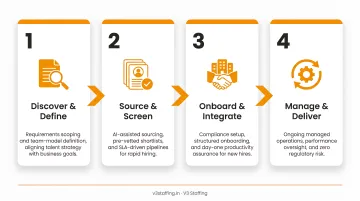
The engagement is designed so teams are productive from day one, not weeks after placement.
Key Benefits of Outsourcing Talent Acquisition for Remote Teams
Broader talent pool access. Deloitte found 59% of organizations used remote work specifically to expand their available talent pool, and 41% identified global talent pools as a key driver for the next five years. Outsourcing partners with established networks across geographies accelerate access to that pool — particularly in markets like India where demand for qualified remote professionals is high but requires local sourcing knowledge.
Faster hiring cycles. Pre-built pipelines and dedicated sourcing capacity compress timelines that in-house teams can't match. Partners like V3 Staffing operate on SLA-driven commitments — 48–72 hour deployment for temporary roles and a 10-day average time-to-hire — delivering predictable speed rather than best-effort timelines.
Lower recruitment overhead. SHRM reports an average cost-per-hire of approximately $4,700, with many organizations estimating total hiring cost at 3–4x the annual salary of the role. Soft costs — manager time spent on screening, scheduling, and decision rounds — account for roughly 60% of total hiring costs.
Outsourcing shifts those costs off internal teams and allows recruitment capacity to scale with actual demand rather than fixed headcount.
Compliance risk reduction. Employment law variability across states and countries creates genuine exposure. Misclassification risk, payroll tax obligations, and benefits compliance all differ by jurisdiction. Partners who manage these requirements systematically — with audit-ready documentation — catch the errors that internal teams without multi-jurisdiction expertise routinely miss.
Scalable capacity without proportional overhead. Outsourcing lets organizations surge hiring during growth phases and scale back during slower periods without the disruption of expanding or contracting an internal recruiting function. For GCCs ramping from 20 to 200 people — or product organizations responding to a funding round — that elasticity directly reduces time-to-productivity when it matters most.
Common Pitfalls to Avoid When Outsourcing Remote Talent Acquisition
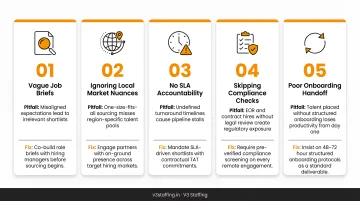
Most outsourcing failures trace back to the same avoidable mistakes. Watch out for these before you sign:
- Choosing on price alone — Vague screening criteria and absent SLA commitments produce mismatched hires. Re-hiring costs and productivity loss from one bad remote hire typically exceed whatever you saved upfront.
- Skipping the transition briefing — A partner performs only as well as the context you give them. Role requirements, team structure, culture fit, and success benchmarks all need to be communicated clearly before sourcing begins. Gaps here mean accurate sourcing to the wrong target.
- Ignoring time zone and async work fit — Remote roles have operational realities that office roles don't. Failing to screen for async communication skills, overlap hours, or home-office setup leads to onboarding friction that shows up weeks later.
- Treating the partner as a CV vendor — Outsourcing works best as a two-way relationship. Partners who receive no feedback on rejected candidates can't recalibrate; the shortlist quality degrades with each round.
- Skipping a structured handoff process — Handing over a job description without an onboarding workflow leaves the partner to guess at interview stages, assessment criteria, and offer parameters — all of which affect offer acceptance rates.
How to Choose the Right Talent Outsourcing Partner for Remote Teams
Evaluate screening and vetting rigor
Ask specifically how the partner assesses remote-work readiness — not just technical skills. A credible partner should have a defined process for evaluating self-management, written communication, and virtual collaboration before candidates reach your shortlist. If they can't walk you through that process in detail, their shortlists will reflect it.
Confirm SLA commitments and pipeline speed
Look for partners who operate on defined shortlist timelines and maintain active candidate pipelines for common role types. V3 Staffing, for example, operates on SLA-driven shortlisting with an 80% shortlist accuracy rate, 48–72 hour deployment for temporary staffing, and structured dashboards that give clients visibility into hiring progress at every stage.
Assess compliance and onboarding support
The partner should demonstrate how they handle multi-location employment compliance — not just sourcing. Ask whether they manage statutory filings, contract administration, and structured onboarding. A placement that doesn't come with compliant employment infrastructure shifts regulatory risk back to your organization.
Check domain and sector experience
Compliance infrastructure matters less if the partner doesn't understand your talent market to begin with. A partner with deep experience in your industry — GCCs, IT, product organizations, BFSI, manufacturing — will know the specific skills, compensation benchmarks, and candidate expectations relevant to your roles. That domain knowledge reduces sourcing misalignment and improves offer acceptance rates. V3 Staffing's work with organizations including Google, FactSet, DuPont, and Dream11 spans exactly these verticals, with specialized pipelines for technology, engineering, and data roles.
Frequently Asked Questions
What are the 5 C's of recruitment?
The 5 C's of recruitment are commonly cited as Competency, Character, Culture fit, Compensation, and Commitment. These dimensions guide evaluation of whether a candidate has both the skills and the organizational alignment to perform well in a specific role.
What are the 4 P's of recruitment?
The 4 P's of recruitment refer to Planning, Posting, Processing, and Placement — the sequential stages of a structured hiring process from workforce planning through candidate onboarding.
Is RPO a good fit for my company?
RPO suits organisations with continuous or high-volume hiring needs, limited internal recruiter bandwidth, or the requirement for consistent outcomes across multiple locations. It's less appropriate for companies with sporadic, low-volume hiring where the overhead of an embedded RPO engagement outweighs the benefit.
What is the difference between RPO and staff augmentation?
RPO outsources the recruitment process itself — sourcing, screening, and pipeline management. Staff augmentation provides external professionals who work directly within your team on defined roles or projects. Both work for remote teams but address different problems: RPO fixes hiring capacity, augmentation fills specific skill gaps quickly.
What functions within talent acquisition can be outsourced?
Companies can outsource the full recruitment lifecycle or specific functions: candidate sourcing, screening and shortlisting, interview scheduling, compliance management, or onboarding coordination. Partial outsourcing works well when internal teams need support in specific areas rather than full outsourcing.
How do you measure the success of an outsourced talent acquisition partner?
Key metrics include time-to-fill, offer acceptance rate, 90-day retention, SLA adherence on candidate delivery, and hiring manager satisfaction. A reliable partner should report on these proactively — not just when asked — and use the data to continuously refine sourcing and screening quality.