Introduction
India already hosts over 1,900 Global Capability Centers as of 2025, employing 1.9 million professionals — with projections reaching 2,400 GCCs and 4.5 million jobs by 2030. Companies across industries are hiring across cities, states, and borders. Cross-location hiring isn't a trend anymore; it's standard practice.
Scaling without proper legal and administrative infrastructure leads to compliance violations, payroll errors, and costly hiring delays. Most internal HR teams struggle to navigate state-level labour codes, PF/ESIC rules, and multi-state tax requirements on their own.
That challenge sharpened considerably when India's four new labour codes took effect on November 21, 2025 — consolidating 29 existing laws and overhauling compliance requirements across every state.
This guide explains exactly how an Employer of Record (EOR) works in practice — the operational stages, what it handles, and why it's become the go-to model for remote team expansion in 2026.
Key Takeaways
- An EOR acts as the legal employer, handling payroll, compliance, benefits, and contracts without requiring local entity setup
- EOR removes three core barriers: regulatory complexity, onboarding delays, and misclassification risk
- India's 2025 labor code overhaul makes EOR a strategic necessity for compliant hiring
- Best fit for GCCs, large enterprises, and product organizations expanding across states
- Choose an EOR with genuine in-market expertise over broad global platform coverage
What Is an Employer of Record (EOR)?
An EOR is a third-party organization that legally employs workers on behalf of another company. The EOR signs employment contracts, runs payroll, manages statutory benefits, and bears employer liability under local law, while the client company retains day-to-day management of the worker.
Why EOR Exists
The model was designed to solve a specific operational gap: businesses want to hire talent in new geographies without spending 6-12 months incorporating a legal entity, hiring local HR, and navigating local labor law. Establishing an Indian subsidiary costs ₹6,25,000–₹16,65,000 and requires approximately 8 weeks for incorporation plus 4 additional weeks for bank account approval.
What EOR Is Not
EOR is distinct from:
- Staffing agencies: source and place talent, but the client holds employer liability
- PEOs (Professional Employer Organizations): co-employ workers, but require you to already hold a local entity
- Outsourcing arrangements: delegate work to a third party without direct employment
Under an EOR model, the worker is genuinely employed under local law with full statutory protections, not contracted or outsourced.
EOR Model Variations
EOR providers operate through two broad structures:
- Owned-entity models: The EOR holds its own legal entities in each country or state, giving it direct control over compliance
- Partner-network models: The EOR relies on third-party local partners, which can introduce variability in how consistently regulations are applied
The distinction matters most in complex markets like India, where professional tax rates, shops and establishments registrations, and labor code timelines vary across Karnataka, Maharashtra, Telangana, and other states.
The Compliance Reality Facing Remote Teams in 2026
2026 represents a compliance turning point for distributed workforces. India's four new labor codes became effective November 21, 2025, consolidating 29 central labor laws into unified frameworks. Full state-level implementation rules are expected by April 1, 2026.
The New Compliance Framework
The four codes transform how employers manage distributed workforces:
Key Changes:
- Revised wage definition — If excluded components (HRA, travel allowances) exceed 50% of total remuneration, the excess is added back to wage calculations, directly impacting PF and gratuity liabilities
- Accelerated settlements — Final dues must be paid within two working days of termination or resignation
- Expanded gratuity eligibility — Fixed-term workers qualify for gratuity after one year (reduced from five years)
- Inspector-cum-facilitator system — Web-based, randomized inspections with mandatory advisory services before prosecution
Penalty Structure:
| Violation | First Offense | Repeat Offense |
|---|---|---|
| Underpayment of wages | Fine up to ₹50,000 | 3 months imprisonment and/or ₹100,000 fine |
| PF/ESI non-payment (wilful) | Fine up to ₹100,000 | Up to 3 years imprisonment |
| Non-registration of eligible employees | ₹50,000 | ₹30,000 per day (continuing) |
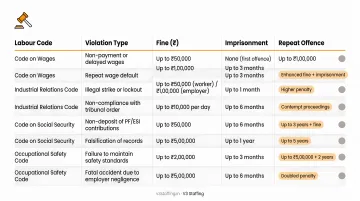
Source: India Briefing, December 2025
These penalties apply from day one of implementation — and many employers are not ready.
The Compliance Confidence Gap
While 78% of organizations feel prepared for employment compliance, only 49% agree their compliance initiatives receive adequate funding. This gap between confidence and resourcing creates tangible risk for companies managing multi-state workforces without specialist support.
State-Level Complexity
Cross-state hiring stacks compliance obligations — each state adds its own layer of rules on top of the central codes. Professional tax alone illustrates the challenge:
| State | Exemption Threshold | Maximum Annual Tax |
|---|---|---|
| Karnataka | Up to ₹24,999/month | ₹2,500 |
| Maharashtra (Men) | Up to ₹7,500/month | ₹2,500 |
| Maharashtra (Women) | Up to ₹25,000/month | ₹2,500 |
| Telangana | Up to ₹15,000/month | ₹2,400 |
Each state applies different thresholds, slabs, and gender-based exemptions. Multiply this across PF, ESIC, shops and establishments registration, and labor welfare funds — and a company hiring across five states is tracking 20+ distinct compliance variables simultaneously. That's where EOR arrangements shift from a convenience to a structural necessity.
How EOR Works: The Step-by-Step Process
EOR operates through a defined sequence, transferring specific employer obligations from your business to the EOR provider while keeping you focused on productivity and growth.
Onboarding Without Borders
The EOR initiates employment as soon as you select a candidate. The provider generates a locally compliant employment contract reflecting correct classification, role terms, probation rules, and notice periods for that specific state or country. Required documentation is collected, and the employee is registered under relevant statutory schemes.
Entity setup takes 8–12 weeks minimum. EOR cuts that to days — no waiting on tax ID setup, local HR legal review, or entity registration before a new hire can start.
For businesses hiring across India, pairing EOR with a talent partner that pre-vets candidates before onboarding starts — like V3 Staffing, present across Hyderabad, Bengaluru, Chennai, Pune, Delhi NCR, and Mumbai — removes the lag between candidate selection and first day of work.
Payroll and Tax Processing
The EOR calculates gross-to-net pay using local tax slabs and applicable deductions. In India, this includes:
Provident Fund (PF):
- Employee contribution: 12%
- Employer contribution: 13% (3.67% to EPF, 8.33% to EPS, plus 0.5% EDLI and 0.5% admin charges)
- Payable on maximum wage ceiling of ₹15,000/month
Employee State Insurance (ESIC):
- Applicable to establishments with 10+ employees where wages don't exceed ₹21,000/month
- Employee: 0.75% | Employer: 3.25%
TDS on Salary:
- Deducted at applicable income tax slab rates based on estimated annual income
The client company receives one consolidated invoice covering salary, employer contributions, and EOR fees — creating a single, predictable cost per hire rather than fragmented administrative overhead.
According to the EY 2022 HR Processing Risk and Cost Survey, the average payroll accuracy rate is only 80.15%, with each error costing $291. 14% of companies experienced litigation from payroll mistakes. EOR providers eliminate this risk through specialized payroll management.
Ongoing Compliance and Risk Management
The EOR handles compliance continuously, not just at onboarding. Key ongoing responsibilities include:
- Monitoring labor law changes at central and state levels
- Updating employment terms when regulations shift
- Renewing statutory registrations on schedule
- Responding to inspector queries on behalf of the employer
- Managing employee relations issues within the correct legal framework
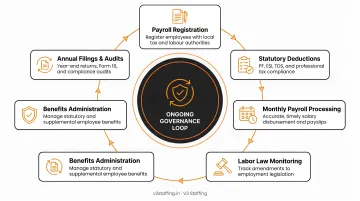
Why this matters most: This prevents compliance drift — the gradual divergence between what a company does and what the law requires. Compliance drift is the most common cause of labor audits and penalties for fast-growing remote teams.
New inspection regime: Under the Inspector-cum-Facilitator system, inspections are now web-based, randomized, and data-driven. Inspectors must provide advisory services and issue improvement notices before initiating prosecution. Employers must maintain digital records — paper-based registers are now punishable offenses.
Offboarding and Exit
The EOR handles exits compliantly: notice periods are served per contract and local law, final settlements (gratuity calculation, PF withdrawal processing, experience letters) are completed correctly, and the employee is properly deregistered from statutory schemes. This protects both the departing employee and the company from post-employment disputes.
What EOR Takes Off Your Plate
An EOR absorbs the full scope of employer responsibilities:
- Employment contracts and amendments
- Statutory registrations (PF, ESIC, PT, LWF)
- Monthly payroll processing and salary disbursement
- TDS computation and Form 16 issuance
- Compliance filings and returns
- Mandatory benefits administration (gratuity, maternity, leave encashment)
- Inspector queries and audit responses
With these responsibilities off their plate, internal HR teams shift from administrative fire-fighting to talent development, culture building, and workforce planning. For GCCs and product organizations in particular, that freed bandwidth goes directly into strategic hiring and retention — where it drives measurable impact. That shift also raises a practical question: who owns the employee data an EOR handles on your behalf?
Data Security Considerations
EORs handling payroll and employee records carry data protection obligations too. Verify that any EOR partner uses encrypted storage and transmission, access controls, and audit trails — particularly important when payroll data covers large distributed teams.
EOR vs. Other Hiring Models: When Does EOR Win?
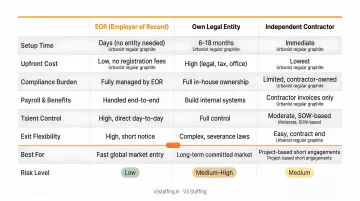
Not every hiring model fits every situation. The table below maps the key trade-offs so you can quickly identify where EOR has a clear edge.
| Feature | EOR | Own Legal Entity | Independent Contractor |
|---|---|---|---|
| Legal entity required? | No — EOR uses its own | Yes — must incorporate | No |
| Time to first hire | Days | 8-12+ weeks | Immediate (but risky) |
| Setup cost | Per-employee fee | ₹5.5L–₹15L+ | Minimal |
| Compliance ownership | EOR provider | Client company | Shared/ambiguous |
| Misclassification risk | Low | Low | High |
When EOR Wins
EOR consistently outperforms the alternatives in three scenarios:
- Speed over entity setup: Hiring through an EOR takes days, not the 8–12+ weeks required to incorporate locally. If you're testing a new market or need headcount now, the capital and time cost of entity setup rarely makes sense.
- No local entity for PEO: A PEO requires co-employment and an existing local entity. If you don't have one, EOR is the only compliant path to full-time employment in that geography.
- Statutory employment vs. contractor risk: When a role demands full-time status and statutory benefits, classifying that person as an independent contractor is the most penalized compliance error in India and globally. Under the new labor codes, failure to register eligible employees carries a penalty of ₹50,000, with ₹30,000 per day for continuing violations.
Ideal EOR Use Cases
- Companies entering a new Indian state or country for the first time
- GCCs scaling engineering or ops teams rapidly
- Product organizations hiring niche specialists in cities where they have no HR presence
- Startups needing compliant employment without HR department overhead
When EOR May Not Fit
If you already have stable, large-scale presence in a geography with established local HR infrastructure, direct employment or a PEO model may be more cost-efficient than ongoing EOR fees.
Frequently Asked Questions
What is an employer of record (EOR) in remote hiring?
An EOR is a third-party entity that legally employs workers on behalf of a client company, handling contracts, payroll, taxes, and compliance so the client can hire remotely without setting up a local legal entity.
What does remote hiring mean?
Remote hiring refers to recruiting and employing workers outside a company's physical office — across different cities, states, or countries. EOR services handle the legal and compliance groundwork that makes this operationally feasible across multiple locations.
How much do employer of record (EOR) services for remote team expansion cost?
EOR pricing is typically structured as a per-employee per-month fee, varying by geography, role complexity, and employee count. Factor in avoided costs — entity registration, local HR hiring, and ongoing compliance management — when evaluating the total value.
What does a global payroll provider do?
A global payroll provider processes salaries across multiple countries in local currencies, manages tax withholdings and statutory filings, and ensures payroll compliance in each jurisdiction. Many EORs bundle this as part of their broader service offering.
What is the difference between an EOR and a PEO?
An EOR becomes the sole legal employer and requires no existing local entity. A PEO co-employs workers alongside the client company and requires the client to have a registered entity in the country or state of hire.
Can an EOR help companies hire compliantly across multiple Indian states?
Yes, EORs with in-country India expertise manage state-specific compliance variations — including professional tax rates, shops and establishments registrations, and labor code implementation timelines — making them well-suited for companies scaling simultaneously across cities like Bengaluru, Hyderabad, Mumbai, Pune, and Delhi NCR.