
Introduction
US enterprise leaders are caught in a real bind. Growth targets don't slow down, but hiring pipelines do. According to SHRM's 2025 research, 69% of organizations report difficulty recruiting full-time roles — driven by low applicant volume, intense competition, and candidates dropping out mid-process.
Meanwhile, the demand for tech talent keeps climbing. Deloitte projects US tech jobs will grow from roughly 6 million in 2023 to over 7 million by 2034. Internal hiring alone can't close that gap.
Building a virtual offshore team in India has become a serious strategic response to that pressure. Enterprises are doing it to access skilled talent at scale, move faster on delivery, and hold operational control — without adding headcount risk domestically.
This guide walks through the full playbook: how to structure your team before you hire, vet talent rigorously, onboard for immediate productivity, and manage performance across time zones without burning out either side.
Key Takeaways
- India's tech workforce is projected to reach 5.8 million employees in FY2025 — one of the largest skilled talent markets globally
- Dedicated offshore teams work exclusively on your priorities and build institutional knowledge — unlike outsourcing vendors
- Role ambiguity is the top cause of offshore team failure; define responsibilities and 30/60/90-day outcomes before sourcing
- Structured onboarding, not just fast hiring, drives time-to-productivity
- Async-first communication and outcome-based performance management are the two most important operational levers
Why Build a Virtual Offshore Team in India?
The Talent Access Argument
India's tech workforce is expected to reach 5.8 million employees in FY2025, with over 126,000 net additions in a single year, according to NASSCOM's 2025 Strategic Review.
The engineering pipeline behind that number runs deep. The All India Survey on Higher Education reports 4.13 million engineering and technology students currently enrolled, with nearly 850,000 BE/BTech graduates produced annually.
The GCC ecosystem validates this at enterprise scale. The Zinnov-NASSCOM India GCC Landscape Report found that India's GCCs generated $64.6 billion and employed over 1.9 million professionals as of 2024. More than 1,750 GCCs now operate in India — including units from companies like Google, Johnson Controls, and DuPont. These aren't experimental outposts. They're integrated capability centers running product, data, cloud, and operations functions at scale.
The Business Case Beyond Cost
Cost matters, but framing offshore teams purely as a cost play misses the stronger argument. Deloitte's 2024 Global Outsourcing Survey found that skilled talent access and organizational agility now rank alongside cost reduction as the primary drivers for global sourcing decisions.
The real advantages of a virtual offshore team in India:
- Follow-the-sun delivery — India is 9.5–12.5 hours ahead of US time zones, enabling genuine handoff cycles where work continues while your US team sleeps
- Scalability without restructuring — add or reduce capacity without the overhead of full-time employment changes at headquarters
- Sustained domain expertise — offshore team members build product and process knowledge over time, unlike rotating vendors
Dedicated Team vs. Traditional Outsourcing
The distinction matters. A dedicated virtual offshore team works exclusively on your priorities, operates within your processes, and develops institutional knowledge specific to your product or business. Traditional outsourcing typically involves shared resources across clients, vendor-defined delivery models, and arm's-length accountability.
The two models produce measurably different results:
| Factor | Dedicated Offshore Team | Traditional Outsourcing |
|---|---|---|
| Resource allocation | Exclusively yours | Shared across clients |
| Process ownership | Your workflows | Vendor-defined |
| Institutional knowledge | Builds over time | Resets with each engagement |
| Accountability | Direct, integrated | Arm's-length |
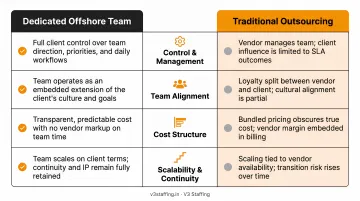
That shift in accountability — from vendor relationship to team extension — is what makes the dedicated model worth building deliberately.
Step 1: Define Roles and Team Structure Before You Hire
Why Role Clarity Comes First
Vague job descriptions are the single most avoidable cause of offshore team failure. When a hire lacks clear direction from Day 1, expectations go unmet, output drifts, and the failure gets attributed to "the talent" — when the real problem was never defined to begin with.
A strong role brief should include:
- 5–7 core responsibilities the person will own daily, not a general skill list
- Tools and system access required from Day 1 (Jira, Confluence, Slack, internal systems)
- Measurable outcomes for the first 30, 60, and 90 days tied to actual business deliverables
- Designated US-side counterpart who owns communication and decisions for that role
- Escalation path — who the offshore hire goes to when blocked, and expected response times
The clearer this brief is before hiring begins, the faster a new hire reaches meaningful output — typically within the first two weeks rather than the first two months.
Team Structure Design
A well-functioning offshore team typically needs three layers:
- Functional contributors — the engineers, analysts, or specialists doing the core work
- A delivery or team lead on the ground — someone in India who can coordinate locally, flag friction early, and maintain day-to-day momentum
- A designated US-side owner — not a committee, but one person accountable for offshore team communication, prioritization, and feedback
Each layer solves a distinct failure mode. No ground-level lead means context gaps compound silently. No single US owner means the offshore team absorbs conflicting direction from multiple stakeholders — and slows down trying to reconcile it.
Choosing the Right Engagement Model
Once your team structure is clear, the engagement model determines how that structure gets resourced. Three options cover most scenarios:
| Model | Best For | Characteristics |
|---|---|---|
| Dedicated Offshore Team | Ongoing product work, GCC buildouts, sustained domain functions | Long-term, integrated, outcome-aligned; works exclusively on your priorities |
| Staff Augmentation | Short-term skill gaps, project sprints | Contractors plug into existing projects; less institutional continuity |
| Project Outsourcing | Fixed-scope, time-bound deliverables | Vendor-managed delivery; limited ongoing alignment |
The deciding factor is usually time horizon. If the work is recurring and the team will outlive any single project, a dedicated model protects the institutional knowledge that accumulates — and makes it much harder for a vendor switch or team reshuffle to set you back months.
Step 2: Source and Vet the Right Offshore Talent
Why Speed Shouldn't Win Over Quality
A bad hire who joins quickly and underperforms costs far more than taking an extra week to get the right person. SHRM has cited bad hire costs reaching as high as $240,000 when you account for recruiting, onboarding, lost productivity, and replacement costs. That number is higher when the hire is offshore and ramp time is longer.
A rigorous vetting process for offshore roles includes:
- Technical or skills assessments before the interview stage — validate capability early so you interview only credible candidates
- Structured interviews with consistent evaluation criteria across candidates
- Reference checks with direct managers, not just HR contacts
- Work-sample tests or trial assignments for senior or specialized roles
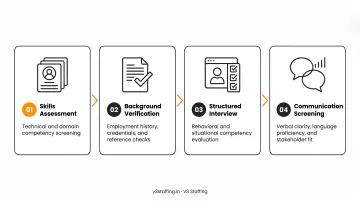
V3 Staffing uses a multi-layer evaluation model that combines technical tests, culture-fit screening, and reference validation. Pre-vetted shortlists arrive within 7–10 business days for most tech roles, with an average time-to-hire of 10 days and a 90% offer-to-join ratio.
The Compliance Layer US Companies Often Skip
India's employment compliance landscape isn't optional. Key requirements US companies frequently underestimate:
- Contract Labour (Regulation and Abolition) Act applies once you engage 20 or more contract workers — contractor classification without proper structure creates legal exposure
- Digital Personal Data Protection Act (DPDPA) 2023 creates obligations around data processing, breach notification, and safeguards — penalties for failure to implement reasonable security measures can reach 250 crore rupees
- Payroll compliance covers PF, ESIC, professional tax, TDS, and gratuity — each with its own filing and calculation requirements
For US companies without an Indian entity, the cleanest path is a compliant structure: a local employment entity, an Employer of Record (EOR), or a staffing partner who manages compliance entirely.
V3 Staffing's EOR service handles payroll, statutory filings, and labor law compliance directly — so US organizations can hire and manage Indian talent without setting up a local company.
Evaluating Communication Fit
Technical competence is necessary but not sufficient. For offshore roles, also assess:
- English proficiency — conversational fluency plus written clarity, especially for documentation-heavy roles
- Async communication comfort — can the candidate articulate thoughts clearly in writing without needing a call?
- Responsiveness during the interview process — how promptly and clearly they communicate through scheduling and follow-up is a reliable signal for how they'll behave on the job
Step 3: Onboard Your Offshore Team for Immediate Productivity
Onboarding Is an Operational Decision, Not an HR Formality
SHRM research shows new hires are 50% more productive when they go through standardized onboarding. For offshore hires, this effect is amplified — without structure, the time-zone gap means a confused hire can drift for weeks before anyone notices.
Pre-boarding (before Day 1) should include:
- A welcome message explaining communication norms and preferred tools
- A first-week task checklist so the hire knows exactly what to accomplish
- An org chart showing who they report to and how feedback flows
- Access credentials initiated in advance, not requested on Day 1
Day 1 Access and Process Alignment
Tool access failures are more damaging in offshore contexts because the time-zone gap turns a small delay into a half-day problem. Ensure offshore team members have working access to:
- Project management platforms (Jira, Asana, ClickUp)
- Communication tools (Slack, Teams)
- Documentation systems (Confluence, Notion)
- Any proprietary internal systems they'll need to contribute
Provide walkthroughs with a live person, not just login credentials and a user manual.
Assign an Onboarding Buddy for the First 30 Days
Live walkthroughs help on Day 1 — but the questions that slow people down tend to surface on Day 8 or Day 15. That's where a buddy earns its value.
Microsoft's research on onboarding found that more frequent buddy meetings correlated directly with stronger new-hire perceptions of speed to productivity. For offshore hires, a buddy — ideally someone on the India-side team — does three things no document can:
- Answers day-to-day questions before they become blockers
- Flags friction early, before it compounds across time zones
- Helps the new hire absorb unwritten norms and team culture
After 30 days, most hires no longer need the structure. The arrangement pays for itself in shortened ramp time and fewer costly misunderstandings early on.
Step 4: Establish Communication Rhythms Across Time Zones
The Real Problem Isn't the Time Gap
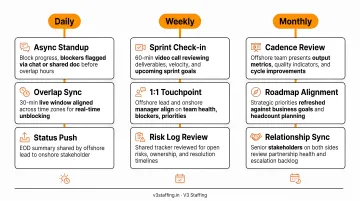
Time zone differences don't kill offshore teams. Poor communication habits do. The solution isn't more meetings. It's a deliberate cadence:
- Daily async standups via Slack or Loom — keeps everyone aligned without requiring real-time overlap
- Weekly live check-in via video — for relationship-building and anything requiring real-time judgment
- Monthly performance reviews — outcome-focused, not activity-focused
McKinsey research found that employees included in more detailed communication are nearly 5x more likely to report increased productivity. The lesson: document more, assume less.
Time Zone Etiquette
Putting that principle into practice starts with understanding the actual overlap window. India is roughly 9.5 hours ahead of US Eastern time during daylight saving, and 12.5 hours ahead of the West Coast. That means:
- There's a narrow natural overlap window — typically early morning US / late evening India for East Coast teams
- Neither side should always bear the scheduling burden; rotate early/late slots fairly
- Async tools (Loom for video updates, Slack for written context, shared docs for decisions) should carry the majority of daily communication
Tools That Make It Work
| Purpose | Recommended Tools |
|---|---|
| Task visibility | Jira, Asana, ClickUp |
| Async updates | Loom, Slack |
| Documentation | Confluence, Notion |
| Live collaboration | Zoom, Teams |
A practical threshold: if a misunderstanding could cost a full day of rework, escalate to a live call. Everything else runs async.
Step 5: Manage Performance and Build Team Cohesion Virtually
Shift from Activity Tracking to Outcome Tracking
Monitoring hours or time-zone availability tells you almost nothing useful. What matters is whether the work gets done and whether the quality meets the bar.
Define performance around:
- Track sprint deliverables and project milestones weekly
- Measure monthly outcomes against broader business objectives
- Maintain shared dashboards that give both offshore and US teams real-time visibility
SHRM's hybrid work guidance puts it clearly: role-specific, outcome-focused goals drive sustained performance in distributed teams — not hours logged or tasks checked off.
Fix the System Before Replacing the Person
The most common management mistake with offshore teams: replacing people instead of diagnosing why performance is off. Before attributing underperformance to a bad hire, ask:
- Are SOPs documented and current?
- Is the US-side counterpart providing consistent direction?
- Does the offshore hire have the tools and context they need?
- Has feedback been timely and specific?
Often the answer reveals a system problem, not a talent problem. Fixing that system also lays the foundation for something harder to rebuild once it breaks: team cohesion.
Virtual Cohesion as a Retention Lever
Gallup and Workhuman's 2024 research found that well-recognized employees were 45% less likely to have turned over after two years. Recognition doesn't require elaborate programs — small, consistent gestures move the needle:
- Brief weekly shout-outs in Slack for work well done
- Inclusive rituals that span both US and India teams (shared retrospectives, virtual team events)
- Onboarding buddies for newer offshore members to build belonging early
- Career path conversations, not just performance reviews
When offshore employees feel seen and connected to the broader team, they stay. When they don't, no compensation adjustment will hold them for long.
Frequently Asked Questions
What is the difference between a virtual offshore team and staff augmentation?
A dedicated offshore team works exclusively on your priorities, builds institutional knowledge over time, and operates as an integrated extension of your internal team. Staff augmentation fills short-term skill gaps with contractors who plug into existing projects — useful for sprints, but not designed for sustained capability building.
How long does it take to build and onboard a virtual offshore team?
With a strong talent partner, sourcing typically takes 2–4 weeks from role definition to vetted shortlist. V3 Staffing averages a 10-day time-to-hire. Structured onboarding adds 1–2 weeks to reach full contribution. Pre-boarding and pre-vetting compress overall ramp time considerably.
How do you manage time zone differences with a virtual offshore team in India?
Use an async-first approach: daily Slack or Loom standups, one live weekly video check-in, and documented decisions in shared workspaces. Rotate meeting times so neither team always bears the scheduling burden. Reserve live overlap for high-judgment work.
What are the most common mistakes companies make when building offshore teams?
Vague job definitions, skipping structured onboarding, measuring hours instead of outcomes, and ignoring India's compliance requirements — these four issues account for the majority of offshore team failures. Each one is avoidable with deliberate planning before the first hire.
What roles can be effectively filled by a virtual offshore team in India?
Technology roles — software engineers, QA, DevOps, data engineers, AI/ML specialists — are the strongest fit. Finance shared services, operations, product management support, analytics, and GCC leadership functions also draw from deep, well-established talent pools across India.
How do you maintain team culture and engagement with a virtual offshore team?
Consistent small interactions matter more than one-off events. Regular async check-ins, outcome-based recognition, and onboarding buddies for new members create continuity. Inclusive rituals that span both teams build the belonging that keeps distributed teams stable long-term.