Introduction
EOR (Employer of Record) is the smart first move for global expansion into India — it's fast, compliant, and low-risk. Companies can test the market, hire their first teams, and validate offshore operations without the overhead of entity setup. But EOR was never designed to scale indefinitely. The question isn't whether to transition to a GCC (Global Capability Centre), but when.
Misjudging this timing carries steep costs. Companies that move too early face legal and operational chaos: standing up a legal entity before validating headcount need or securing local leadership creates governance burden without the benefits. Those that stay too long on EOR pay a compounding premium in fees, lose ground on IP control, and watch senior talent hesitate to join.
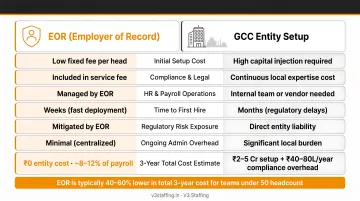
According to industry cost comparisons, EOR fees can reach $5,000–$12,500 per month for a 25-person team, while entity operating costs run $25,000–$40,000 annually.
This guide covers the key inflection points, cost thresholds, and operational signals that tell leaders it's time to make the shift.
Key Takeaways
- EOR works well for market validation but becomes a cost and control liability beyond 15–20 employees
- Transition timing hinges on team size, cost trajectory, IP risk, strategic intent, and leadership readiness together
- Clear signals include recurring EOR fee strain, culture gaps, IP governance pressure, and senior talent hesitation
- Move too early and you create avoidable disruption; wait too long and you overpay for a model that no longer fits
- Best practice: plan the GCC transition 9–12 months in advance while still operating on EOR
Why the Timing of This Transition Matters
EOR and GCC are not competing models — they serve different stages of maturity. Treating EOR as a permanent solution rather than a launchpad is one of the costliest expansion mistakes companies make.
The Compounding Cost Problem
EOR fees are ongoing operating expenses with no residual value. Depending on the provider and model, costs add up faster than most finance teams anticipate:
- Global providers (Deel, Remote, Papaya Global): $500–$700/employee/month flat fee
- India-specialist providers: $200–$400/employee/month flat fee
- Percentage-of-payroll models: 8%–15% of gross payroll, plus a 2%–4% FX spread on every payroll run
At 10 employees with an average salary of $40,000, the modeled 3-year total cost for EOR is approximately $420,000 versus $195,000–$255,000 for an owned entity (including setup and overhead). GCC setup costs — entity registration, workspace, HR infrastructure, leadership hiring — are capital expenditures that build long-term assets. The longer companies delay, the more they pay without accumulating any of that equity.
Strategic Risk Beyond Cost
Operating core engineering or product teams on EOR indefinitely creates IP ambiguity, limits employer branding, and makes it harder to attract senior local leadership.
India now hosts approximately 53% of the world's GCCs, with over 1,700 centres employing 1.9 million professionals and generating $64.6 billion in revenue as of FY2024. Companies that remain on EOR while competitors build GCCs lose ground in India's talent market — where professionals increasingly prioritize career pathways and global mandates over compensation alone.
When EOR Works — and When It Starts to Strain
EOR is the right model when you need to hire a small team quickly, test a new market, or build initial proof-of-concept. The model is purpose-built for speed, compliance, and minimal upfront investment.
But as teams grow, the EOR structure starts to strain.
Team Size and the Cost Crossover
The financial inflection point hits around 15–20 employees, where recurring EOR management fees start to outweigh the cost of standing up a legal entity. At 25 employees, EOR fees alone reach $5,000–$12,500 per month ($60,000–$150,000 annually), while entity operating costs (excluding salaries) run $25,000–$40,000 per year.
The per-head fee model means EOR costs scale linearly with headcount. GCC operational costs, by contrast, flatten after setup.
Entity incorporation runs $8,000–$25,000 one-time, with annual recurring costs of $25,000–$80,000 for accounting, statutory filings, payroll administration, and company secretary services. The financial crossover typically occurs between month 18 and month 24 of entity operation.
On top of management fees, Indian statutory employer costs include Provident Fund contribution at 12% of salary, gratuity at 15 days' wages per year (calculated after 5 years), and ESI at 3.25% for eligible low earners — costs that apply under both EOR and GCC models but become more transparent and manageable under direct employment.
Operational Control and IP Risk
As teams grow from a small pod to cross-functional groups doing core engineering, product, or R&D work, the EOR's arm's-length employment structure creates real problems:
- Performance accountability becomes murky when you don't legally employ the team
- IP ownership defaults to the legal employer — in EOR structures, that's the EOR entity, not you. Without specific assignment clauses, the Indian Copyright Act, 1957 creates a "chain of title" risk for software and other copyrightable work
- Patent rights are even more exposed: the Indian Patents Act, 1970 has no default employer provision, meaning the employee-inventor owns patent rights without a written contract
Compliance frameworks compound this further. SOC2 audits, customer data processing agreements, and India's Digital Personal Data Protection (DPDP) Act, 2023 all surface gaps in EOR structures — auditors frequently flag unclear data-processing responsibilities and access control ambiguities that direct employment would resolve.
Strategic Commitment to India
If India is confirmed as a long-term growth market — not just a trial — then EOR's value as a "testing ground" has served its purpose. Continuing on EOR signals organizational indecision to local talent and partners.
The typical transition trigger appears after 6–12 months of validating talent delivery quality, when the company confirms a 3–5 year strategic commitment to India as a permanent hub.
Leadership and Governance Readiness
Transitioning to a GCC requires local leadership (a Site Head or India GM), HR/finance functions, and governance infrastructure. The right time to transition is when the company is prepared to invest in this — not when it's rushed by cost pressure alone. Global leadership roles based in Indian GCCs have grown at a 40% CAGR over the last five years, projected to exceed 30,000 roles by 2030.
Clear Signals It's Time to Move to a GCC Model
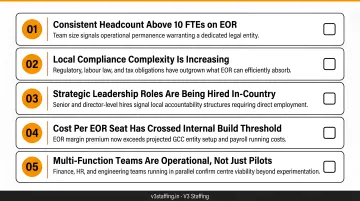
Not every signal needs to be present, but clusters of these indicators are a strong prompt to begin the transition planning process.
Signal 1 — EOR fee burden: The monthly EOR cost has become a recurring boardroom conversation. Finance leadership is questioning the ROI of per-head fees at current headcount, and the numbers favor entity setup.
Signal 2 — Talent attraction friction: Senior engineers, product leads, and data scientists in India are declining offers or asking pointed questions about employment structure, growth trajectory, and career clarity. EOR employment signals impermanence to high-caliber candidates — professionals at this level consistently prioritize direct employment with clear career pathways and global mandates.
Signal 3 — Culture and performance gaps: The offshore team operates in a cultural and operational no-man's-land — they follow HQ directives but don't feel owned by the brand. Performance management, career development, and recognition frameworks are inconsistent because the EOR intermediary creates structural distance.
Signal 4 — IP and compliance pressure: Legal, security, or enterprise customers are raising questions about who legally employs the team that has access to proprietary systems or customer data. IP ownership on work products created under EOR is increasingly unclear, surfacing as risk during M&A due diligence, funding rounds, or IP licensing.
Signal 5 — The talent acquisition challenge at scale: When you need to hire 20, 30, or 50+ people for a GCC buildout, an EOR partner's hiring capabilities rarely scale at the speed or quality required. A specialist GCC talent partner like V3 Staffing bridges that gap — with pre-vetted pipelines across Bengaluru, Hyderabad, Pune, Chennai, and other major hubs, delivering SLA-driven shortlists within 8-10 business days and structured onboarding so teams are productive from day one.
When You Should NOT Make the Switch Yet
Premature GCC setup is a real risk that creates entity overhead without the benefits.
Hold off on transitioning if any of the following apply:
- Headcount is still small: Fewer than 15 employees in India, or you're still evaluating whether offshore operations add real value. EOR setup costs are recoverable; premature entity setup is not.
- No local leadership confirmed: Registering a legal entity without a committed Site Head or India country manager is a governance gap waiting to happen. Companies that rush this step often end up with a GCC in name only — the same visibility and control issues as before, now with added entity cost.
- Internal teams are already stretched: GCC setup demands sustained involvement from HR, legal, finance, and senior leadership. If that bandwidth doesn't exist, the transition produces compliance gaps, hiring delays, and a poor employee experience — outcomes that erase the cost savings you were chasing.
What Happens If You Transition at the Wrong Time
Too Early — Premature Transition Costs
Companies that set up a GCC before validating headcount need or market commitment absorb high entity maintenance costs — accounting, compliance, HR infrastructure — across a small team. This wipes out the cost savings the GCC was meant to provide. Without the economies of scale to justify it, the governance burden compounds the problem.
Too Late — Compounding EOR Penalties
Companies that stay on EOR past the 25–30+ employee mark continue paying a premium that could have funded GCC infrastructure. More critically:
- EOR employees increasingly feel like contract workers — not company employees — driving higher attrition
- Chain of title issues surface during due diligence, putting IP ownership in legal dispute
- Competitors already running GCCs build stronger employer brands and local talent pipelines
GCC attrition dropped from 13% in 2023 to 9% by 2025 among GCCs that invested in career architecture, while contractors experience high attrition due to short-term engagements and limited growth opportunities.
Cultural and Operational Consequences
Teams that operate under EOR for too long develop patterns — reporting structures, engagement norms, performance frameworks — that are misaligned with what the company actually wants from a GCC. Unwinding these entrenched patterns during a late-stage transition is harder and more disruptive than building them correctly from the start.
Best Practices for Planning the EOR-to-GCC Transition
Start Planning the Transition While Still on EOR
The best GCC transitions are not reactive — they begin 9–12 months before the intended go-live, with entity registration, office space decisions, and talent pipeline development running in parallel with ongoing EOR operations.
Run EOR and GCC Simultaneously During the Transition Window
Employees currently on EOR can be transferred to the new legal entity in a phased way, maintaining compliance continuity. This avoids employment gaps, visa complications for foreign nationals, and payroll disruptions.
The full transition — including entity registration, office setup, talent transfer, and operational handover — typically takes 6–12 months, though accelerated models can compress this to 10–14 weeks with expert support.
Prioritize Local Leadership Hiring First
The GCC Site Head or India GM should be hired before the entity is fully operational. This person will anchor the culture, drive the talent buildout, and serve as the organizational bridge between HQ and the India team.
Build the Talent Pipeline in Advance of the Transition
Transitioning to a GCC often coincides with an acceleration in hiring. Companies that wait until the entity is live to start recruiting experience a lag that sets back their timeline by months.
To avoid that lag, leading GCC teams typically start recruitment in parallel with entity registration. That means:
- Identifying priority roles and leveling frameworks before go-live
- Pre-qualifying candidates through a staffing partner during the EOR phase
- Aligning offer timelines so new hires can onboard within weeks of entity activation
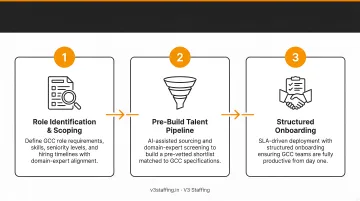
V3 Staffing's SLA-driven recruitment model supports this approach — with structured vetting, rapid deployment, and coverage across Bengaluru, Hyderabad, Pune, Chennai, Delhi NCR, and Mumbai, plus an extended network in Tier-II cities where talent retention tends to be stronger. For GCC teams building on tight timelines, that depth of hiring infrastructure makes a measurable difference.
Frequently Asked Questions
What is the difference between GCC and EOR?
An EOR is a third-party entity that legally employs workers on behalf of a company without requiring the company to set up a local entity. A GCC is a company's own offshore subsidiary or captive centre where it directly employs, manages, and owns all operations. In practice, the EOR serves market entry; the GCC serves long-term strategic ownership.
How many employees do you need before setting up a GCC in India?
The financial and operational inflection point is generally around 15–20 employees, though there's no hard universal rule. At this point, recurring EOR fees begin to outweigh GCC setup and maintenance costs, and governance needs become complex enough to warrant direct ownership.
How long does the EOR-to-GCC transition typically take?
The full transition — including entity registration, office setup, talent transfer, and operational handover — typically takes 6–12 months. Most companies start planning the GCC while still running under the EOR model to avoid disruption.
Can you run EOR and GCC simultaneously during the transition?
Yes, and it's the recommended approach. Existing EOR employees are transferred to the GCC entity in a phased manner, ensuring compliance continuity and avoiding employment or payroll gaps during the cutover period.
What happens to employees on EOR when you set up a GCC?
Employees are typically transferred from the EOR's legal employment to the new GCC entity through a structured process involving new employment contracts, payroll migration, and benefits realignment. In India, this process must comply with applicable labour law requirements — it's straightforward when planned at least 3–4 months ahead of the entity go-live date.
What are the upfront costs of setting up a GCC in India?
GCC setup costs vary significantly based on city, office size, and team configuration, but include entity registration fees ($8,000–$25,000), workspace, HR and compliance infrastructure, and leadership hiring. Indian state governments often provide incentives such as capital subsidies (15%–30% depending on state and location), employment stipend reimbursements, and patent support that partially offset setup investment. Karnataka, Telangana, Tamil Nadu, Maharashtra, and Gujarat each run structured GCC incentive programs — reviewing state-specific eligibility early in planning can meaningfully reduce Year 1 costs.