This guide walks through the global workforce management strategies and HR solutions that enterprises actually need: coordinated systems for hiring, compliance automation, payroll processing, and structured onboarding—all designed to scale across geographies without the administrative chaos.
Key Takeaways
- Global workforce management coordinates hiring, compliance, payroll, and performance across multiple countries and locations simultaneously
- HR solutions include staffing partners for speed and reach, HCM software for automation, and blended models combining both
- India's new Labour Codes (effective 21 November 2025) mandate appointment letters, cut gratuity eligibility to 1 year, and add gig worker obligations — audit your policies now
- Platform choice depends on scale and geography: India-built systems (Darwinbox, Keka, greytHR) excel at state-level compliance; global platforms (SAP, Oracle, Workday) offer multi-country integration
What Is Global Workforce Management?
Global workforce management is the process of strategically planning, deploying, tracking, and optimizing a company's workforce across multiple locations, business units, or geographies. It covers both permanent employees and contingent workers—treating talent as a coordinated resource rather than isolated headcount.
Traditional HR management focuses on individual employee administration: onboarding one hire, processing one payroll cycle, managing one performance review. Global workforce management operates at a macro level—aligning talent supply with business demand, coordinating capacity across locations, and adapting to regulatory requirements that vary city by city.
The scope includes:
- Talent acquisition and structured onboarding
- Time, attendance, and multi-location payroll
- Workforce planning and headcount forecasting
- Performance management and retention strategies
- Compliance and regulatory adherence across geographies
- Offboarding and lifecycle management
Why This Matters for India's GCCs and Large Enterprises
As of FY2024, India hosts over 1,800 GCCs employing 1.9 million professionals and generating $64.6 billion in annual revenue. By 2030, this ecosystem is projected to reach 2,100–2,200 centers absorbing 2.5–2.8 million workers. These centers operate across cities with distinct talent dynamics:
| City | GCC Talent Share | Notable Characteristic |
|---|---|---|
| Bengaluru | ~36% | 880+ individual GCC units; leading hub |
| Hyderabad | ~14% | Fastest-growing Tier-1 city year-on-year |
| Delhi NCR | ~13% | Engineering and R&D focus |
| Pune | ~12% | Strong in BFSI and automotive |
| Chennai | ~9% | Lowest attrition rate |
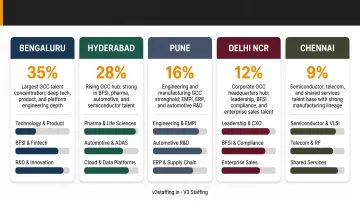
Each location has different labor laws, talent availability, cost structures, and compliance timelines. A GCC scaling across these cities cannot run five independent HR operations. Unified workforce management is what allows local compliance to coexist with consistent global reporting.
Contingent vs. Permanent Workforce Management
Many large organizations run a blended workforce: full-time employees for core functions alongside contract or temporary staff for project work, seasonal demand, or niche expertise. Managing both categories effectively means keeping them operationally distinct while ensuring they work together for planning and compliance purposes:
- Permanent staff require structured benefits, statutory compliance (PF, ESI, gratuity), and performance frameworks tied to long-term retention
- Contract/contingent workers need rapid onboarding, project-scoped agreements, and compliance under applicable labour contract regulations
- Both categories must feed into a single headcount view for accurate forecasting and audit readiness
Core Components of Global Workforce Management
Workforce Planning and Forecasting
Effective global workforce management starts before the first job posting: anticipating talent needs, mapping skill gaps, and aligning hiring timelines with business milestones. Organizations that skip this step operate reactively—posting roles when projects are already delayed, which drives up costs and extends delivery timelines.
Key planning activities include:
- Headcount planning aligned with quarterly business targets
- Skill gap analysis identifying capabilities the organization lacks
- Hiring timeline mapping to ensure roles are filled before project kick-off
- Cost modeling for permanent vs. contingent workforce mix
Companies operating without forecasting face unplanned recruitment surges, higher per-hire costs, and misalignment between talent availability and project start dates.
Talent Acquisition and Onboarding at Scale
Enterprise hiring isn't about filling one role—it's about filling 50, 100, or 500 roles while maintaining consistent quality and predictable timelines. SLA-driven processes ensure each stage (sourcing, screening, shortlisting, offer rollout, onboarding) happens on schedule, because delays at any point disrupt business continuity.
Structured onboarding ensures new hires contribute from day one, not weeks later. This includes:
- Pre-boarding documentation and system access setup
- Role-specific training and workflow orientation
- Manager alignment on expectations and deliverables
- First-week check-ins to address blockers early
For contract and temporary roles, the same discipline applies: pre-verified talent with structured 48-72 hour onboarding eliminates the multi-week ramp-up that typically stalls project timelines.
Compliance and Regulatory Management
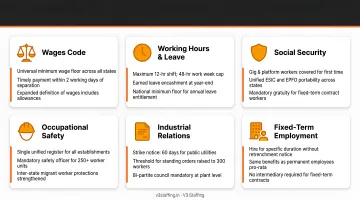
Managing labor law compliance across Indian states is one of the most complex pillars of global workforce management. India's new Labour Codes, effective 21 November 2025, replace 29 existing laws with four unified codes, introducing:
- Mandatory appointment letters for all workers
- Gratuity eligibility reduced to 1 year for fixed-term and contract employees
- ESI wage threshold of ₹21,000/month
- Gig worker social security: aggregators must contribute 1-2% of annual turnover
- IT/ITES salary timelines: wages due by the 7th of every month
Beyond central statutes (EPF, ESI, TDS), state-level regulations vary significantly:
Professional Tax filing cycles:
- Maharashtra: Monthly, by last day of month
- Karnataka: Monthly, by 20th of following month
- Telangana: Monthly, by 10th of following month
- Tamil Nadu: Half-yearly, within 15 days of period end
Labour Welfare Fund rates:
- Maharashtra: Employee ₹25, Employer ₹75
- Karnataka: Employee ₹50, Employer ₹100
- Tamil Nadu: Employee ₹20, Employer ₹40
A multi-state business operating across five locations typically manages 40-60 annual compliance entries. One IT company with 80 employees incurred ₹4.9 lakh in arrears and penalties due to missed state-specific compliance updates.
Time, Attendance, and Payroll Management
Accurate payroll processing tied to attendance data across multiple locations requires either integrated HR technology or a reliable managed service. Challenges include:
- Handling variable pay, incentives, and statutory deductions
- Processing multi-state payroll with different Professional Tax and LWF rates
- Managing minimum wage revisions (Maharashtra and Telangana update twice yearly; Karnataka and Tamil Nadu update annually)
- Ensuring timely statutory remittances (EPF by 15th, ESI half-yearly)
Manual payroll processing across even three states creates enough variability that a single missed revision—such as a mid-year minimum wage update—can trigger back-pay liability across hundreds of employees.
Performance and Retention Management
Retention is where workforce management either compounds its earlier investments or erodes them. In competitive markets like Bengaluru and Hyderabad, where GCCs pay 1.5x to 2.5x higher packages for specialized roles, annual appraisals alone won't hold top performers.
Effective retention frameworks include:
- Quarterly performance reviews with clear growth paths
- Learning and development investments aligned with career goals
- Employee engagement initiatives addressing burnout and recognition
- Predictive attrition analytics identifying flight risks early
Chennai reports the lowest attrition rate among Tier-1 GCC cities—highlighting that location-specific retention strategies matter as much as compensation.
Common HR Challenges in Managing a Global Workforce
Talent Scarcity and Time-to-Hire Pressure
Sourcing niche skills across multiple cities simultaneously is increasingly competitive. The numbers make the problem concrete:
- Average time-to-hire in India runs ~39 days, yet top tech talent stays available for only 10
- GCCs face up to a 42% shortage in advanced skills like AI and data engineering
- Multiple organizations are chasing the same shrinking candidate pool across the same cities
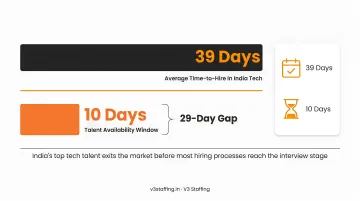
Long hiring cycles directly impact project delivery. If a critical cloud engineer role takes 60 days to fill, a product launch scheduled for Q2 slips to Q3. For GCCs scaling across Hyderabad, Bengaluru, and Pune simultaneously, staggered hires disrupt team formation and delay go-live dates.
Multi-Location Compliance Complexity
Operating across Maharashtra, Karnataka, Telangana, Tamil Nadu, and Delhi NCR means navigating different labor regulations, licensing requirements, and statutory deadlines—each with distinct rates and revision cycles.
Consider Professional Tax: 18 states levy PT, but Delhi, Haryana, and Uttar Pradesh don't. Odisha abolished PT effective 1 April 2026. Maharashtra caps PT at ₹2,500 annually, while Karnataka caps at ₹2,496. Filing is monthly in some states, half-yearly in others.
A single missed deadline can trigger audits, penalties, and reputational risk. One logistics company was ordered to pay ₹1.8 lakh in compensation for terminating a driver without a written appointment letter—a requirement now mandatory under the new Industrial Relations Code.
Managing a Blended Workforce
Permanent employees and contract workers operate under different legal frameworks, benefits structures, and performance models. Yet workforce planning must integrate both categories to forecast costs, manage capacity, and track compliance.
Challenges include:
- Different policy frameworks (leave, benefits, exit terms)
- Separate legal categorization under labour laws
- Distinct performance management systems
- Coordinating headcount reporting across permanent and contingent staff
Without a unified system, misclassification risk rises — and so does exposure to audits and statutory penalties.
Inconsistent Hiring Outcomes Across Locations
Decentralized hiring across multiple offices often creates inconsistencies in candidate quality, vetting standards, and offer-to-join ratios. In Bengaluru, a candidate for the same role might go through three rounds of technical screening; in Pune, only two. That variation leads to quality drift — and unpredictable hiring outcomes across sites.
Standardizing the hiring process — through a consistent framework or a single partner managing all locations — is the most direct way GCCs close that gap.
Types of HR Solutions for Global Workforce Management
Internal HR Teams
An in-house HR department works best for organizations with stable, predictable headcount. Internal teams understand company culture deeply and can build long-term employee relationships.
Limitations:
- High overhead (salaries, tools, infrastructure)
- Limited reach into niche talent pools outside primary cities
- Slow scale-up capability during hiring surges
- Difficult to maintain multi-state compliance expertise in-house
Staffing and Talent Solutions Partners
For organizations needing to hire fast, manage contingent workforces, or access talent across multiple cities, specialized staffing partners provide the speed and reach internal teams cannot.
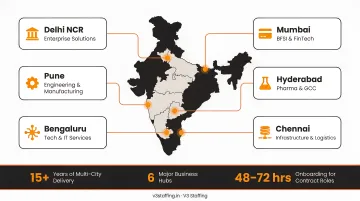
V3 Staffing, for example, provides enterprise clients with:
- Pre-vetted candidates for permanent roles delivered within 7-10 business days, with SLA-driven shortlists at 80%+ accuracy
- 48-72 hour onboarding for temporary roles, so project teams scale without multi-week delays
- Geographic coverage across Hyderabad, Bengaluru, Chennai, Pune, Delhi NCR, Mumbai, and Tier-II city networks
- End-to-end compliance management covering PF, ESI, Professional Tax, Labour Welfare Fund, and multi-state contract labor regulations
HCM Software and Technology Platforms
Human Capital Management (HCM) platforms automate and centralize workforce data, payroll, benefits, and performance tracking. The India HCM market was valued at $1,732.5 million in 2024 and is projected to reach $4,213.4 million by 2035.
Organizations should invest in HCM platforms when:
- Workforce exceeds 500 employees across multiple locations
- Payroll complexity requires multi-state statutory automation
- Leadership needs real-time workforce analytics and dashboards
- Integration with ERP, ATS, and finance systems is required
Smaller organizations with simpler compliance needs will often find outsourcing more cost-effective than implementing enterprise HCM software.
Key Features to Look for in HR Workforce Management Software
Core HR and Payroll Automation
Enterprise-grade global workforce management software must handle:
- Multi-location payroll processing with state-specific Professional Tax, LWF, and minimum wage rates
- Statutory compliance automation for EPF, ESI, TDS, gratuity, and maternity benefits
- Employee data management with role-based access and audit trails
- Integration with attendance systems for accurate payroll calculation
When comparing platforms, evaluate:
- Pre-built compliance engines vs. manual configuration requirements
- Frequency of regulatory updates (critical given state-level revision cycles)
- Support for fixed-term employees, contract workers, and gig workers under the new Labour Codes
Workforce Analytics and Reporting
70% of company executives cite people analytics as a top priority, and organizations with dedicated data-engineering resources report recruitment efficiency gains up to 80% and attrition reductions up to 50%.
Critical analytics capabilities include:
- Headcount tracking by location, department, and workforce type
- Attrition prediction models identifying flight risks
- Hiring funnel visibility (applications, screens, offers, joins)
- Cost-per-hire and time-to-fill metrics by role and geography
Platforms like Oracle HCM Analytics, SAP SuccessFactors Workforce Analytics, and Workday People Analytics provide enterprise-scale reporting, while India-built platforms like Darwinbox offer pre-configured dashboards aligned with Indian workforce structures.
Integration and Scalability
Analytics only deliver value when the underlying data flows cleanly across systems. HCM software must integrate with existing tools:
- Applicant Tracking Systems (ATS) to maintain uninterrupted candidate data from sourcing through to hire
- ERP systems for finance and cost-center alignment
- Time-tracking tools for attendance and shift management
- Learning Management Systems (LMS) for development programs
Scalability matters most when organizations expand into new geographies or business units. GCCs adding Tier-II city operations or launching new capability centers need platforms that can absorb that growth without requiring a re-implementation.
India-Built vs. Global Platforms
India-built platforms (Darwinbox, Keka, greytHR) offer:
- Pre-built EPF/ESI/PT/LWF/Gratuity automation
- State-level policy management aligned with Indian labor laws
- CTC structure handling specific to Indian compensation models
- Frequent updates matching state-specific minimum wage and PT revision cycles
Global platforms (SAP SuccessFactors, Oracle HCM Cloud, Workday) provide:
- Multi-country payroll processing for organizations with global operations
- Enterprise-scale ERP integration across HR and finance
- Broader talent management suites (learning, succession, performance)
- Typically require India-specific localization modules for full statutory compliance
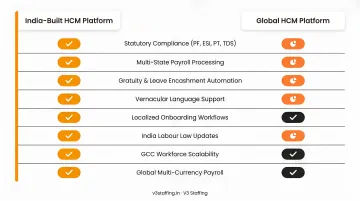
The clearest decision trigger: once your payroll spans more than one country, a global platform becomes necessary. For India-only operations, local platforms typically get you to compliance faster and at lower total cost of ownership.
How to Choose the Right HR Solutions Partner
Define Your Workforce Model First
Clarify whether your primary need is permanent hiring, contingent workforce management, or a blended approach. A technology company scaling its GCC in Pune has different requirements than a manufacturing firm managing contract workers across multiple sites.
Questions to answer:
- What percentage of your workforce is permanent vs. contingent?
- Do you need rapid hiring (weeks) or strategic pipeline building (months)?
- Are you scaling one location or launching multiple sites simultaneously?
- Do you require compliance management across multiple states?
Evaluate Track Record, Compliance Expertise, and Geographic Reach
Once you've mapped your workforce model, evaluate whether a prospective partner can actually deliver in your specific cities and talent segments — with verifiable compliance credentials to back it up.
For large enterprises and GCCs across India, V3 Staffing's 15+ years of experience covers high-volume, multi-location hiring. One example: supporting a global Fortune 500 HVAC company's 2,000-role finance shared services build across multiple Indian cities. SLA-driven processes, city-specific sourcing strategies, and end-to-end compliance ownership across PF, ESI, PT, and contract labor regulations give enterprises the consistency they need at scale.
Ask potential partners:
- What is your documented SLA timeline from briefing to shortlist?
- Can you provide case references for multi-city hiring engagements?
- What compliance credentials or statutory registrations do you hold?
- How do you ensure consistent quality across branch locations?
Assess Speed-to-Deploy and Onboarding Capability
Compliance credentials matter, but speed determines whether you win the talent you've shortlisted. How fast a partner deploys ready-to-join candidates — and how thoroughly they've been vetted — is often the deciding factor in a competitive market.
For temporary staffing, ask:
- What is your onboarding turnaround time for contract roles?
- What pre-verification steps (skills checks, background screening) do you complete before deployment?
- How do you handle compliance documentation and statutory filings?
For permanent hiring, ask:
- What is your average time-to-hire for niche technical roles?
- What percentage of shortlisted candidates reach offer stage?
- What is your offer-to-join conversion rate?
Before signing, ask for documented SLAs with specific turnaround benchmarks — for example, 48–72 hours for contract deployment or defined shortlist timelines for permanent roles. A partner who can't commit to numbers in writing is a partner who hasn't done this at scale.
Frequently Asked Questions
What is global workforce management?
Global workforce management is the process of strategically planning, deploying, and optimizing a company's workforce across multiple locations. It covers hiring, compliance, payroll, performance, and offboarding in a coordinated way—rather than managing each employee or location in isolation.
What does an HR Solutions Company do?
An HR solutions company helps organizations manage one or more aspects of their workforce—from talent acquisition and staffing to compliance management, payroll processing, and HR technology—either supplementing or replacing internal HR teams.
Which HRM software is widely used for global workforce management?
Commonly adopted platforms include SAP SuccessFactors, Oracle HCM Cloud, and Workday for global enterprises, while India-focused organizations often use Darwinbox, Keka, and greytHR. The right choice depends on organizational size, geography, and integration requirements.
Which HR software is best for global payroll?
ADP Global Payroll, Rippling, and Multiplier are the most widely adopted for multi-country payroll. For India-focused teams managing multiple states, the India-focused platforms noted above (Keka, greytHR, Darwinbox) are generally the stronger fit due to their built-in statutory compliance.
What is the difference between workforce management and human resource management?
HRM focuses on the full employee lifecycle including culture, benefits, and development. Workforce management is more operationally focused on scheduling, headcount planning, time tracking, and ensuring the right talent is in the right place at the right time.
How do companies manage compliance across multiple locations in India?
Most companies rely on a combination of dedicated compliance teams, compliance-enabled HCM software, and staffing partners with state-specific expertise. Key obligations covered include PF, ESI, Professional Tax, Labour Welfare Fund, and Shops and Establishments regulations, which vary by state.