

This guide covers every step: correct worker classification, compliant agreements, payment methods, tax obligations, and common mistakes. Whether you're a US-based company hiring Indian contractors remotely or an Indian enterprise scaling your workforce, you'll learn how to hire and pay contract workers in India compliantly and efficiently.
Key Takeaways
- Classification under the Contract Labour (Regulation and Abolition) Act 1970 determines tax treatment, benefits, and termination rights.
- Written contractor agreements prevent misclassification disputes, even where not legally required.
- Contractors manage their own taxes; you don't withhold payroll taxes the way you would for employees.
- Specify currency (INR vs. USD), payment method, and schedule in the contract before work begins.
- Contract-to-hire (C2H) models let you evaluate contractors for 3–12 months before converting to permanent roles.
How to Hire Contract Workers in India: A Step-by-Step Guide
Step 1: Classify the Worker Correctly
Worker classification is the single most critical compliance step. Indian law distinguishes between an employee (contract of service) and an independent contractor (contract for service). The difference determines tax obligations, benefits eligibility, and termination protections.
Employee (Contract of Service):
- Implies a "master and servant" relationship
- Employer controls what work is done and how it's performed
- Worker is integrated into the company's core operations
Independent Contractor (Contract for Service):
- Provides services using own professional judgment
- Not subject to detailed direction and control
- Exercises discretion over mode and manner of work
Indian courts apply two primary tests:
Control Test: Does the employer dictate not only the work output but the method and manner of execution? If yes, the worker is likely an employee. For example, if you require a software developer to work fixed office hours, use company equipment, and follow detailed daily instructions, you're exercising control that signals employment.
Integration Test: Is the worker fully embedded in your business or accessory to it? If the contractor performs core activities alongside permanent employees and is indistinguishable from your team, courts may reclassify them as an employee.
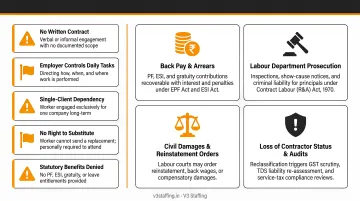
Red flags that trigger reclassification:
- Providing office equipment, company email, or workspace
- Enforcing fixed working hours or exclusive work arrangements
- Restricting the contractor from taking other clients
- Paying monthly "salary" instead of project-based invoices
Consequences of misclassification include back payment of gratuity, paid leave, statutory bonus, Provident Fund (PF) and Employee State Insurance (ESI) contributions, and exposure to penalties under the Industrial Disputes Act.
Step 2: Source and Screen Candidates
The right sourcing channel depends on the role, timeline, and compliance requirements you're working with.
Where to find contractors:
- Professional job boards: Naukri, LinkedIn, and Indeed India attract skilled professionals across IT, engineering, finance, and HR functions
- Freelance platforms: Upwork, Toptal, and Turing specialize in gig and project-based roles
- Staffing partners: Agencies with pre-verified talent pools reduce time-to-hire and compliance risk
What a strong contract job description includes:
- Defined scope of work and deliverables
- Contract duration (3 months, 6 months, 12 months)
- Required skills, certifications, and experience
- Clear contractor status (not employee)
- Payment terms: hourly rate, project fee, or milestone-based
For urgent requirements, staffing partners like V3 Staffing can deliver SLA-driven shortlists with pre-vetted candidates across Bengaluru, Hyderabad, Pune, Chennai, Mumbai, and Delhi NCR — with onboarding achievable in 48–72 hours.
Step 3: Draft a Compliant Contractor Agreement
Even though written contracts are not legally mandatory in most Indian states, they're strongly advisable to establish clear terms and protect both parties.
Essential clauses every contractor agreement should include:
- Scope of work with specific deliverables, milestones, and timelines
- Payment terms: rate, currency (INR or USD), and schedule (monthly, milestone-based, or on completion)
- IP ownership: explicitly state who owns the work product
- Confidentiality obligations covering proprietary information and trade secrets
- Termination conditions: notice period, early exit triggers, and final payment terms
Important legal caveat: Indian labor law supersedes contract provisions. Non-compete clauses, for example, are generally unenforceable under Section 27 of the Indian Contract Act. While non-compete restrictions are valid during employment, they are void post-employment because the right to livelihood prevails. However, non-disclosure and non-solicitation clauses may still be enforced separately.
CLRA registration requirement: If you engage 20 or more contract workers on any day in the preceding 12 months, you must obtain a principal-employer registration certificate under the CLRA. However, the Occupational Safety, Health and Working Conditions (OSH) Code 2020, which became effective on 21 November 2025, raises this threshold to 50 workers. Verify current implementation status and state-specific rules, as some states may have different thresholds.
Step 4: Onboard the Contractor
Compliant onboarding sets the tone for the entire engagement. Here's what it involves:
Key onboarding steps:
- Collect PAN details for TDS deduction
- Execute the contractor agreement — ensure both parties retain signed copies
- Set expectations for deliverables, check-in frequency, and progress reporting
- Clarify invoice format, submission deadlines, and payment timelines upfront
Avoid these onboarding mistakes:
- Providing company equipment, email addresses, or office space — all signal an employment relationship (see Step 1 red flags)
- Requiring fixed office hours or exclusive availability
Contractors should ideally use their own tools, work on their own schedule, and retain independence. These operational boundaries are critical to maintaining contractor classification.
Step 5: Evaluate Performance and Decide on Conversion (C2H)
The contract-to-hire (C2H) model is increasingly popular in India, especially in GCCs and tech firms. It allows companies to evaluate contractors for a trial period—typically 3–12 months—before making a permanent offer.
How C2H works:
- Engage the contractor for a defined period
- Assess real-world performance, cultural fit, and reliability
- Decide whether to convert to permanent employment
What conversion involves:
- Transitioning the contractor onto company payroll
- Registering for statutory contributions (Provident Fund, ESI)
- Renegotiating compensation to include employee benefits (health insurance, paid leave, gratuity eligibility)
Benefits of C2H:
- Reduces hiring risk by allowing performance evaluation before long-term commitment
- Lowers initial costs (statutory benefits aren't owed during the contract phase)
- Provides flexibility to both employer and candidate
For example, a Bengaluru-based GCC might hire a cloud architect on a 6-month contract, evaluate their ability to lead infrastructure projects, and then offer a permanent role with full benefits if performance meets expectations.
Legal Requirements and Compliance Before You Begin
Before you engage a single contractor, verify which laws apply to your geography. India's compliance framework is layered: central legislation (the Labor Codes, CLRA, Industrial Disputes Act) sits alongside state-specific rules that vary significantly across locations.
The Contract Labour (Regulation and Abolition) Act, 1970
The CLRA is the primary legislation governing contract workers in India. It defines who qualifies as a contract laborer, sets employment conditions, and specifies when principal-employer registration is mandatory.
Key provisions:
- Section 12 requires contractors executing work through contract labour to obtain a license from the licensing officer
- Section 7 mandates that establishments employing contract labour register with the registering officer; operating without registration is prohibited
- Principal employers are liable for amenities and timely wages if the contractor defaults
OSH Code 2020 update: The OSH Code, effective 21 November 2025, replaces and expands CLRA provisions:
- Raises the contractor licensing threshold from 20 to 50 workers, with stricter misclassification penalties
- Establishments with 10 or more employees must still meet safety and welfare requirements regardless of the threshold
Tax Obligations: TDS and Income Tax
TDS (Tax Deducted at Source): Under certain conditions, companies must deduct TDS from contractor payments before remitting. The applicable section depends on the nature of services:
- Section 194C (contractors/sub-contractors): TDS rate is 1% for individuals/HUF and 2% for other entities. Thresholds: single payment exceeding ₹30,000 or aggregate annual payments exceeding ₹1,00,000
- Section 194J (professional/technical services): TDS at 10% for professional services and 2% for technical services
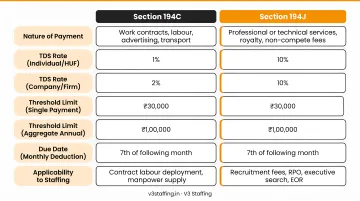
If the contractor doesn't provide a PAN, TDS is deducted at 20%. Contractors claim this deduction against their annual income tax liability.
Contractor tax filing: Indian contractors must file their own income tax returns annually by July 31 of the assessment year. Failure to file results in penalties. Ensure contractors understand this obligation as part of the engagement.
US-based companies paying Indian contractors:
- Require contractors to submit IRS Form W-8 BEN (certifying non-US taxpayer status)
- Payments for services performed entirely outside the US may not constitute US-source income, potentially eliminating Form 1042-S filing requirements. Confirm with US tax counsel
Termination Rules
Termination rights for contractors are generally governed by the contract terms, not statutory notice periods (unlike employees). However, for workmen-category contractors, the Industrial Disputes Act may require due process.
Industrial Disputes Act (1947):
- Defines "workman" as any person employed to do manual, skilled, technical, operational, clerical, or supervisory work (excludes managerial/administrative roles and supervisors earning over ₹10,000/month)
- Employers with 100 or more workmen must obtain government permission before retrenchment or closure (some states have raised this to 300 workmen)
- Contract workers on the premises count toward this headcount threshold
Misclassifying a contractor as a non-workman can expose you to retrenchment obligations and government approval requirements you never planned for. Get classification right before the engagement begins, not after.
How to Pay Contract Workers in India
Getting payment right matters as much as getting the contract right. Currency choice, platform fees, and applicable tax deductions all affect what the contractor actually receives — so clarity upfront prevents disputes later.
Payment Schedules and Structures
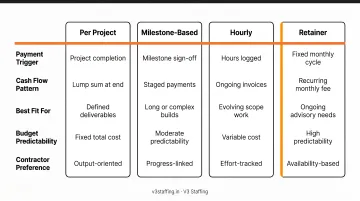
Unlike employees (who receive regular salary), contractors can be paid:
- Per project: Fixed fee for defined deliverables
- Milestone-based: Payments tied to completion of specific phases
- Hourly: Common for freelance or part-time engagements
- Retainer: Fixed monthly fee for ongoing availability
Indian contractors can receive up to 33% of the total project fee upfront as an advance—a common practice for longer engagements.
All terms should be codified in the contract, including invoice submission deadlines and payment timelines (for example, "within 15 days of invoice receipt").
Domestic Payment Methods (India-Based Employers)
NEFT (National Electronic Funds Transfer):
- Available 24x7x365
- No minimum or maximum limit set by RBI
- Settled in 48 half-hourly batches; beneficiary bank credits within 2 hours
- Free for online-initiated transfers from savings accounts
RTGS (Real Time Gross Settlement):
- Minimum ₹2,00,000; no maximum ceiling
- Available 24x7x365
- Real-time settlement; beneficiary bank credits within 30 minutes
- Outward charges capped at ₹24.50 (₹2–5 lakh) or ₹49.50 (above ₹5 lakh), plus GST
IMPS (Immediate Payment Service):
- Limit: ₹5,00,000 per day per account (individual banks may set lower sub-limits)
- Real-time settlement, available 24x7x365
GST invoice requirement: If the contractor is GST-registered (annual turnover exceeds ₹20 lakh, or ₹10 lakh in special category states), they must provide a GST invoice. Verify registration status before processing payment.
Cross-Border Payment Methods (International Employers)
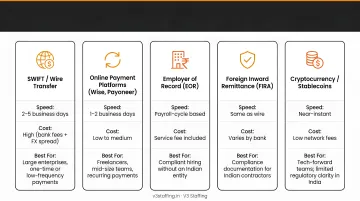
SWIFT Bank Transfers:
- All foreign inward remittances must go through an Authorized Dealer Category-I (AD Cat-I) bank licensed by RBI under FEMA
- Each transaction requires an RBI Purpose Code — for example, P0802 (software consultancy) or P0104 (general business services)
- Banks issue a FIRC (Foreign Inward Remittance Certificate) or FIRA as proof of receipt — both are required for tax compliance
- Fees vary by intermediary bank routing
For smaller or more frequent transfers, digital platforms offer a simpler alternative to SWIFT.
Digital Payment Platforms:
- Wise, PayPal, Remitly, OFX: Accessible for smaller transactions; watch for exchange rate markups
- Payoneer: Received in-principle RBI authorization as a Cross-Border Payment Aggregator in January 2026
- All compliant platforms route through AD-I banking channels and apply correct RBI purpose codes
Currency and conversion: Always specify payment currency (USD or INR) in the contract and clarify who bears currency conversion costs. Exchange rate fluctuations can materially affect contractor earnings, so transparency is critical.
Common Mistakes When Hiring Contract Workers in India
Misclassifying a contractor as an employee (or vice versa)
Misclassification carries the steepest penalties: regulatory fines, back payment of benefits, reputational damage, and—in the most serious cases—restrictions on operating in India. Apply control and integration tests before engagement begins, and preserve the contractor's operational independence throughout.
Using a generic or foreign-law contract
Indian labor law supersedes contract provisions. A US or UK law contract without India-specific clauses gives you limited legal protection and can trigger compliance issues. Always use an India-specific contractor agreement reviewed by local counsel.
Ignoring TDS obligations
Some companies assume contractors handle all taxes independently, but under certain payment scenarios, the company has a TDS deduction obligation. Failing to comply attracts penalties from Indian tax authorities. Verify applicable TDS sections (194C vs. 194J) and thresholds before processing payments.
Treating contractors like employees during the engagement
Certain behaviours signal an employment relationship and can trigger reclassification, regardless of what the contract says:
- Requiring exclusive availability or barring work with other clients
- Providing company equipment as the primary work tool
- Enforcing fixed office hours or attendance policies
Contractors should use their own tools, set their own schedules, and retain the freedom to take other engagements.
When Does Contract Hiring Make Sense in India?
Contract hiring is well-suited to specific organizational contexts.
It works well when:
- Scope and timeline are defined — a 6-month product launch or 12-month infrastructure migration
- Specialized skills (AI/ML, data analytics, cloud platforms) aren't available in-house
- Headcount needs to flex up during growth or down during uncertainty without long-term commitment
- You want to evaluate a candidate before making a permanent offer
Contract hiring is less appropriate when:
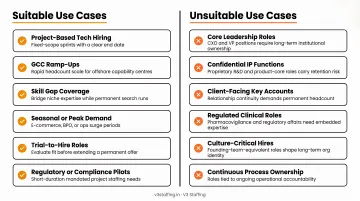
- The role involves core business functions — the CLRA restricts outsourcing these to contractors
- The position requires full embedding into the organization's structure
- Long-term continuity and institutional knowledge are critical to the function
These patterns align with where the market is heading. India's flexi staffing industry reached 7.2 million workers in FY25 and is projected to grow to 9.16 million by FY27, with strongest demand across IT, GCCs, consumer durables, e-commerce, and retail. Most IT/ITeS and GCC companies now offer 12- to 24-month contracts — a sign that contract staffing has moved from stopgap to strategic.
Frequently Asked Questions
How does a contract to hire work?
A contractor is engaged for a defined period (typically 3–12 months), often through a staffing firm, and then evaluated for conversion to a permanent role based on performance and organizational fit.
Is an employee contract legal in India?
Written contracts are not legally mandatory in most Indian states to establish a working relationship, but are strongly advisable. Indian labor law supersedes contract terms, so clauses must align with local legislation.
How to pay contractors in India from the USA?
Use SWIFT bank transfers, digital platforms like Wise or Payoneer, and specify whether payment is made in USD or INR. US companies must collect Form W-8 BEN from Indian contractors to certify non-US taxpayer status.
How to hire someone in India from the USA?
US companies can hire Indian contractors directly (without a local entity) by establishing a clear contract-for-service agreement, handling tax documentation, and using a compliant payment method. Alternatively, partnering with a staffing firm that has a local presence simplifies compliance and documentation significantly.
What does a 3-month contract to hire mean?
A 3-month C2H arrangement is a short-term contract period during which the candidate works on a trial basis before the company decides on a permanent offer.
What are the benefits of C2H?
C2H reduces hiring risk by allowing performance evaluation before any long-term commitment. It also lowers initial costs, since statutory benefits are not owed during the contract phase, and gives both the employer and candidate flexibility to assess fit.