Introduction
Companies scaling teams across India or hiring internationally often encounter two distinct EOR arrangements without fully understanding what separates them. Contingent EOR handles temporary, project-based, or contractor engagements. Global EOR manages full-time, permanent cross-border employment. Confusing the two leads to misaligned contracts, compliance gaps, and in some cases, significant legal exposure.
The stakes are real. According to Deloitte, contingent workers now make up 30–50% of the total workforce at many organizations — getting the classification right is a strategic priority, not just an administrative one.
Using the wrong EOR model can trigger misclassification penalties, create unnecessary overhead, or leave a growing team without the flexibility it needs at a critical moment.
This guide breaks down both models clearly: what each covers, where each fits, and how to choose—or combine—them based on your business situation.
Key Takeaways
- Contingent EOR = temporary or project-based workers; Global EOR = permanent, full-time cross-border employees
- Contingent EOR offers speed and flexibility; Global EOR provides statutory benefits coverage and legal permanence
- Compliance responsibility sits with the EOR provider under both models, but the type of risk managed differs
- GCCs and enterprises often run both models together: contingent for project ramp-ups, Global EOR for core permanent roles
- Misclassifying a permanent employee under a Contingent EOR structure is one of the most penalised workforce errors
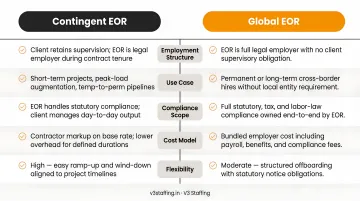
Contingent EOR vs. Global EOR: Quick Comparison
| Factor | Contingent EOR | Global EOR |
|---|---|---|
| Employment Type | Temporary, project-based, or contractor | Full-time, permanent employee |
| Engagement Duration | Short-term; defined end date | Long-term; open-ended |
| Cost Structure | Lower per-worker cost; minimal benefits obligations | Higher cost; full statutory benefits and entitlements |
| Workforce Flexibility | High—scale up or down rapidly | Lower—proper notice and termination procedures required |
| Compliance Scope | Contractor classification, short-term tax treatment | Full employment law: PF, gratuity, leave, termination rights |
What Is Contingent EOR?
A Contingent EOR model places a third-party provider in the legal employer role for temporary, project-based, or contractor workers. The EOR handles payroll, tax filings, and labour compliance. The client company retains day-to-day operational control over the work itself.
This differs from a standard staffing agency arrangement. A staffing agency sources and places talent, but the client often inherits employer liability. Under a Contingent EOR structure, the EOR provider carries full employer-of-record responsibility—reducing co-employment exposure for the client.
Why Speed Matters for Contingent Hiring
The primary advantage is speed. EOR providers can typically onboard a worker within two to three days, compared to the weeks or months required for traditional entity-based registration. For GCCs and product organisations that need to staff up quickly for a specific technology sprint or R&D project, that difference is meaningful.
V3 Staffing's contingent staffing model, for example, deploys pre-verified talent within 48–72 hours, maintaining 90% attendance and continuity rates across temporary engagements—without cutting corners on compliance or vetting.
Managing Worker Classification Risk
The Contingent EOR manages worker classification risk. Treating a contractor as an independent worker when they legally qualify as an employee creates direct liability — and enforcement is active.
The U.S. Department of Labor recovered $844,274 in back wages and liquidated damages for 158 misclassified workers in a single January 2025 enforcement action. In India, violations under the Contract Labour (Regulation and Abolition) Act carry penalties including imprisonment up to three months and fines for continuing contraventions.
Where Contingent EOR Fits
Common use cases include:
- Staffing eight contract engineers for a five-month AI deployment, then offboarding cleanly
- Scaling operations teams during peak cycles without adding permanent headcount
- Testing a new geography before committing to entity setup or permanent hires
- Bringing in niche specialists — VLSI designers, MLOps engineers, pharma regulatory consultants — for defined engagements
Industries where this model dominates include IT and technology, GCCs building temporary innovation pods, manufacturing firms covering production surges, and staffing agencies or MSPs placing contingent talent on client sites.
What Is Global EOR?
Global EOR goes further. Here, the EOR provider becomes the full legal employer of a permanent worker in another country—managing payroll, statutory benefits, tax contributions, and complete compliance with that country's employment law. The client company does not need to incorporate a local subsidiary or register a legal entity.
The Strategic Value
The speed difference versus entity setup is substantial. As a representative benchmark, setting up a UK entity typically takes one month and costs between $22,000 and $63,000 in one-off setup costs, according to Deel's 2026 benchmarks. With a Global EOR, the same hire can be onboarded in two days.
For companies entering India or any new market with fewer than 15–25 employees, Global EOR is typically more practical and cost-effective than entity setup.
That speed and cost advantage makes Global EOR the default market-entry approach for:
- Multinationals hiring their first 5–15 employees in India
- Remote-first organisations building distributed full-time teams
- U.S. or European companies permanently employing engineering or operations talent in Bengaluru, Hyderabad, or Pune
The Compliance Scope in India
India's permanent employment obligations are extensive, and they vary by state. A Global EOR manages all of the following:
- Employees' Provident Fund (EPF): Employee contribution of 12% (or 10% in applicable cases); employer contributes 8.33% to EPS and 0.5% to EDLI
- Gratuity: Payable after five years of continuous service at 15 days' wages per completed year; applies to establishments with 10 or more employees
- Statutory leave: Varies by state under respective Shops and Establishments Acts—covering privilege leave, sick leave, and casual leave
- TDS, ESIC, Professional Tax: Managed monthly with payslips and statutory filings
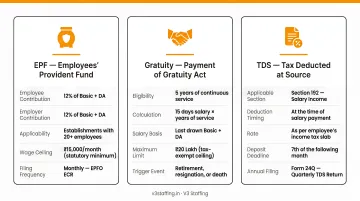
V3 Staffing's Global EOR service covers this full compliance stack—PF, ESIC, PT, TDS, gratuity, maternity benefits, and local labour law—across India's major business centres and into Tier-II cities.
When to Transition to Your Own Entity
Most financial leaders begin evaluating direct entity registration when headcount in a single country reaches 15–25 employees, according to Remote's 2026 guidance. Beyond that threshold, cumulative EOR fees typically exceed entity operating costs, and the volume of local operations justifies dedicated HR and legal infrastructure.
Which Model Fits Your Business?
The right choice comes down to four variables: the nature of the work, the intended duration, the benefits obligations you're prepared to carry, and your long-term market strategy.
Choose Contingent EOR When:
- The engagement has a defined end date or deliverable milestone
- You need to staff up within days, not weeks
- The work is project-driven—a feature launch, a regulatory audit, a seasonal ramp
- You want to pilot a market or role type before committing to permanent headcount
Choose Global EOR When:
- The role is core to ongoing operations (not tied to a specific project)
- The worker will be employed for more than 12 months
- Local law mandates permanent employment protections after a certain tenure
- The team will eventually transition to a wholly-owned subsidiary
The Hybrid Approach
Many large enterprises and GCCs run both models simultaneously. A pharma GCC might use Contingent EOR for six-month clinical data engineers while keeping its permanent regulatory and quality leadership under Global EOR. An automotive R&D centre might staff ADAS validation engineers on a project basis through Contingent EOR while hiring its India site head and core engineering managers as full-time Global EOR employees.
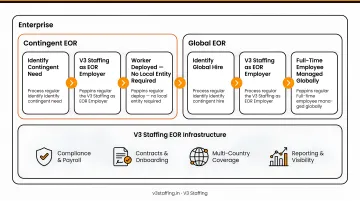
Running both models through a single EOR provider keeps compliance oversight unified and payroll administration clean—without the fragmentation that comes from managing two separate vendors. That consolidation also reduces the risk of misclassification slipping through the cracks.
The Misclassification Risk
One common and costly error: placing a permanent-role worker under a Contingent EOR structure to avoid benefit costs. If a worker is performing core, ongoing work and their engagement extends well beyond the original project scope, Indian labour law may treat them as a permanent employee regardless of how the contract is labelled.
The exposure includes back-payment of statutory contributions, gratuity liability, fines, and potential labour authority scrutiny. Getting the classification right before the engagement starts costs far less than unwinding it later—so structure the contract based on actual work scope, not budget preference.
Conclusion
Contingent EOR and Global EOR are complementary tools, not competing ones. The decision hinges on the duration, nature, and strategic intent of the hire—not on which model looks cheaper in isolation. A three-month product sprint warrants Contingent EOR. A full-time engineering lead building your India team warrants Global EOR. Each model carries a distinct compliance architecture—and choosing the wrong one creates cost and risk that compound over time.
For enterprises and GCCs building teams across India, aligning the EOR model to workforce strategy—Contingent EOR for agility, Global EOR for permanence—reduces compliance exposure and keeps hiring costs predictable.
V3 Staffing's EOR services support both models across India's major business hubs and Tier-II cities, covering payroll, statutory compliance, and the full employment lifecycle from onboarding to exit.
Frequently Asked Questions
What is considered a contingent workforce?
A contingent workforce includes workers hired on a non-permanent basis—contractors, freelancers, consultants, and temporary staff engaged for specific projects, defined periods, or variable demand. These workers are not on the company's permanent payroll and are not entitled to the same statutory benefits as full-time employees.
What is the difference between a staffing agency and an EOR?
A staffing agency sources and places talent, but the client company often retains employer liability. An EOR legally employs the worker on the client's behalf, taking on full payroll, tax, and compliance responsibility—giving the client company full legal cover without direct employer obligations.
Can a company use both Contingent EOR and Global EOR at the same time?
Yes. Many enterprises run both models in parallel—Contingent EOR for project-based staff augmentation and Global EOR for permanent cross-border hires. Both are often managed through the same EOR provider for unified compliance oversight.
Is Global EOR the same as setting up a legal entity in another country?
No. With Global EOR, the EOR provider (not the client) is the legal employer. It allows companies to hire legally in a new country without incorporation. Companies that grow to significant headcount—typically 15–25 employees in one country—generally transition from Global EOR to their own registered entity.
When should a company switch from Contingent EOR to Global EOR?
Switch when an engagement exceeds 12 months, the role becomes operationally critical, or local labor law mandates permanent employment protections past a defined tenure threshold. Keeping a core employee in a contingent structure beyond that point creates real legal and financial exposure.
What are the risks of misclassifying a worker under the wrong EOR model?
Risks include back taxes, unpaid statutory benefit liabilities, fines from labor authorities, and reputational damage. Placing a permanent-role worker under a Contingent EOR structure to avoid benefit costs is one of the most commonly penalized misclassification scenarios, and the financial penalties typically far outweigh any savings.