Introduction
Hiring a mid-level software engineer in the US now costs a median of $133,080 per year — and the pressure isn't easing. Software developer jobs are projected to grow 15% through 2034, adding 129,200 openings annually.
For US engineering leaders, that creates a compounding problem: compensation is climbing while specialized talent grows harder to find, and product timelines don't move for either.
An Offshore Development Center (ODC) in India addresses all three. Unlike project outsourcing, an ODC gives you a dedicated team that works exclusively for you — aligned on your goals, integrated into your tools, and operating within your delivery culture — just located in a market where engineering talent is both deep and available.
This article covers what an ODC actually is, why India leads as a destination, how ODCs differ from outsourcing and GCCs, which setup model fits your situation, and how to plan the build.
TL;DR: Key Takeaways
- An ODC in India is a dedicated, controlled extension of your team — staffed, managed, and accountable to you
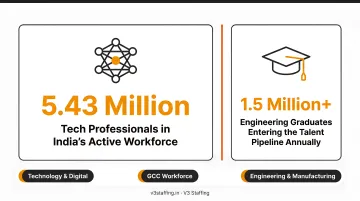
- India's tech workforce of 5.43M professionals and annual output of 847,000+ engineering graduates creates genuine hiring depth
- Four ODC models — EOR, Managed, Dedicated, and BOT — suit different control levels, timelines, and risk tolerances
- Most ODC builds succeed or stall on two variables: hiring speed and legal structure
What Is an Offshore Development Center in India?
An ODC is a dedicated remote engineering team in India that functions as an extension of your company. The team works exclusively for you, follows your processes and tooling, and is aligned to your product goals — positioned offshore to tap India's deep talent pool and favorable cost structure.
NASSCOM defines an ODC as an offsite office outside the company's country that can provide a dedicated team with greater control and integration than traditional outsourcing. That distinction matters.
What Makes an ODC Different
Three characteristics separate an ODC from a typical vendor engagement:
- Exclusivity — the team works only for you, not across multiple clients
- Operational control — you set priorities, sprint cadences, architecture decisions, and KPIs
- Scalability — you ramp up or down without restarting a hiring cycle from scratch
Common ODC Use Cases
ODCs aren't built for one-off projects. They're set up to handle sustained work:
- Core product engineering and feature development
- R&D and applied AI/ML experimentation
- Digital transformation and platform modernization
- Legacy system re-architecture
- Continuous QA, DevOps, and engineering support
If your tech roadmap extends 18+ months, the compounding value of domain knowledge — built by a team that stays with your product — is what separates an ODC from any short-term engagement.
Why India Is the Ideal Innovation Hub for Your ODC
Talent at Scale
India's tech industry employed 5.43 million people in FY2024, including 2M+ digitally skilled professionals across AI, cloud, data, and cybersecurity. The graduate pipeline reinforces this: India produced 847,000+ BE/BTech graduates in 2021-22 alone, with over 258,000 undergraduate pass-outs specifically in IT and Computer disciplines, according to the AISHE 2021-22 report.
The depth shows when you're hiring for niche roles. Cloud architects, ML engineers, full-stack developers, cybersecurity specialists — these profiles exist in volume across India's major tech cities.
The Cost Reality
The salary differential is significant and verifiable. According to the 2025 Stack Overflow Developer Survey, US Engineering Managers report a median salary of $200,000, while their India counterparts report $52,000. For software engineers, Levels.fyi data puts US average total compensation at approximately $191,700, compared to a median of around INR 2M in Pune.
One important caveat: fully loaded ODC costs include benefits, payroll taxes, EOR or entity fees, equipment, workspace, and management overhead. The salary differential is real; the net savings depend on your model, team size, and governance setup.
Ecosystem Maturity
India operates as a full delivery ecosystem, not just a labor pool. NASSCOM reports $199.5B in tech export revenue in FY2024, with India commanding 57–58% of the global sourcing market. Over 38,000 tech firms and 31,000+ tech startups operate in the country.
Teams sourced here are typically fluent in Agile, Scrum, CI/CD pipelines, and enterprise delivery frameworks. One nuance to note: EF EPI 2024 ranks India 69th globally on English proficiency at the national level, but IT and private-sector roles consistently score higher. Communication screening during hiring is essential; don't assume uniform fluency.
City Selection Guide
| City | Strengths |
|---|---|
| Bengaluru | Deepest tech talent pool, strong AI/ML and product engineering community |
| Hyderabad | Growing infrastructure, slightly lower costs, strong cloud and data talent |
| Pune | Strong engineering talent, quality of life, automotive and manufacturing tech |
| Chennai | Stable IT industry, lower attrition historically, strong backend engineering |
| Delhi NCR | Large market access, enterprise and BFSI sector depth |
| Mumbai | Financial services, enterprise tech, strong leadership-level talent |
Tier-II cities like Coimbatore, Nagpur, and Indore are emerging as meaningful options for specific roles — particularly where attrition pressure and real estate costs are concerns.
V3 Staffing's presence across all six major tech hubs, plus an extended Tier-II network, means US companies can source in the right location without managing multiple regional hiring partners.
Regulatory Environment
India's Digital Personal Data Protection (DPDP) Act, enacted August 2023, establishes consent requirements, data security obligations, and breach notification standards — concepts familiar to US companies already working with SOC 2 or GDPR frameworks. It doesn't mirror GDPR directly, but it aligns on core principles.
FDI into India's tech sector remains strong: Computer Software and Hardware accounted for 15% of FDI equity inflows in FY2022-23, supported by both automatic and government approval routes.
ODC vs. Outsourcing vs. GCC: Key Differences Explained
ODC vs. Outsourcing
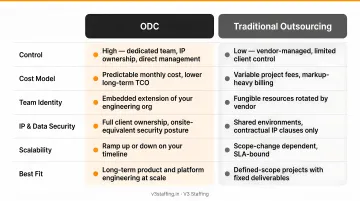
Outsourcing assigns a deliverable to a vendor who manages their own team, works across multiple clients, and owns the process. When the contract ends, the knowledge leaves with them.
An ODC inverts that model. The team is yours: dedicated exclusively to your company, integrated into your sprint cycles, and building institutional knowledge that stays.
| Dimension | ODC | Outsourcing |
|---|---|---|
| Team dedication | Exclusive to one company | Shared across clients |
| Management control | Client-directed | Vendor-directed |
| Knowledge retention | Stays with your company | Leaves when contract ends |
| IP ownership | Client retains all IP | Often splits or stays with vendor |
| Integration depth | Full workflow integration | Task or deliverable handoff |
| Long-term scalability | Built-in | Requires new contract cycles |
ODC vs. GCC
A GCC (Global Capability Center) is a fully owned legal entity — essentially an Indian subsidiary — with complete IP ownership, its own HR and compliance infrastructure, and a mandate for strategic work like R&D and innovation at scale. India had 1,700+ GCCs employing 1.9M+ people in FY2024, according to NASSCOM.
An ODC, by contrast, is faster and lighter. You access dedicated talent through a partner without the upfront investment of entity registration, HR buildout, and compliance infrastructure.
Choose an ODC over a GCC when:
- You're entering India for the first time
- Your team requirement is between 10 and 150 people
- You want operational control without entity overhead
- You want to validate the model before committing to a full subsidiary
Many companies convert to a GCC once the team exceeds 150–200 people and the business case for full ownership is clear.
ODC Models: Choosing the Right Setup
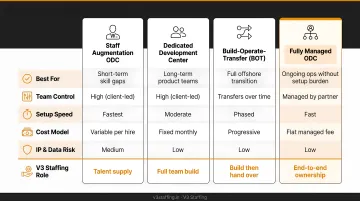
Four primary models cover most US company needs:
1. Dedicated ODC — The team works exclusively for you under a long-term engagement. Best for companies building a permanent engineering capability in India.
2. Managed ODC — The vendor handles execution (hiring, HR, operations) while you set KPIs and direction. Lower management overhead, less direct control.
3. Build-Operate-Transfer (BOT) — A partner builds the team, runs operations, then transfers full legal and operational ownership to you. Best path to eventual GCC status.
4. EOR-based ODC — Hire talent legally in India through an Employer of Record without establishing a local entity. Fastest to deploy, with the lowest setup complexity of the four.
How to Choose
| Your Situation | Recommended Model |
|---|---|
| Testing India for the first time | EOR-based ODC |
| Want control without entity setup | EOR or Managed ODC |
| Planning to own an entity eventually | BOT |
| Scaling a permanent product team | Dedicated ODC |
Of these four options, the EOR model tends to catch US companies off guard — in a good way. You can legally employ talent in India, maintain full operational control, and sidestep permanent establishment (PE) risk from entity registration. And if you decide to formalize later, converting to a full subsidiary remains on the table.
One important caveat: an EOR manages employment compliance, but it doesn't eliminate PE risk entirely. Revenue-generating roles and fixed-place arrangements can still trigger PE exposure — conditions worth reviewing with legal counsel before you scale.
How to Set Up an ODC in India: Step-by-Step
Step 1: Define Goals and Scope
Before engaging any partner, answer these questions:
- What will the ODC do — product engineering, R&D, IT support, or a mix?
- What's the target team size at 6, 12, and 24 months?
- What does success look like at each stage?
- What's the realistic budget, including compliance and operational costs?
Vague goals produce vague teams. Define the mandate in writing before the first partner conversation — scope, headcount milestones, and measurable outcomes.
Step 2: Choose Model and Location
Match your control requirements and timeline to the right model — captive, build-operate-transfer, or managed ODC — then select a city based on the skills you need most. AI/ML engineers: Bengaluru or Hyderabad. Cloud and platform engineering: any of the top six cities. Manufacturing-adjacent tech: Pune or Chennai.
Step 3: Navigate Legal and Compliance
This is where many ODC builds slow down. Key considerations:
- Entity options: Wholly owned subsidiary, LLP, branch office, liaison office, or EOR-supported hiring pre-entity
- Mandatory registrations: PAN, TAN, GST (entity-dependent), Shops and Establishments
- Labor obligations: Provident Fund (PF), ESIC coverage (applies at INR 21,000/month wage threshold), professional tax, gratuity after 5 years
- FEMA compliance: Required for foreign currency remittances and investment structures
- DPDP Act: Data handling obligations apply if processing personal data of Indian residents
- PE risk: Without proper structuring, Indian tax authorities may treat your ODC as a taxable Indian entity — get this reviewed before committing to a model
Working with a compliance-experienced EOR partner like V3 Staffing handles the employment layer. Tax and entity structuring require qualified legal counsel.
Step 4: Build Your Talent Pipeline
Hiring speed and quality determine whether your ODC launches on schedule or stalls. What to look for in a talent partner:
- Deep local network across the cities relevant to your role mix
- Technical pre-vetting, not just resume forwarding
- SLA-driven shortlist delivery
- High offer-to-join ratios (low candidate drop-off)
- Onboarding infrastructure that gets people productive quickly
V3 Staffing supports ODC and GCC builds across all six major tech hubs. Pre-vetted candidates are delivered in 7–10 business days for technical roles, with a 90% offer-to-join ratio and a 48–72 hour deployment window for contract and EOR engagements. With 10,000+ specialists placed across 200+ clients — including Google, FactSet, Flutter International, and DuPont — the pipeline is ready when you are.
Step 5: Establish Operations and Governance
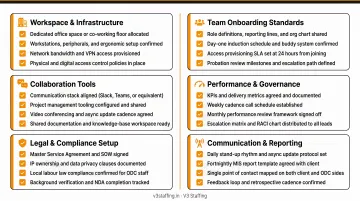
Infrastructure decisions to make before day one:
- Workspace: Dedicated office, managed coworking, or fully remote
- Collaboration stack: Slack, Jira, Confluence, Zoom — align on tools before hiring
- Cadence: Daily standups, sprint reviews, async documentation standards
- Performance dashboards: Define KPIs by team and individual from the start
- Cultural integration: IST-to-EST overlap windows, communication norms, and onboarding practices that bridge the two working cultures
The 3–4 hour overlap between IST and EST business hours (early morning US time, end of day India time) is the real-time collaboration window. Design your sprint ceremonies around it.
Common Challenges When Setting Up an ODC
Talent Acquisition and Retention
India's tech attrition rate stabilized at 12.7% in Q1 FY2025 after seven consecutive quarters of decline, per NASSCOM — still material. Address it by:
- Benchmarking offers against current market rates, not last year's data
- Building clear career progression paths from day one
- Creating a team identity, not just a headcount
Communication and Time Zone Management
The IST–EST gap is 9.5–10.5 hours. Don't fight it — design around it:
- Schedule one 3–4 hour daily overlap for real-time collaboration
- Default to async-first documentation for everything else
- Over-invest in written communication standards early; they compound over time
Legal Complexity and PE Risk
Without proper structuring, tax authorities may treat your ODC as a taxable Indian entity, triggering unexpected compliance obligations. The EOR model mitigates employment risk by keeping the legal employer relationship local. But PE risk from fixed-place presence, authority to conclude contracts, or revenue-generating activity still requires dedicated legal review.
Getting the legal structure right from the start is far cheaper than correcting it after the fact.
Frequently Asked Questions
What is an offshore development center (ODC) in India?
An ODC is a dedicated engineering team based in India that works exclusively for one company, integrated into its workflows, tools, and delivery culture. The client retains full operational control while day-to-day HR, payroll, and compliance are managed locally by a partner or through the company's own India entity.
Is an ODC the same as outsourcing?
No. Outsourcing assigns work to a third-party vendor who manages their own team and serves multiple clients. An ODC is a dedicated team that works exclusively for you, follows your processes, and retains institutional knowledge long-term.
What is the difference between a GCC and an ODC?
A GCC is a fully owned legal entity in India — like a subsidiary — with complete IP ownership and typically a strategic mandate including R&D and innovation. An ODC is managed through a partner and faster to set up, making it the standard first step before the larger commitment of a full GCC.
How much does it cost to build an ODC team in India?
Salary benchmarks show a clear differential: US Engineering Managers earn a median of $200,000 versus $52,000 in India (Stack Overflow 2025). Fully loaded ODC costs go beyond base salary — factor in benefits, statutory contributions (PF, ESIC), EOR or entity fees, workspace, and management overhead.
Is building an ODC in India worth it?
For companies with sustained, long-term tech needs — not one-off projects — yes. India's 5.43M-strong tech workforce, $199.5B export ecosystem, and significant salary arbitrage make it a defensible strategic choice. ROI depends on choosing the right model, location, and talent partner from the start.