Introduction
Recruitment is one of the most consequential decisions a company makes. Yet most organizations default to a model based on familiarity, not strategic fit — and that mismatch is expensive.
The U.S. Department of Labor estimates that the cost of a bad hire is at least 30% of the employee's first-year earnings. Meanwhile, 80% of organizations in India report difficulty hiring the right talent, with average time-to-hire stretching 35-45 days. Slow hiring, poor culture fit, spiraling costs, and lost business momentum can cripple growth.
This article breaks down the four main recruitment models: In-House, Embedded, RPO, and Hybrid. It covers how they differ across cost, control, and scalability — and how to determine which one fits your organization's stage and strategic goals.
Key Takeaways
- A recruitment model structures your talent acquisition function — internally, externally, or both
- Four models to know: In-House, Embedded, RPO, and Hybrid — each with a distinct ownership and delivery structure
- Each model differs in cost structure, scalability, cultural alignment, and control
- The right choice depends on hiring volume, growth stage, budget, and how central recruitment is to your strategy
- A poor fit leads to wasted spend, missed hires, or a team that never quite gels with your culture
What Is a Recruitment Model?
A recruitment model is the structured framework that determines who handles talent acquisition, how they're engaged, their scope of responsibility, and how costs are managed. It covers everything from sourcing and screening to onboarding.
While sometimes used interchangeably with "hiring strategy," a recruitment model specifically defines the operational structure: who owns the function, where they sit, and how they're accountable.
This is a deliberate, strategic choice — not something that should happen by default. Many organizations unknowingly run a model that no longer fits their stage, and the cost shows up in slower hiring, higher attrition, or bloated recruitment spend.
Why Your Choice of Recruitment Model Matters
The recruitment model directly shapes three critical metrics: time-to-hire, quality of hire, and cost-per-hire. These compound rapidly at scale.
The U.S. Department of Labor estimates a bad hire costs at least 30% of first-year earnings. For senior roles, SHRM reports costs can reach up to 5x annual salary.
Prolonged vacancies add another layer of cost. In the Indian context, unfilled positions bleed productivity, delay product timelines, and create downstream compliance risk — particularly for organizations hiring at scale across multiple cities.
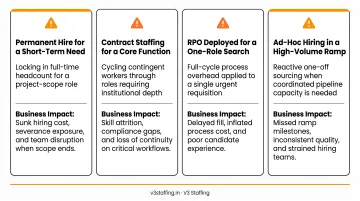
Common mismatches create predictable problems:
- In-house teams can't scale fast enough during growth phases
- RPO providers lacking cultural context produce high-volume, low-fit candidates
- Overspending on external partners during hiring freezes
- Companies resort to ad-hoc agency fees and overtime when surges hit
These cost pressures are compounded by India's hiring complexity. For large enterprises, GCCs, and product organizations expanding across metros or into Tier-II cities, the recruitment model carries real compliance and operational weight. With India hosting over 1,700 GCCs employing 1.9 million people, the wrong model doesn't just slow hiring — it creates structural gaps that are hard to reverse.
The Four Types of Recruitment Models
No single recruitment model is universally superior. Each exists because it solves a different set of problems. The right one depends on where your organization is and where it's going.
In-House Recruitment
In-house recruitment means a dedicated internal team, on payroll, working exclusively for your organization. They handle sourcing, screening, interviewing, and onboarding as a core HR function.
Key strength: Deep cultural integration. Internal recruiters know the business inside out — its priorities, people, and what "good fit" looks like. This improves quality of hire and retention over time.
Core trade-off: Cost inflexibility and limited scalability. In-house teams are sized for steady-state hiring. The fully loaded annual cost per recruiter averages ₹1.46 crore to ₹1.66 crore, including salary, benefits, and ATS licenses. Scaling up means adding headcount. Scaling down means layoffs.
SHRM 2025 data shows only 55% of organizations have dedicated in-house recruiters, down from 58% in 2022. During hiring surges, internal teams face bandwidth constraints and resort to ad-hoc agency fees that spike costs unpredictably. During slow periods, recruiters sit idle.
Best suited for: Large, stable organizations with consistent, predictable hiring volumes and sufficient budget to maintain a full-time recruitment function year-round.
Embedded Recruitment
Embedded recruitment means external recruitment specialists operate fully within your organization — using your brand, systems, and communication channels — functioning as an extension of your internal team for a defined engagement period.
Unlike RPO, embedded recruiters work exclusively for one client. They're present in day-to-day team life and develop the same cultural fluency as internal hires — without the fixed overhead of permanent headcount.
Core strengths:
- Combines cultural alignment of in-house hiring with expertise and scalability of external recruitment
- Fixed, predictable cost structures without long-term payroll commitments
- Can scale up or down based on hiring demand
- Recruiters integrate into internal workflows, using client tools and reporting structures
Limitation: Embedded models typically require a ramp-up period for recruiters to integrate effectively. Embedded works best for sustained engagements, not one-off campaigns.
Best suited for: Fast-scaling companies, GCCs setting up new capability centers, and product organizations that need dedicated hiring support without the overhead of building a permanent function.
V3 Staffing has deployed embedded recruitment teams for clients including Johnson Controls and DuPont, achieving an 85% offer-to-join rate and an average time-to-close of 7 days per role.
Recruitment Process Outsourcing (RPO)
RPO means transferring ownership of part or all of your recruitment process to an external provider. They manage sourcing, screening, talent pooling, and often employer branding and onboarding — using their own systems and methodologies.
Unlike embedded models, RPO providers typically operate externally and serve multiple clients at once. They bring proprietary technology platforms, established talent pools, and full recruitment infrastructure to the engagement.
Core strengths:
- Highly scalable on demand
- Access to established talent pipelines and specialist domain expertise
- Technology-enabled processes that produce faster time-to-hire
- Strong for high-volume hiring across multiple locations
RPO models can reduce cost-per-hire by 25-50% compared to in-house recruitment. The global RPO market is valued at $8.18 billion (2025) and projected to reach $16.42 billion by 2030, with Asia-Pacific as the fastest-growing region.
Key limitations:
- Less cultural immersion than embedded or in-house models, which can affect candidate quality and employer brand representation
- Requires strong governance and clear SLAs to avoid misalignment
- May feel transactional for niche or senior hiring
Best suited for: Organizations with large-scale, multi-location hiring needs; companies entering new geographies; businesses that need to rapidly ramp hiring without building permanent internal infrastructure.
The Hybrid Recruitment Model
Hybrid recruitment means a deliberate combination of two or more recruitment models running simultaneously. For example, an in-house team for core roles combined with an embedded team for specialized or high-volume hiring.
Why hybrid models have gained traction: They eliminate the specific weaknesses of standalone models. A company can maintain cultural control through its internal team while leveraging the scalability and expertise of embedded or RPO partners for specific needs.
Common hybrid configurations:
- In-house + embedded: Product or tech companies in rapid growth use in-house teams for core roles and embedded specialists for high-volume tech hiring
- In-house + RPO: Enterprises hiring across multiple cities use in-house for strategic roles and RPO for geographic expansion
- Embedded + RPO: GCCs use embedded teams for cultural depth and RPO for volume capacity
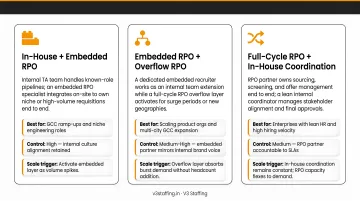
Best suited for: Mature organizations with complex, multi-layered hiring needs; fast-growing companies that have outgrown a single model; enterprises managing both steady-state and surge hiring across different business units or geographies.
How to Choose the Right Recruitment Model
The right model isn't the most sophisticated or popular one — it's the one that fits your organization's current hiring volume, growth stage, budget structure, and day-to-day operational realities.
Factor 1: Hiring Volume and Predictability
- Consistent, moderate volumes: In-house teams work well when hiring is steady and predictable
- High-volume, variable, or multi-location: RPO or hybrid models handle fluctuation better
- Specialized, culture-intensive with sustained demand: Embedded recruitment provides depth without permanent overhead
Factor 2: Growth Stage and Scalability Needs
Early-stage or rapidly scaling organizations benefit from the flexibility of embedded or hybrid models. These can expand and contract without headcount decisions.
Stable, mature organizations with defined HR functions may sustain in-house teams effectively, provided hiring volumes remain consistent.
Factor 3: Budget Structure and Cost Visibility
Cost benchmarks across models:
| Model | Cost Structure | Indicative Cost |
|---|---|---|
| In-house recruiter | Fixed annual (salary + benefits + tools) | ₹1.46–1.66 crore/year per recruiter |
| External agency | Percentage of first-year salary | 15–30% of annual salary |
| RPO / Embedded | Monthly retainer (variable) | ₹8.3–16.6 lakh/month |
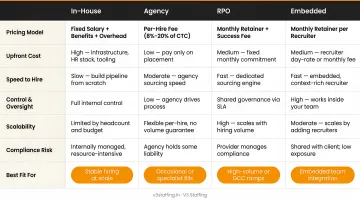
In-house teams carry fixed annual costs that are difficult to reduce. RPO and embedded models offer more predictable monthly structures.
SHRM 2025 data shows median cost-per-hire for executive roles is ₹8.86 lakh (up 113% since 2017); for non-executive roles, ₹1 lakh. The cost ratio between executive and non-executive hiring has widened to 1:8.9 overall and 1:18.3 for extra-large organizations.
Factor 4: Control, Compliance, and Employer Brand
Organizations in regulated industries or those with strong employer brand priorities need models that allow them to retain control over candidate experience and communication. Embedded models perform better here than traditional RPO.
For enterprises and GCCs hiring across Indian metros and Tier-II cities, local compliance requirements, talent availability, and market norms add another layer of complexity to this decision.
V3 Staffing has spent 15+ years helping enterprises and GCCs across Hyderabad, Bengaluru, Chennai, Pune, Delhi NCR, and Mumbai design and execute the right recruitment model from day one.
Mistakes to Avoid When Finalizing Your Recruitment Model
Defaulting to the Most Familiar Model
Many organizations replicate what they've always done — or what competitors appear to do — without checking whether it fits their current hiring needs. This leads to either overspending or under-delivery.
Ignoring Total Cost of Ownership
Comparing models on headline costs alone — per-placement fees vs. monthly retainers — ignores what typically drives the real spend. Hidden costs routinely tip the balance: management time, technology, training, ramp-up periods, and the carrying cost of unfilled roles.
SHRM's cost-per-hire definition covers a wide range of expenses:
- Third-party fees, advertising, and job fair costs
- Referral bonuses, travel, and relocation
- Recruiter pay, benefits, and HR software
Hard costs account for just 30–40% of total recruitment spend. Soft costs make up the remaining 60% — and they're the ones most budgets miss.
Treating the Model as Permanent
Recruitment needs evolve with business stage. The model that works for a 200-person company rarely serves a 2,000-person organization. Build in regular reviews and be willing to shift models or move to a hybrid approach as needs change.
Frequently Asked Questions
What is RPO in recruitment?
RPO (Recruitment Process Outsourcing) is a model where an external provider takes ownership of part or all of an organization's recruitment process — managing sourcing, screening, and hiring using their own expertise and infrastructure. It differs from a staffing agency in scope and strategic depth.
What is the difference between embedded recruitment and RPO?
While both involve external recruitment partners, embedded recruiters work exclusively within one client's organization (using their brand, tools, and culture), whereas RPO providers typically operate externally, may serve multiple clients, and manage recruitment as a managed service rather than as a team extension.
What is the 70/30 rule in hiring?
The 70/30 rule is a popular heuristic — not a formal standard — suggesting roughly 70% of hiring should come from proactive sourcing and talent pipelines, while 30% comes from inbound applications. The recruitment model a company uses directly affects how well it can maintain this split.
What are the 4 R's for recruitment?
The commonly referenced 4 R's are Reach, Recruit, Retain, and Return. For example, embedded and in-house models tend to perform better on retention, while RPO models excel at reach and speed of recruitment.
Which recruitment model works best for GCCs and large enterprises?
GCCs and large enterprises — especially those scaling across multiple locations — typically benefit most from embedded, RPO, or hybrid models. These offer the scalability, domain expertise, and compliance support that in-house teams alone often cannot provide at speed.
Can a company run more than one recruitment model at the same time?
Yes, this is exactly what the hybrid model represents. Many fast-growing companies combine an in-house team for core or senior roles with embedded or RPO partners for high-volume, specialized, or geographically distributed hiring, allowing them to balance control with scale.