

Introduction
Picture this: a fast-growing Global Capability Center in Hyderabad realizes their VP of Engineering isn't scaling with the organization. Performance reviews confirm the gap. Board members agree something must change. But posting the role publicly? That would signal strategic weakness to competitors, trigger panic among the engineering team, and potentially jeopardize the three enterprise clients whose contracts hinge on delivery stability.
What do they do?
They turn to confidential executive search, a specialized hiring process most companies don't know exists until they urgently need it. In India's tightly connected professional communities, where talent pools in Bengaluru, Hyderabad, and Mumbai are dense and word travels fast, a leaked senior search can inflict more damage than the leadership gap itself.
According to the Association of Executive Search and Leadership Consultants (AESC), 52% of business leaders cite confidentiality as the primary reason they engage executive search firms, compared to just 2% who cite it for in-house recruitment.
This article covers what confidential executive search is, when you need it, how the process works, and what separates a search partner who can truly protect your organization from one who cannot.
Key Takeaways
- Confidential executive search fills senior roles privately, withholding the company's identity until the right moment
- Most commonly triggered by incumbent replacement, GCC expansion, succession planning, or pre-announcement strategy builds
- Reaches passive candidates (roughly 80% of the executive talent pool) who never respond to public job postings
- Maintains confidentiality through staged disclosure, NDAs, and strict internal information controls
- Success depends on choosing a search partner with deep passive network access, a structured search methodology, and reference-checked shortlists
What Is a Confidential Executive Search?
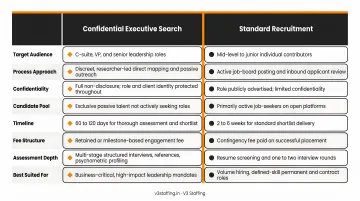
A confidential executive search fills senior leadership roles—CEO, CFO, CHRO, CTO, VP-level—without publicly disclosing that the position is open, who the hiring organization is, or that a transition is underway. Unlike standard recruitment, where job listings appear on LinkedIn or career pages and candidates self-select, confidential searches operate invisibly.
The distinction comes down to what's shared—and when. In a standard search, the company name and role details are visible from day one. In a confidential search, the firm approaches candidates with only:
- Industry, company size, and geography
- Revenue scale and scope of the role
- Functional responsibilities and reporting structure
The company name stays withheld until a candidate shows genuine interest and signs an NDA.
Confidential search isn't reserved for struggling companies or crisis situations. Any organization that recognizes leadership transitions as a business risk—when handled carelessly—uses it as standard practice. The AESC Executive Talent 2025 report confirms that 62% of business leaders engage executive search firms specifically to reach passive candidates not browsing job boards. That same data shows C-suite mandates made up 50.64% of all executive search placements in 2025—confirming confidential, retained search is the dominant model for the most senior appointments.
When Is a Confidential Executive Search the Right Call?
Incumbent Replacement Without a Gap
The most common trigger: replacing an underperforming or transitioning C-suite leader while keeping them in role. Removing the person too soon creates a leadership vacuum; announcing the search exposes the vacancy and destabilizes the team. Spencer Stuart's 2025 research found that roughly 1 in 6 BSE 200 companies changed CEOs in a single year, with approximately 50% of predecessors stepping down within 3 years of starting. The confidential search solves this by running the process in parallel, ensuring a successor is ready before any announcement is made.
GCC Build-Outs and Enterprise Expansion Leadership
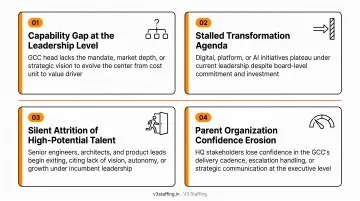
For Global Capability Centers setting up or scaling in India—particularly in tech, finance, automotive, or pharma—bringing in a new head of operations, delivery lead, or VP of engineering is inherently sensitive. India now hosts over 1,800 GCCs employing nearly 2 million professionals, generating ₹5.3 lakh crore (US$64.6 billion) in export revenue in FY2024 (a 40% year-over-year jump).
The pressure to hire senior talent quickly is real: according to KPMG-Nasscom research:
- 72% of GCC leaders cite talent management as their top operational priority
- 58% take more than 45 days to fill critical leadership roles
The parent organization may not be ready to announce the new structure, or the incumbent may be transitioning out as part of a global reorganization. Running a confidential search lets GCCs hire ahead of any public announcement.
Succession Planning for Founder- or Promoter-Led Businesses
Many large Indian enterprises and family-owned conglomerates are in active succession phases, with founding generation leaders stepping back from operations. The governance gaps are striking: PwC's 12th Global Family Business Survey found 36% of Indian family businesses lack a clear succession plan (versus 28% globally).
More telling: 52% struggle with senior generation resistance to transitioning leadership, nearly double the global average of 29%.
Employees, clients, and banking relationships are all sensitive to signals of leadership instability. Running the search confidentially gives the organization room to identify and onboard professional leadership without triggering speculation before the transition is ready.
Building New Functions Before Announcing Strategy
Sometimes a company is building a new business unit, entering a new market, or restructuring, and needs to hire senior leadership for a function that doesn't yet publicly exist. Announcing the hire before the strategy is public can alert competitors. India's M&A activity surged to US$123.8 billion in 2025, an 18% increase, with cross-border deals jumping 155%. At that pace, the scope of a role can be just as confidential as the hire itself — which means search partners need to operate with the same discretion as the deal teams they're supporting.
The Real Risks of Going Public with a Senior Hiring Decision
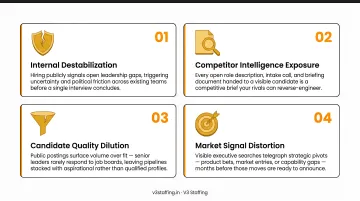
Internal Destabilization
When employees learn a senior leader's role is open—especially before the incumbent has been notified or resigned—it creates anxiety, informal power struggles, and attrition risk among high performers. Gallup research confirms that managers account for at least 70% of the variance in employee engagement across business units.
The scale of that dependency is significant: only 20% of employees worldwide were engaged in 2025, costing the global economy an estimated $10 trillion in lost productivity.
Gallup's Great Detachment report found that 73% of employees experienced disruptive change in the past year, and only 45% (a record low) clearly know what is expected of them at work. Leadership uncertainty compounds this damage.
Competitor Intelligence
Making a leadership search public tells competitors exactly where you're growing and what capabilities you're building next. In competitive sectors like technology, fintech, and GCC-dominated industries, that information has direct business value for rivals. A 2025 LinkedIn poll of HR and business leaders found 44% use confidential searches case-by-case, and 25% always keep leadership searches discreet—precisely to avoid tipping off the market.
Candidate Quality Degradation
Public postings for senior roles attract large volumes of inbound applications, the majority from active job-seekers. The problem: 73% of professionals globally are passive candidates, and at the executive level, that figure rises to approximately 80%. The highest-caliber leaders are typically currently employed, high-performing, and not actively searching. They won't apply to a public listing—they need to be approached directly and discreetly.
Reputational Risk from a Botched Search
If a public search is launched and then quietly withdrawn, or if the announced hire falls through, the visible failure signals organizational dysfunction to the market. A confidential search has no public footprint, so if circumstances change, the process can be paused or redirected without any external visibility.
How a Confidential Executive Search Actually Works
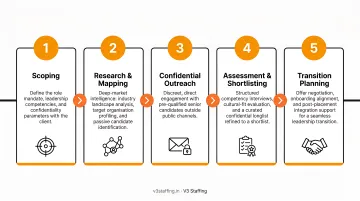
Step 1: Scoping and Confidentiality Alignment
Before any external activity begins, the search firm documents the hiring organization's situation, the precise confidentiality requirements, who internally knows about the search, and what can and cannot be disclosed to candidates at each stage. This scoping conversation is the foundation that prevents leaks later.
Step 2: Blind Candidate Outreach
The search firm approaches candidates by describing the role using only non-identifying attributes:
- Industry and sector
- Company size and revenue scale
- Geography and ownership type
- Scope of the role and reporting structure
This "confidential client" approach allows the recruiter to assess candidate interest and qualification before any sensitive information is shared. The AESC Code of Professional Practice mandates that member firms maintain strict confidentiality at all times, respecting information entrusted by both clients and candidates.
Step 3: Staged Disclosure with NDA
Once a candidate demonstrates genuine interest and passes initial screening, the recruiter and hiring organization jointly decide whether to reveal the company's identity. This disclosure happens only after the candidate signs a mutual NDA — not during initial outreach, and not before. Organizations that skip this sequencing risk the candidate sharing the information before an offer is made, which can surface with competitors or current employers within days.
Step 4: Shortlisting and Client-Side Interviews
Only candidates who have cleared screening, shown alignment with the role, and signed confidentiality agreements are presented to the hiring organization. Client-side interviews follow the same confidentiality framework. Key controls at this stage include:
- Limiting interview participants to essential decision-makers only
- Conducting all written communication through secure, private channels
- Running reference checks on finalists only with the candidate's explicit consent
Step 5: Transition Planning
The offer, negotiation, and onboarding planning happen privately. The new hire is announced only when the hiring organization controls both the timing and the message. A capable search partner will help script internal communications, prepare the leadership team, and sequence the external announcement to prevent rumor cycles before the transition is confirmed.
What to Look for in a Confidential Executive Search Partner
Depth of Network, Not Just Breadth
A search firm's ability to run a truly confidential search depends on having established, trust-based relationships with senior professionals in your specific industry and geography, not just a large database. Ask any prospective partner how many placements they've made at the leadership level in your sector and region in the past 12–24 months.
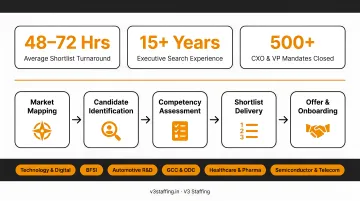
A broad claim of "pan-India presence" means little without verifiable depth in the talent pools that matter to your search. V3 Staffing brings this kind of verified, relationship-based network to confidential senior searches — built over 15 years serving large enterprises, GCCs, and product organizations across India's major business hubs. Their structured market mapping and discreet outreach to passive executive talent (leaders not listed on job portals) consistently surfaces candidates who fit both the strategic brief and the organization's culture.
Operational Discipline in Confidentiality
Ask specifically:
- How does the firm restrict information about a confidential engagement internally?
- How do they describe the role to candidates before NDA execution?
- Have they experienced a search breach, and how did they handle it?
A firm that answers these questions with specific process details, not general assurances, has run confidential searches before.
Rigorous Candidate Vetting Beyond Sourcing
Confidential search isn't just about keeping a secret—it's about producing the right hire under those constraints. Retained executive search firms report 85-95% completion rates versus 20-35% for contingency search models for senior roles.
Look for a search partner who combines confidential sourcing with:
- Structured evaluation against the role's requirements
- Cultural fit assessment
- Leadership style and decision-making analysis
- SLA-driven shortlisting timelines that keep the process from dragging into months of unproductive delay
V3 Staffing's retained search model delivers pre-screened candidates within 10 days on average for senior roles, with over 90% leadership retention for CXO placements — a result of structured evaluation rather than speed-first sourcing.
Frequently Asked Questions
What is a confidential executive search?
A confidential executive search is a specialized hiring process to fill senior leadership roles without publicly disclosing the search or the company's identity. It's used to protect internal stability, competitive positioning, and candidate relationships during sensitive leadership transitions.
What are the two kinds of executive search firms?
The two primary models are retained search firms, paid upfront to exclusively dedicate resources to a search (most common for confidential and senior-level engagements), and contingency search firms, paid only upon successful placement. Contingency firms are typically used for lower-level roles and are not well-suited to confidential searches, which require exclusive resource commitment.
Are recruiters supposed to keep things confidential?
Yes. Reputable executive search firms operate under confidentiality obligations to both the hiring organization and the candidates they approach. In a confidential search, these obligations are formalized through NDAs and strict access controls within the firm.
How much does an executive headhunter cost?
Confidential executive search is typically conducted on a retained basis, with fees generally ranging from 25–33% of the placed executive's first-year total compensation. According to PCG International's 2025 data, retainer-model fees in India average 30–35% of annual CTC, structured in milestone payments. The real question is what placement guarantee and post-hire support the fee covers.
How long does a confidential executive search take?
Confidential searches typically run 10–20% longer than standard executive searches, because blind outreach and the staged NDA-disclosure process add steps a public posting skips. According to PIN's executive search strategy guide, C-suite confidential searches generally take 10 to 18 weeks, depending on role complexity and decision speed once shortlists are presented.
Which senior roles are most commonly filled through confidential executive search?
CEO, CFO, CHRO, CTO, and VP/Director-level functional heads are the most commonly placed roles, particularly when an incumbent is still in seat, when a new function is being built ahead of a public announcement, or when the business context—such as a GCC build-out, M&A, or succession transition—requires the search to remain invisible to the market until the hire is finalized.