Introduction
Global companies face a stark reality when expanding internationally: setting up a local legal entity takes 3 to 12 months and costs anywhere from $15,000 to over $100,000 in initial setup alone. For enterprises testing new markets or hiring specialized talent quickly, this timeline is untenable.
Employer of Record (EOR) services solve this problem. An EOR becomes the legal employer in countries where your company has no entity, managing compliance, payroll, benefits, and employment contracts while you retain full operational control of your workforce. The result? Market entry in 7–10 days instead of 6–9 months.
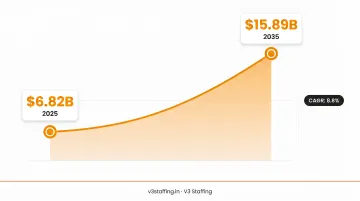
The numbers reflect how quickly this model has matured. Valued at approximately $6.82 billion in 2025, the EOR market is projected to reach $15.89 billion by 2035 at a 9.24% CAGR.
EOR has shifted from a cost-avoidance workaround for startups into permanent hiring infrastructure for global enterprises. Understanding the seven trends driving this shift is critical for companies expanding into markets like India, LATAM, and EMEA.
Key Takeaways
- EOR has evolved from temporary workaround to permanent HR infrastructure, with 41% of distributed teams already using EOR services
- AI reduces compliance admin costs by 19%, flagging compliance issues before audits trigger them
- Board-level risk: misclassification penalties now exceed ₹83 lakh per worker in high-compliance regions, pushing EOR onto executive agendas
- India's 1,800+ GCCs are driving the next expansion wave — LATAM is following close behind with 18.5% EOR growth
- Leading providers process over $22 billion in annual payroll, handling payroll, benefits, and FX within a single system
The EOR Market at a Glance: Where It Stands Today
The global EOR market is growing fast, and the numbers confirm it. Multiple analyst firms cluster around a consensus 6.5–9.2% CAGR, with market size estimates ranging from $5.73 billion to $6.82 billion in 2025. Regional distribution shows North America commanding 39–42% of market share, Europe at 28–30%, and Asia-Pacific at 22–24%.
Enterprise Buyers Redefine the Market
Historically, SMEs made up approximately 56% of the EOR market to avoid entity setup costs — but that profile is shifting rapidly. By 2024, 41% of distributed teams already use EOR services and 49% plan to adopt one, a sign that EOR is becoming standard infrastructure, not a stopgap.
The cost advantage driving this shift is significant:
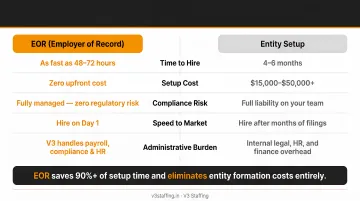
- Eliminates the 6–12-month entity setup timeline — talent can be onboarded in days
- Avoids initial setup costs averaging $15,000–$20,000
- Cuts annual entity maintenance costs of up to $200,000
- Delivers ~90% faster market entry than traditional entity establishment
Leading Adoption Sectors
Technology leads EOR adoption at 94% penetration, followed by finance (78%), marketing (71%), and consulting (68%). Global Capability Centers (GCCs) represent the fastest-growing segment, particularly in India where over 1,800 centers employ 1.9 million professionals.
7 Key Trends Reshaping EOR and Global Expansion
Trend 1: EOR Shifts from Stopgap to Permanent Enterprise Infrastructure
Large organizations no longer view EOR as a temporary talent gap solution — they're integrating it as a permanent layer of their HR and legal architecture. This shift shows up in both adoption rates and operational integration depth.
Adoption reaching critical mass:
- 41% of distributed teams currently use EOR services
- 49% plan to start using EOR within the next year
- 65% of companies cite regulatory and compliance risk reduction as their primary driver
- 51% use EOR specifically to access global talent and specialized skills
The enterprise use case has fundamentally changed. Companies now use EOR to maintain a "fast lane" for international hiring, reserving entity establishment only for markets where they exceed 15+ employees — the commonly cited threshold where owned entities become cost-effective.
HRIS integration becomes table stakes:
The clearest signal of permanence is technical integration. Deel offers a dedicated EOR Connector on the Workday Marketplace, enabling synchronized employee profiles, automated time-off syncing, and bidirectional data updates. This creates a single source of truth for global workforce data, treating EOR employees identically to direct hires in core HR systems.
Enterprise buyers increasingly require API-first platforms with native integrations to Workday, SAP SuccessFactors, and Oracle HCM. Feeding EOR data directly into central HRIS platforms — without manual CSV uploads — is now a procurement requirement, not a nice-to-have.
Trend 2: AI and Predictive Compliance Are Redefining EOR Operations
Artificial intelligence is transforming EOR from reactive compliance checking to predictive risk management. The operational and cost impacts are measurable.
AI adoption by the numbers:
- 73% of HR directors and above have adopted AI tools by 2025
- Companies using AI in payroll and compliance report a 19% reduction in administrative costs
- 38% of EOR providers now use AI for payroll and compliance functions
- HR tech vendors offering built-in compliance auditing features rose 42% in 2025
How AI changes daily operations:
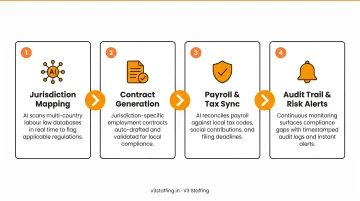
- Contract review at scale: NLP tools scan employment contracts against local labor codes in minutes, flagging non-compliant clauses before execution
- Permanent establishment (PE) risk detection: AI analyzes worker activity patterns, contract terms, and role scope to flag PE exposure before tax authorities identify it
- Automated classification audits: Systems continuously review contractor vs. employee classification, preventing the "scope creep" that triggers misclassification penalties
- Tier-1 support automation: AI-powered chatbots handle complex statutory queries across multiple jurisdictions, freeing compliance experts for strategic advisory work
Providers without embedded AI compliance tooling will lose enterprise RFPs to AI-native competitors — that inflection point arrives within 12–18 months.
Trend 3: "Fintech-ization" — EOR Providers Become Payment Platforms
Leading EOR providers are evolving beyond employment services into cross-border payment infrastructure. This convergence of HR and treasury functions represents a structural shift in how global companies manage workforce operations.
Payment infrastructure at scale:
- Deel processes $22 billion in annual payroll across 150+ countries and 200+ currencies
- Revolut ($75B valuation, 65M customers) plans to launch "GlobalHire" EOR covering 160 countries in H2 2026
- Payoneer acquired Skuad (2024) and Boundless (January 2026) to layer EOR onto its cross-border payments heritage
What this convergence means operationally:
- Multi-currency digital wallets: Employees access earnings in their preferred currency, reducing conversion fees from the traditional 3–5% to under 1%
- Real-time cross-border payment rails: Same-day or next-day payroll delivery replacing the 3–5 day wire transfer standard
- Treasury function integration: HR teams now manage currency exchange, liquidity across wallets, and payment timing to optimize FX costs
- Financial wellness tools: Earned wage access, crypto payment options, and savings programs bundled directly into employment platforms
This convergence increases platform stickiness dramatically. Once a company's finance team integrates EOR-provider payment rails into treasury operations, switching costs multiply well beyond a simple HR system migration.
Trend 4: Regulatory Crackdowns on Worker Misclassification Are Accelerating Compliant Hiring
Governments worldwide are aggressively auditing worker classification to reclaim lost payroll tax revenue and enforce employment protections. The financial and legal consequences of misclassification have reached board-level materiality.
Regulatory pressure intensifying globally:
The EU Platform Work Directive affects 28 million platform workers, projected to reach 43 million by 2025. Member states must transpose the directive into national law by December 2, 2026, establishing a legal presumption of employment that shifts the burden of proof to employers.
India's Social Security Code 2020 extends mandatory coverage to gig workers, platform workers, and unorganized workers for the first time, fundamentally changing compliance obligations for companies using contract labor.
Penalty landscape:
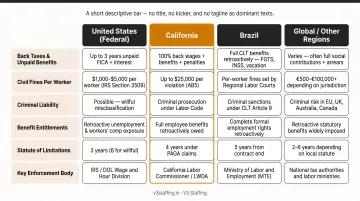
- United States: $3–4 billion in annual payroll tax revenue lost to misclassification
- California: Up to $25,000 per misclassified worker
- Brazil: Up to 400,000 BRL per violation plus back-pay of all statutory benefits
- High-compliance regions: Penalties exceeding $100,000 per worker
How this changes EOR operations:
Classification is now treated as a "live stream" requiring continuous monitoring:
- Quarterly classification audits: Regular reviews of contractor scope, work patterns, and reporting relationships
- Manager training programs: Educating hiring managers to prevent contractor "scope creep" into employee-like arrangements
- Real-time legal monitoring: Automated tracking of regulatory changes across jurisdictions with immediate client notifications
- Proactive re-classification: Moving contractors to employee status before enforcement triggers
For enterprises, EOR has evolved from an HR convenience into a risk management tool with CFO-level governance requirements.
Trend 5: Emerging Markets — India's GCC Boom, LATAM, and Africa Lead New EOR Demand
LATAM and Africa show the highest regional growth rates (18.5% and 19.8% CAGR respectively), but India's GCC expansion represents the most operationally significant driver for enterprise EOR adoption.
India's GCC landscape:
India hosts approximately 1,800 GCCs employing 1.9 million professionals — over 53% of the global total. Projections show this expanding to 2,100+ centers by FY28 at an 8% CAGR. Direct economic output reached $76 billion in FY25, with forecasts surpassing $100 billion by decade's end.
City-level GCC distribution (2025):
- Bengaluru: 40%
- Delhi NCR: 24%
- Chennai: 14%
- Hyderabad: 10%
- Mumbai: 6%
- Pune: 5%
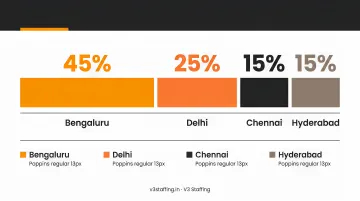
Over 220 GCC units now operate in Tier-II cities including Ahmedabad, Kochi, Coimbatore, and Indore. For enterprises scaling GCC teams quickly, recruitment partners with pan-India coverage — including Tier-II city reach — become critical for sourcing the talent volume these expansions require. V3 Staffing's presence across Bengaluru, Hyderabad, Chennai, Delhi NCR, Pune, Mumbai, and extended Tier-II networks directly supports this demand.
The same high-growth dynamic plays out differently across other regions, each with its own compliance complexity.
LATAM payroll complexity:
The 13th-month pay is legally required in Argentina, Bolivia, Brazil, Colombia, Costa Rica, Peru, Mexico, and Nicaragua. In Brazil, the Decimo Terceiro equals one full month's salary (first installment by November 30, second by December 20), plus an 8% FGTS severance fund and 40% termination penalty on accumulated FGTS balance.
Mexico mandates an Aguinaldo of minimum 15 days' salary plus 10% PTU profit-sharing. Across LATAM, these mandatory bonuses add 8–17% on top of base salary — a cost that surprises enterprises accustomed to simpler compensation structures.
APAC mandatory contributions:
- India EPF: 24% total (12% employer + 12% employee)
- India ESI: 4% total (3.25% employer + 0.75% employee)
- Singapore CPF (age 55 and below): 37% total (17% employer + 20% employee)
Africa background verification timelines:
Standard criminal record checks take 1 working day, but qualification verification for African universities (excluding South Africa) takes 7–21 business days, and SAPS69 reports require 2–6 weeks. These timelines add 3–5 weeks to onboarding compared to digitized markets.
Trend 6: Market Consolidation — The Race for Infrastructure Depth Over Geographic Breadth
The EOR competitive landscape is consolidating rapidly. The "land grab" era of claiming coverage in 150+ countries is giving way to a battle for depth of legal and operational infrastructure.
Consolidation metrics:
- The top five EOR vendors hold approximately 47% of market share
- Over 150 providers operate globally, but M&A activity is accelerating
- Deel reached $1 billion ARR in Q1 2025 and raised a $300 million Series E at a $17.3 billion valuation
- Payoneer acquired Skuad (2024) and Boundless (January 2026)
- Revolut ($75B valuation) enters in H2 2026 with "GlobalHire"
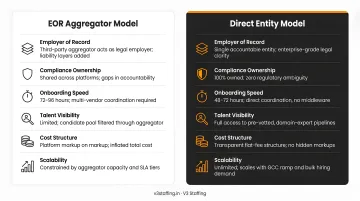
Aggregator vs. direct entity model:
The aggregator model holds 68% market share, partnering with in-country providers for local operations. The direct entity model — where providers own local legal entities — currently represents the minority but is growing among enterprise buyers for specific advantages:
- Faster error resolution: Single point of accountability without vendor finger-pointing
- Predictable flat-fee pricing: Replacing volatile percentage-of-salary models
- Greater data security: No data sharing with third-party sub-vendors
- Compliance accountability: Direct ownership of the entire legal stack
Pricing evolution:
EOR fees range from $199 to $1,200 per employee per month, with a market median of $400–700 on top of salary and statutory contributions (which range from 7.65% to 45% depending on country). The Per-Employee-Per-Month (PEPM) model holds 49% market share. Custom and enterprise pricing is growing at 8.6% CAGR — the fastest of any pricing structure.
Enterprise buyers increasingly demand transparency: flat-fee pricing with no hidden percentage charges, clear breakdowns of statutory vs. service costs, and multi-year rate locks for budget predictability.
Trend 7: Structured Hybrid Work Forces Borderless Role Architecture and Modular HR Policies
Remote work normalization has created a new operational challenge: roles designed for regions rather than countries, triggering complex multi-jurisdiction employment scenarios.
Hybrid work by the numbers:
- 51% of remote-capable employees work in hybrid arrangements (down modestly from 55% in late 2024)
- 78% of companies now hire internationally for remote positions
- Technology sector leads at 94% remote adoption, followed by finance (78%), marketing (71%), and consulting (68%)
Borderless job architectures:
Companies increasingly design roles as "EMEA Lead" or "APAC Director" rather than country-specific positions. This creates real operational complexity: a single role change or promotion can trigger contract amendments across multiple jurisdictions simultaneously, each with different notice requirements, amendment procedures, and regulatory filings.
How leading EOR providers respond:
- Modular policy frameworks: Standardizing core corporate culture elements (Code of Conduct, values, brand guidelines) globally while keeping statutory benefits, leave policies, and employment terms strictly localized
- API-first contract generation: Automated "right to work" verification and contract creation based on work location, not corporate structure
- Real-time compliance mapping: Systems that automatically identify which jurisdiction's laws apply based on where work is performed, not where the employee is hired
- Synchronized multi-country amendments: Platforms that can execute role changes, title updates, or compensation adjustments across 5+ countries simultaneously with jurisdiction-specific paperwork
Enterprises with 100+ EOR workers across 20+ countries can't afford platforms that treat cross-border role management as an edge case. At that scale, multi-jurisdiction workflow needs to be built into the system's core — not bolted on.
What's Driving These EOR Market Trends
Four structural forces are accelerating EOR adoption — and they're not slowing down.
Technology Advances
LLMs and AI make compliance prediction scalable globally for the first time. Automation removes human bottlenecks from payroll processing, contract generation, and worker classification audits. The global AI in HR market is projected to grow from $6.05 billion in 2024 to $14.08 billion by 2029 at a 19.1% CAGR.
Persistent Talent Shortages
ManpowerGroup's 2026 survey of 39,000 employers across 41 countries found 72% report difficulty filling roles. For the first time, AI skills surpassed all others as the hardest capability to source globally. That scarcity pushes enterprises toward high-skill pools in India, Poland, Brazil, and Eastern Europe — where EOR is the fastest legal on-ramp.
Regulatory Volatility
Governments across Europe, LATAM, and APAC are tightening worker classification rules, expanding benefit mandates, and revising minimum wage structures — often at the same time:
In-house compliance teams can no longer keep pace across multiple jurisdictions.
Cost Pressure and Competitive Dynamics
Entity setup runs $20,000–$100,000+ with 6–12-month timelines. For market testing or project-based hiring, EOR is the financially rational choice. When competitors can enter a new market in weeks, organizations still navigating entity incorporation fall further behind with every hiring cycle.
How These Trends Are Impacting Global Expansion Strategy
These trends aren't just changing EOR providers — they're reshaping how enterprise leaders plan international growth, staff globally, and manage workforce risk.
Operational Impact
Compliance is no longer a quarterly audit exercise. Document handling, contract generation, and classification review are now automated end-to-end, cutting turnaround times from weeks to hours in well-integrated EOR environments. V3 Staffing manages statutory obligations including PF, ESI, gratuity, and Professional Tax contributions, keeping clients compliant across India's state-by-state labor regulations.
Cross-border payroll is also merging with HR platforms, forcing closer collaboration between HR and finance teams. Treasury now owns visibility into payroll timing, currency exposure, and wallet liquidity — territory that HR once managed alone.
Business Impact
Enterprises now use EOR to validate market demand with a small local team before committing to entity establishment. The commonly cited graduation threshold is 15+ employees in a country, at which point owned-entity economics become favorable.
Permanent establishment (PE) risk remains the primary concern blocking aggressive EOR use. Enterprises that define clear "safe harbor" governance frameworks — limiting EOR workers from contract signing authority or local decision-making — move faster while keeping tax exposure in check.
Workforce Impact
Global talent teams are upskilling in multi-jurisdiction employment nuances, benefits benchmarking, and asynchronous onboarding for distributed teams. Teams that build this capability consistently win competitive hires faster than those that don't.
Employee expectations are rising in parallel. Workers hired through EOR in competitive markets — tech talent in India, engineers in Eastern Europe — expect timely multi-currency payments, locally benchmarked benefits, and contracts that hold up. In India's GCC market, where V3 Staffing delivers 8–10 business day onboarding timelines with full compliance infrastructure, speed and accuracy directly determine whether you close the hire or lose it.
Future Signals for EOR in the Next 1–3 Years
Three pressure points will determine how the EOR market develops over the next 1–3 years — and where the biggest opportunities (and risks) sit.
AI-Guaranteed PE Risk Mitigation
If LLM-assisted compliance tools can protect enterprises against permanent establishment exposure, CFO resistance to aggressive EOR use will collapse. Analysts project a 10–12% annual growth scenario if AI compliance guarantees materialize. The signal to track: providers shifting from "compliance advisory" to financially-backed "compliance guarantee" models.
Regulatory Convergence vs. Fragmentation
Two scenarios are competing here: global regulatory bodies may attempt to harmonize worker classification standards (reducing complexity), or local governments may accelerate jurisdiction-specific crackdowns (increasing it). The EU Platform Work Directive represents the largest harmonization effort, but implementation timelines remain uncertain. The outcome will define how much deep local legal infrastructure becomes a competitive differentiator.
EOR as Standard Enterprise Infrastructure
Within 3 years, expect leading enterprises to treat EOR coverage across key talent markets as table stakes — similar to how cloud infrastructure is now standard, not optional. Providers that can't offer HRIS integration, flat-fee pricing, and SOC 2 Type II security certifications will lose enterprise mandates. All major players — Deel, Remote, Rippling, G-P, Oyster, and Papaya Global — already treat SOC 2 Type II as baseline, not a differentiator.
Conclusion
The seven EOR market trends — from enterprise adoption and AI-driven compliance to fintech-ization and emerging market expansion — are collectively reshaping how global companies hire, manage risk, and scale. EOR has evolved from a niche workaround into permanent talent infrastructure, with 41% of distributed teams already integrating these services into core HR operations.
Organizations that treat EOR as a strategic layer of their talent infrastructure, rather than a reactive fix, gain measurable advantages:
- 90% faster market entry compared to entity establishment
- 70–80% lower setup costs across new geographies
- Direct access to talent pools in India, LATAM, and EMEA without entity overhead
Those advantages compound fastest in markets where ground-level infrastructure already exists. In India — where 1,800+ GCCs are scaling rapidly — the difference between a smooth launch and a compliance setback often comes down to who you hire through and who helps you hire. V3 Staffing's pan-India presence across major business hubs and Tier-II cities gives global organizations the on-ground recruitment infrastructure to expand without regulatory exposure.
Frequently Asked Questions
Can an employer of record (EOR) help with global expansion?
Yes, an EOR enables companies to hire in new markets without establishing a local legal entity, handling compliance, payroll, and employment contracts. This makes it the fastest and most cost-effective route to international market entry, reducing timelines from 6–12 months to 7–10 days.
What is the difference between a global PEO and an employer of record (EOR)?
An EOR becomes the legal employer of record in countries where the client has no entity, taking on full employment liability. A PEO co-employs workers through a shared model and typically requires the client to already have a legal entity in that country.
What EOR agreement is best for international hiring in the USA?
For US international hiring, a direct EOR model (where the provider owns its own local entities rather than using sub-vendors) offers the strongest compliance guarantees, fastest resolution times, and clearest accountability. Flat-fee pricing structures provide the most transparency.
What is driving the growth of the EOR market globally?
Four structural forces are pushing enterprises toward EOR:
- Talent shortages: 72% of employers struggle to fill roles globally
- Regulatory complexity: EU Platform Work Directive, India Social Security Code
- Remote work normalization: 78% of companies now hire internationally
- Entity setup costs: $20,000–$100,000+ per market entry
How is AI changing EOR services?
AI enables EOR providers to move from reactive compliance management to predictive risk mitigation. Providers now use NLP to review contracts in real time, automate classification audits, and catch permanent establishment risks early. Companies report 19% administrative cost reductions from AI-powered compliance tools.
How do EOR services benefit companies expanding into India?
India's GCC boom has made compliant hiring critical for enterprises setting up capability centers. EOR and trusted staffing partners with pan-India compliance expertise allow companies to onboard talent across major tech hubs (Bengaluru, Hyderabad, Pune, Chennai) and Tier-II cities quickly, managing India-specific statutory requirements like PF, ESI, and gratuity without entity overhead.