Introduction
Over 40% of India's organized white-collar workforce now operates remotely or in hybrid models, with approximately 12.7% working fully from home and 28.2% following hybrid arrangements. For global companies and GCCs, this shift creates a clear opportunity: India now hosts approximately 1,700 Global Capability Centers employing 1.9 million professionals, generating $64.6 billion in export revenue as of FY24.
Accessing that talent, though, comes with real compliance obligations. Companies must navigate India-specific employment contracts, payroll deductions (TDS, EPF, ESI), state-level labor law variations, and cultural onboarding — each with its own failure modes.
Misclassifying full-time employees as freelancers, for instance, can trigger backdated liabilities, regulatory penalties, and scrutiny during funding rounds or audits. This guide walks through what compliant remote hiring in India actually requires — and where most companies get it wrong.
Key Takeaways
- India's talent pool spans IT, engineering, finance, and operations—~1.5 million engineering graduates annually, at 60–90% lower salaries than Western markets
- Compliant hiring means India-specific contracts, payroll withholdings (TDS, EPF, ESI), and state-level professional tax and S&E registrations
- Choose your hiring model based on scale and speed—direct employment, EOR, or staffing partners like V3 Staffing
- Set up structured onboarding and clear communication tools so remote hires are productive from week one
- Never misclassify employees as freelancers—it's the costliest compliance mistake global companies make
Why India Is a Top Destination for Remote Hiring
Massive Talent Pipeline Across Functions
India's 5.43 million-strong IT workforce extends far beyond technology. The country produces approximately 1.5 million engineering graduates annually, feeding deep talent pools in:
- Software engineering, DevOps, QA, data science
- Finance and shared services operations
- Product management, marketing, analytics
- R&D engineering (automotive, aerospace, manufacturing)
This breadth means companies can build entire cross-functional teams—not just IT centers—across India's distributed workforce.
Cost Savings That Hold Up at Scale
The median US software developer earns $133,080 per year, while the average Indian software engineer earns approximately INR 9,00,000 (~$10,700)—representing a 60–90% cost differential depending on role seniority and location.
Total employer costs in India include statutory contributions (12% EPF, 3.25% ESI, professional tax, gratuity provisions). Even after accounting for these, the cost advantage remains substantial for companies building remote teams at scale.
English Proficiency and Time Zone Advantages
India's professional workforce demonstrates higher English competency than national averages suggest. States like Telangana, Himachal Pradesh, and Kerala score significantly higher on proficiency measures, and English serves as the primary business language in IT and corporate sectors.
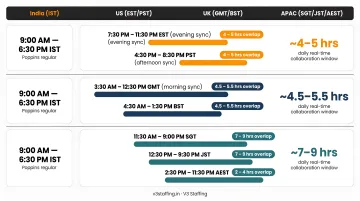
That language alignment pairs well with India's time zone positioning, which supports meaningful overlap with US, UK, and APAC teams:
- 10.5–13 hours ahead of US Eastern Time (3–5 hour overlap for late India/early US meetings)
- 4.5–5.5 hours ahead of UK/Europe (strong overlap during India afternoons)
- Aligned with APAC business hours (Singapore, Australia, Japan)
Digital Infrastructure Enabling Distributed Work
India's internet user base crossed 950 million in 2025. That growth is backed by 924.06 million broadband subscribers, ensuring high-speed connectivity is no longer limited to metros. Tier-II cities—Coimbatore, Jaipur, Vizag, Indore—recorded a 42% increase in job openings between September 2024 and February 2025, giving hiring teams access to experienced professionals with lower attrition rates than major metro markets.
How to Hire Remote Employees in India: A Step-by-Step Process
Define the Role and Set Remote Work Expectations
Before sourcing begins, clarify the role:
- Responsibilities, required skills, experience level, reporting structure
- Whether the role is fully remote, hybrid, or requires specific time zone coverage
- Expected working hours, overlap requirements with global teams
- Communication tools (Slack, Teams, Zoom), meeting cadence, async update norms
Vague job descriptions lead to mismatched hires in India's competitive talent market. Set remote work policies upfront—expected availability windows, performance review cadence, and collaboration expectations.
Source and Attract the Right Candidates
Once the role is defined, the sourcing strategy determines how quickly you reach the right candidates.
Where to find remote talent:
- Naukri.com: Dominant platform with 80% market share, 82 million resumes
- LinkedIn: India's second-largest market globally for professional networking
- CutShort, Instahyre: Tech-focused platforms with AI-driven candidate matching
Pan-India sourcing strategy: Expand beyond metros to Tier-II cities—Coimbatore, Jaipur, Vizag, Indore—where digitally skilled talent has grown over 25% and salary pressure is lower.
Staffing partner advantage: Specialist recruitment firms like V3 Staffing maintain SLA-driven shortlists and pre-vetted talent networks across Hyderabad, Bengaluru, Chennai, Pune, Delhi NCR, and Mumbai—with a 7–12 day time-to-hire and 80% shortlist accuracy.
Screen, Interview, and Shortlist
With a candidate pool identified, the screening process determines who actually fits the role—and the working model.
Remote hiring in India must assess more than technical skills:
- Articulates complex ideas clearly in writing and on video calls
- Demonstrates a track record of meeting deadlines without direct supervision
- Comfortable with documentation, status updates, and async collaboration tools
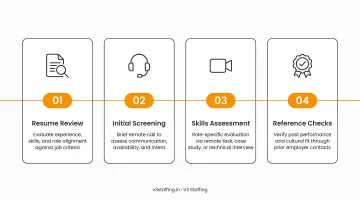
Best-practice screening process:
- Resume screen for role-specific skills and experience
- Skills assessment (coding tests, case studies, domain exercises)
- Video interview assessing communication, problem-solving, cultural fit
- Final shortlist with reference checks
Issue Offer Letters and Employment Contracts
Shortlisting the right candidate is only half the work—the offer letter and contract structure determines legal standing in India.
Employment offers must include:
- Full CTC breakdown: basic salary, allowances, bonuses, and employer contributions
- Notice period of 30–90 days, depending on seniority
- Leave entitlements: 15–18 days annual leave, public holidays, sick leave, and maternity leave
- Termination terms: notice requirements and severance provisions
- IP and NDA clauses covering work product ownership and data access policies
Generic global contracts do not hold up under Indian labor law. Contracts must comply with state-specific Shops and Establishments Acts and central labor codes.
Set Up Payroll, Benefits, and Onboarding
With contracts signed, payroll setup and onboarding determine how quickly the hire becomes productive.
Payroll setup requirements:
- India follows an April–March financial year
- Salaries must include statutory deductions: TDS (income tax at source), EPF (12% employer + 12% employee), ESI (3.25% employer for eligible employees)
- All statutory contributions factor into the total CTC—ensure these are reflected accurately in your payroll system from day one
Structured onboarding: V3 Staffing's onboarding model ensures remote hires are fully productive from day one by completing documentation, compliance, payroll setup, and training before the start date. For temporary staffing, pre-verified talent enables 48–72 hour onboarding.
Legal and Compliance Requirements When Hiring Remote Employees in India
Mandatory Statutory Contributions
| Obligation | Employer Rate | Employee Applicability | Source |
|---|---|---|---|
| EPF (Provident Fund) | 12% of basic wages | Establishments with 20+ employees; wage ceiling ₹15,000/month | EPFO Contribution Rates |
| ESI (State Insurance) | 3.25% of wages | Employees earning ≤ ₹21,000/month | ESIC Contribution Page |
| TDS (Income Tax) | Applicable slab rates | All salaried employees | ClearTax Section 192 |
| Professional Tax | Varies by state; max ₹2,500/year | 21 states + 1 union territory | TaxGuru PT Rates |
EPF Note: The 12% employer contribution splits into the Employees' Pension Scheme (8.33%) and EPF account, plus 0.5% EDLI and 0.5% administrative charges.
Employment Contract Requirements
Remote employees must have India-compliant contracts covering:
- Role definition, compensation breakdown, working hours
- Leave policy (annual, public holidays, sick, maternity)
- Notice period, probation terms, termination conditions
- IP ownership clauses, data access policies, confidentiality agreements
⚠️ Misclassification risk: Classifying a long-term employee as a contractor triggers backdated EPF/ESI contributions, back wages, penalties, and potential criminal prosecution under the EPF Act.
Key Leave Entitlements
- Annual paid leave: Typically 15–18 days
- Public holidays: National and state-specific holidays
- Maternity leave: 26 weeks for first two children, 12 weeks for subsequent children (minimum 80 days of service required)
- Sick leave: As per company policy and state regulations
These entitlements apply to remote employees identically to in-office staff.
Data Protection Under DPDPA 2023
Beyond leave and contract obligations, employers must also account for how employee data is collected and handled. India's Digital Personal Data Protection Act (2023) applies directly to remote work arrangements. Key employer obligations include:
- Process employee data (payroll, performance, compliance) without explicit consent under the Legitimate Use Exemption
- Notify the Data Protection Board of India and affected employees of any personal data breach
- Delete personal data once its specific purpose is fulfilled or consent is withdrawn
- Remain liable for third-party vendors — payroll software, HR platforms — that process employee data on your behalf
State-Level Labor Law Variations
India lacks a standalone remote work statute. WFH arrangements operate under state-specific Shops and Establishments Acts, creating inconsistent compliance requirements across jurisdictions:
- Professional tax: Rates and slabs differ across 21 states
- S&E registrations: Required based on the nature of employment and state jurisdiction
- Working hours and overtime: State-specific regulations apply
For distributed remote teams, this means juggling multiple registrations and compliance deadlines simultaneously — a common pain point for organizations scaling across India's major business hubs. V3 Staffing handles state-level filings, professional tax registrations, and audit-ready documentation across jurisdictions, so your team isn't managing it piecemeal.
Choosing the Right Hiring Model for Remote Talent in India
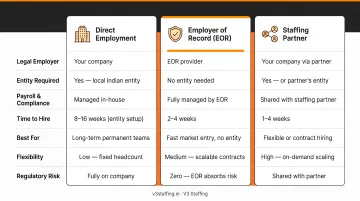
Direct Employment
How it works: Your company sets up a legal entity in India and hires employees directly.
Best for: Large teams with a long-term India presence and budget for entity setup.
Considerations: Entity setup involves multiple steps and a meaningful time commitment:
- Register a Private Limited Company or Branch Office
- Complete PAN/TAN, EPF/ESI, and GST registrations
- Budget for ongoing legal and accounting overhead
Setup typically takes 3–6 months before you can hire your first employee.
Employer of Record (EOR) Model
How it works: A third-party EOR acts as the legal employer in India, managing payroll, statutory benefits, and compliance, while you direct day-to-day work.
Best for: Companies without an Indian entity that need to hire within weeks rather than waiting 3–6 months for entity setup.
Considerations: EOR providers handle employment contracts, payroll deductions, EPF/ESI contributions, and TDS filings. You avoid entity setup but pay a service fee per employee. Suitable for small-to-medium teams testing the India market.
Staffing and Recruitment Partner Model
How it works: A specialist partner like V3 Staffing handles sourcing, vetting, and placement of remote talent, with flexibility to support contract, temporary, or permanent hiring.
Best for: Companies wanting speed and quality without building full HR infrastructure—particularly useful for GCCs and enterprises scaling across multiple cities.
Considerations: V3 Staffing's model is built around measurable delivery:
- SLA-driven shortlists with 7–12 day time-to-hire and 80% accuracy
- Structured onboarding for day-one productivity
- Compliance management across state-level regulatory variations
- Pre-verified talent for temporary roles, with 48–72 hour onboarding
Best Practices for Managing Remote Employees in India
Set Communication Infrastructure Early
Define tools, norms, and expectations before day one:
- Platforms: Slack, Microsoft Teams, Zoom for sync; Notion, Confluence for async documentation
- Meeting cadence: Daily standups, weekly 1:1s, monthly reviews
- Overlap hours: Establish 2–3 hour windows for real-time collaboration with global teams
- Async update norms: End-of-day summaries, weekly progress reports, documented decision-making
Poor communication structure is the top reason remote teams underperform.
Build a Structured Onboarding Experience
Introduce new remote hires to company goals, culture, tools, and team within the first week:
- Pre-onboarding: Complete contracts, payroll setup, compliance before start date
- Day 1: Welcome session, tool access, org chart walkthrough
- Week 1: Role-specific training, team introductions, first assignments
- Month 1: Regular check-ins, feedback loops, performance expectation setting
V3 Staffing structures onboarding so compliance is resolved before day one and employees are contributing within the first week — a practical advantage for enterprises scaling remote teams quickly.
Prioritize Engagement and Retention
India's IT sector attrition fell from 19.3% in 2023 to 15.1% in 2024, but remains notable compared to Western markets. Retention strategies include:
- Offer clear promotion paths, mentorship, and funded skill development programs
- Recognize performance publicly through bonuses, peer recognition, and team-wide acknowledgment
- Provide health insurance, mental health support, learning stipends, and flexible time off
In India's tech talent market, engineers with in-demand skills receive multiple offers. Getting compensation and growth right from the start reduces turnover before it becomes a pattern.
Use Agile Project Management Tools
Retention keeps your team intact; the right tooling keeps them aligned. Platforms like Jira, Trello, Asana, or ClickUp ensure task visibility, accountability, and faster decision-making in distributed teams:
- Establish clear OKRs or sprint-based goals from day one
- Track progress transparently with real-time dashboards
- Document decisions and updates asynchronously to reduce meeting overhead
Common Pitfalls to Avoid When Hiring Remotely in India
Two compliance failures trip up most companies entering the Indian remote hiring market: misclassifying workers and underestimating payroll complexity. Both are avoidable with the right structure in place.
Misclassifying Employees as Freelancers or Independent Contractors
If a remote worker has fixed hours, reports to a manager, uses company tools, and performs a core business function, Indian law may treat them as an employee regardless of contract language.
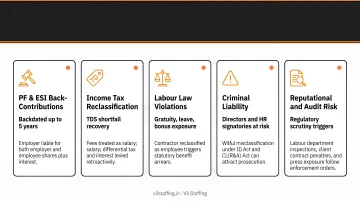
Consequences of misclassification:
- Regularization of the worker as a full-time employee with all entitlements
- Backdated EPF and ESI contributions for the entire engagement period, plus interest
- Back wages, gratuity, leave encashment, bonus payments
- Penalties and fines from EPFO or ESIC
- Legal liability including potential criminal prosecution for willful non-compliance
- Reputational damage during funding rounds or audits
The Supreme Court of India has ruled that contractual workers are entitled to provident fund benefits, reinforcing that the substance of the relationship—not its label—determines classification.
Underestimating State-Level and Payroll Compliance Complexity
Many companies set up payroll informally or use generic global structures that ignore India-specific rules:
- Professional tax rates vary across 21 states (capped at INR 2,500/year per Article 276)
- Shops and Establishments registrations differ by state jurisdiction
- Gratuity eligibility applies after 5 years of service
- Maternity leave, notice periods, and termination clauses must comply with state-level variations
Retroactive corrections typically involve back payments, penalty interest, and legal exposure across multiple state jurisdictions simultaneously — costs that dwarf what compliant setup requires upfront. Working with a staffing partner experienced in India's multi-state compliance landscape, like V3 Staffing, helps companies manage professional tax filings, Shops and Establishments registrations, and audit-ready documentation from the first hire.
Frequently Asked Questions
How do I hire remote employees from India?
Start by defining the role and remote work policy, then source candidates through job portals (Naukri, LinkedIn) or a recruitment partner like V3 Staffing. Issue India-compliant offer letters covering CTC, notice period, and leave entitlements, and set up payroll with statutory contributions (EPF, TDS, ESI) before the employee's first day.
Are US companies still hiring remote employees from India?
Yes, US companies continue to actively hire remote talent from India, driven by cost efficiency, strong English proficiency, and a deep tech talent pool. This trend is accelerating as GCCs and product companies expand India teams—1,700 GCCs now employ 1.9 million professionals with headcount projected to reach 2.5–2.8 million by 2030.
What are the 70/30 and 80% rules in hiring?
The 70/30 rule suggests hiring candidates who meet ~70% of stated requirements, with the remaining 30% trainable post-hire. The 80% rule (four-fifths rule) is a US EEOC adverse impact standard requiring that a protected group's selection rate be at least 80% of the non-protected group's rate. Neither applies as an Indian regulatory requirement.
What are the key Indian labor laws employers must know when hiring remotely?
Core obligations include EPF and ESI contributions, 26 weeks' paid maternity leave under the Maternity Benefit Act, state-level Shops and Establishments Acts (working hours, professional tax), and the Digital Personal Data Protection Act. Remote employees carry the same statutory entitlements as in-office staff.
What is the difference between a remote employee and a freelancer in India?
Remote employees have defined roles, fixed compensation, statutory benefits (EPF, ESI, leave), and long-term commitment under India-compliant employment contracts. Freelancers are project-based, self-managed, and receive invoiced payments without statutory benefits. Misclassifying employees as freelancers creates legal exposure including backdated liabilities and penalties.
How long does it take to hire and onboard a remote employee in India?
With the right recruitment partner and clear hiring process, remote hires in India can be sourced, interviewed, and onboarded within 2–4 weeks. V3 Staffing's SLA-driven model achieves 7–12 day time-to-hire for permanent placements, with temporary staffing models enabling 48–72 hour onboarding through pre-verified talent pools.
Ready to build your remote team in India? Hiring remote employees in India offers deep talent pools, significant cost advantages, and time zone flexibility—but only when done compliantly. Partner with V3 Staffing for SLA-driven hiring, structured onboarding, and compliance support across Hyderabad, Bengaluru, Chennai, Pune, Delhi NCR, Mumbai, and Tier-II cities. Contact us to discuss your hiring needs.