Introduction
Large enterprises and GCCs today manage two very different hiring realities at the same time. On one side, there's a constant flow of contractors, project-based consultants, and temporary workers. On the other, there's ongoing pressure to build permanent, high-performing teams without ballooning the HR headcount needed to do it.
MSP and RPO are the two models designed to solve these distinct problems, but they get conflated in HR conversations constantly. The confusion is understandable: both involve outsourcing talent-related functions. Mixing them up, though, has real consequences.
Deploy an MSP for permanent hiring and you're paying for vendor governance infrastructure you don't need. Use an RPO for contingent workforce management and you lose the compliance controls and spend visibility that protect you operationally.
This guide covers clear definitions, a side-by-side comparison, and a practical decision framework to help HR and talent leaders choose the right model, or the right combination of both.
Key Takeaways
- MSP manages your entire contingent workforce (contractors, freelancers, temps, SOW consultants) through a structured vendor ecosystem.
- RPO takes over part or all of your permanent hiring function, with recruiters embedded directly into your TA process.
- Core distinction: MSP = contingent workforce governance; RPO = permanent hiring optimization.
- Your choice depends on workforce composition, primary pain point, and internal HR capacity.
- Total Talent Management (TTM) combines both for organizations managing a mixed workforce.
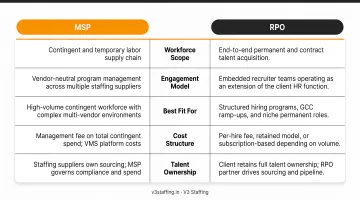
MSP vs RPO: Quick Comparison
Here's how MSP and RPO compare across the dimensions that matter most for your hiring decisions.
| Dimension | MSP | RPO |
|---|---|---|
| Workforce type | Contractors, temps, freelancers, SOW consultants | Permanent full-time employees |
| Sourcing method | Vendor network coordinated via VMS | Direct talent network, ATS, outreach campaigns |
| Operational scope | Onboarding, offboarding, contracts, invoicing | Sourcing, screening, interviews, onboarding coordination |
| Team integration | Dedicated program manager as vendor liaison | Embedded recruiters supplement or replace internal TA |
| Primary KPIs | Cost savings, compliance, spend visibility | Time-to-hire, cost-per-hire, quality-of-hire |
What Is an MSP (Managed Service Provider)?
A Managed Service Provider in the staffing context is a third-party company that takes over the sourcing, engagement, management, and offboarding of an organization's entire contingent workforce — temporary workers, contractors, independent consultants, and freelancers operating under a Statement of Work (SOW).
How MSP Operates
Rather than HR managing eight to fifteen staffing agencies independently, the MSP becomes the single point of accountability. It typically operates through a Vendor Management System (VMS) that consolidates visibility across all suppliers — standardizing pricing, running compliance checks, and tracking performance metrics across the full supplier network.
The scale of contingent workforces makes this governance layer genuinely necessary. According to Deloitte, contingent workers now represent 30–50% of total headcount for many large enterprises. Cisco, for example, manages over 50,000 contingent contributors alongside 83,000 employees globally.
Without a centralized management layer at that scale, compliance gaps and uncontrolled spend become hard to contain.
SIA reports that 58% of companies with 1,000+ employees already engage a third-party firm to manage their staffing providers — a sign of how widely this need has been recognized.
Core MSP Benefits
- Consolidates contingent spend previously scattered across departments and cost centers
- Standardizes employment law adherence across geographies — valuable for multinational programs
- Scales resources up or down based on project demand without adding HR overhead
- Controls costs through rate governance, supplier rationalization, and VMS automation
When MSP Fits
MSP works best for large enterprises, GCCs, or manufacturing and logistics organizations where project-based or seasonal contract staff make up a significant share of total headcount. India's broader flexi staffing sector grew 9.7% in FY25 — a direct signal of how fast demand for contingent workforce governance is expanding across the region.
One important boundary: the MSP operates after a hiring decision has been made, managing vendors, tracking assignments, and handling offboarding. Strategic candidate sourcing for permanent roles falls outside its scope — and that's where RPO comes in.
What Is RPO (Recruitment Process Outsourcing)?
RPO is an arrangement where an organization outsources part or all of its permanent recruitment function to an external provider. Unlike a traditional staffing agency that fills roles transactionally, an RPO acts as an embedded extension of your HR team — taking ownership of employer branding, talent mapping, job advertising, screening, interviewing, and onboarding of full-time hires.
How RPO Operates
RPO providers integrate with a client's internal ATS and HRIS systems, deploying dedicated recruiters on-site or virtually. They own quality-of-hire outcomes, not just candidate delivery. Their success is tied to the long-term performance of the hires they make , not just the volume of CVs submitted.
Aberdeen Group's primary research found that organizations investing in RPO reported a 55% decrease in cost per hire and a 64% improvement in time-to-fill (2012 data; directionally relevant, though current benchmarks vary by market). HRO Today further notes that RPO providers typically reduce the internal hiring period by 30–40%.
V3 Staffing's RPO model follows this structure: dedicated account managers and specialized recruiting teams embed into client workflows, aligned to SLAs with transparent dashboards tracking every requisition.
Across documented engagements, V3 has achieved an 85% sourcing-to-L1-select ratio and a 90% offer-to-join ratio, with candidates delivered within 8–10 business days on average.
Core RPO Benefits
- Improved quality of hire through structured screening and technical validation before interviews begin
- Reduced time-to-fill, especially for high-volume or niche permanent roles
- Access to passive candidate pools not reachable through job boards
- Employer brand development that improves offer acceptance rates
- Cost-per-hire reduction through process standardisation at scale
RPO Variations
RPO models vary depending on scope and commitment. Three common formats exist:
- End-to-end RPO — the full recruitment function is outsourced under a multi-year agreement
- Project RPO — a defined hiring push, typically over 3–6 months, for a specific growth need
- Selective/modular RPO — specific stages only (sourcing, screening, or interview coordination) are outsourced
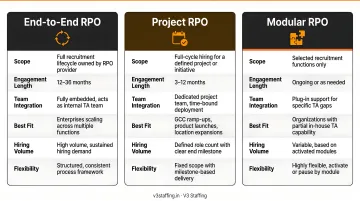
V3 Staffing offers all three formats — short-term, long-term, and project-based — making the model accessible to organisations at different growth stages, not just enterprises with mature TA functions.
When RPO Fits
RPO is the right fit for organisations with high-volume permanent hiring needs: large IT companies, GCCs scaling engineering or analytics teams, product organisations building specialised functions, and enterprises entering new markets. It's especially valuable when internal TA teams are stretched across too many open requisitions to maintain hiring quality.
V3 Staffing has delivered at this scale across sectors:
- ~2,000 hires over two years for a Fortune 500 HVAC company building out finance shared services
- ~1,000 software engineers within 12 months for a global automotive manufacturer
Both engagements ran through embedded RPO teams operating as a direct extension of each client's HR function.
MSP vs RPO: Which Model Is Right for Your Organization?
The right model depends on the specific workforce problem you're trying to solve — not on which option sounds more sophisticated.
The Decision Framework
Three variables determine the right answer:
- Workforce composition — what percentage of your workforce is contingent vs. permanent?
- Primary pain point — is it compliance and cost visibility, or is it quality and speed of permanent hiring?
- Internal HR capacity — do you have TA teams who need support, or a vendor ecosystem that needs governance?
Choose MSP when:
- Your contingent workforce is large, fragmented across suppliers, and lacks centralized visibility
- Multi-vendor management creates compliance exposure across geographies
- Contingent spend is inconsistent or uncontrolled across business units
- You need scalable capacity for project-based or seasonal contract labor
Choose RPO when:
- Your primary challenge is permanent hiring quality, time-to-fill, or employer brand
- Internal TA teams are overwhelmed relative to open requisition volume
- You're scaling a new function without the budget to proportionally grow HR headcount
- You need specialized domain expertise for niche roles your team struggles to fill
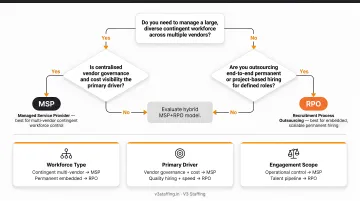
When to Use Both — Total Talent Management
Most large enterprises and GCCs today manage both contingent and permanent workforces simultaneously. An increasing number are formalizing this under a Total Talent Management (TTM) model — integrating MSP and RPO programs under a unified talent strategy.
NelsonHall identifies TTM as a distinct market category, noting a clear trend toward merging RPO, contingent workforce management, and talent management services as organizations seek to eliminate duplicated technology, processes, and supplier relationships.
The operational benefit: one partner, one framework, full visibility across permanent and contingent headcount.
Contingent RPO as a Middle Ground
For organizations that need to rapidly scale specialized contract talent — data engineers, cloud architects, embedded systems specialists — without depending entirely on agency-dependent fulfillment, Contingent RPO (also called direct sourcing) applies RPO methodology to contingent hiring. It uses employer branding, dedicated recruiters, and talent community building to source contract talent directly rather than through a vendor chain.
This model suits organizations that want the governance of an MSP combined with the sourcing quality of an RPO — particularly relevant for GCCs building specialized contract teams on project terms.
If you're an enterprise or GCC in India working through this decision, V3 Staffing supports both models — SLA-driven permanent hiring and scalable contract staffing. Their GCC engagements start with a Blueprint and Feasibility assessment, so the recommended model is matched to your actual workforce composition before any hiring begins.
Conclusion
MSP and RPO are complementary solutions, not competing ones. When the challenge is managing vendor ecosystems and compliance for a contingent workforce, MSP delivers the control and cost discipline you need. When the challenge is building a high-quality permanent team faster than your current TA function allows, RPO is the right move.
For large enterprises and GCCs managing both hiring tracks, the answer is usually both — structured under a unified talent strategy.
The metrics that justify either model are concrete:
- Lower hiring costs through consolidated vendor management or reduced agency dependency
- Compliance assurance across contingent and permanent workforce categories
- Faster time-to-fill without adding internal TA headcount
- Workforce scalability that doesn't require proportional HR overhead growth
When structured well, both models put accountability where it belongs — with people who hire at scale, every day.
Frequently Asked Questions
Frequently Asked Questions
What does RPO and MSP mean?
RPO stands for Recruitment Process Outsourcing, where an external provider manages permanent hiring end-to-end. MSP stands for Managed Service Provider, a model that governs the full contingent workforce — contractors, temps, and SOW-based consultants — through a centralized vendor management structure.
What is the difference between MSP and RPO recruitment?
MSP recruitment focuses on sourcing and managing temporary or contract workers through a coordinated vendor network via a VMS. RPO handles permanent hires end-to-end, with embedded recruiters taking ownership of sourcing, screening, and onboarding while working as an extension of your internal TA team.
What is the difference between outsourcing and managed services?
Outsourcing, as in RPO, transfers a business function like recruitment to an external provider who executes it on your behalf. Managed services, as in MSP, is an ongoing operational relationship where the provider manages a workforce category, vendor relationships, and compliance — with defined accountability for outcomes.
Can a company use both MSP and RPO at the same time?
Yes — many large enterprises do. RPO handles permanent hiring while MSP governs contingent labor in parallel. This is increasingly formalized under a Total Talent Management (TTM) model that integrates both under a single provider or unified strategy, removing the friction of managing two separate vendor relationships.
Which model is more cost-effective — MSP or RPO?
It depends on your workforce mix. MSP reduces costs through vendor consolidation, rate governance, and compliance risk reduction for contingent labour. RPO targets cost-per-hire and time-to-fill for permanent roles; Aberdeen's research found a 55% decrease in cost per hire among RPO adopters. Whichever cost driver is most pressing in your organisation points to the better ROI.
What is Total Talent Management (TTM)?
TTM is a workforce strategy that combines MSP and RPO under one framework, managing both contingent and permanent talent together. NelsonHall classifies it as a distinct market segment for organisations that want unified visibility and a single strategy across all workforce categories.