
.svg)
.svg)
As organisations scale across functions and geographies, traditional employment models often struggle to keep up with changing demand, specialized skill needs, and project-based work. With up to 40% of the global workforce failing into this category, contingent employment is becoming a core part of how enterprises build and manage teams.
This article breaks down what contingent employment means in practice, how it differs from other hiring models, and where it fits within modern workforce strategy. It explores the benefits, risks, and use cases of contingent hiring, along with how organisations can apply it effectively; especially when operating across India and global markets like the USA and the UAE. By the end, readers will have a clear framework to decide when and how to use contingent employment as part of a scalable hiring approach.
Key Takeaways
- Contingent employment is a strategic workforce model, not just a temporary hiring solution, enabling flexibility and faster scaling.
- It is most effective when applied to project-based, high-volume, or specialised hiring needs, rather than core long-term roles.
- Enterprises benefit from contingent hiring through cost optimisation, speed, and access to niche talent, especially in technology-driven roles.
- However, success depends on strong governance, compliance, and visibility, particularly when operating across regions like India, the USA, and the UAE.
- The most effective approach is a blended workforce strategy, combining contingent and full-time hiring to balance flexibility with long-term stability.
What Is Contingent Employment? All You Need to Know in 2026
Contingent employment refers to a workforce model where individuals are engaged on a non-permanent, flexible basis rather than through traditional full-time employment.
For enterprises, this typically includes hiring talent for project-based roles, short-term needs, or specialised functions where long-term commitments are not required.
Instead of building permanent teams for every function, organisations use contingent workers to adapt quickly to changing business demands, manage costs, and access specific expertise when needed.
These roles are usually tied to specific deliverables, timelines, or business needs:
- Non-permanent workforce: Workers are engaged for a defined period or scope of work
- Project-based or flexible roles: Hiring is aligned to business cycles, project demands, or specialised tasks
This model allows organisations to scale hiring up or down without long-term employment obligations.
Types Of Contingent Workers
Enterprises typically engage different types of contingent workers depending on their hiring needs:
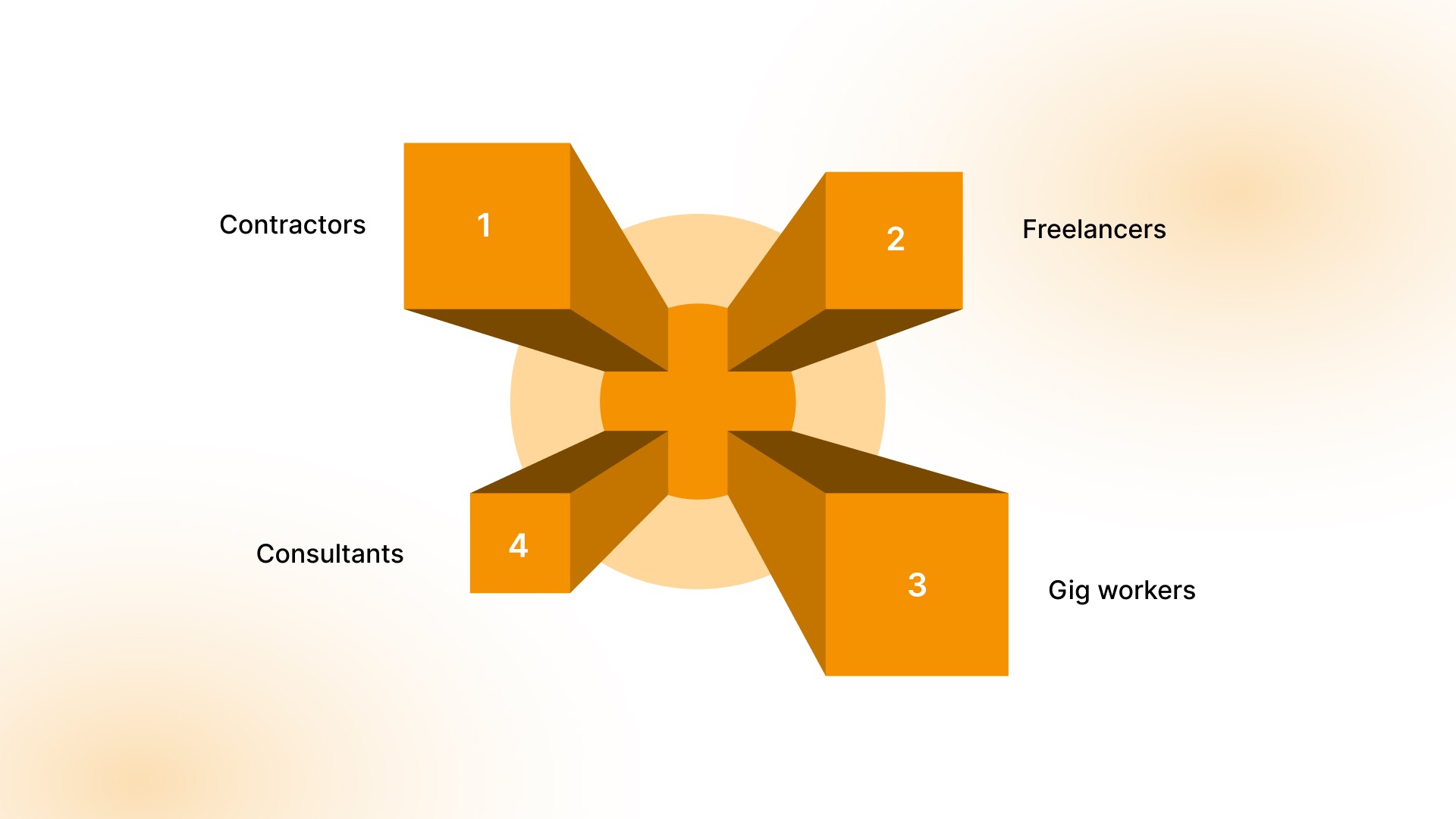
- Contractors: Professionals hired for a fixed duration or project
- Freelancers: Independent workers offering specialised services on a flexible basis
- Gig workers: Task-based workers engaged for short, often repeatable assignments
- Consultants: Experts brought in for strategic or domain-specific guidance
Each type serves a different purpose, from execution-heavy roles to advisory functions.
How It Differs From Traditional Employment
Contingent employment differs significantly from full-time hiring in terms of structure and obligations:
- No long-term employment contract: Engagement is limited to a defined period or project scope
- Different benefits and obligations: Organisations are not typically responsible for long-term benefits such as insurance, retirement plans, or career progression
For enterprises, this creates greater flexibility in workforce planning, but also requires clear contracts, compliance oversight, and structured management.
Also Read: How India's AI Workforce is Shaping the Future of Jobs in 2026
Why Contingent Employment Is Growing In 2026
Contingent employment is expanding rapidly as enterprises rethink how they build and manage teams. Instead of relying solely on full-time hiring, organisations are adopting more flexible workforce models to respond to changing business demands, specialised skill needs, and global expansion strategies.
Shift Towards Flexible Workforce Models
Enterprises are moving toward flexible workforce structures that allow them to scale teams based on project needs, market conditions, and business cycles.
Contingent hiring enables organisations to bring in talent when required and adjust workforce size without long-term commitments.
- Supports project-based and short-term hiring needs
- Reduces dependency on fixed workforce structures
- Enables faster response to changing business priorities
This flexibility is particularly valuable in industries where demand fluctuates or where teams need to scale quickly.
Demand For Specialized Skills
The growing need for specialized talent is another key driver of contingent employment. Roles in areas such as engineering, data, cloud, AI/ML, and cybersecurity often require niche expertise that is not always available within internal teams.
- Access to highly specialised, hard-to-find skills
- Ability to engage experts for specific deliverables or projects
- Reduced need for long-term hiring for short-term requirements
Contingent models allow enterprises to tap into this talent without committing to permanent roles, improving both speed and efficiency in hiring.
Global Hiring And Distributed Teams
As organisations expand across geographies, contingent employment supports the shift toward global and distributed workforce models. Companies are increasingly hiring across India’s talent hubs while also building teams in markets like the USA and the UAE.
- Enables cross-border hiring without full local entity setup
- Supports remote and distributed team structures
- Helps manage regional talent availability and cost differences
This trend allows enterprises to access broader talent pools and scale internationally, while using contingent models to manage complexity in compliance and workforce management.
Also Read: 8 AI-Based Hiring Methods That Cut Recruitment Time in Half (2026)
Contingent Employment Vs Contract Vs Full-Time: Key Differences
Understanding the distinction between contingent, contract, and full-time employment is essential for enterprise workforce planning. Each model serves a different purpose, and choosing the right one depends on hiring goals, role complexity, and required flexibility.
Contingent Vs Contract Workers
While often used interchangeably, contract workers are actually a subset of the broader contingent workforce. The table below highlights how they differ in structure and engagement:
Key takeaway: All contract workers are contingent, but not all contingent workers are contract-based.
Contingent Vs Full-Time Employees
The difference between contingent and full-time employees is more structural, impacting cost, flexibility, and long-term workforce planning. The comparison below outlines the key distinctions:
Key takeaway: Contingent workers provide flexibility and speed, while full-time employees offer stability and continuity.
When To Use Each Model
Selecting the right employment model depends on the nature of the role and business requirements. The guidance below outlines when each approach is most effective:
Use contingent employment when:
- Hiring for short-term projects or fluctuating workloads
- Needing specialised skills without long-term commitment
- Expanding into markets like India, the USA, or the UAE
Use contract workers when:
- Roles have clearly defined timelines and deliverables
- Projects require dedicated resources for a fixed duration
Use full-time employees when:
- Roles are core to long-term business operations
- Continuity, ownership, and team integration are critical
For enterprise teams, the most effective approach is often a blended workforce model, combining full-time employees with contingent and contract talent to balance flexibility, cost, and long-term capability.
Also Read: Hiring Offshore Tech Talent from India in 2026: Costs, Risks, and Realities
Benefits Of Contingent Employment For Enterprises in 2026
Contingent employment has become a key lever for enterprises looking to balance speed, cost, and access to talent. When applied strategically, it enables organisations to adapt quickly to changing business needs without overextending internal teams.
Workforce Flexibility And Scalability
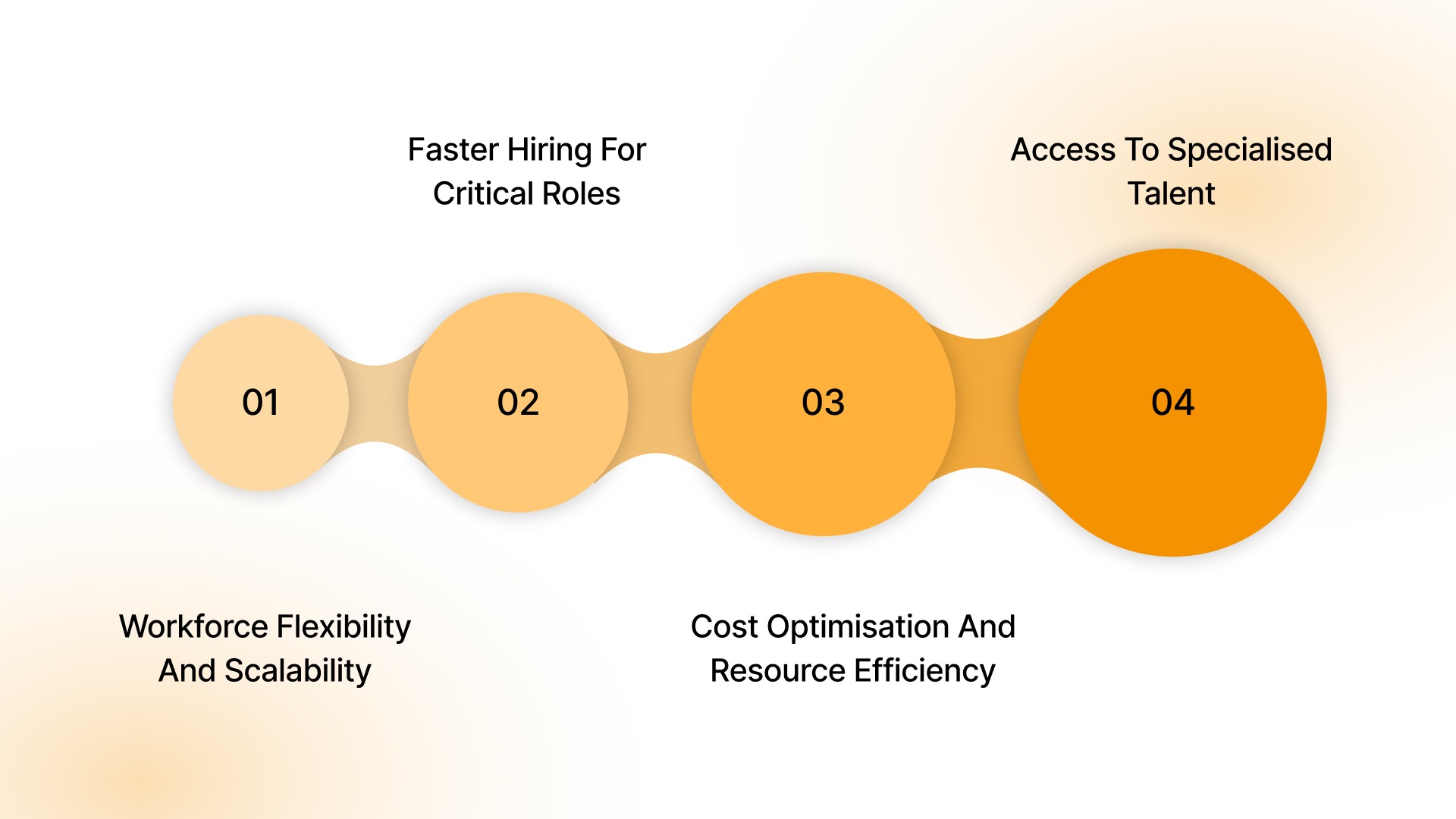
Contingent hiring allows enterprises to scale teams up or down based on demand. Instead of committing to permanent headcount, organisations can align workforce size with project timelines and business cycles.
- Adjust team size without long-term obligations
- Respond quickly to changing priorities
- Support expansion into new functions or markets
This flexibility is especially valuable in dynamic environments where hiring needs are not constant.
Faster Hiring For Critical Roles
Contingent models enable faster hiring, particularly for urgent or high-impact roles. Pre-existing talent pools and streamlined processes reduce time-to-hire significantly.
- Access ready-to-deploy candidates
- Reduce delays in sourcing and screening
- Accelerate project timelines
For enterprise teams, this ensures critical roles are filled without disrupting business operations.
Cost Optimisation And Resource Efficiency
Contingent employment helps optimize costs by aligning hiring with actual demand. Organisations avoid long-term financial commitments associated with full-time roles.
- Pay for talent only when needed
- Reduce overhead costs (benefits, long-term liabilities)
- Improve budget allocation across projects
This makes contingent hiring a practical option for managing both short-term and fluctuating workloads.
Access To Specialised Talent
Enterprises can tap into niche skill sets that may not be available internally or required on a long-term basis.
- Hire experts for specific technologies or projects
- Access broader talent pools beyond full-time candidates
- Bring in domain expertise quickly
This is particularly important for roles in areas like cloud, data, AI/ML, and cybersecurity.
Also Read: 8 AI-Based Hiring Methods That Cut Recruitment Time in Half (2026)
Challenges And Risks Of Contingent Employment in 2026
While contingent employment offers clear advantages, it also introduces operational and strategic challenges. Enterprises need structured processes to manage these risks effectively.
Compliance And Legal Complexity
Managing contingent workers across regions involves navigating different labour laws, tax structures, and classification rules.
- Risk of worker misclassification
- Varying compliance requirements across India, USA, and UAE
- Need for proper contracts and documentation
Without strong governance, compliance gaps can create legal and financial exposure.
Workforce Visibility And Control
Contingent workers are often managed outside core HR systems, making it harder to track performance, availability, and costs.
- Limited visibility into workforce utilisation
- Challenges in managing distributed teams
- Inconsistent reporting across vendors
This can impact decision-making and overall workforce planning.
Cultural Integration And Engagement
Contingent workers may not be fully integrated into organisational culture, which can affect collaboration and alignment.
- Lower engagement compared to full-time employees
- Limited connection to company goals and values
- Challenges in team cohesion
This is particularly relevant for long-term or strategic projects.
Quality And Consistency Risks
Without structured screening and management, the quality of contingent hires can vary significantly.
- Inconsistent candidate evaluation across vendors
- Risk of skill mismatch or underperformance
- Dependence on external partners for delivery quality
Enterprises need clear standards and processes to maintain consistency.

Also Read: Best Practices for Managing High-Volume Seasonal Hiring in 2026
When Should Enterprises Use Contingent Workers?
Contingent employment is most effective when used in specific, well-defined scenarios. Rather than replacing full-time hiring, it complements it as part of a broader workforce strategy.
Project-Based Hiring Needs
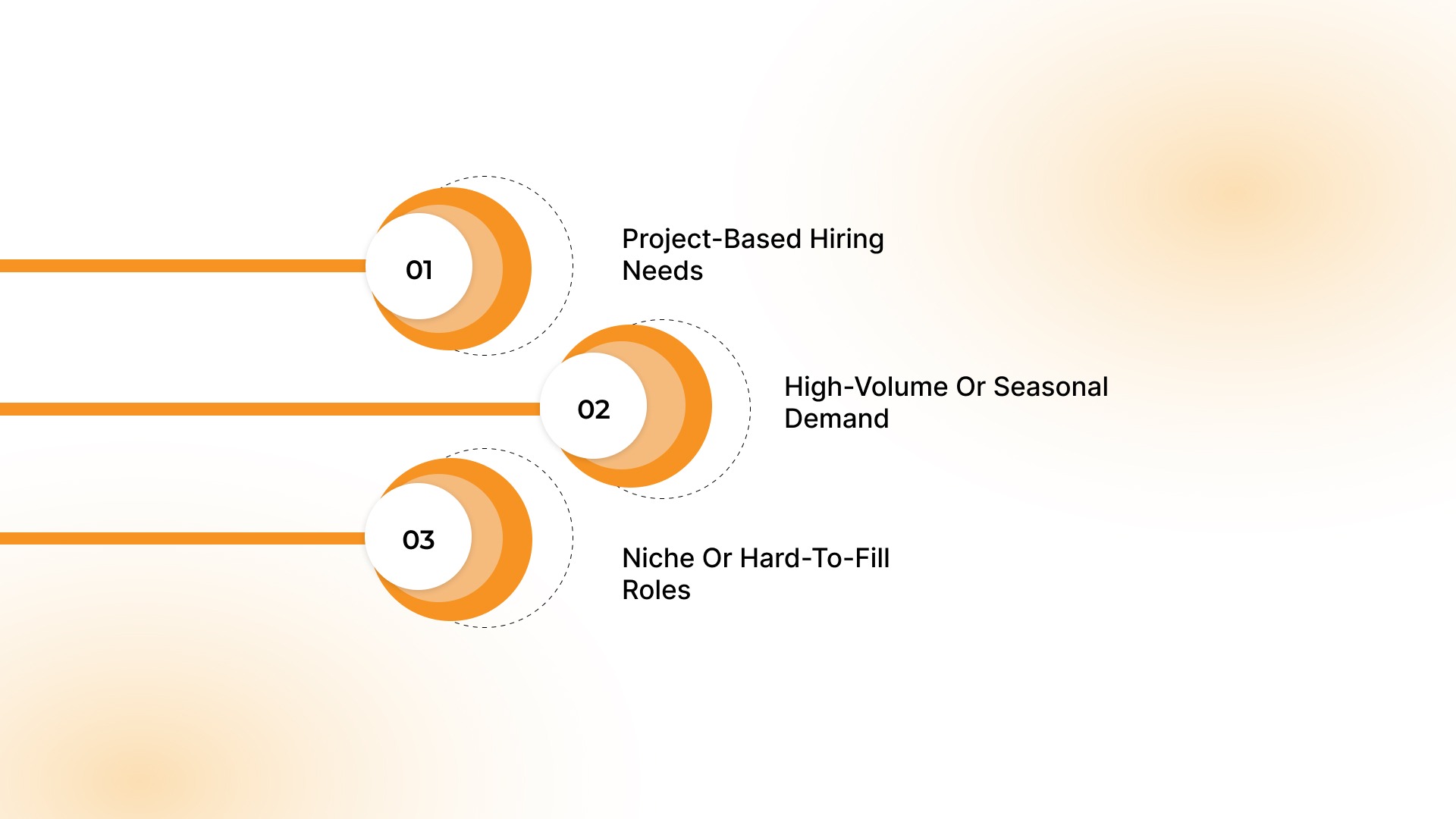
Contingent workers are ideal for roles tied to specific projects with defined timelines and deliverables.
- Short-term technology implementations
- Product development cycles
- Consulting or advisory engagements
This ensures resources are aligned with project duration without long-term commitments.
High-Volume Or Seasonal Demand
When hiring demand fluctuates, contingent models help manage volume without overburdening internal teams.
- Seasonal hiring spikes
- Large-scale operational rollouts
- Temporary workforce expansion
This approach maintains efficiency during peak periods.
Niche Or Hard-To-Fill Roles
For specialised roles that are difficult to fill permanently, contingent hiring provides a practical alternative.
- Roles in AI/ML, cloud, data, and cybersecurity
- Short-term need for expert-level skills
- Limited availability of full-time candidates
This allows enterprises to access critical expertise without delaying business priorities.
Also Read: How Fast-Growing Companies Build Scalable Hiring Solutions in 2026
How To Build And Manage A Contingent Workforce Strategy
Building an effective contingent workforce strategy requires more than ad hoc hiring. Enterprises need a structured approach that defines when to use contingent talent, how to manage it, and how it fits into broader workforce planning; especially when operating across India, the USA, and the UAE.
Define Use Cases And Role Categories
The first step is identifying where contingent employment adds the most value. Not all roles are suited for flexible hiring, so enterprises should clearly define use cases.
- Project-based roles: Technology implementations, product builds, consulting
- High-volume or temporary needs: Seasonal demand or short-term scaling
- Specialised roles: Niche skills in areas like AI/ML, cloud, and data
This ensures contingent hiring is applied strategically rather than reactively.
Choose The Right Engagement And Management Model
Selecting the right model is critical for both execution and control. Enterprises must decide how contingent workers will be sourced, engaged, and managed.
- Direct hiring vs staffing partners or RPO models
- Contract duration and scope definition
- Integration with internal teams and workflows
Strong vendor and partner management becomes essential here, especially when working with multiple agencies or across regions.
Set Up Governance, Compliance, And Visibility
Contingent hiring introduces additional complexity in compliance and workforce tracking. Enterprises need structured governance frameworks to maintain control.
- Clear contracts and worker classification
- Compliance with labour laws across India, the USA, and the UAE
- Centralised reporting for workforce visibility and cost tracking
Without this, organisations risk legal exposure and fragmented workforce management.
Integrate With Core Hiring And Workforce Strategy
Contingent employment should not operate in isolation. It must align with the organisation’s overall hiring and workforce planning strategy.
- Balance between full-time and contingent workforce
- Alignment with long-term business goals
- Coordination between HR, procurement, and business teams
This integration ensures consistency in hiring decisions and avoids siloed workforce management.
Fit Within Global Hiring Models
Contingent employment plays a key role in enabling global hiring strategies. It allows enterprises to access talent across geographies without committing to full-scale local operations.
- India as a talent hub: Scalable access to skilled talent across technology and operations
- USA and UAE expansion: Flexible hiring without immediate entity setup
- EOR and compliance models: Managing payroll, contracts, and regulations across borders
When managed effectively, contingent workforce strategies support both local scalability and global expansion, making them a critical component of modern enterprise hiring.
How V3 Staffing Supports Contingent Workforce Strategies
As contingent employment becomes a core part of workforce planning, enterprises need more than flexibility; they need structured execution. V3 Staffing supports organizations in building and managing contingent workforce strategies that align with business needs, while ensuring consistency, compliance, and scalability.
V3 Staffing works with GCCs, MNCs, and high-growth teams to design contingent hiring models that support project-based work, high-volume hiring, and specialised talent needs. With delivery across India and active hiring capabilities in the USA and the UAE, it enables organisations to manage both local and cross-border contingent hiring with greater control and predictability.
Key areas of support include:
- Contract staffing: Deployment of contingent talent for project-based and high-volume hiring needs
- IT staffing: Access to specialised talent across engineering, cloud, data, AI/ML, and cybersecurity roles
- Recruitment Process Outsourcing (RPO): Embedded hiring teams to manage ongoing contingent workforce requirements
- Global hiring & EOR services: Compliant engagement, payroll, and workforce management across India, the USA, and the UAE
- Permanent hiring integration: Supporting blended workforce models that combine full-time and contingent talent
By combining structured processes, domain expertise, and SLA-driven delivery, V3 Staffing helps enterprises move from ad hoc contingent hiring to planned, scalable workforce strategies. Its ability to maintain consistency across roles, functions, and geographies makes it a reliable partner for organisations looking to optimise workforce flexibility while reducing operational and compliance risks.
Conclusion
Organisations looking to stay competitive in 2026 need more than awareness of workforce trends; they need the ability to apply them in a way that supports scale, flexibility, and consistency. Contingent employment, when used strategically, becomes a key lever in building a more adaptable and efficient workforce.
For enterprises navigating this shift, V3 Staffing supports hiring across contract staffing, IT staffing, RPO, leadership hiring, EOR, and global hiring models; helping teams build and manage contingent workforce strategies across India and markets like the USA and the UAE.
If you are evaluating how contingent employment fits into your workforce strategy, V3 Staffing can help you identify the right approach based on your current needs and growth plans.
Contact us to explore the best path forward.