

.svg)
.svg)
India continues to be a strategic choice for offshore tech hiring as businesses seek scale, speed, and specialised skills that are hard to source locally. India’s IT industry is projected to grow strongly in 2026, supported by large talent pools and increasing adoption of cloud and digital technologies.
India now hosts around 1,700 Global Capability Centers employing nearly 2 million professionals, reflecting how global companies are building strategic offshore hubs there.
This growing ecosystem helps organisations quickly fill complex roles while keeping pace with product roadmaps and delivery demands.
This blog breaks down why companies are choosing offshore tech talent in India, what it costs, which hiring models scale best, what commonly goes wrong, and how to structure offshore teams for stable growth.
Key Takeaways
- India offers scale and depth in engineering, product, data, cloud, AI/ML, and cybersecurity roles, supported by a multi-million-strong tech workforce and a mature GCC ecosystem.
- Cost differentials between India and the US remain significant, but model selection (entity, EOR, RPO, contract, executive search) determines true long-term efficiency.
- Offshore success depends on structured hiring, SLA-driven timelines, defined ownership, and product alignment.
- EOR enables compliant hiring without entity setup. RPO strengthens hiring velocity for 10–50+ roles while permanent and contract models serve different stages of scaling.
- Governance frameworks, retention planning, and measurable KPIs directly impact delivery stability across distributed tech teams.
Why Companies Are Turning to Offshore Tech Talent India in 2026
Organisations across the United States, the UAE, and Europe are intensifying hiring from India because of clear structural advantages in talent, cost, and access to specialised tech capabilities.
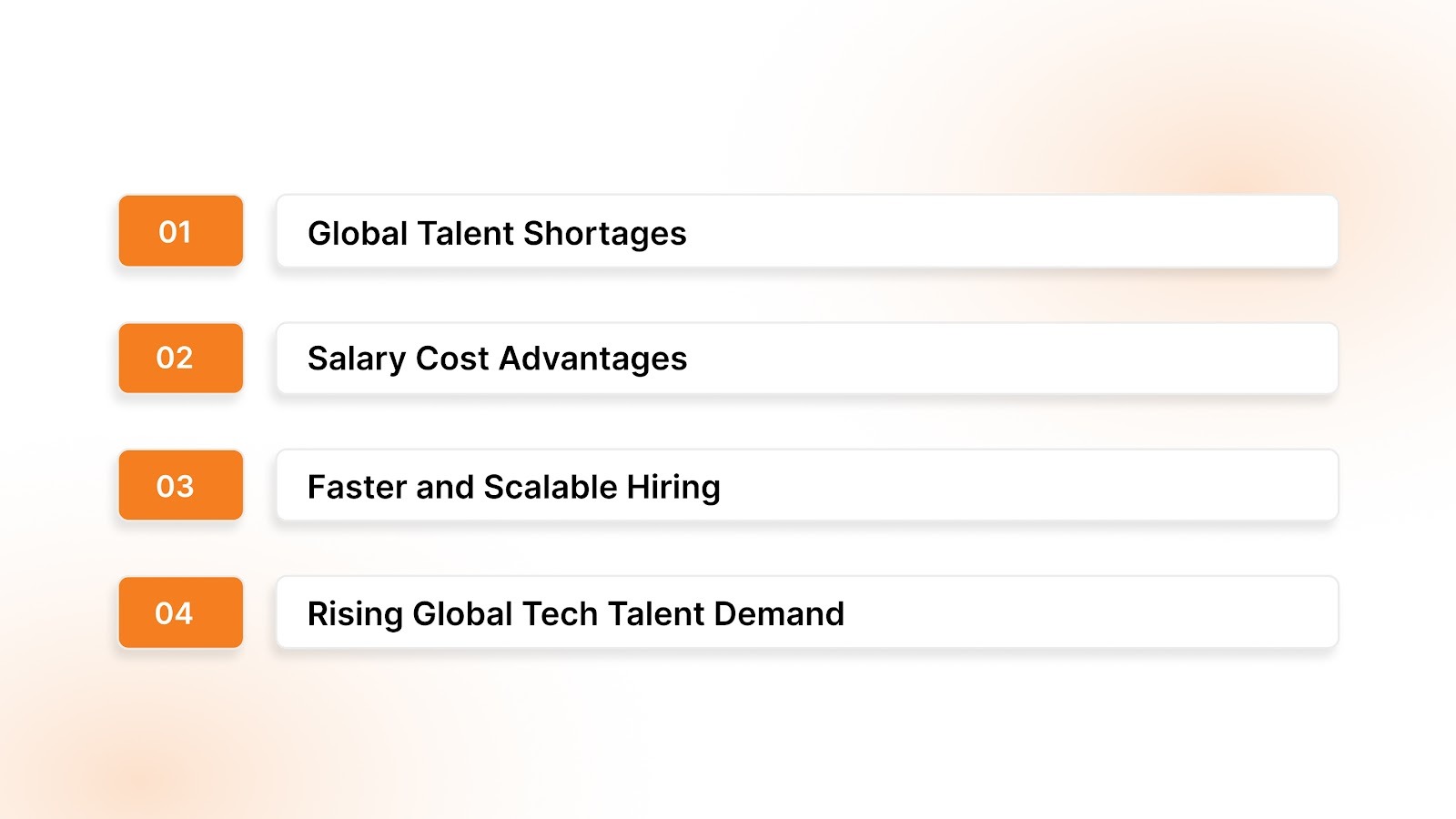
Offshore hiring is a response to persistent global hiring challenges combined with India’s growing capability in advanced tech disciplines.
1. Acute talent shortages abroad
Hiring data shows that a majority of employers globally report difficulties in sourcing suitable candidates, with specialised technology roles being particularly hard to fill.
A recent survey found that 82% of employers struggle to find the right talent, underlining how severe the skills gap has become.
This shortage is most pronounced in roles like AI/ML engineering, cloud infrastructure, and cybersecurity, where demand continues to outpace supply.
2. Salary disparity and cost efficiency
Comparative cost data clearly illustrates the financial advantage of offshore talent. In 2026, hourly wage benchmarks show that developers in traditional offshore locations like India command significantly lower rates than onshore US roles.
Offshore developer rates often fall in the $18–$65 per hour range, substantially lower than typical US onshore costs, which can range from $80–$150+ per hour.
This scale of savings makes it feasible for organisations to invest in larger, more diverse teams without proportionally increasing budget.
3. Faster, scalable hiring cycles
One of the unambiguous advantages of offshore tech talent in India lies in the speed and scale of hiring. India produces over 1.5 million engineering graduates annually, providing a continual pipeline of technical talent ready for enterprise workflows.
Even beyond sheer numbers, the prevalence of recruitment services and specialised staffing firms in India accelerates onboarding timelines compared to direct hires in highly competitive markets.
4. Alignment with global tech demand trends
Technical hiring trends in 2026 reveal an increasing priority on AI, cloud, cybersecurity, and data roles. Talent reports indicate that these categories have shifted from experimental to core organisational needs, with enterprises significantly increasing demand for them.
In parallel, India’s tech sector has crossed major size markers, with projections showing it as a $300 billion+ market employing nearly six million tech professionals.
These factors combine to make India a reliable source of both volume and vertical skills that enterprises are actively seeking.
Also Read: 7 Mass Hiring Companies in India for IT, GCC, and Shared Services Teams

What Roles Are Commonly Hired Through Offshore Tech Talent India
India’s tech workforce is not just large. It covers a spectrum of enterprise-critical competencies. Organisations offshore not only traditional software roles but also strategically important disciplines deeply aligned with business outcomes.
Below is a structured view of the primary clusters that enterprises routinely offshore from India:
1. Engineering Teams
These roles cover core product delivery, quality assurance, and automation:
- Backend developers: Skilled in languages such as Java, Python, and Node.js.
- Frontend engineers: Experts in modern frameworks like React, Angular, or Vue.
- Full-stack developers: Versatile performers across front and backend systems.
- QA automation engineers: Focused on test automation frameworks and CI/CD quality checks.
Engineering roles remain the backbone of offshore tech teams because they combine depth of knowledge with the ability to deliver scalable output.
2. Product & Platform
Product roles in offshore teams help bridge technical execution with business objectives:
- Technical Product Managers: Define feature priorities and drive sprint outcomes.
- Scrum Masters: Ensure agile delivery rhythms and reduce bottlenecks.
- UX engineers: Translate user insights into usable interfaces.
Offshore product roles are increasingly sought after as remote and distributed teams must be tightly coordinated.
3. Data & Artificial Intelligence
Data and AI functions are a major reason companies choose specialist hires offshore:
- Data engineers: Build and optimise data pipelines and warehouses.
- Machine learning engineers: Deploy models that power predictive systems.
- NLP specialists: Focus on language-based machine learning applications.
Demand for these roles is part of a broader global trend in which data-centric and AI-proficient professionals are in high demand elsewhere.
4. Cloud & Infrastructure
Cloud adoption drives the need for robust infrastructure architects:
- AWS, Azure, GCP engineers: Design and manage cloud infrastructure.
- DevOps specialists: Enhance deployment processes and system reliability.
- Site Reliability Engineers (SREs): Maintain high-availability of large-scale systems.
These competencies increasingly anchor distributed team operations and infrastructure resilience.
5. Cybersecurity
Security roles offshored from India reflect growing organisational exposures:
- SOC analysts: Monitor threats and incident response activities.
- Cloud security engineers: Secure cloud environments against intrusions.
- Application security experts: Harden code and system configurations against vulnerabilities.
India’s growing education and certification in cybersecurity have made quality talent more accessible in these areas.
This breadth of role types shows how Indian offshore teams support enterprise engineering and strategic technology functions, not just low-complexity coding tasks.
Scaling offshore tech talent in India without slowing product delivery? V3 Staffing builds SLA-driven hiring engines for engineering, product, data, cloud, AI/ML, and cybersecurity roles across India, the USA, and the UAE. Hire faster with a 10-day average time to hire backed by 16+ years of recruitment expertise. Contact us today.
Also Read: Building Scalable Recruitment Models: Key Strategies for Success
Direct Hiring or Offshore Model: Which One Scales Better?
When planning an offshore expansion into India, organisations repeatedly face the same question: Do you invest in setting up your own entity, or use outsourced models that accelerate hiring and de-risk compliance?
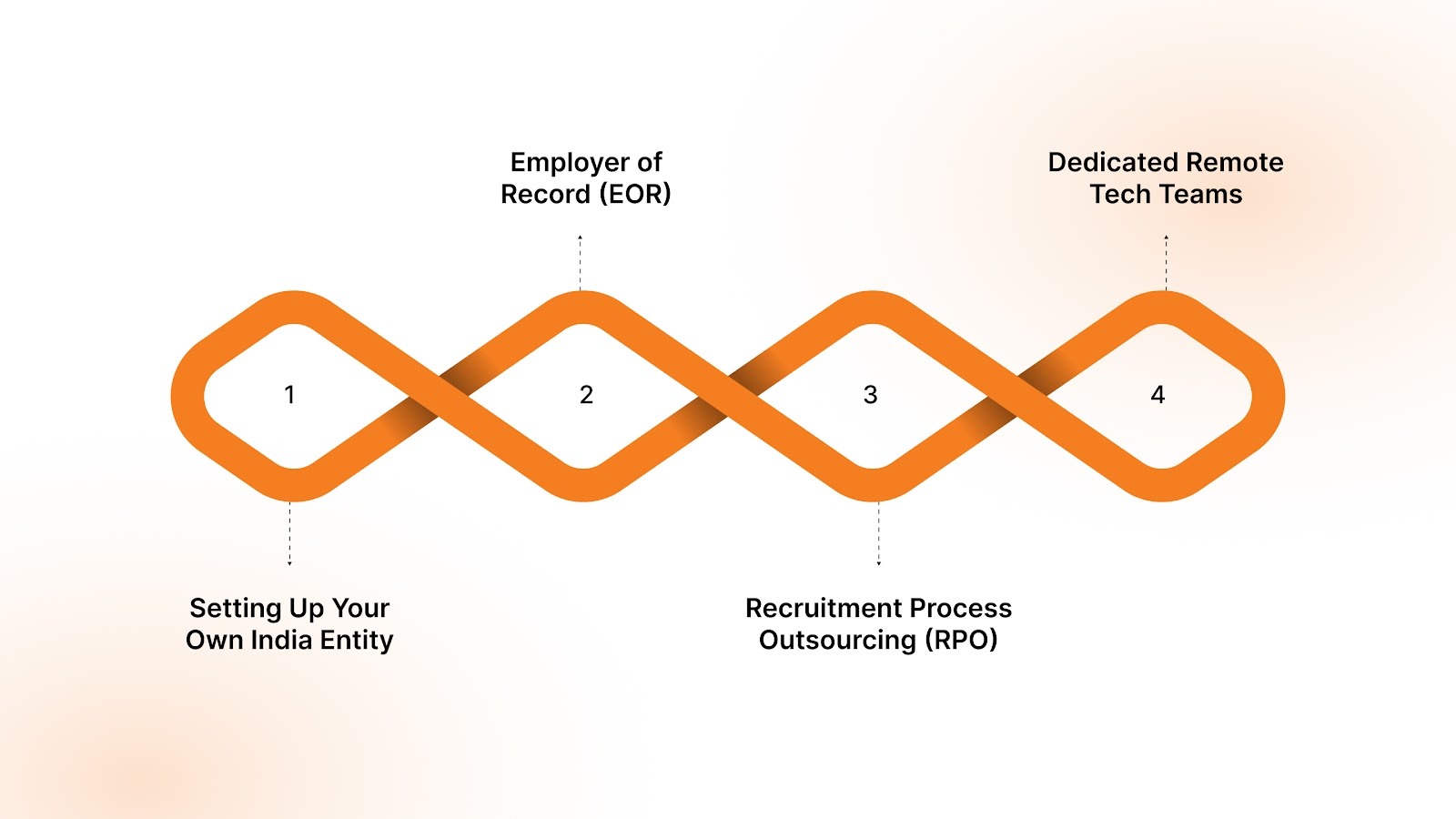
Each approach has real trade-offs in cost, speed, control, and long-term scalability.
Option 1: Setting Up Your Own India Entity
Creating your own legal entity in India gives you full operational and HR control. This means your company becomes the legal employer of record and directly owns payroll, recruitment, benefits, compliance, and employment relationships.
Pros:
- Full operational control: You own all HR processes and decision-making, including compensation structures, benefits policies, and organisational culture.
- Brand presence: A local entity strengthens the employer brand in the Indian market and supports employer-employee trust.
- Scalability at high volume: If you plan to hire dozens or hundreds of tech roles (engineering, cloud, data, cybersecurity), having an entity helps centralise HR and career-growth programmes.
- Tax and benefits flexibility: Direct ownership can allow tailored benefit programmes beyond statutory requirements, which can improve talent retention.
Compliance Requirements:
Setting up a legal entity involves navigating India’s labour code landscape and corporate registration process. You must register with the Ministry of Corporate Affairs, establish payroll and tax systems, and ensure adherence to multi-state labour and employment regulations.
These tasks require dedicated HR and legal resources and often take 3–6 months to complete.
You are accountable for statutory contributions like provident fund (EPF), employee state insurance (ESI), tax deducted at source (TDS), and employee benefits.
Non-compliance can lead to penalties, litigation, or restrictions on business operations.
Long-Term Investment View:
A wholly owned Indian entity is most cost-effective when hiring at scale (50+ roles annually) and building long-term delivery centres. Over time, the entity absorbs operational costs more efficiently than third-party services.
But upfront complexity and overhead remain significant, and building internal recruitment and payroll teams takes time and investment.
Option 2: Employer of Record (EOR)
Employer of Record services allow you to hire legally in India without a local entity. The EOR becomes the legal employer, handling payroll, contracts, statutory compliance, tax deductions, and employee benefits, while you manage day-to-day work and performance.
When It Makes Sense
EOR is ideal when:
- You are entering the market for the first time.
- Hiring needs are modest (e.g., 1–20 roles initially).
- Speed and legal safety are priorities.
EORs can onboard employees in days rather than months, allowing companies to begin operations quickly without entity setup.
Speed and Compliance Advantage
An EOR absorbs the burden of labor law compliance, including statutory deductions (EPF, ESI, TDS) and multi-state filings. This removes the risk of fines or administrative penalties and mitigates business liability tied to unfamiliar local regulations.
Cost Implications
EOR pricing typically ranges from a few hundred to over a thousand dollars per employee per month, depending on the provider and service level. While this can be more expensive per employee than direct entity payroll, it eliminates entity setup costs, HR systems, and legal overhead.
EORs are particularly effective for test hires, market validation phases, or early-stage offshore teams, where paying slightly higher employment service fees is offset by reduced risk and faster time to hire.
Option 3: Recruitment Process Outsourcing (RPO)
Recruitment Process Outsourcing partners with you to build and manage the talent acquisition function. Unlike EORs, RPOs do not assume employment or compliance responsibilities; instead, they own sourcing, screening, interview coordination, and pipeline management.
Best for Scaling 10–50 Roles
RPO shines when you have predictable hiring volumes and need to standardise recruitment workflows. Organisations with ongoing hiring needs for mid-to-senior engineering, product, or cloud roles benefit from an RPO partner that embeds with internal HR teams to drive consistency and quality.
SLA-Driven Hiring Delivery
Top RPO engagements are governed by service level agreements (SLAs) that define metrics such as time-to-screen, interview throughput, candidate pipeline depth, and quality scores. This introduces measurable delivery expectations, similar to those of internal functions.
Embedded Recruitment Teams
An RPO provider often allocates recruiters dedicated to your account. These specialists bring market insights, talent mapping, benchmarking, and assessment frameworks tailored to your job families — reducing bias and improving match quality.
Operational Fit
RPO does not eliminate compliance overhead. You retain employer status and must manage payroll, benefits, and legal obligations through your entity or EOR.
But for volume hiring where speed and quality are core challenges, RPO strengthens delivery capabilities and shortens time-to-hire, often by 20–40% compared to in-house alone.
Option 4: Dedicated Remote Tech Teams
A dedicated remote team model focuses on hiring long-term, remotely based employees through a third-party aggregator or staffing partner. The vendor sources, screens, and onboards developers who then work full-time for your organisation. This model blends aspects of outsourcing with dedicated hiring.
Managed Model:Closer to Direct Hire
Unlike project-based outsourcing, dedicated teams are integrated with your planning and execution cycles. You manage technical deliverables, sprint commitments, and performance outcomes, while the partner manages payroll and employment administration.
Lower Operational Complexity
This model eliminates the need to build local HR, payroll, or administrative capability while still giving you a stable, long-term team. Remote staffing specialists handle employment contracts, salary remittance, and often statutory compliance in India.
Because teams are dedicated to clients, as in classic outsourcing, there is greater ownership and continuity.
This model is especially effective when hiring mid- to senior-level software engineers, cloud specialists, and full-stack teams that require deep collaboration with core product groups.
Strategic Fit
Dedicated remote teams offer a middle ground: you gain operational simplicity and speed without outsourcing entire functions away from your core business.
For organisations scaling offshore talent in increments (rather than building large delivery centres), this provides a consistent pipeline without the administrative burden of entity management.
Hiring tech teams in India without setting up internal recruitment or legal infrastructure? V3 Staffing delivers embedded RPO solutions and compliant EOR services in India to hire across roles. Build your India team faster with SLA-driven recruitment and fully managed payroll and compliance.
Also Read: How to Approach Leadership Hiring for Organisational Success
What Breaks Offshore Tech Teams (And How to Avoid It)
Offshore teams rarely fail due to geography. Breakdowns typically occur when operating models, technical governance, and hiring discipline are weak. The issues below are structural and preventable.
1. Poor Communication Cadence
When engineering, product, and cloud teams operate across time zones without a defined communication architecture, backlog drift and rework increase.
Daily stand-ups alone are insufficient. Teams need:
- A shared sprint board with strict status hygiene.
- Defined handover windows across regions.
- Async documentation standards in tools like Jira and Confluence.
- Weekly sprint reviews with measurable output metrics.
For AI/ML and data teams, model updates and deployment changes must be logged in version control and documented, along with assumptions. Without traceability, distributed teams quickly accumulate technical debt.
2. Lack of Ownership Clarity
Ambiguity in accountability creates duplication, delays, and silent blockers. This is especially common in cross-functional offshore environments where engineering, DevOps, and product overlap.
Define ownership at three levels:
- System ownership: Who owns codebase modules, pipelines, or cloud environments?
- Delivery ownership: Who is accountable for sprint commitments?
- Outcome ownership: Who is responsible for revenue, uptime, or model performance impact?
For cybersecurity roles, clarify incident response authority in advance. During a breach, hesitation over ownership can multiply damage exposure.
3. No Product Alignment
Engineering output disconnected from product metrics leads to technically correct but commercially weak delivery. Offshore teams must understand user impact, not just tickets.
Embed offshore engineers and data specialists in:
- Quarterly roadmap reviews.
- Feature prioritisation sessions.
- KPI discussions tied to user adoption and retention.
AI and cloud teams should understand the business context behind infrastructure scaling decisions. Without this, resource allocation becomes reactive rather than strategic.
4. Inconsistent Leadership Visibility
Distributed teams require visible technical leadership. Absence of engineering directors or product heads from offshore sprint reviews reduces alignment and slows escalation paths.
Maintain:
- Monthly architecture reviews across regions.
- Clear technical escalation matrices.
- Leadership participation in major release planning.
For cloud and DevOps teams, leadership should review reliability metrics such as incident frequency and mean time to recovery. Regular oversight prevents drift in standards.
5. Offer Drop-offs and Counteroffers
Top engineering, AI/ML, and cloud candidates in India often receive multiple offers within weeks. Delayed approvals or unclear compensation bands increase drop-offs.
Reduce risk by:
- Pre-approving salary bands before final interviews.
- Completing technical evaluation within defined SLAs.
- Issuing verbal offers within 48 hours of the final round.
For cybersecurity and senior product roles, communicate growth trajectory early. Career clarity often outweighs marginal differences in compensation.
Addressing these structural gaps strengthens retention, delivery predictability, and long-term offshore stability.
How Global Companies Scale Offshore Tech Talent in India Successfully
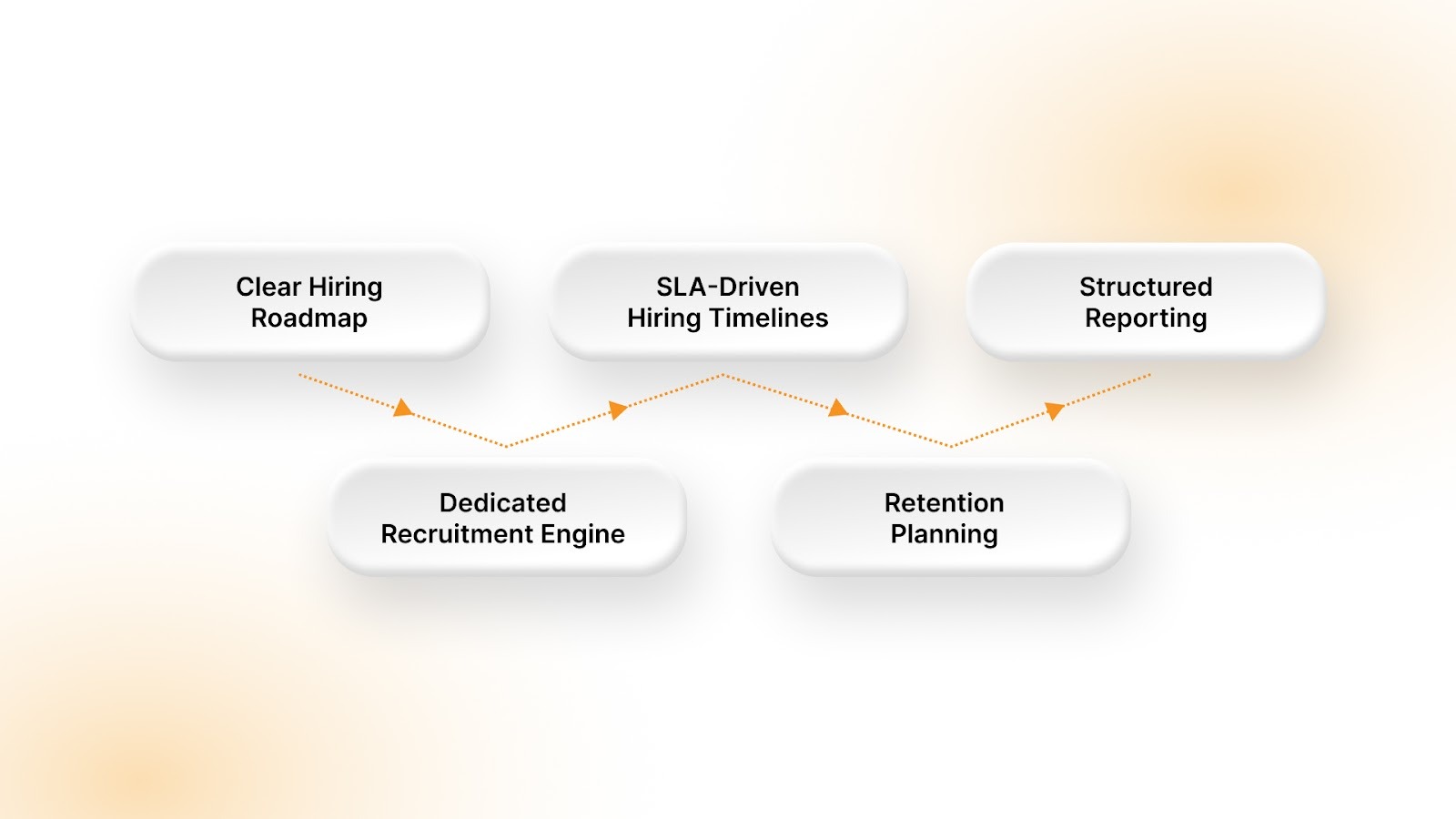
Scaling offshore tech talent from India requires a defined operating blueprint. Organisations that succeed treat offshore hiring as an integrated extension of their core engineering function.
1. Clear Hiring Roadmap
Tie hiring to product velocity and infrastructure goals, not generic headcount targets.
Map:
- Engineering capacity required per release cycle.
- Data and AI resource needs per analytics initiative.
- Cloud and DevOps capacity tied to system scaling.
- Cybersecurity coverage is required per the compliance framework.
Forecast six to twelve months ahead to avoid reactive hiring surges that weaken quality.
2. Dedicated Recruitment Engine
High-performing companies avoid ad-hoc recruitment. They build specialised pipelines aligned to skill clusters.
Segment recruiters across:
- Backend and full-stack engineering
- Product and agile leadership
- Data and AI talent
- Cloud and infrastructure
- Cybersecurity
Use structured technical assessments, live architecture evaluations, and scenario-based interviews rather than generic screening. This improves quality-of-hire consistency.
3. SLA-Driven Hiring Timelines
Define measurable timelines for each hiring stage:
- CV screening within 72 hours.
- Technical evaluation within one week.
- Final decision within 10 business days.
Track offer-to-join ratio and time-to-productivity for engineering and cloud hires. Hiring performance must be treated as an operational KPI.
4. Retention Planning
Retention risk increases when offshore teams feel siloed. Structured career pathways reduce churn.
Implement:
- Technical certification sponsorship for cloud and AI roles.
- Clear progression bands for engineering and product tracks.
- Cross-region exposure to major releases.
Retention frameworks should be linked to skill advancement, not only compensation adjustments.
5. Structured Reporting
Offshore performance must be visible at the leadership level.
Track:
- Sprint velocity and spillover rate.
- Deployment frequency and rollback ratio.
- Cloud uptime and incident response time.
- Model accuracy drift for AI/ML teams.
- Security incident closure timelines.
Dashboards should connect technical output to business impact. When metrics are transparent, offshore teams operate with the same accountability as onshore units.

Scaling Offshore Tech Talent India with V3 Staffing
Building offshore tech teams in India requires more than access to resumes. It demands structured hiring, compliance control, and delivery accountability across engineering, product, data, cloud, AI/ML, and cybersecurity roles.
V3 Staffing supports enterprises hiring across India, the USA, and the UAE with scalable recruitment and workforce models aligned to long-term growth.
With 16+ years of industry experience, 10,000+ specialists hired, and 300+ clients served, V3 operates as a structured hiring partner rather than a transactional vendor.
Below is how V3 Staffing supports the hiring of offshore tech talent at scale.
1. Permanent Recruitment
V3 Staffing delivers domain-specific permanent hiring for engineering, product, data, cloud, AI/ML, and cybersecurity roles across India, the USA, and the UAE.
The process includes competency-based screening, structured technical evaluation, and disciplined offer management to improve the quality of hire and reduce attrition risk.
2. Employer of Record (EOR)
V3 Staffing’s EOR services enable companies to hire offshore tech talent in India without setting up a legal entity. The model covers compliant employment contracts, payroll, statutory filings, tax management, and exit processes, enabling enterprises to scale quickly while reducing compliance exposure.
3. Contract Staffing
For project-based scaling across engineering builds, cloud migrations, AI implementations, and cybersecurity programmes, V3 provides flexible contract staffing. This model supports rapid deployment of vetted specialists without long-term employment commitments.
4. Recruitment Process Outsourcing (RPO)
V3 Staffing’s RPO model embeds dedicated recruiters aligned to specific skill clusters such as engineering, product, data, cloud, AI/ML, and cybersecurity. With SLA-driven hiring timelines and structured reporting, it strengthens recruitment velocity for companies scaling 10–50+ offshore roles.
5. Executive Search
V3 conducts targeted executive searches for senior leadership roles, including CTOs, VPs of Engineering, Heads of Product, Chief Data Officers, and cybersecurity leaders.
The process involves discreet market mapping, strategic headhunting, and competency-led evaluation aligned to long-term offshore growth plans.
Conclusion
India’s role in global tech talent strategies continues to strengthen in 2026, supported by both macroeconomic indicators and real hiring patterns. Its deep engineering and AI talent base contributes to a growing share of global software engineers and attracts expansion from major global players.
This landscape means companies scaling offshore tech talent from India benefit from both cost-efficiency and access to specialised capabilities, especially as skill-led compensation rises and demand outpaces supply in mature markets.
Looking to build structured offshore teams in India with compliance, speed, and quality delivery? Partner with V3 Staffing for tailored RPO, EOR, contract, executive, and permanent hiring solutions across engineering, product, data, cloud, AI/ML, and cybersecurity roles. Contact us today.