
.svg)
.svg)
Hiring works smoothly when a company adds a few roles each quarter. It breaks down once hiring becomes a monthly operational requirement. Interview queues stretch, managers repeat screening calls, and strong candidates accept other offers before they receive feedback. The issue is rarely a talent shortage. It is the absence of scalable hiring solutions.
Data shows the impact clearly. Around 26% of candidates drop out because the hiring process takes too long, and many move to employers that move faster.
For growing businesses, delays result in missed delivery deadlines, slower product rollouts, and overloaded teams. Scalable hiring solutions replace ad hoc recruitment with defined workflows, role-based evaluation, and predictable turnaround times.
This guide explains why growth breaks traditional hiring, when companies must redesign recruitment operations, and how structured hiring systems support expansion across teams and locations.
Quick Look
- Hiring fails during growth when decision capacity and process design do not scale with role volume, especially across specialised functions and locations.
- Scalable hiring solutions rely on structured workflows, evaluation rubrics, and fixed turnaround timelines instead of adding more recruiters.
- Clear signals such as continuous hiring, interview overload, and rising offer drop-offs indicate the need for a formal hiring infrastructure.
- Each company stage requires a different hiring model, from founder-led selection to embedded teams and RPO-based operations.
Why Hiring Collapses When a Company Starts Growing
Early hiring depends on founders, referrals, and instinct. It works when hiring is occasional. Once hiring becomes continuous, decision-making cannot keep pace with volume. The same process that worked for five hires fails at fifty.
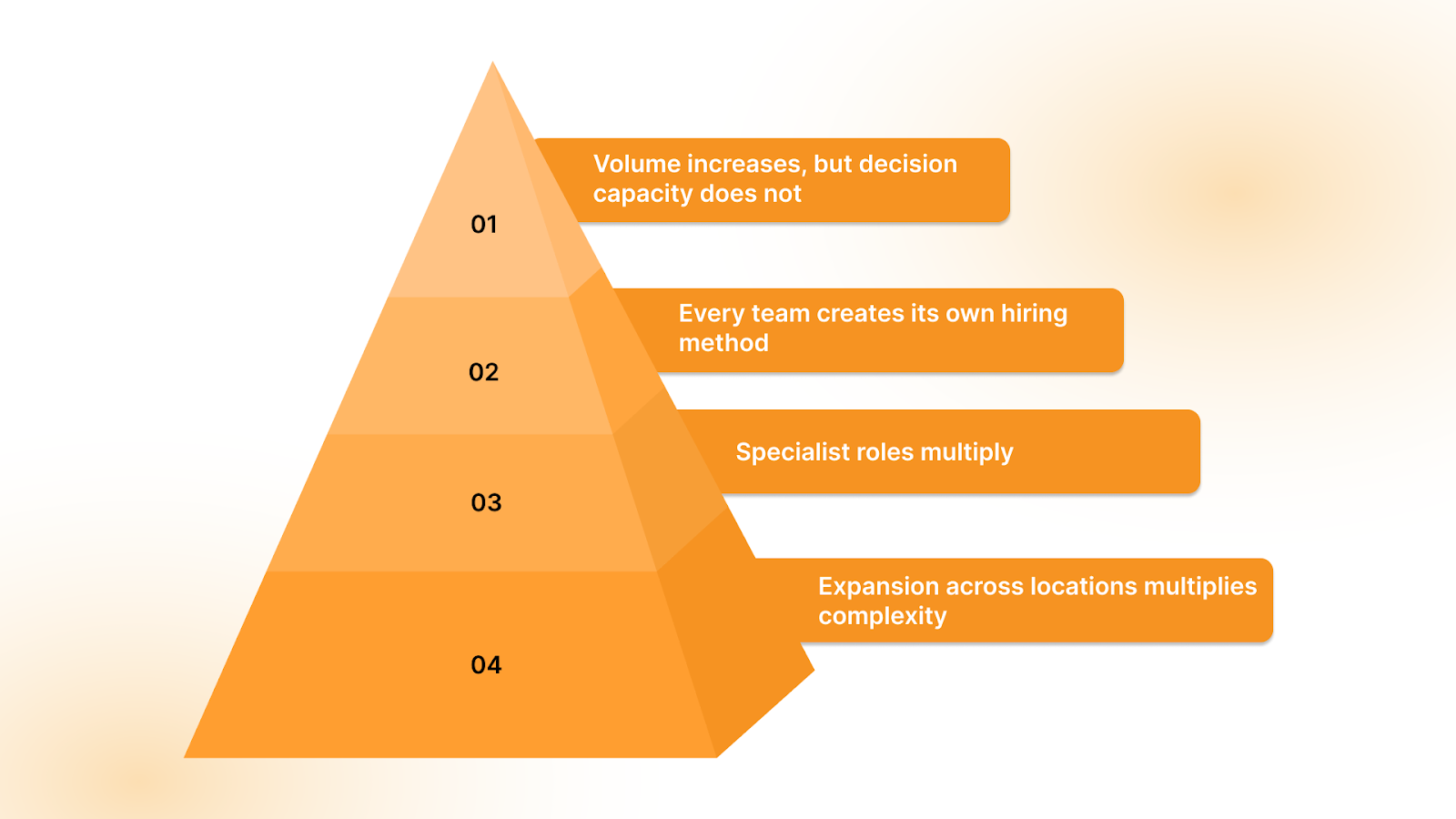
Volume increases, but decision capacity does not
Growth adds candidates faster than interviewers can evaluate them. The challenge shifts from sourcing to decision-making.
Before the breakdown appears, teams usually notice these operational signals:
- Interview panels expand, but calendars stay blocked for days
- Feedback cycles stretch beyond one week
- Candidates complete all rounds yet wait for approvals
- Offers are released after competing companies already decided
Every team creates its own hiring method
Without a shared process, hiring becomes a collection of personal preferences. Each department defines quality differently.
This fragmentation produces measurable consequences:
Offer-to-join ratios decline when candidates perceive uncertainty. They read inconsistency as organisational risk.
Specialist roles multiply
Growth does not increase headcount evenly. It increases complexity. Companies move from generalists to specialists.
Typical shift seen during scaling:
- Software developers split into backend, frontend, and platform roles
- IT expands into cloud infrastructure ownership
- Analysts are divided into data engineering and analytics
- Product teams add product operations and technical product managers
- Security roles emerge for compliance and audits
Each role requires separate evaluation criteria. Using the same interview structure across all roles produces false positives and false negatives.
Expansion across locations multiplies complexity
Hiring across cities or countries adds variables beyond recruitment.
Operational differences include:
- Compensation benchmarks differ by market
- Notice periods vary widely
- Candidate availability windows shift
- Legal employment norms change
Teams often use a single hiring process across all regions. The result is rejected offers in one geography and overpayment in another.
Also Read: Best Practices for Managing High-Volume Seasonal Hiring in 2026
What Are Scalable Hiring Solutions And What Are They Not
Scalable hiring solutions treat recruitment as a repeatable operational workflow rather than a series of urgent tasks.
They are often misunderstood as speed-focused actions. The distinction matters.
What they are not
- Posting jobs across more portals
- Increasing the recruiter count randomly
- Outsourcing individual roles reactively
These increase activity, not capacity.
What they are
A structured hiring infrastructure that absorbs higher volume without lowering decision accuracy.
To achieve that, companies introduce defined components:
- Structured intake planning that clarifies role scope before sourcing
- Predefined evaluation rubrics for each role family
- Central pipeline tracking is visible to leadership
- Interview turnaround timelines linked to internal accountability
- Dedicated sourcing lanes are separated from evaluation panels
Outcome comparison
Scalability comes from removing dependency on individual bandwidth.
Scaling hiring across teams or countries often fails at coordination, not sourcing.
V3 Staffing supports continuous hiring with dedicated delivery teams, 10,000+ specialists hired, and an average time-to-hire of 10 days. Talk to us to stabilise hiring before growth slows execution.
Also Read: Understanding Payroll Deductions and Their Types
When Does a Business Actually Need Scalable Hiring Solutions
Most organisations recognise the problem late. Headcount growth is not the real trigger. Operational strain is. The moment hiring starts affecting delivery timelines, revenue cadence, or leadership bandwidth, recruitment has shifted from a support activity to a business infrastructure.
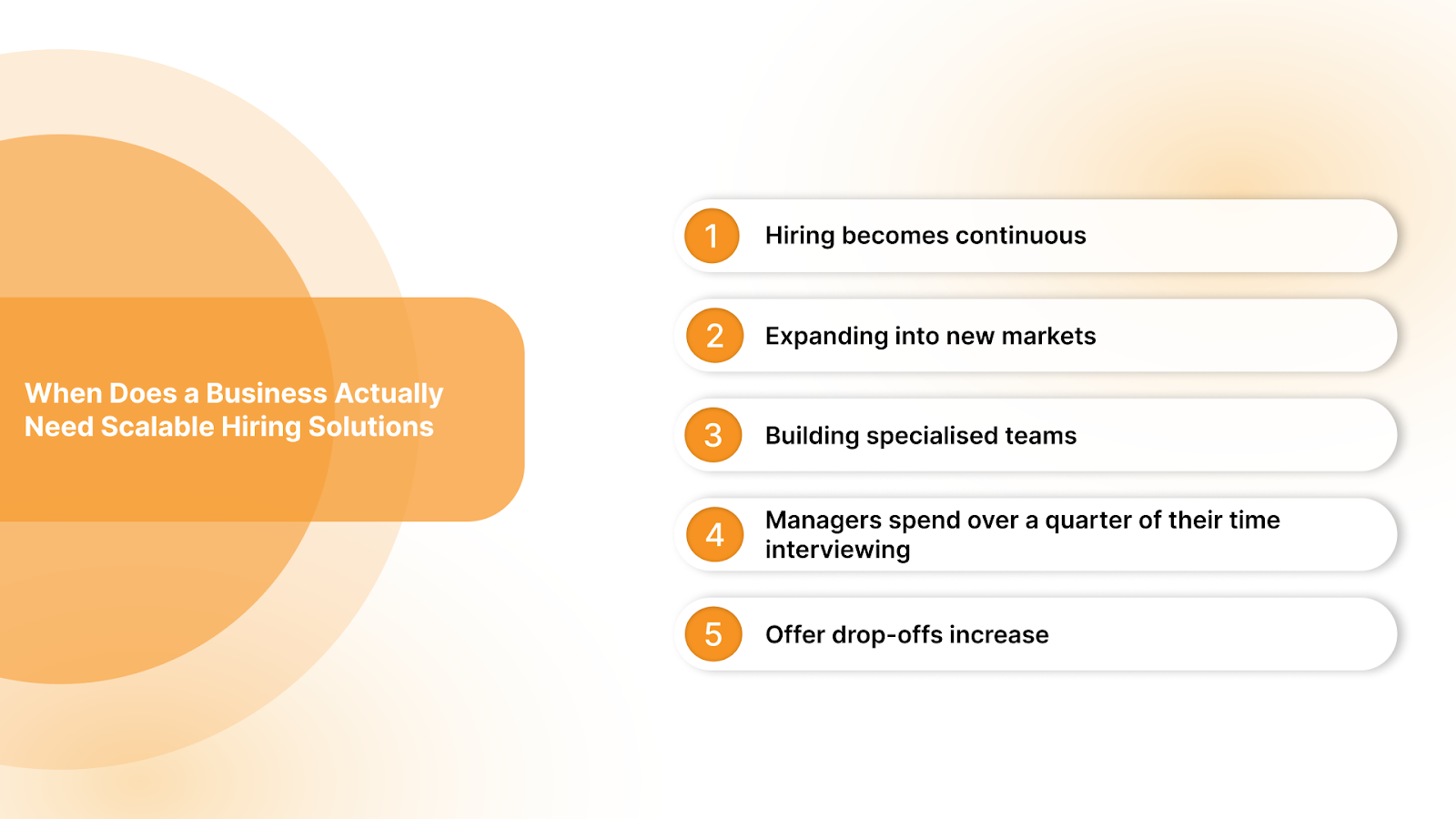
Trigger 1: Hiring becomes continuous
Once hiring shifts from quarterly bursts to monthly targets, coordination becomes the bottleneck rather than sourcing.
What teams begin noticing internally:
- Open roles never reach zero
- Recruiters manage multiple pipelines at the same time
- Hiring managers review candidates every week
- Feedback cycles overlap across departments
Many companies track time to hire as a primary metric, and prolonged processes directly affect acceptance rates. When hiring becomes ongoing, each delay compounds across roles instead of remaining isolated.
Continuous hiring requires a defined workflow. Increasing recruiter effort alone cannot stabilise output.
Trigger 2: Expanding into new markets
Hiring across countries such as India, the USA, and the UAE introduces behavioural and structural differences, not just location changes.
Operational friction appears as:
- Same role closes in different timeframes across regions
- Compensation negotiations follow different norms
- Interview expectations vary by seniority culture
- Candidate availability windows differ
Without region specific hiring structure, expansion delays market entry rather than enabling it.
Trigger 3: Building specialised teams
Growth increases role diversity faster than hiring maturity.
A typical scale phase includes hiring across engineering, product, data, infrastructure, and security in the same quarter. Each requires a separate evaluation method.
What breaks first:
- Generic interview panels assess technical roles inaccurately
- Hiring decisions depend on the interviewer's preference
- Training time rises after joining
The result is measurable. About 32 per cent of technical roles remain unfilled for more than 3 months, often because evaluation methods fail to identify qualified candidates quickly.
Specialised hiring requires structured evaluation, not broader sourcing.
Trigger 4: Managers spend over a quarter of their time interviewing
Leadership involvement initially improves hiring quality. Beyond a point, it reduces operational output.
What organisations observe:
- Delivery managers attend interviews daily
- Project reviews move to evenings
- Product timelines slip before roles close
Vacancy cost explains the impact. A single unfilled role can cost thousands in lost productivity within weeks. The loss comes from delayed execution, not just salary savings.
When managers become full-time interviewers, hiring has exceeded internal capacity.
Trigger 5: Offer drop-offs increase
Candidates who complete all rounds but decline offers signal process instability, not a talent shortage.
Common internal patterns:
- Feedback gaps between interview rounds
- Compensation expectations were clarified late
- Role scope explained inconsistently
Over half of withdrawn applicants cite process speed and communication issues, and many reject offers after a poor hiring experience.
Rising drop-offs indicate that the recruitment workflow needs redesign rather than additional sourcing.
Also Read: 7 Mass Hiring Companies in India for IT, GCC, and Shared Services Teams
What Hiring Model Works at Each Growth Stage?
Hiring structure changes as the company shifts from survival to scale. The same recruitment setup cannot support every phase without creating delays or quality gaps.
Choosing the right model early prevents re-hiring cycles, team imbalance, and sudden cost spikes later.
Stage 1 — Early Growth (20–80 employees)
When hires are infrequent and roles remain broad, founders and senior leads should retain control over role fit and culture match.
Actions:
- Use targeted sourcing for core functions rather than open advertising.
- Create one-page role briefs listing outcomes and must-have skills.
- Reserve technical take-home tasks only for senior or specialised roles.
Risk if ignored: Time wasted on generic candidates and slow decisions that delay early product milestones.
Stage 2 — Scaling (80–300 employees)
Hiring becomes ongoing, and managers start losing focus on delivery. Build embedded recruitment inside teams.
Actions:
- Place one dedicated recruiter per key function
- Standardise evaluation rubrics for role families to reduce subjective judgment
- Implement weekly hiring syncs with clear feedback timelines
At this stage, many companies introduce an external recruitment partner to stabilise capacity. V3 Staffing operates as an embedded hiring unit, aligning recruiters to specific functions and maintaining fixed turnaround timelines so managers can return their focus to delivery rather than coordination.
Risk if ignored: Fragmented assessment and rising offer rejections.
Stage 3 — Expansion (300–1,000 employees)
Volume and role complexity both jump. Move to specialised recruiters and compact hiring pods.
Actions:
- Create role-wise recruiters and recruitment pods aligned to product or function.
- Reserve a small panel of trained interviewers per role family to keep calibration.
- Run short technical assessments that map to the rubric, not generic puzzles.
Risk if ignored: Long vacancies for critical roles and hidden training costs after hires join.
Stage 4 — Multi-location operations
Hiring must work across markets. Formalise governance, local pay bands, and compliance.
Actions:
- Adopt an RPO or hybrid model for sustained pan-country hiring capacity.
- Maintain local compensation matrices and mandatory onboarding checklists per region.
- Track hire velocity and offer acceptance separately by geography.
Risk if ignored: Market entry delays and frequent offer renegotiations.
Need consistent hiring across engineering, product, data, cloud, AI, and cybersecurity roles? V3 Staffing recruits across India, the USA, and the UAE with domain recruiters and SLA driven workflows backed by 15+ years of experience and 200+ clients served.
Start building a reliable hiring engine with V3 today.
How Companies Build Scalable Hiring Solutions in Practice
Companies can convert recruitment into a predictable operation by standardising intake, separating sourcing and evaluation, enforcing SLAs, centralising visibility, and committing capacity to continuous hiring.
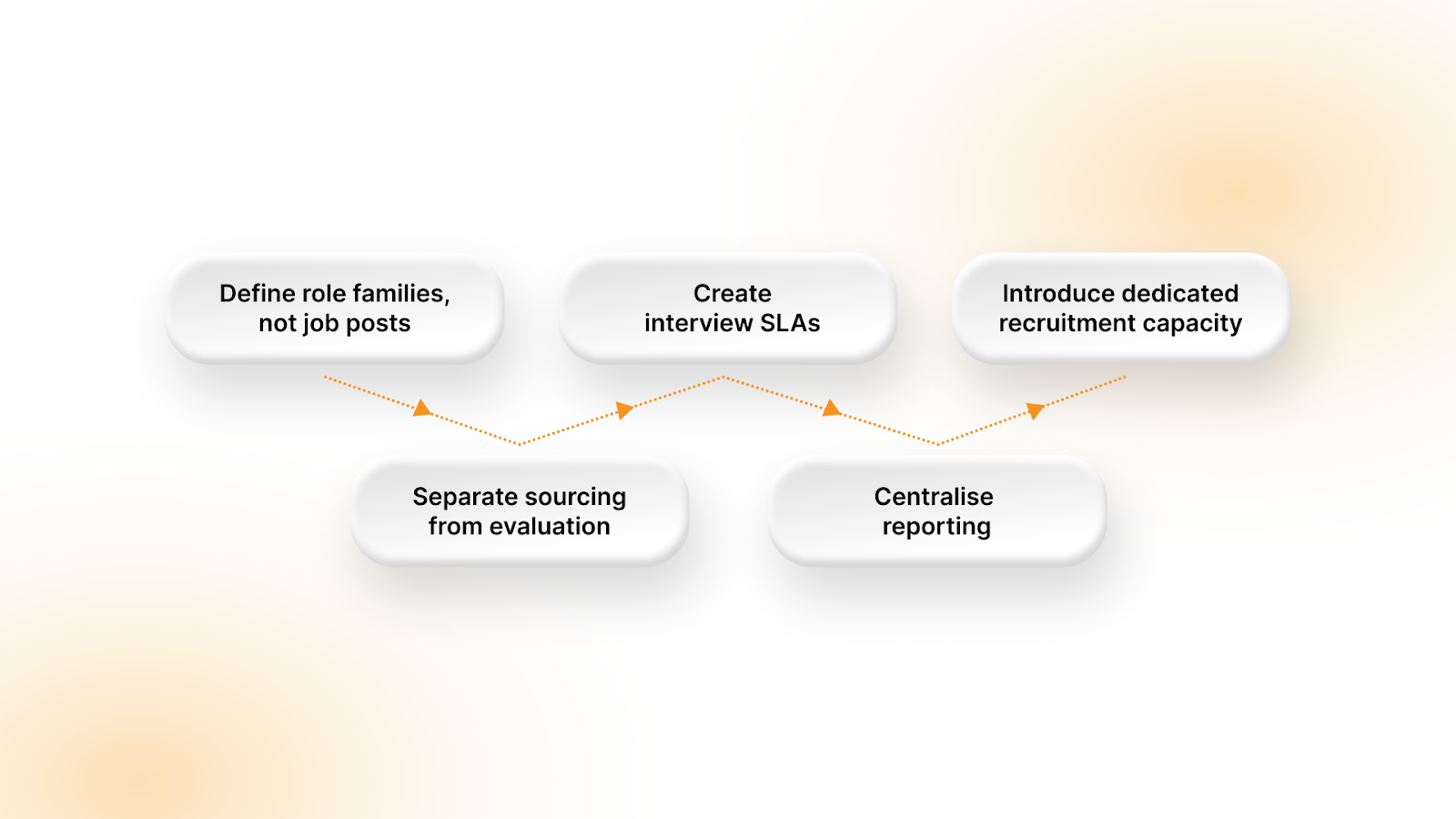
Below each step, you’ll find specific practices and a practical metric to track.
Step 1: Define role families, not job posts
Before sourcing, group roles into families with shared competencies and career ladders. This reduces the need for repeated role engineering and keeps interviewers aligned.
Practical practices:
- Create a role family template that includes responsibilities, core skills, seniority markers, and the target compensation band.
- Use the template to auto-generate scorecards for interviews.
Metric to track: Time from intake to shortlist for family roles.
Step 2: Separate sourcing from evaluation
Treat sourcing as a continuous funnel and evaluation as a scheduled decision process. This increases throughput without lowering assessment quality.
Practical practices:
- Maintain dedicated sourcers who deliver curated slates to interview teams.
- Use short, structured triage calls to clear basic fit before scheduling technical interviews.
Metric to track: Percentage of screened candidates that reach the final interview.
Step 3: Create interview SLAs
Set explicit time windows for each stage and hold interviewers accountable. SLAs compress decision cycles and reduce candidate dropouts.
Practical practices:
- Define SLAs such as 48 hours for feedback after an interview and 3 business days for offer approval.
- Publish SLA breaches monthly and assign remediation owners.
Metric to track: Average time in each pipeline stage and SLA breach rate.
Step 4: Centralise reporting
Leadership needs a single source of truth for capacity planning and hiring risk. Reporting must be role-, family-, and geography-aware.
Practical practices:
- Build dashboards showing open roles, pipeline stage distribution, source performance, and offer acceptance by location.
- Surface cost of vacancy estimates for every critical role to prioritise hiring effort. The cost of a single unfilled developer role can run into tens of thousands per quarter, depending on revenue impact.
Metric to track: Cost of vacancy for top 10 roles.
Step 5: Introduce dedicated recruitment capacity
Sustain hiring capacity with committed recruiters, pods, or an RPO partner rather than episodic agency use.
Practices to follow:
- Scale capacity in lanes: Campus, senior tech, product, sales.
- When hiring is continuous across regions, prefer an RPO or hybrid engagement to provide on-demand bandwidth and compliance coverage. RPOs typically shorten time-to-hire and reduce total recruitment costs for high-volume programmes.
Metric to track: Time to hire and cost per hire before and after dedicated capacity.
How V3 Staffing Supports Scalable Hiring Solutions
Growth requires hiring to operate like a structured function rather than an urgent activity. Many organisations reach a stage where internal teams cannot maintain interview turnaround, candidate communication, and role calibration together.
V3 Staffing serves as an operational hiring extension, helping keep recruitment predictable during expansion across teams and geographies.
The focus is not just filling vacancies. The objective is to maintain hiring continuity while companies expand functions, locations, and specialised roles.
Key services include:
- Permanent Recruitment: We align domain recruiters with each function and conduct structured evaluations to ensure consistent full-time hiring as teams grow.
- Temporary & Contract Staffing: We deploy project-based professionals through compliant contracts, helping teams handle delivery spikes without expanding permanent headcount.
- IT Staffing: We source specialised talent across engineering, product, data, cloud, AI, and security, so managers interview only role-matched candidates.
- Recruitment Process Outsourcing (RPO): V3 Staffing manages the entire hiring pipeline with fixed turnaround times and reporting visibility to support continuous hiring.
- Executive Search: We conduct targeted leadership searches, using competency-based assessments, to ensure senior roles close without disrupting business operations.
Conclusion
Growth pressure exposes hiring capacity limits faster than most operational issues. Studies on candidate behaviour show that slow decisions and inconsistent communication reduce acceptance rates and extend vacancy costs.
Companies that treat recruitment as a structured function maintain delivery stability during expansion, while ad hoc hiring leads to repeated backfills and delayed projects. Scalable hiring solutions create predictable turnaround, calibrated evaluation, and steady hiring bandwidth across locations and teams.
If hiring volume is increasing or roles remain open for weeks, it is time to shift from reactive recruitment to a defined model.
Contact V3 Staffing to build a dependable hiring engine that supports expansion across India, the USA, and the UAE.