
.svg)
.svg)
For talent acquisition leaders, HR heads, and GCC hiring teams, recruitment becomes difficult not just when a vacancy opens, but when the usual channels stop bringing in the right candidates. That is where external sources of recruitment become important. They give businesses access to wider talent pools, specialised skills, and faster hiring options when internal movement alone is not enough.
The urgency is real. India's white-collar hiring index hit 3,001 points in December 2025, a 13% year-on-year surge, with fresher hiring jumping 39% and GCC hiring up 80% in January 2026 alone. At the same time, over 40% of tech roles in Indian GCCs face a skill gap, according to NASSCOM. The pressure to hire faster, hire smarter, and hire from the right channels has never been higher.
But not every external hiring source works the same way. Some are better for volume hiring, some for niche roles, and others for quick closures. Choosing the wrong one increases screening effort, delays hiring, and reduces candidate quality.
In this article, we break down 8 external sources of recruitment with platform-specific examples from the Indian market, sector context, and guidance on how to choose the right source for different hiring needs.
At a Glance
- External sources of recruitment help businesses hire from outside the organisation. These sources are used when internal talent is not enough to meet role, skill, or hiring volume requirements.
- Different sources work better for different hiring needs. A channel that works for entry-level or volume hiring may not be the best fit for niche, urgent, or senior roles.
- The most common external sources include job portals, recruitment agencies, referrals, career pages, social platforms, and campus hiring. Each source offers a different mix of reach, speed, cost, and candidate quality.
- External recruitment can widen access to talent, but it also needs better source selection and screening discipline. More applicants do not always mean better hiring outcomes.
- The best recruitment source depends on role type, urgency, budget, and candidate availability in the market. Choosing the right source matters as much as using external recruitment itself.
What Are External Sources of Recruitment?
External sources of recruitment refer to the methods and channels organisations use to hire candidates from outside the company. Instead of filling positions through internal movement such as promotions or transfers, organisations look beyond their existing workforce to identify suitable candidates.
In human resource management, external recruitment is used when organisations need to access a wider talent pool or hire professionals with specific skills that are not available internally. These sources help companies bring in new perspectives, industry experience, and specialised capabilities required for business growth.
External sources of recruitment are commonly used for both entry-level and experienced roles. Depending on the hiring requirement, organisations may use different channels such as job portals, recruitment agencies, campus hiring, or professional networks to identify and attract candidates.
Also Read: 10 Proven Recruitment Techniques to Hire Faster in 2026
Why Businesses Use External Sources of Recruitment
Businesses turn to external recruitment when the hiring need goes beyond what the current workforce can realistically support. In many situations, the issue is not only a vacant role but the need for wider choice, better market access, or a faster response to changing business demand.
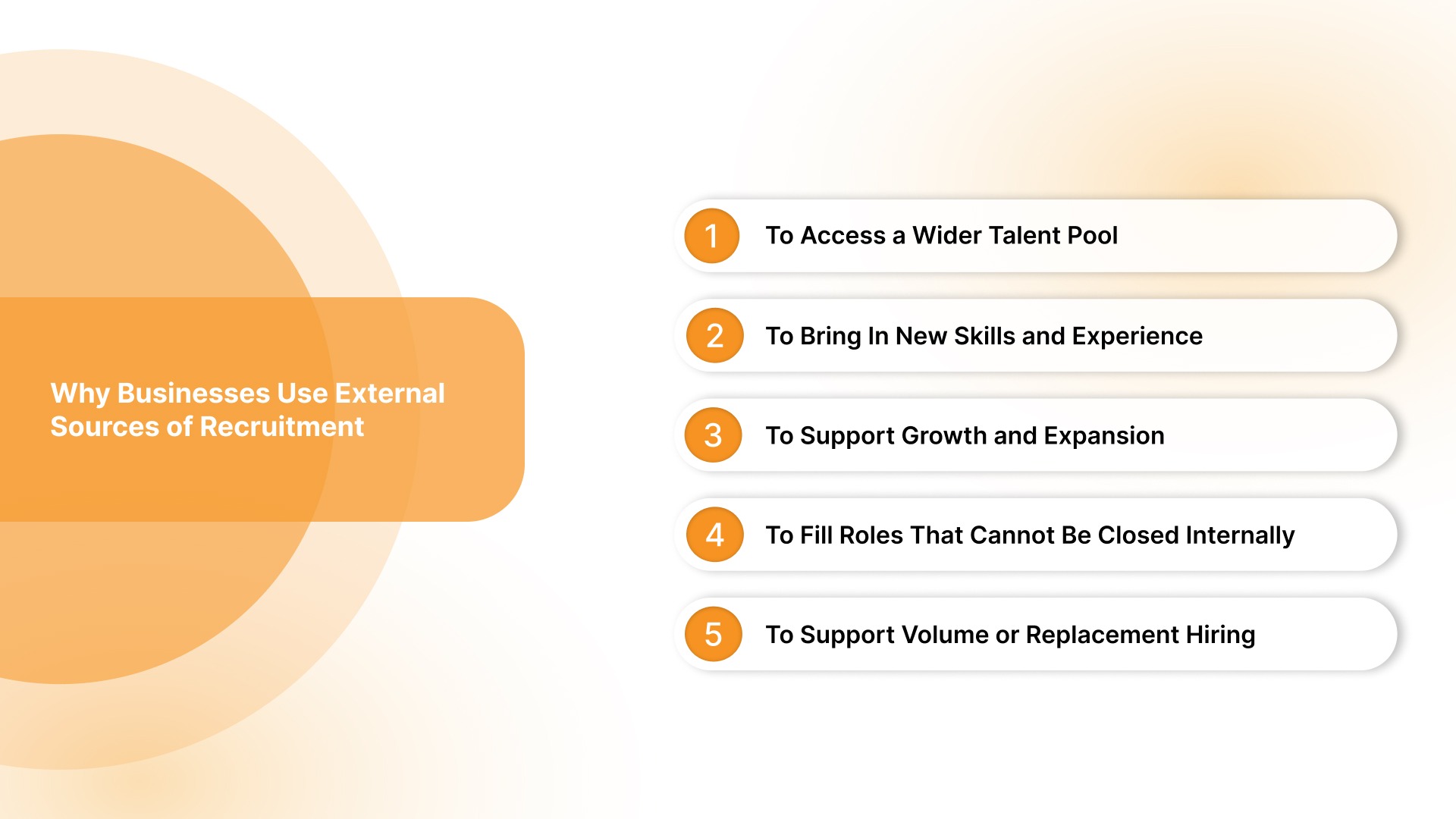
To Access a Wider Talent Pool
One of the main reasons companies use external recruitment is to reach candidates they would not find internally. This becomes important when the organisation needs more options in terms of experience, location, industry background, or skill availability. India's Naukri.com alone holds over 7.83 crore resumes and serves more than 500,000 active recruiters, making external channels a far broader hunting ground than most internal pipelines.
To Bring In New Skills and Experience
External hiring allows businesses to add people who can introduce different working methods, domain knowledge, or technical expertise. This is especially useful when the role needs capabilities that are not currently available inside the organisation. In India's GCC ecosystem, demand for AI specialists has surged over 300% since 2024, while the country faces an AI skills deficit of nearly 53%, making external sourcing for these roles non-negotiable.
To Support Growth and Expansion
When a business is expanding into new functions, markets, products, or locations, internal movement alone is often not enough to support the pace of hiring required. GCCs in India are expected to create 4.25 to 4.5 lakh new jobs in 2025 alone, with the sector targeting 1 million hires by 2030. External sources help employers build teams faster by reaching candidates already active in the market.
To Fill Roles That Cannot Be Closed Internally
Some positions remain open because there is no suitable internal successor or replacement ready to move into the role. In these cases, external recruitment gives the business a way to keep hiring moving instead of waiting for internal capacity to develop.
To Support Volume or Replacement Hiring
Businesses also use external recruitment when hiring demand rises across several openings at once or when roles need repeated replacement over time. This is common in functions where workforce demand is more dynamic and the organisation needs a larger and more responsive candidate pool.
Also Read: What Employers Need to Know About Contingent Employment in 2026
8 Major External Sources of Recruitment in India
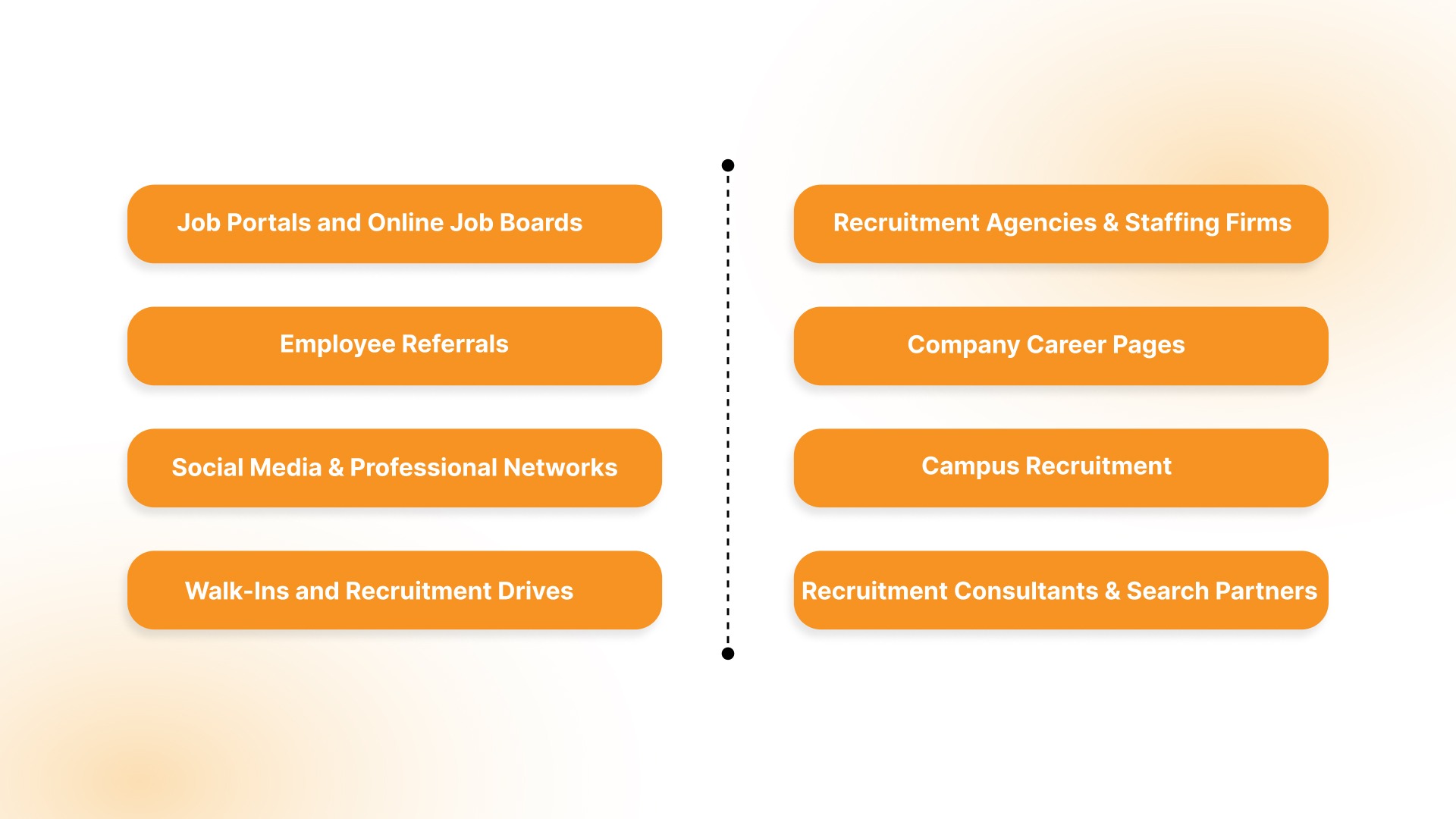
Once a business decides to hire externally, the next step is choosing the right channel. Each source works differently in terms of reach, candidate type, cost, and hiring effort, which is why employers often use more than one depending on the requirement.
1. Job Portals and Online Job Boards
Job portals are one of the most widely used external recruitment sources because they allow employers to advertise roles to a broad candidate base in a short time. They are commonly used for standard hiring needs where application volume matters and the role can be described clearly enough for candidates to apply directly.
In India, the major platforms include:
- Naukri.com: India's largest job portal, with a 7.83 crore resume database and 500,000+ active recruiters. Fills over 80% of postings and is especially strong for IT, BFSI, and experienced lateral hiring. Widely used by IT companies in Bengaluru and Hyderabad for mid-to-senior hiring.
- LinkedIn India: India is LinkedIn's second-largest market with 135.4 million users. Best for white-collar, GCC, and leadership roles. Keyword-optimised profiles can boost candidate visibility by 70%.
- Apna: Apna has 50 million+ users and 700,000+ employers. Built for speed, verified employers, and operational role hiring. Commonly used for blue-collar, sales, delivery, and retail hiring across Tier 2 and Tier 3 cities.
- Monster India / Foundit: Suited for experienced professionals; strong in cross-industry and mid-level hiring.
- Shine.com: Popular for creative and generalist roles.
- TimesJobs: Reliable for mid-level hiring backed by the HT Media ecosystem.
Best for: IT companies doing lateral hiring, BFSI volume hiring, and operational roles in metros and Tier 2 cities.
2. Recruitment Agencies and Staffing Firms
Recruitment agencies are often used when businesses need outside help with sourcing and shortlisting. This source is useful when hiring teams want support in identifying candidates, especially for roles that are harder to close through direct applications alone.
For IT companies in India, specialised staffing partners provide pre-vetted pipelines for cloud, AI/ML, cybersecurity, and DevOps roles, where open portals often produce high volume but poor match rates. BFSI GCCs increasingly use staffing firms for niche specialisations like financial modelling, regulatory technology, and MLOps, where skill gaps are acute and time-to-fill pressure is high.
Best for: Specialist, niche, and senior roles where sourcing effort is high and match rate from open portals is low.
3. Employee Referrals
Employee referrals are external in the sense that the candidate comes from outside the organisation, even though the connection is made through an existing employee. This source often works well when businesses want candidates who come with a basic level of trust or role relevance through internal networks.
Referral programmes are particularly effective in India's IT and GCC sector, where professional networks within the same tech stack or domain are tight. Companies like Infosys, Wipro, and Capgemini run active referral programmes where employees can recommend candidates for open roles, with bonus incentives tied to successful hires.
Best for: Mid-level tech and functional roles where culture fit, speed of trust, and role relevance matter alongside technical skill.
4. Company Career Pages
Career pages allow businesses to attract candidates directly through their own website. This source is stronger when the company already has visibility in the market or when candidates are actively interested in applying to a specific employer rather than responding through third-party channels.
For large Indian IT companies and GCCs with established employer brands such as TCS, Infosys, Wipro, Google India, and Microsoft India, career pages draw significant organic traffic. For smaller or less visible organisations, career pages work best when supported by active employer branding on LinkedIn or social media to drive traffic.
Best for: Employer-brand-driven hiring for companies with strong market visibility; graduate and campus applications.
5. Social Media and Professional Networks
Social platforms and professional networking sites are used when businesses want more direct outreach or broader hiring visibility. These channels are especially useful for reaching passive candidates, building employer presence, or promoting roles beyond traditional application platforms.
LinkedIn remains the primary platform for professional outreach in India. InMail campaigns achieve 300% higher response rates than standard cold email, and well-targeted messages to relevant candidates consistently outperform generic blasts. For entry-level and operational roles, platforms like Instagram and WhatsApp-based hiring are increasingly used by companies targeting younger, mobile-first candidate pools in Tier 2 and Tier 3 cities.
Best for: Passive candidate outreach, employer branding, GCC and senior leadership hiring, and tech roles where direct approach matters.
6. Campus Recruitment
Campus recruitment is commonly used for entry-level hiring, graduate intake, and trainee roles. It helps employers build early-career talent pipelines by engaging directly with students and recent graduates through colleges, institutes, and placement cells.
In India, campus hiring follows a predictable seasonal pattern. Bulk intake happens in Q2 and Q3, with onboarding of campus graduates forming a significant component of net workforce additions. IIMs and IITs remain key recruiting grounds for management and tech roles, while Tier 2 and Tier 3 engineering colleges have become important pipelines for IT services companies doing volume fresher intake. GCCs are resuming targeted campus hiring in Generative AI, platform engineering, data security, and core engineering roles, with new tech clusters in Karnataka, Coimbatore, and Indore targeting 60 to 70% fresher intake in FY2025-26.
However, campus conversion rates have dropped sharply in recent hiring seasons, making it important for companies to engage early, offer role clarity, and back campus offers with strong onboarding infrastructure.
Best for: Entry-level IT hiring, management trainee programmes, BFSI graduate intake, and GCC fresher pipelines in AI/ML and engineering.
7. Walk-Ins and Recruitment Drives
Walk-ins and recruitment drives are useful when businesses need to assess and process candidates quickly, often for operational, support, or repeated-hiring roles. This source works best when speed and hiring volume matter more than long search cycles.
In India, walk-in drives are common for BPO/ITES hiring in cities like Pune, Chennai, and Hyderabad, as well as for retail, logistics, and BFSI back-office roles. Platforms like Apna Enterprise support large-scale walk-in drives with enterprise workflows including WhatsApp invites, ATS integrations, smart inbound hiring, and AI-powered candidate screening, making recruitment drives more manageable even at high volume.
Best for: BPO, ITES, logistics, BFSI operations, retail, and any role requiring fast on-ground hiring at scale.
8. Recruitment Consultants and Search Partners
Search partners are usually involved when the role needs more targeted outreach than broad advertising can provide. This source is often preferred for senior, specialist, or niche requirements where market mapping and direct approach matter more than application flow.
In India's GCC and IT sector, search partners are increasingly used to fill CXO, Principal Engineer, AI Research, and domain-expert roles where the candidate pool is small, often passive, and unlikely to respond to job board postings. External hiring for niche AI and cloud roles can take three to six months and carry a 1.7x salary premium over standard roles, making search partners worthwhile when speed and precision outweigh the cost of broader sourcing.
Best for: Senior leadership, GCC heads, AI/ML specialists, cybersecurity architects, and niche domain experts where precision matters more than application volume.
Also Read: Enterprise Hiring in 2026: What Actually Works for Scaling Teams
Source Comparison: All 8 at a Glance
Advantages of External Sources of Recruitment
External recruitment gives businesses access to hiring options that internal movement alone cannot always provide. Its main advantage is not simply that it brings in outside candidates, but that it gives employers more flexibility in how they respond to different hiring situations.
- Wider Candidate Reach: The business is not limited to its current workforce. India's major job portals collectively hold hundreds of millions of candidate profiles across experience levels, industries, and geographies. External recruitment makes it possible to reach people who would never appear in an internal search, improving both the quality and diversity of the candidate pool.
- Better Access to Specialised Talent: Some positions require experience or capabilities not available internally. When roles in areas like AI, cloud architecture, or cybersecurity remain open because no internal candidate is ready, external recruitment becomes the only realistic path to keep the business moving. This is especially true in GCC hiring, where the gap between what organisations need and what the internal workforce currently holds continues to widen.
- Useful for Business Expansion: GCCs and IT companies scaling into Tier 2 cities such as Indore, Coimbatore, Mohali, and Visakhapatnam are using external sources to access talent that was previously unreachable. External recruitment helps build new teams without waiting for internal capability to develop.
- Supports Faster Market-Based Hiring: Certain external sources, especially portals and staffing firms, allow employers to reach active job seekers directly, reducing the time spent waiting for internal options to open up. Naukri's average hiring cycle of 27 days reflects how structured external sourcing can compress time-to-fill.
- Brings in New Perspectives: Hiring from outside adds different working methods, broader market exposure, and fresh problem-solving approaches. This matters especially for GCC and product-led companies where innovation drives business value and internal echo chambers can slow transformation.
Limitations of External Sources of Recruitment
External recruitment gives businesses broader access to candidates, but it also brings certain trade-offs. The challenge is not whether external hiring works, but whether the source being used matches the role, timeline, and level of screening the business is prepared to manage.
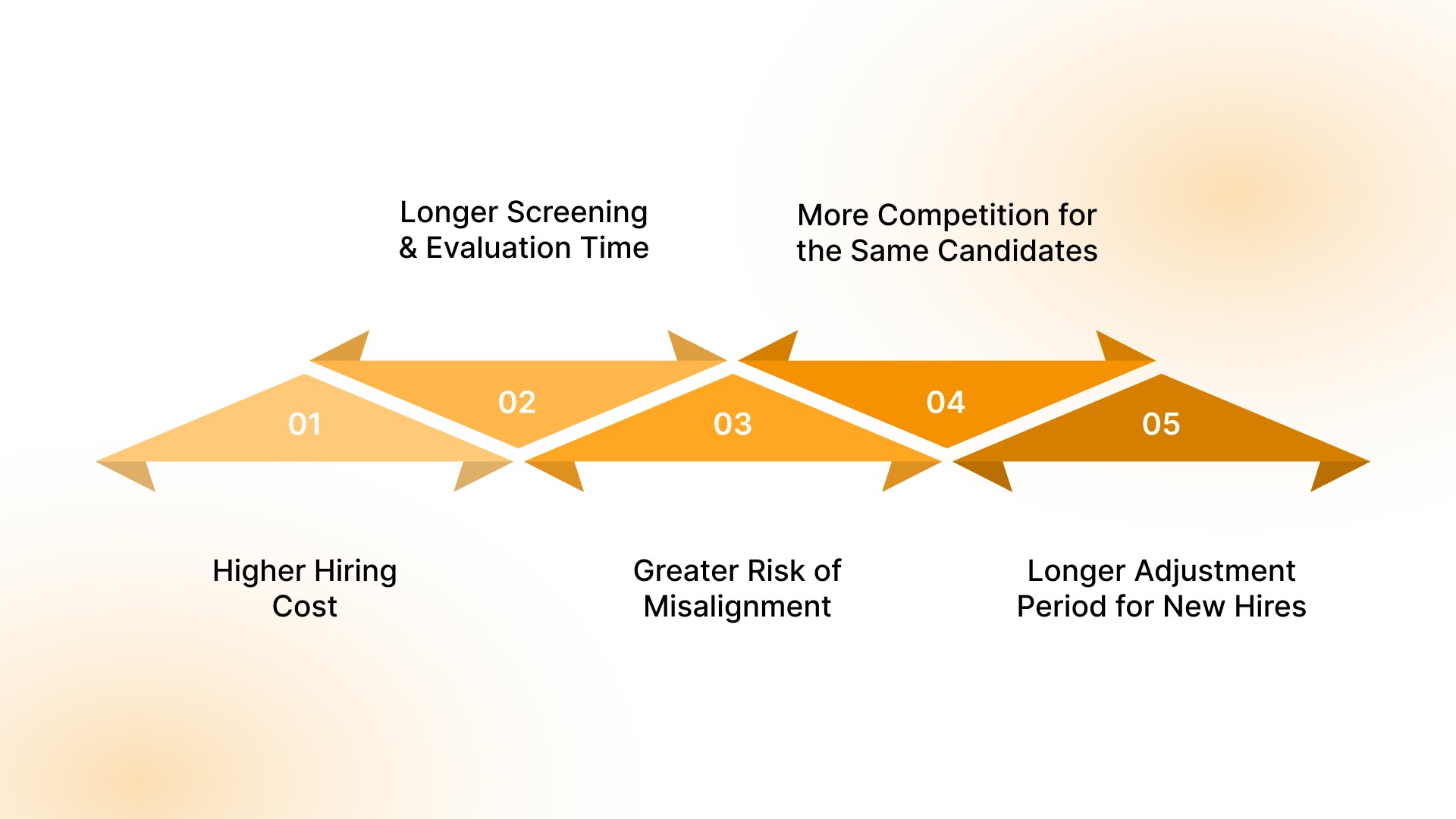
- Higher Hiring Cost: Some external sources involve direct spend through job postings, agency fees, or consultant support. Even channels that appear low-cost at the start can become expensive when screening volume is high, coordination takes longer than expected, or the hire does not work out and the role needs to be filled again.
- Longer Screening and Evaluation Time: A wider candidate pool improves choice on paper, but it also increases the filtering work the hiring team has to absorb. Without structured screening criteria set upfront, teams often spend more time eliminating poor-fit profiles than identifying strong ones, which slows down the overall hiring cycle.
- Greater Risk of Misalignment: Candidates from the external market may match the role on paper but still differ in expectations, working style, or readiness for the organisation's environment. This is especially relevant for GCC roles where global cultural alignment matters alongside technical skill.
- More Competition for the Same Candidates: External hiring means entering the open market where other employers are reaching the same candidate pools simultaneously. In India's tech hubs, this is particularly acute for roles in AI, cloud, and cybersecurity, where candidate supply is limited and multiple organisations are often pursuing the same shortlist at the same time.
- Longer Adjustment Period for New Hires: External hires usually need more time to understand the organisation, its culture, team structure, and ways of working. Unlike internal candidates, they do not begin with built-in context, which can affect how quickly they contribute meaningfully after joining.
External vs Internal Recruitment in India: Key Differences
Understanding the external vs internal recruitment debate in the Indian context is important before choosing a hiring strategy. The difference is simple in principle, but the implications vary significantly once speed, skill need, cost, and role importance are factored in.
When internal recruitment works better
Internal recruitment tends to work better when the organisation already has suitable candidates, the role depends on business familiarity, or the goal is to support career progression and succession planning. For stable, well-defined roles where institutional knowledge is the biggest asset, promotion from within often outperforms external hiring.
When external recruitment works better
When comparing external vs internal recruitment in India, external wins when the role needs skills unavailable internally, when hiring volume exceeds what internal movement can support, or when the business needs broader market reach; particularly in GCC expansion, AI/ML hiring drives, or Tier 2 city build-outs.
Best External Recruitment Sources for Different Hiring Needs
There is no single best source of recruitment for every role. The stronger approach is to match the source to the hiring situation.
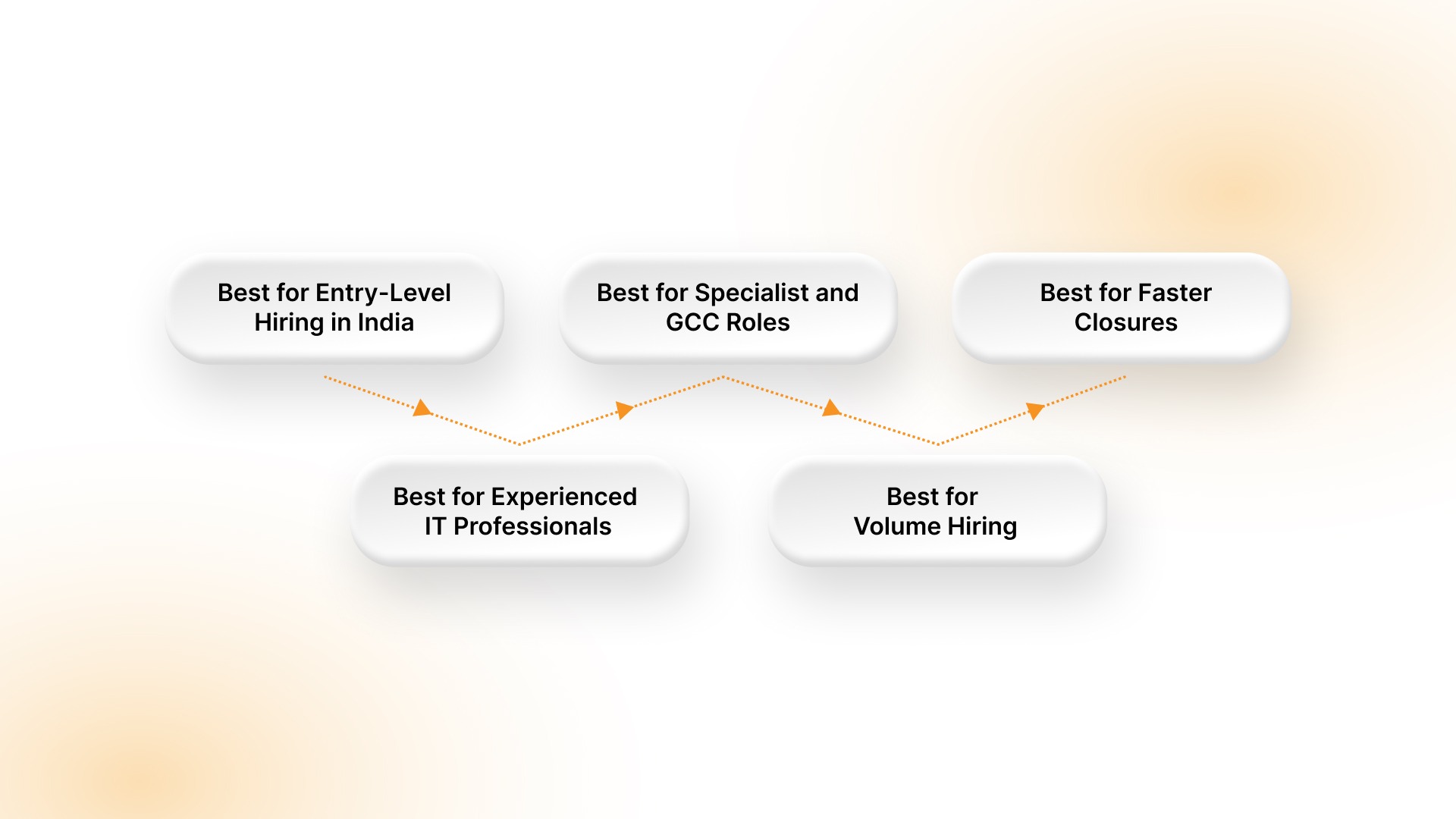
- Best for Entry-Level Hiring in India: Campus recruitment at IITs, IIMs, and Tier 2 engineering colleges, combined with Apna and WorkIndia for operational roles and Internshala for tech freshers, collectively covers the widest fresher funnel. GCCs are increasingly using campus channels for AI/ML and platform engineering intake.
- Best for Experienced IT Professionals: Naukri and LinkedIn are the primary channels for lateral hiring in India's IT sector. Cutshort and iimjobs serve well for tech and management roles respectively. Recruitment agencies fill the gap for niche skills where portal-driven sourcing produces poor match rates.
- Best for Specialist and GCC Roles: Recruitment consultants and search partners are better suited for narrow talent pools, covering roles in Generative AI, cybersecurity, financial modelling, and platform engineering where a curated, direct approach outperforms open advertising. LinkedIn outreach with structured InMail campaigns also performs well here.
- Best for Volume Hiring: Apna Enterprise for operational and blue-collar roles; Naukri Resdex for scaled professional sourcing; walk-in drives and staffing partners for BPO, ITES, and logistics hiring. For BFSI, a combination of Naukri and campus drives is common for branch and operations-level intake.
- Best for Faster Closures: Employee referrals, recruitment agencies with ready candidate pipelines, and Apna for operational roles all shorten the path between requirement and interview-ready profiles.
Also Read: What Is a Staffing Recruiter? Roles, Skills, and Hiring Process
How to Choose the Right External Recruitment Source
Choosing the right external recruitment source is less about which channel is most popular and more about which one fits the hiring requirement with the least mismatch.
- Role Type and Seniority: The source should match the kind of candidate the business actually needs. Entry-level, operational, specialist, and senior roles respond differently to the market. Apna works for the first; search consultants for the last.
- Hiring Urgency: Some sources support immediate candidate flow; others are better suited to longer search cycles. For urgent closures, referral channels, staffing firms, and platforms like Apna with fast-response workflows compress time-to-hire most effectively.
- Budget and Internal Bandwidth: Not every source creates the same level of cost or internal effort. Job portals appear cheaper at the start but require more screening time. Agencies add cost but reduce internal sourcing effort. The right choice should reflect both the hiring budget and the team's capacity to absorb screening volume.
- Candidate Availability in the Market: If the talent pool is highly active and visible, open-market channels work well. For narrower or less active talent pools such as GCC AI roles and cybersecurity architects, the business needs more focused sourcing routes, typically through search partners or targeted LinkedIn outreach.
- Hiring Volume and Repeat Demand: A business hiring for one niche role has different sourcing needs from one running ongoing intake across 20 branches. Some sources perform well for one-time specialist requirements; others are built for consistent, volume-driven pipelines.
Also Read: Top 10 Talent Acquisition Companies in India 2026
How V3 Staffing Supports External Recruitment for Enterprises
External recruitment can help organisations access a wider talent pool, but managing sourcing, screening, and hiring at scale often becomes complex, especially in India's competitive GCC and IT market, where skill gaps are acute and time-to-fill pressure is high.
V3 Staffing supports enterprises by providing structured recruitment solutions designed to simplify external hiring and improve outcomes.
- IT Staffing for Specialised Roles: V3 Staffing helps organisations source professionals across engineering, product, data, cloud, AI/ML, and cybersecurity functions. Recruiters with domain expertise identify candidates who align with both technical requirements and organisational expectations, which is critical in a market where 72% of GCC leaders cite upskilled talent shortage as a top priority.
- Recruitment Process Outsourcing (RPO): For organisations with ongoing or high-volume hiring needs, V3 Staffing offers RPO that integrates with internal hiring teams. Dedicated recruiters manage sourcing, screening, interview coordination, and reporting through structured workflows and defined SLAs.
- Contract Staffing for Flexible Hiring: Certain hiring requirements are project-based or temporary. V3 Staffing provides contract staffing solutions that allow organisations to deploy skilled professionals quickly without expanding permanent headcount, which is increasingly important as GCCs move toward hybrid workforce models.
- Global Hiring Across India, the USA, and the UAE: V3 Staffing supports recruitment across India, the USA, and the UAE, enabling organisations to access talent across multiple regions while maintaining consistent hiring standards.
Proven Hiring Outcomes
- 10,000+ specialists hired
- 300+ clients served
- Average time to hire: 10 days
Conclusion
External sources of recruitment play an important role in helping organisations build capable and future-ready teams, particularly in India, where the GCC ecosystem is scaling aggressively, AI talent demand is outpacing supply by wide margins, and Tier 2 cities are emerging as the next frontier for hiring.
But access to more candidates is not enough on its own. Managing external recruitment effectively requires structured processes, the right sourcing channels matched to each role type, and consistent evaluation discipline. Organisations that combine multiple external sources with well-defined hiring frameworks are better positioned to achieve quality hiring outcomes at the speed the market demands.
V3 Staffing supports enterprises with structured recruitment solutions that simplify external hiring across roles and locations. Get in touch with V3 Staffing to make external recruitment more targeted, efficient, and easier to scale across your hiring needs.