

.svg)
.svg)
Introduction
Scaling delivery capacity while keeping costs under control is one of the more stubborn tensions in operations leadership right now. The US talent market for engineering, analytics, finance, and product functions remains expensive — US software developers earn a median of $133,080 annually, financial analysts $101,910, and data scientists $112,590, according to BLS 2024 data.
For operations leaders under pressure to expand headcount without ballooning cost structures, India has become the answer — not as a vendor arrangement, but as genuine team infrastructure.
The evidence backs the shift. NASSCOM reports India's tech industry reached over $282.6B in FY2025, employing 5.8 million people, with over 1,750 GCCs now operating in the country. This is a mature, scaled professional ecosystem — not an emerging experiment.
But most offshore team builds still fail — and the talent pool isn't the problem. They collapse because US operations leaders skip the groundwork: requirements definition, city selection, compliance structure, onboarding design, and governance. This five-step framework is built to change that.
TL;DR
- Build before you hire: define outcomes, not just headcount, before approaching any talent partner
- City selection directly affects hiring speed, attrition risk, and the depth of available talent by function
- India's statutory obligations (PF, ESIC, gratuity) are non-trivial; compliance must be built into the model from day one
- Structured onboarding — role documentation, KPIs, and system access ready before day one — prevents costly ramp delays
- Governance (cadences, ownership, outcome metrics) must be defined before the team scales, not retrofitted later
Why US Operations Leaders Are Building Offshore Teams in India Right Now
US median salaries for technical roles now run between $91,000 and $133,000 — and that's before factoring in benefits, recruiter fees, and the months a role sits open. Operations leaders at enterprises and GCCs are dealing with three compounding pressures at once: tight domestic labor supply, long time-to-fill cycles, and wage inflation that keeps outpacing productivity gains. India addresses the cost structure directly, but cost alone doesn't explain the scale of what's happening.
Three factors make India structurally different from other offshore markets:
- Talent depth — India's AISHE 2021-22 data shows nearly 9.85 million STEM enrollments and over 4.1 million Engineering and Technology enrollments annually. The pipeline is genuinely large and continuously replenished.
- English as a working language — India's professional workforce uses English as the default for technical and business communication, which reduces friction in cross-border team collaboration.
- Established GCC infrastructure — Bengaluru, Hyderabad, Pune, Mumbai, Delhi NCR, and Chennai have decades of GCC buildout behind them, with mature payroll, compliance, and management talent ecosystems already in place.

The bigger shift is how enterprises now frame the relationship. An offshore team in Hyderabad that owns a product delivery workstream is not a vendor — it's a distributed arm of the core organization, with the same accountability structures and escalation paths as any domestic team.
Operations leaders who approach it that way get different outcomes than those treating it as a cost-reduction transaction.
The 5-Step Framework for Building an Offshore Team in India
Step 1: Define Strategic Needs, Not Just Job Titles
The most common failure point happens before recruitment even starts. Teams built around headcount targets — "we need 10 engineers in India" — drift within 90 days because no one anchored each hire to a specific delivery outcome.
Before approaching any talent partner, an operations leader should be able to answer:
- What specific business outcomes will this team own or support?
- What does success look like at 30, 60, and 90 days for each role?
- Which functions are being offshored — engineering, analytics, finance, operations, product?
- What seniority mix is required? (Too many junior hires creates management overhead; too few seniors creates delivery bottlenecks.)
- Will this team own work end-to-end, or support existing US-based functions?
The seniority question deserves direct attention. A team of 10 where 8 are junior-level produces output volume — but creates a management burden on the US side that erodes the efficiency gain. A well-calibrated mix, typically anchored by 2-3 senior or lead-level hires, operates with far less oversight dependency.
The operating model shapes everything else. A support-oriented team needs strong async communication skills and defined handoff protocols. A team owning end-to-end delivery needs domain authority, decision-making frameworks, and escalation clarity. These aren't the same team — and they shouldn't be hired the same way.
Lock these three dimensions before the first job description is written: function and skill requirements, seniority mix, and operating model. Everything downstream — city selection, partner briefing, onboarding design — flows from this.
Step 2: Choose the Right Indian City for Your Talent Profile
India is not a single talent market. City selection affects hiring speed, the depth of the candidate pool for your specific functions, attrition dynamics, and infrastructure cost. Getting this wrong means competing for scarce talent in oversaturated markets — or hiring in a city where the role type has shallow supply.
Functional fit by city:

NASSCOM data confirms that 90-95% of India's GCCs are concentrated across these six cities — so infrastructure, compliance support, and management talent availability are all anchored here.
Tier-II cities are worth considering for specific scenarios. EY notes that Tier-II cities offer lower talent and infrastructure costs than Tier-I metros. Separately, Zinnov-NASSCOM data shows digitally skilled talent in Tier-II cities grew by over 25% between 2017 and 2022. Cities like Coimbatore, Ahmedabad, Kochi, and Chandigarh are viable for certain IT, operations, and shared services roles — particularly where attrition pressure from competing GCCs is a concern.
V3 Staffing's network spans all six major metros plus Tier-II city reach, which matters for clients who need sourcing flexibility outside the most competitive talent pockets.
Step 3: Select a Staffing and Talent Partner with India-Specific Compliance Depth
Recruitment speed is not the right primary criterion for selecting an India talent partner. The right question is: does this partner have the compliance infrastructure to protect the US parent entity from regulatory exposure?
India's statutory obligations are specific and mandatory:
- Provident Fund (PF): Both employee and employer contribute 12% of basic wages. The employer's share splits between the EPF (3.67%) and Pension Fund (8.33%), per EPFO regulations.
- ESIC: Employer contribution is 3.25% of wages; employee contributes 0.75%. Coverage applies to employees earning up to Rs. 21,000/month.
- Gratuity: Payable after five years of continuous service, calculated as last drawn monthly wage ÷ 26 × 15 × completed years of service.
- Permanent Establishment (PE) risk: US entities directing India-based personnel without a local legal structure may inadvertently create a taxable presence in India. Per PwC and Deloitte guidance, PE analysis is fact-specific and should be assessed before any staffing arrangement begins.

Red flags when evaluating partners:
- No transparency on sourcing methodology
- Unable to provide statutory compliance documentation
- No structured onboarding framework beyond placing the hire
- One-size-fits-all approach that ignores your specific industry or function
- Can't articulate how their engagement structure addresses PE risk
Rigorous partner selection means retaining final hiring authority and demanding shortlists pre-screened for communication ability and ownership mindset — not just technical qualifications. A partner who can't demonstrate this screening depth is optimizing for placement speed, not your long-term team performance.
V3 Staffing maintains an 80% shortlist accuracy rate and a 90% offer-to-join ratio — metrics that reflect multi-layer vetting including behavioral screening, technical assessment, and cultural fit evaluation, not just resume matching.
Step 4: Structure Onboarding for Day-One Productivity
Once the right partner delivers a vetted shortlist, onboarding becomes the next failure point. New hires arrive without role documentation, system access, or defined 30-day expectations — and the first few weeks become a slow, expensive orientation rather than productive delivery.
Structured onboarding for offshore teams includes:
- Pre-start role documentation — written KPIs, defined responsibilities, and clear scope of ownership before the hire's first day
- Alignment calls with US counterparts — at least one structured intro before day one so the offshore hire understands team context, not just job description
- Access provisioning on day one — systems, tools, communication channels, and data access ready and tested
- Knowledge transfer protocol — documented process walkthroughs, recorded sessions, and written runbooks for the first 30 days
- 30-60-90 day milestones — explicit performance markers the hire and their US counterpart both understand
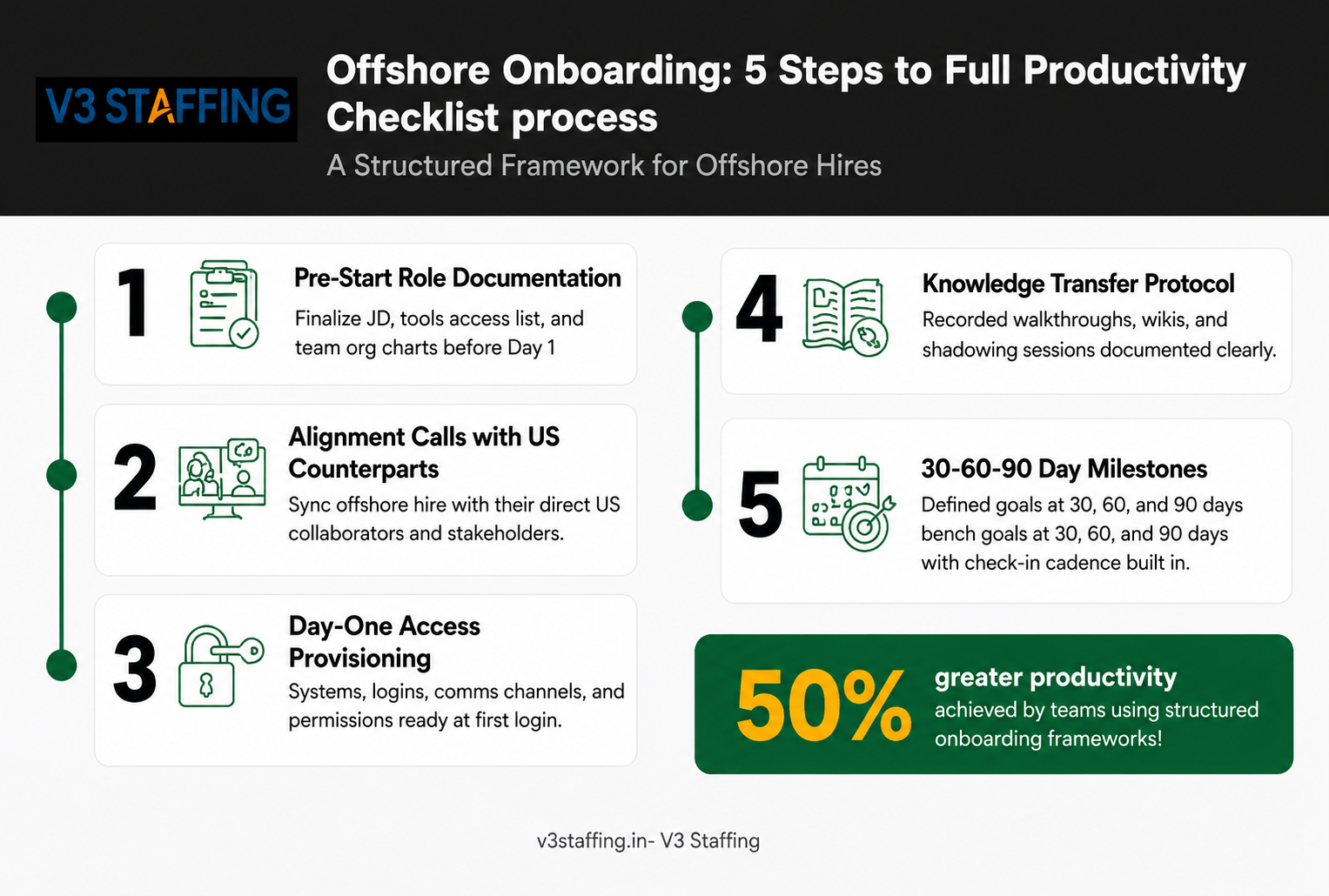
SHRM data shows that organizations with standard onboarding processes see 50% greater new-hire productivity, and new hires in structured programs are 58% more likely to still be with the organization after three years. For offshore hires, where the cost of early attrition includes both replacement cost and time zone coordination overhead, this is not optional infrastructure.
The benchmark to hold partners to: with pre-verified talent and structured onboarding processes in place, initial team members should be fully operational within 48 to 72 hours. V3 Staffing commits to this timeline for pre-vetted temporary staffing placements — and it's worth asking any partner to document this commitment contractually.
Step 5: Establish Operating Rhythms and Governance Before Scale
The biggest governance mistake is building the team first and figuring out the operating model later. By the time problems surface — unclear ownership, communication gaps, missed deliverables — the defaults have already calcified.
Three pillars of offshore governance:
1. Communication cadences Identify the 2-3 daily overlap hours between US and India time zones and protect them for decisions, not status updates. HBS research confirms that losing even one hour of schedule overlap measurably reduces real-time coordination within the working day. Async tools — written summaries, recorded walkthroughs, documented decisions — should carry the non-urgent workload so overlap hours stay high-value.
2. Ownership and escalation paths Every workstream needs a named owner on the India side. US operations leaders who appoint a dedicated India-side team lead or engagement manager consistently see faster ramp-up and stronger retention than those managing individual headcount directly. This layer cuts US-side coordination hours and gives the India team a single accountable point of contact.
3. Outcome-based performance metrics KPIs should tie to delivery milestones, not activity proxies like hours logged or tickets closed. Define what "good" looks like at the workstream level, then work backward to role-level indicators. This gives offshore team members clear targets and reduces the ambiguity that drives early attrition.
IP and contract clarity belong at the governance layer, not the legal afterthought stage. Under India's Copyright Act, employers generally own copyright for work produced during employment — but the Patents Act has no comparable default provision, meaning invention ownership requires an explicit assignment clause in employment contracts. Establish IP assignment scope, data access controls, and confidentiality obligations from day one.
Common Mistakes US Operations Leaders Make When Building Offshore Teams in India
Three patterns consistently derail offshore team builds that look well-resourced on paper.
Treating Headcount as Output
When team growth becomes the proxy for progress, accountability evaporates. Expanding from 5 to 15 people without tying each new hire to a delivery milestone creates a bloated team with unclear ownership and rising management overhead. Scale should follow delivery maturity, not precede it.
Underestimating Compliance Complexity
US operations leaders often assume India's labor regulations are straightforward — or that the partner handles compliance invisibly. Neither is true. PE risk, PF contribution structure, ESIC wage thresholds, gratuity calculation, and contract labor classification each require active oversight.
Misclassifying workers or misunderstanding PE exposure creates retrospective tax and legal liability that no staffing partner can absorb on your behalf.
Assuming Good Intentions Replace Written Structure
Daily standups feel like coordination, but they don't function as coordination without written escalation paths, documented decisions, and clear role boundaries. Offshore teams operating on assumptions rather than written alignment develop informal workarounds that accumulate over time.
More meetings won't fix this. Better documentation and clearer ownership — established before the team scales — will.
Conclusion
The framework's logic is straightforward: offshore team success in India comes down to how structured your requirements definition, talent partner selection, onboarding, and governance are from day one — not simply where you hire.
Operations leaders who apply the same rigor to offshore design as they do to domestic team-building consistently outperform those treating it as a cost-reduction transaction. India's professional talent depth is real, GCC infrastructure is mature, and the right partner makes compliance frameworks straightforward to navigate.
The teams that scale into genuine delivery assets all share one trait: the decisions made before the first hire was placed were deliberate, structured, and informed. That's where the outcome is actually determined.