
.svg)
.svg)
Recruitment cycles have lengthened considerably in recent years as organisations compete for specialist talent across multiple cities and countries. Traditional hiring approaches struggle under high application volumes, slowing time-to-hire, increasing costs, and placing stress on internal HR teams.
Business leaders are responding by adopting AI-based hiring techniques that deliver speed without compromising decision quality. These methods automate repetitive tasks, analyse large datasets, and provide structured shortlists that align with role requirements.
This blog explains practical hiring techniques used in 2026 that significantly reduce recruitment lead times.
Key Takeaways
- AI-based hiring significantly reduces screening and coordination time through structured automation across sourcing, resume parsing, scheduling, and offer management.
- The biggest time savings come from resume ranking, predictive matching, and smart scheduling, which compress early and mid-stage delays.
- Human judgment remains critical for leadership hiring, cultural alignment, and negotiation, ensuring automation supports rather than replaces recruiters.
- A phased rollout with defined KPIs such as time-to-hire and offer-to-join ratio is essential for measurable implementation success.
Why Is AI-Based Hiring Becoming Central to Modern Recruitment?
AI-driven recruitment is no longer a niche idea. It is an operational requirement for organisations facing higher hiring volumes, tighter timelines, and specialist workforce needs.
A recent industry report found that 99% of hiring managers now use AI in some part of the recruitment process, such as screening, scheduling, or skills evaluation.
The Drivers Behind Adoption
Organisations adopt AI for reasons that directly affect efficiency and outcome quality. These include:
- High volume of applications: Corporate job postings attract broad applicant pools, making manual filtering impractical.
- Specialist roles that require precision: Quickly capturing the right skills and experience gives organisations an advantage in competitive talent markets.
- Diversity and bias mitigation mandates: AI-enabled screening helps apply consistent criteria at scale.
- Multiple locations and time zones: Centralising hiring operations across cities like Delhi NCR, Bengaluru, Hyderabad, Pune, and overseas offices requires standardised processes.
Shared Patterns in AI Adoption in Recruitment
Across industries and regions:
- Resume parsing is added at the entry stage: AI systems extract skills, experience, and role relevance within seconds, ranking candidates before recruiter review begins.
- Pre-analysis of candidate profiles happens early: Structured scoring highlights strengths, gaps, and alignment, allowing recruiters to focus only on high-probability matches.
- Interview scheduling and communication are automated: Calendar syncing and real-time updates reduce coordination delays and prevent idle time between stages.
- Predictive insights guide hiring decisions: Historical performance data and retention patterns inform shortlisting and final selection priorities.
- Recruitment reporting is data-driven: Dashboards track time-to-hire and shortlist accuracy, and provide outcomes to quickly identify process issues.
Integrate AI-driven hiring with V3 Staffing, a global recruitment partner across India, the USA, and the UAE, for faster and more accurate placements. Get measurable shortlist accuracy, interview-to-offer ratios, and post-hire retention outcomes.
Top 8 AI-Based Hiring Stategies for Your Organisation
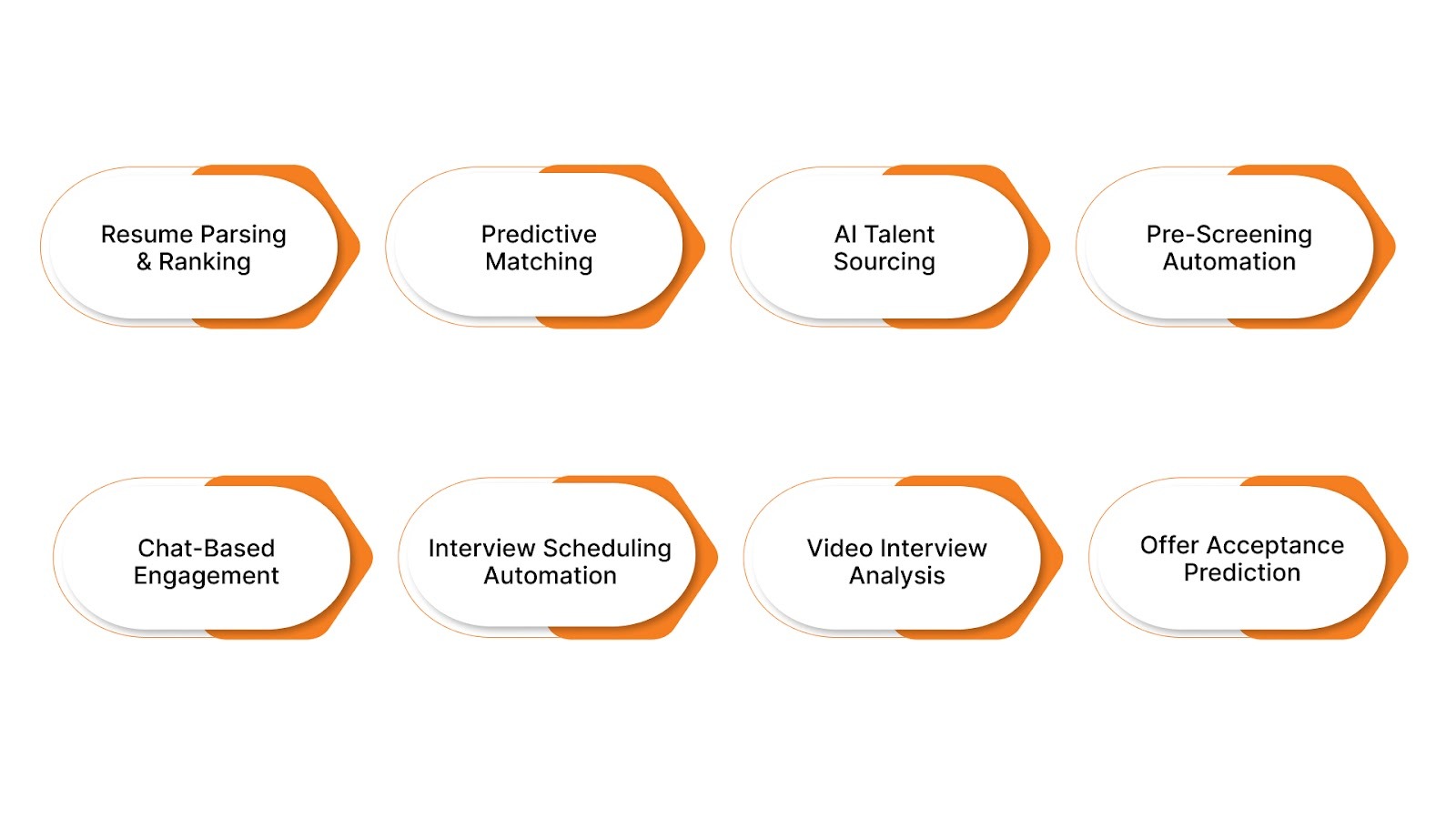
Enterprises that consistently reduce time-to-hire do not rely on a single tool. They apply multiple AI-based hiring methods across sourcing, screening, engagement, and offer stages. When integrated properly, these techniques compress hiring timelines without weakening selection standards.
Below is a deeper look at how each method works in practice and where it creates measurable impact.
1. Intelligent Resume Parsing and Ranking
AI engines use natural language processing to extract structured data from unstructured CVs. Instead of scanning for simple keywords, advanced systems map experience to competency frameworks and role taxonomies.
How It Works in Practice
- Converts CV content into structured skill matrices.
- Identifies tenure stability, domain exposure, and project complexity.
- Flags missing mandatory qualifications automatically.
Operational Impact
- Recruiters shift from reading CVs to validating ranked shortlists.
- Hiring managers receive pre-filtered candidate tiers.
- Screening consistency improves across locations.
This stage alone can reduce the recruitment cycle by several days.
2. Predictive Candidate Matching
Traditional applicant tracking systems rely on keyword overlap. Predictive matching compares candidate attributes with historical hiring outcomes.
What Gets Analysed
- Skill adjacency and transferability.
- Career progression patterns.
- Tenure history and attrition likelihood.
- Past performance signals where available.
Research shows that predictive analytics in recruitment improves hiring efficiency significantly when aligned with performance data benchmarks.
Why It Reduces Time
- Shortlists are narrower and more relevant.
- Fewer interview rounds are needed to identify suitable candidates.
- Hiring managers spend less time reviewing marginal profiles.
This approach strengthens quality while accelerating decision cycles.
3. AI-Powered Talent Sourcing Across Platforms
Manual sourcing across job boards and professional networks is labour-intensive. AI sourcing engines scan multiple databases simultaneously and surface passive candidates aligned with job requirements.
Capabilities
- Multi-platform search automation
- Skills clustering beyond exact keyword matches
- Talent rediscovery within internal databases
Recent surveys indicate that over 65% of recruiters use AI for sourcing, primarily to save time and widen reach.
Time-to-Hire Effect
- Candidate pipelines are built faster
- Passive candidates are engaged earlier
- Less dependence on job posting waiting periods
For niche technology and engineering roles, this method often determines whether hiring takes weeks or months.
4. Automated Pre-Screening Questionnaire
Pre-screening filters candidates based on mandatory criteria before recruiter interaction.
Advanced Screening Features
- Dynamic branching questions
- Scoring models tied to role benchmarks
- Automatic rejection where thresholds are not met
Automation studies show significant reductions in manual screening workload when structured filters are applied consistently.
Impact on Process
- Recruiters interact only with eligible candidates.
- Screening bias is reduced through rule-based scoring.
- Interview volumes become manageable.
Pre-screening compresses early-stage review timelines and improves shortlist accuracy.
5. Chat-Based Candidate Interaction
Conversational AI tools handle routine candidate queries and status updates, which typically consume a large portion of recruiters' time.
Key Applications
- FAQ resolution about role expectations
- Document reminders
- Interview confirmations
- Real-time application tracking
Organisations using chat-based engagement tools have reported improved response rates and lower candidate drop-off rates in the early stages.
Operational Benefit
- Recruiters focus on qualified applicants
- Communication gaps are reduced
- Pipeline transparency improves
This reduces administrative delays between screening and interview stages.
6. Smart Interview Scheduling
Interview coordination often creates challenges, particularly across time zones such as India, the USA, and the UAE.
Automated Scheduling Systems
- Real-time calendar syncing
- Auto-rescheduling and reminder notifications
- Integrated video links and structured evaluation forms
According to recruitment automation benchmarks, interview scheduling automation can reduce coordination time by several days per hiring cycle.
Result
- Faster interview cycles
- Reduced candidate withdrawal due to scheduling friction
- Clearer visibility of stage progression
This stage directly affects overall hiring velocity.
7. Video Interview Analysis Tools
Structured video interviews allow candidates to respond to standardised questions. AI tools analyse verbal responses and response patterns using predefined scoring frameworks.
Capabilities
- Standardised question sets
- Competency tagging
- Automated scoring summaries for reviewers
These systems do not replace judgment but create consistent evaluation baselines across large applicant pools.
Time Savings
- Hiring panels review scored responses instead of conducting repetitive screening calls.
- Early eliminations happen before live interviews.
- Multi-panel reviews become asynchronous.
This method reduces interview backlogs and supports objective comparisons.
8. Offer Acceptance Probability Modelling
Offer rejections prolong hiring timelines. Predictive modelling assesses signals that influence acceptance probability.
Data Analysed
- Compensation benchmarks.
- Candidate engagement patterns.
- Response time during the process.
- Competing offer indicators.
Recruitment studies indicate that predictive offer modelling improves acceptance rates and reduces last-minute drop-offs when compensation and communication are adjusted proactively.
Impact on Hiring Speed
- Fewer declined offers.
- Reduced the need to reopen searches.
- Improved joining ratios.
This final stage prevents timeline resets after offer issuance
For organisations that combine predictive offer modelling with structured recruiter follow-through, hiring timelines can be significantly compressed.
At V3 Staffing, structured screening frameworks and proactive offer management have enabled select mandates to close within 10 working days, particularly for pre-qualified and niche talent pipelines across India, USA and UAE.
Also Read: 11 Best Recruitment Startups Transforming the Hiring Industry
Where Does Human Judgement Still Matter in AI-Based Hiring?
AI accelerates screening and coordination, but high-stakes hiring decisions still require human evaluation. Organisations that rely entirely on automation risk overlooking contextual factors that influence long-term performance.
Critical Human Roles in AI-Enabled Recruitment :
- Cultural alignment evaluation: Algorithms assess skills and experience, but organisational culture fit requires interpreting behavioural cues, communication styles, and value alignment.
- Leadership and executive hiring: Senior roles require assessing strategic thinking, crisis management, and stakeholder influence. These elements are difficult to quantify using data models alone.
- Complex stakeholder discussions: Hiring managers often adjust role scope mid-process. Human recruiters interpret shifting expectations, team chemistry concerns, and organisational priorities that algorithms cannot anticipate.
- Offer negotiation strategy: Compensation benchmarks may be data-driven, but final acceptance often depends on personalised negotiation. Recruiters interpret candidate hesitation signals and adjust communication strategy accordingly.
- Ethical and legal governance: AI systems must be monitored for bias patterns in scoring outputs. Human review is required to validate fairness, audit algorithmic decisions, and comply with regional data regulations, such as the GDPR and local labour laws.
In structured AI-based hiring models, automation handles volume. Humans manage judgment, accountability, and contextual alignment.
The impact of AI-based hiring is most visible in specialist skill clusters where precision and speed are critical. Engineering, product, data and analytics, cloud and infrastructure, AI and ML, and cybersecurity roles demand recruiters who understand technical depth, not just job titles.
V3 Staffing supports enterprises building capability across these domains with structured screening frameworks and curated talent pipelines. If your hiring cycles need measurable acceleration and stronger joining ratios, contact us today.
Also Read: How India's AI Workforce is Shaping the Future of Jobs in 2026
How to Implement AI-Based Hiring Without Disrupting Operations
Rolling out AI-based hiring tools without architectural planning often disrupts workflows, leading to duplicate candidate records, conflicting shortlists, and unreliable reports. Enterprises that succeed treat implementation like a systems integration project rather than a tool purchase.
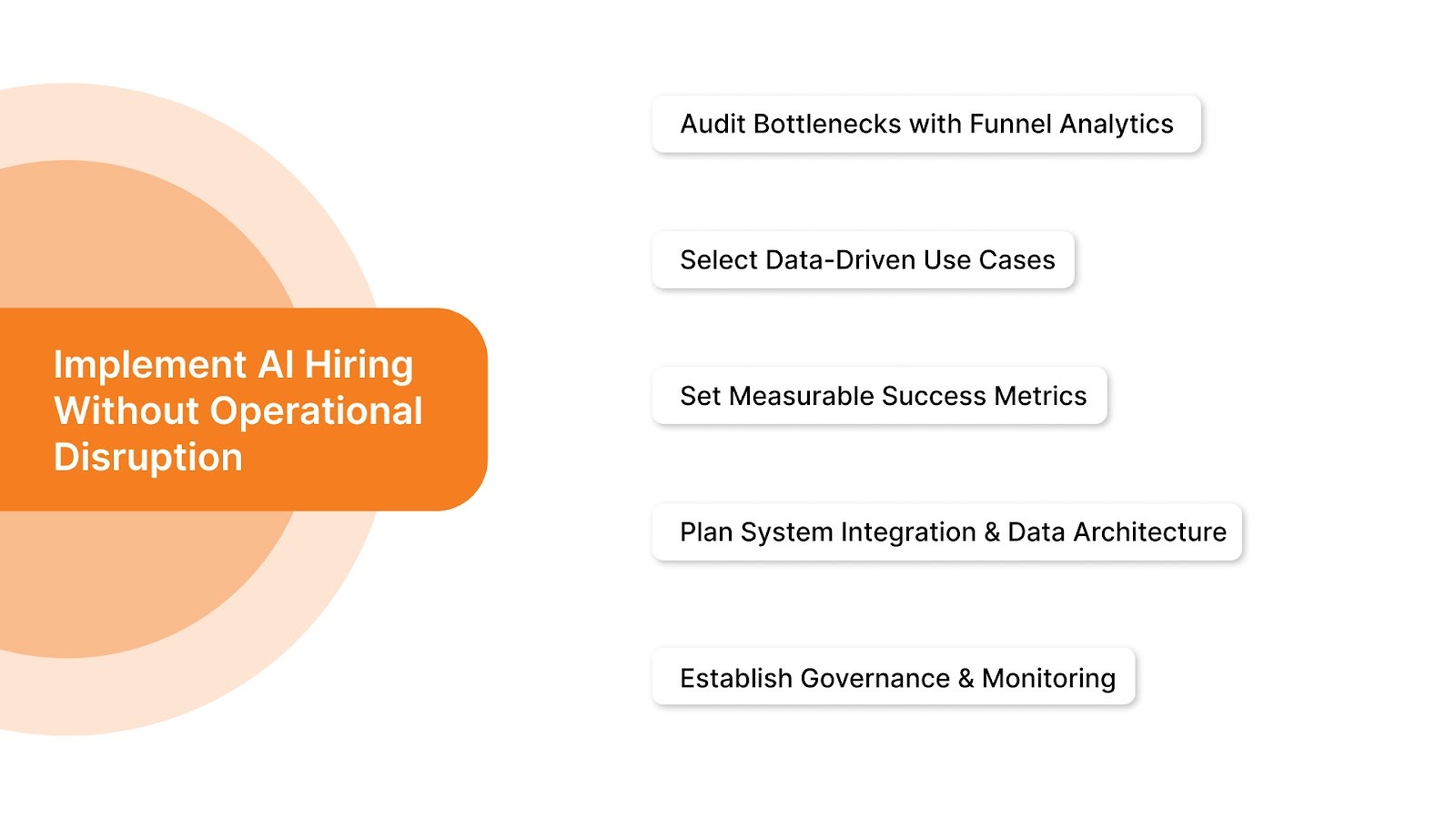
Below is a more technical rollout model used in large hiring environments.
Step 1: Audit Recruitment Bottlenecks Using Funnel Analytics
Start with event-level recruitment data instead of manual observations. Extract historical records from ATS logs and interview calendars for at least 6–12 months.
Analyse stage-level latency
- Application → first review time
- Review → shortlist approval time
- Interview → feedback submission delay
- Offer → acceptance duration
Measure behavioural drop-offs
- Candidate withdrawal after scheduling delays
- Offer rejection linked to compensation mismatch
- Hiring manager response time variance
Segment the data
The objective is to identify friction points in the process before introducing automation. AI should solve a measured bottleneck, not a perceived one.
Also Read: 10 High-Volume Recruitment Strategies for Efficient Hiring in 2026
Step 2: Select Targeted Use Cases Based on Data Volume
Choose automation areas based on transaction frequency and repeatability. High-volume repetitive steps deliver the highest return first.
High Priority Automations
- Resume parsing when applications exceed 150+ per role
- Automated scheduling where the interviewer count > 3
- Pre-screening for compliance-bound roles (finance, regulated functions)
Medium Priority Automations
- Candidate matching for niche technical roles
- Offer prediction for senior or competitive mandates
Low Priority Initially
- Behavioural scoring models
- Advanced sentiment analysis tools
Pilot within one business unit and track outcomes before scaling. This isolates operational risk and prevents organisation-wide disruption.
Step 3: Define Quantifiable Success Metrics Using Baseline Benchmarks
Do not rely on percentage improvements alone. Track absolute time and conversion changes at the stage level.
Run weekly dashboards for the pilot group and compare with a control group still using manual processes.
Step 4: Integrate With Existing Systems Through Data Architecture Planning
AI tools must exchange structured data, not export spreadsheets. Integration should occur at the data schema level.
Required Integration Points
- ATS candidate ID synchronisation
- HRIS employee record creation after hire
- Calendar API for scheduling
- Email server for communication tracking
- Compensation database for offer modelling
Technical Considerations
- API rate limits for high-volume hiring
- Duplicate candidate prevention logic
- Unified candidate status mapping across systems
- Real-time webhook events instead of batch uploads
Without schema alignment, organisations end up manually reconciling multiple candidate records, negating the benefits of automation.
Step 5: Establish Governance, Monitoring, and Model Review Protocols
AI hiring systems require operational monitoring similar to financial systems.
Operational Governance
- Weekly bias variance reports by demographic segment
- Manual review threshold for borderline scores
- Recruiter override logging for audit trails
- Quarterly model retaining using the latest hiring outcomes
Compliance Controls
- Candidate consent tracking for automated evaluation
- Retention policy for interview recordings
- Region-specific data storage requirements
Performance Monitoring
Also Read: Building Scalable Recruitment Models: Key Strategies for Success
How V3 Staffing Applies AI-Based Hiring in Enterprise Recruitment
Enterprises exploring AI-based hiring often face a gap between tools and execution. Technology alone does not shorten recruitment cycles unless supported by structured sourcing, domain expertise, and measurable delivery frameworks.
Backed by 15+ years of industry experience and 10,000+ specialists hired, V3 Staffing applies measurable hiring discipline across mandates. Our focus remains on reducing time-to-hire, improving shortlist precision, and maintaining accountability across complex hiring mandates.
Key Services include:
1. Permanent Recruitment: Mid to senior hiring requires precision from the outset. V3 Staffing applies structured competency mapping and domain-led screening to deliver accurate shortlists across multi-location mandates in countries like India, the USA, and more.
2. Temporary Staffing: Project and peak-demand hiring demands rapid mobilisation. V3 Staffing deploys pre-validated contract talent with full compliance oversight to meet defined timelines without lowering standards.
3. IT Staffing: Specialist technology roles often extend hiring cycles. V3 Staffing aligns technical screening to stack-specific requirements and curated talent pools to improve fit and reduce backlog.
4. Recruitment Process Outsourcing (RPO): Scaling enterprises need embedded hiring support. V3 Staffing provides SLA-aligned RPO teams with centralised reporting and measurable KPIs across major global hubs.
5. Executive Search: Leadership mandates require discretion and structured evaluation. V3 Staffing conducts targeted headhunting with competency-based assessment for CXO and senior-level roles.
Conclusion
AI-based hiring delivers results only when it is applied with structure, role clarity, and accountability for delivery. Automation can shorten screening cycles and organise candidate data, but the true impact appears when sourcing depth, technical validation, and stakeholder alignment work in sync.
Enterprises hiring across engineering, product, data, cloud, AI, and cybersecurity functions require disciplined recruitment execution.
If your organisation is building specialist teams across India, the USA, or the UAE and needs faster closures with stronger shortlist accuracy, partner with V3 Staffing to implement a measurable hiring framework. Contact us today.