

.svg)
.svg)
Choosing a global capability centre is rarely a simple location decision. For GCC leaders like you, the pressure is usually operational. That includes scaling specialised teams without inflating costs and protecting delivery quality as headcount expands. When internal hiring cycles are already stretched, and you need predictable execution, the wrong city can create ongoing talent gaps, slower ramp-up, and higher delivery risk.
This is where Chennai is increasingly becoming a part of serious GCC evaluation conversations. The city is home to 350+ GCCs and accounts for 10% of India’s GCC ecosystem. That gives you a more established base for workforce expansion, functional scale, and long-term capability building.
In this article, you'll explore why planning a global capability centre in Chennai makes sense. You'll also know which sectors are driving GCC growth and other factors to consider before choosing the city as your next expansion hub.
Key Takeaways
Chennai has become a prime location for global capability centres (GCCs) due to its combination of cost-effective operations, deep talent pools, and strategic location. Here's why it's a sensible move to consider GCC setup in Chennai:
- Skilled, Domain-Rich Talent: Access to highly qualified professionals from leading institutions like IIT Madras, ideal for IT, engineering, and R&D functions.
- Competitive Cost Structure: Chennai offers a more manageable operating-cost base than some other major metros, with affordable office infrastructure and lower day-to-day overheads.
- Mature Infrastructure: Well-established IT parks, easy access to global markets via international airports and port connectivity, supporting both digital and physical supply chains.
- Pro-Business Government Policies: Tamil Nadu’s incentives, including tax exemptions, single-window clearance, SEZs, and R&D incentives, simplify expansion efforts.
- Innovation Ecosystem: Growing presence of AI, cloud computing, and healthcare IT sectors, making it an ideal choice for global capability centres driving digital transformation.
The Strategic Role of a Global Capability Centre in Chennai
A global capability centre (GCC) is a dedicated hub that multinational companies set up to manage critical business functions from one location. Rather than outsourcing these functions, the organisation keeps them in-house to retain stronger control over operations, improve productivity, and protect intellectual property more effectively.
This model is relevant because a GCC is no longer just a support centre. It can act as a strategic extension of your parent organisation. Here's why you can use GCCs in locations such as Chennai:
- Tighter control over core operations
- Better process consistency across global teams
- Access to specialised local talent in engineering, data science, cybersecurity, and business operations
- Stronger support for automation, AI tools, and operational improvement
- A more stable way to scale global delivery
Also Read: Expand GCC in India: Key Trends and Opportunities for 2026
Why Chennai Stands Out as a High-Value GCC Hub in 2026
For GCC leaders assessing a global capability centre in Chennai, the decision is usually about more than cost. The right location has to support specialised hiring, operational scale, cross-functional delivery, and long-term business resilience. Chennai stands out because it combines strong talent depth, sector diversity, mature infrastructure, and a more controlled cost base in one market.
That is why GCCs in Chennai continue to attract attention from multinational companies building technology, operations, R&D, finance, and shared-services teams.
A Quick Decision View For GCC Leaders
1. Deep, Domain-Rich Talent
One of the clearest strengths behind a GCC in Chennai is the city’s ability to supply talent across both technical and operational functions. Chennai draws from a large academic and professional base. Institutions such as IIT Madras, Anna University, SRM University, etc., feed talent into engineering, IT, finance, analytics, and research-led roles.
This matters because you're not hiring for one function alone. Instead, it's often building a mix of:
- Software and platform teams
- Analytics and reporting functions
- Finance and shared services
- Engineering and product support
- Customer and operational support teams
- R&D and process-improvement roles
The city also supports demand for new capabilities in areas such as AI, machine learning, data analytics, and digital transformation. That makes Chennai relevant for volume hiring and for more specialised mandates where the quality of hire affects the centre's success.
2. Room to Scale Without the Same Cost Pressure
Cost remains part of the "why Chennai" conversation, but the stronger point is cost control with operational viability. Chennai gives you access to skilled professionals, modern office stock, and business infrastructure at a cost that's easier to manage than some other major metros.
The advantage typically shows up across:
- Affordable office infrastructure: From Grade-A office parks to flexible workspace options, you can build teams in high-quality environments without the same real-estate burden associated with some other business hubs.
- Competitive talent costs: Chennai offers access to skilled professionals in IT, finance, engineering, analytics, and operations without the salary premiums often seen in some more saturated markets. For instance, salaries are on average 30% lower than in Bengaluru.
- Lower operating overheads: Utilities and support services such as IT support, security, and logistics can be more manageable, helping you control day-to-day costs as teams expand.
- Employee cost-of-living advantage: More affordable housing and commuting costs can support both talent attraction, while helping you maintain compensation discipline.
That combination helps you expand headcount without creating the same financial strain that can come with more expensive locations. It also supports phased growth, where you may begin with one function and later expand into multiple teams. That said, it may be less suitable when the priority is immediate access to the broadest pool of startup-led product talent.
Pro tip: When evaluating a global capability centre in Chennai, assess total operating cost rather than rental cost alone. The stronger business case usually comes from the combined effect of talent availability, office economics, and lower day-to-day operating pressure.
3. Infrastructure and Connectivity For Global Operations
A location works for a GCC only when the operating environment can support consistency, access, and continuity. Chennai performs well here because it offers a mature commercial ecosystem with established IT parks, business districts, transport links, and port connectivity.
Key infrastructure strengths include:
- Office clusters such as OMR IT Corridor, Guindy, and TIDEL Park
- Major commercial parks, including Ramanujan IT City and DLF Cybercity
- International airport access for regional and global travel
- Port connectivity that supports logistics-heavy sectors
- Metro and road networks that improve employee accessibility
This makes Chennai particularly relevant for companies that need both digital delivery and physical supply-chain alignment. It is also a reason supporting regional operations and future global expansion from a single location.
4. Policy Support and Business Facilitation
For any GCC setup in Chennai, execution risk matters almost as much as cost. State-level support, facilitation, and investment focus can influence how quickly a centre is approved, launched, and expanded.
In this regard, Chennai benefits from:
- A supportive state approach to high-tech and innovation-led investment (more on this, later)
- Policy backing through Tamil Nadu’s innovation and R&D focus
- Continued investment in commercial and urban infrastructure
This does not mean policy alone makes the decision. But it does strengthen Chennai’s position as a city where long-term capability building is being actively supported rather than treated as a one-off investment story.
5. Quality of Life That Supports Retention
A GCC can hire well and still struggle if retention becomes difficult. Chennai’s mix of established residential areas, social infrastructure, and relatively manageable living costs can support workforce stability over time.
This is useful for you because it can influence:
- Employee retention
- Relocation attractiveness
- Commute practicality across key office corridors
- Long-term leadership mobility
- Overall workforce satisfaction
Major Industries Powering Global Capability Centres in Chennai
Chennai’s position as a preferred GCC destination is closely tied to the strength and range of industries already operating in the city. For you, that matters because a strong sector mix improves access to domain talent and supports cross-functional hiring.
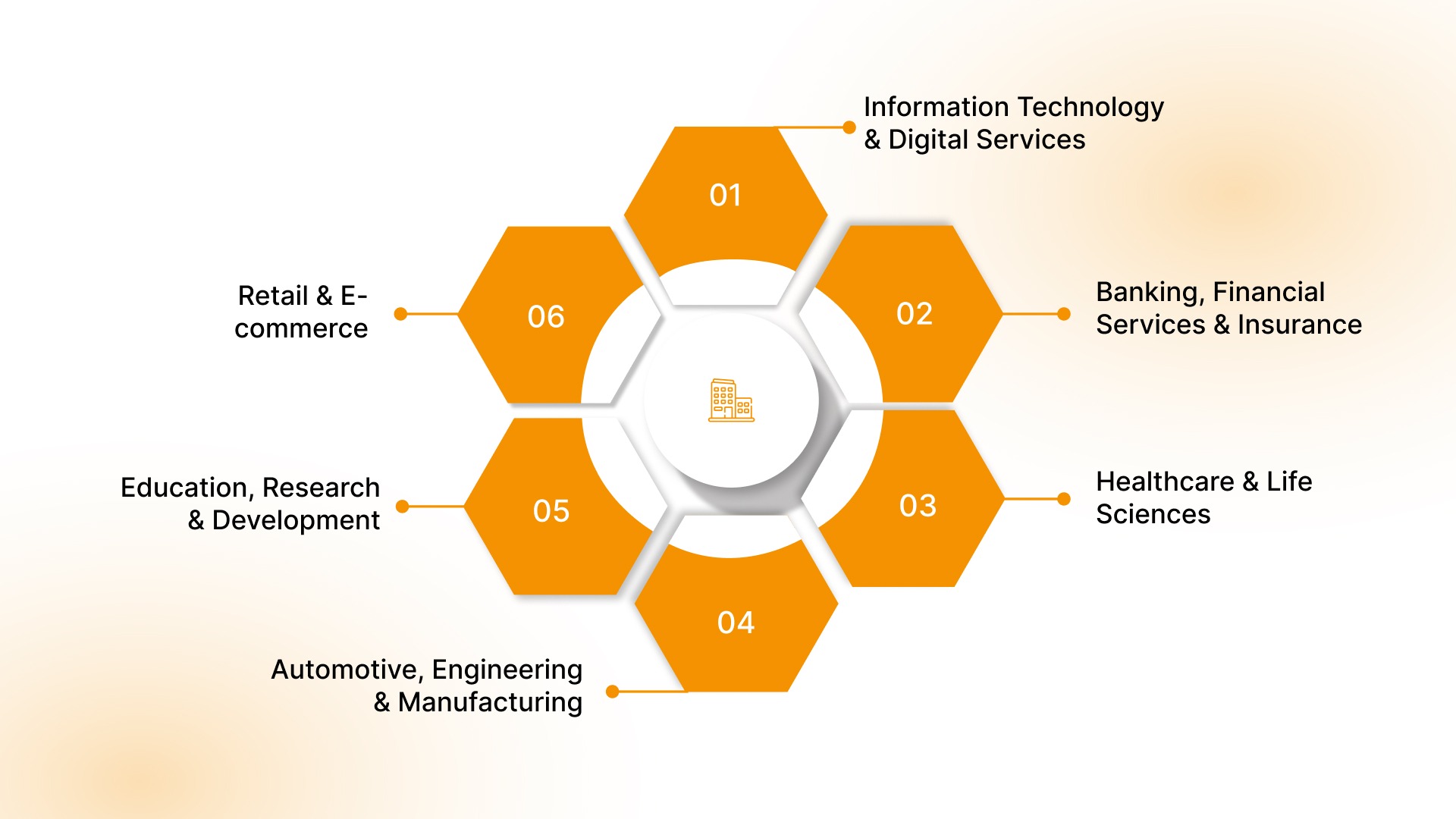
Rather than relying on a single industry, global capability centres in Chennai benefit from an ecosystem that spans technology, engineering, BFSI, healthcare, and research-led work. Here’s a closer look at the key industries shaping Chennai’s GCC growth:
1. Information Technology & Digital Services
IT remains one of the strongest drivers of GCC growth in Chennai. The city supports large technology and operations centres focused on software engineering, cloud, cybersecurity, platform modernisation, and AI-led work.
What strengthens this sector:
- Large technology and operations footprints from companies such as Cognizant, Infosys, Accenture, and Deloitte USI
- Global tech-led centres such as Walmart Global Tech, AT&T, Harman, and Hitachi Energy
- Strong demand for software development, cloud migration, data platforms, IoT, and AI/ML projects
- A strong network of tech startups, accelerators, and venture capital encourages collaboration and growth.
2. Banking, Financial Services & Insurance (BFSI)
BFSI is another important contributor to Chennai's GCC growth. The city supports global financial services centres that need domain expertise, process discipline, and teams capable of handling critical business functions.
What strengthens this sector:
- Capability across risk, compliance, regulatory reporting, treasury, and financial analytics
- Presence of firms such as Standard Chartered, BNP Paribas, Societe Generale, and the World Bank Group
- A growing fintech ecosystem allows GCCs to drive technological advancements in finance.
Also Read: Banking GCC India: Talent Demand and Hiring Trends
3. Healthcare & Life Sciences
Healthcare and life sciences are adding more depth to the city’s GCC profile. Chennai is increasingly relevant to companies seeking talent in research support, healthcare analytics, and medically aligned operations.
What strengthens this sector:
- Leading pharmaceutical companies like Dr Reddy’s Laboratories, AstraZeneca, Pfizer, and Roche focus on drug discovery and clinical research.
- Work across R&D data, clinical operations, pharmacovigilance, and healthcare analytics
- Sectors like telemedicine, AI diagnostics, and electronic health records are expanding rapidly.
- Growing relevance for pharmaceutical development and medical technology innovation
4. Automotive, Engineering & Manufacturing
Chennai’s engineering base is a major differentiator. Often referred to as the Detroit of India, the city has deep capabilities in automotive and industrial engineering. That supports GCC mandates that go far beyond general back-office work.
What strengthens this sector:
- R&D and engineering presence from companies such as Ford, Hyundai, Renault Nissan, Caterpillar, and Vestas
- Strong alignment with product engineering, manufacturing excellence, and supply-chain optimisation
- Professionals across mechanical, civil, and electrical engineering disciplines are available.
- Capability in higher-value areas such as simulation, digital twins, and connected-vehicle platforms
5. Education, Research & Development (R&D)
Chennai’s academic and research ecosystem supports the long-term depth of its GCC market. Institutions such as IIT Madras and Anna University strengthen the talent pipeline for technology, engineering, science, and business-led roles.
What strengthens this ecosystem:
- A steady supply of graduates across engineering, IT, analytics, and business disciplines
- Stronger collaboration between academia and industry
- Support for innovation-led work across technology, life sciences, and engineering
- A broader pipeline for future hiring as GCCs expand into higher-value functions
6. Retail & E-commerce
Chennai is seeing rapid growth in retail and e-commerce. Urbanisation, digital commerce, and strong logistics infrastructure make it an ideal location for GCCs focused on digital retail operations.
Key features include:
- Major e-commerce companies, including Amazon, are establishing significant operations in Chennai, boosting the digital retail market.
- Advanced networks enable efficient scaling of e-commerce operations.
- Professionals in e-commerce management, digital marketing, customer service, and logistics are readily available.
V3 Staffing helps you hire the right talent in Chennai's growing GCC ecosystem. Our expertise in recruitment and workforce management supports your GCC in scaling across key operations.

Also Read: GCC Growth in India: Key Drivers and Talent Impact
The government initiatives we'll discuss next further strengthen the industries that bring GCC growth in Chennai.
Key Government Initiatives Supporting GCC Growth in Chennai
The Tamil Nadu state government has introduced several initiatives to support the growth of Global Capability Centres (GCCs) in Chennai. These measures cover areas such as policy reforms, skill-building programmes, and innovation support. This makes Chennai a competitive choice for global companies looking to set up or expand operations in India.
Here’s a closer look at how these government efforts are helping GCCs grow in the city:
1. Business-Friendly Policies and Easy Operations
The Tamil Nadu government has simplified processes to enable businesses to set up and run operations smoothly. Pro-business policies focus on making it easier to do business, allowing you to establish faster and with fewer regulatory hurdles.
Government support and initiatives include:
- Tamil Nadu Industrial Policy (TNIP): Offers a comprehensive set of incentives for businesses across key sectors like IT, manufacturing, and services. It is designed to reduce operational barriers and drive growth for GCC companies in Chennai. The policy specifically encourages investments in industrial sectors and infrastructure development.
- Single-Window Clearance System: A one-stop system for approvals and clearances helps reduce setup time and administrative delays for GCCs.
- Business Support Services: The government provides facilitation services to help businesses handle compliance and ensure smooth operations in Chennai.
2. Tax Benefits and Financial Support for Businesses
To attract investment and support GCC growth, Tamil Nadu offers tax exemptions and financial incentives. These benefits help you reduce costs and improve profitability.
Key financial support includes:
- Tax Exemptions: Businesses operating in the IT, manufacturing, and research sectors can benefit from exemptions and rebates on registration fees, stamp duties, and other related charges. That helps to reduce the financial burden during the initial setup phase.
- Sector-Specific Financial Support: Emerging industries such as AI, blockchain, and cloud computing receive tailored incentives, helping you scale while keeping operational costs lower.
3. Special Economic Zones (SEZs) and IT Investment Regions (ITIRs) Bringing Growth
Chennai’s SEZs and ITIRs play a crucial role in supporting the growth of GCCs. They offer tax benefits, simplified regulations, and world-class infrastructure, making it easier for companies to operate efficiently.
Key initiatives include:
- Special Economic Zones (SEZs): These zones provide tax exemptions, simplified customs procedures, and other incentives for businesses in IT, manufacturing, and R&D sectors, helping you scale smoothly. The Tamil Nadu Industrial Policy (TNIP) has also laid a strong foundation for further expansion of these zones.
- IT Investment Regions (ITIRs): Dedicated zones for IT companies offer the necessary infrastructure, policy support, and business-friendly regulations.
- Infrastructure Support for SEZs: High-quality facilities within these zones enable GCCs to establish and expand operations without hindrance.
4. Support for Innovation and R&D
The Tamil Nadu government promotes research and innovation, with a focus on IT, life sciences, and engineering. It actively promotes partnerships between industry and academia, enhancing the city’s position as a leading destination for innovation-driven global capability centres. For instance:
- R&D Tax Incentives: Companies engaged in research and development can benefit from tax exemptions and rebates, which encourage investment in advanced technological solutions. These incentives are part of the Tamil Nadu R&D Policy.
- Technology and Innovation Hubs: The government has set up dedicated hubs for R&D, providing grants, resources, and technical support for businesses investing in research, product development, and technological growth and innovation. These hubs are aligned with the Tamil Nadu FinTech Policy, which supports the development of the fintech ecosystem.
What Upcoming GCC Trends in Chennai Mean for Enterprise Hiring
The next wave of GCC growth in Chennai is being shaped by both new market entrants and larger expansions from companies already operating in the city. This momentum is especially visible in pharma, logistics, automotive, and mid-market technology firms.
What makes this wave important is not just the number of centres being added. It is the type of work these centres are expected to handle. Chennai is increasingly attracting GCC mandates in AI, product R&D, data science, supply-chain technology, and digital operations. That indicates a clear shift away from purely transactional or back-office roles.
Key trends shaping the next phase of Chennai GCC growth include:
- Large pharma expansions are accelerating: AstraZeneca has expanded its Chennai GCC into the company’s largest centre worldwide, signalling continued momentum for life sciences and healthcare-led capability building in the city.
- Manufacturing and logistics GCCs are gaining ground: New centres from logistics majors and industrial businesses are being set up to manage supply-chain technology, fleet analytics, and global operations from one location.
- Mid-market and nano-GCCs are becoming more visible: Smaller, domain-led centres with fewer than 100 to 150 employees are emerging across AI, R&D, and specialised platforms. This reflects the broader trend towards more focused, high-value GCC models.
- Demand is expanding across specialist verticals: Mid-market and verticalised GCCs are increasingly targeting areas such as cybersecurity, AI, and industry-specific SaaS. That's where Chennai’s talent base and cost structure can support more focused growth.
- Expansion into Tier-II and Tier-III Cities: As GCCs in Chennai mature, there is growing interest in expanding into nearby Tier-II and Tier-III cities within Tamil Nadu. This expansion provides you with access to more cost-effective talent pools and the ability to expand operations without the same financial burden as large metros. Cities such as Coimbatore, Madurai, and Trichy are gaining attention, further boosting Tamil Nadu’s position as a GCC hub.
Also Read: GCC Hiring Trends And Strategies In India 2026
How to Unlock GCC Potential in Chennai with V3 Staffing’s Strategic Hiring Solutions
V3 Staffing is most relevant when your challenge is to build specialised teams quickly and with stronger local execution. We help GCCs overcome hiring delays, improve role fit, and scale with clearer visibility into delivery. Our recruitment solutions are designed to match your specific needs, helping you build high-quality teams in one of India’s leading GCC hubs.
Here’s how we can support your GCC hiring in Chennai:
- Permanent Recruitment: We help you build stable, future-ready teams by recruiting full-time professionals across key functions. This ensures continuity and growth, while allowing you to establish a solid operational base in Chennai for the long term.
- Temporary & Contract Staffing: Provides flexible, compliant staffing to manage workload spikes, project rollouts, and seasonal demands while keeping GCCs agile and productive.
- Recruitment Process Outsourcing (RPO): For companies looking to scale efficiently, we manage end-to-end hiring processes. Our RPO services help enhance candidate quality, reduce hiring delays, and support smooth multi-location GCC expansion.
- Leadership Hiring: We identify senior leaders for cross-functional and cross-border roles to drive strategy, culture, and performance. Our expertise ensures that you find the right fit for leadership roles, especially for high-impact positions within your Chennai-based GCC.
- Employer of Record (EOR) Services: We simplify compliance and workforce management for GCC setups and expansions by handling payroll, statutory compliance, benefits administration, and employment risk.

Final Thoughts
Chennai’s cost-effective operations, skilled talent, and strategic location make it an ideal choice for businesses looking to set up a GCC. The city offers more than just incentives. It provides a supportive ecosystem where innovation and collaboration drive real business results, making it a top hub for global capability centres.
That said, to maximise Chennai’s potential, partnering with an enterprise-focused staffing firm that understands the local talent scenario is crucial. V3 Staffing’s expertise in specialised talent acquisition, contract staffing, and leadership hiring helps you build high-performing teams, reduce hiring delays, and scale operations smoothly across Chennai.
If you’re ready to take the next step in expanding your GCC in Chennai, consider reaching out. Discuss your hiring strategy and explore how our tailored workforce hiring solutions can support your growth and long-term success.