

.svg)
.svg)
India has emerged as a preferred destination for global enterprises looking to establish Global Capability Centres (GCCs). Among Indian cities, Bengaluru has consistently stood out as the preferred destination for GCCs, attracting both domestic organisations and international enterprises seeking a reliable, scalable, and innovation-driven hub.
The city is home to 875 of GCCs in India, collectively contributing over USD 22 billion in annual economic value and employing nearly 6 lakh professionals, representing 35% of the country's total GCC workforce. This concentration is supported by deep talent availability, technological infrastructure, and a supportive ecosystem, helping Bengaluru maintain its edge over emerging hubs such as Pune, Hyderabad, and Chennai.
In this blog, we'll explore why Bengaluru continues to lead the GCC landscape, the industries driving its growth, supportive policies, operational benefits, and potential challenges.
In a nutshell:
- Bengaluru's deep talent pool, advanced tech ecosystem, and global business readiness make it India's leading destination for multi-function GCCs.
- GCCs in Bengaluru span IT, BFSI, engineering, healthcare, and shared services, utilising specialised skills and innovation-driven capabilities.
- Strong government policies, workforce development initiatives, and fast-track setup programmes provide stable, long-term support for GCC investments.
- Companies operating in Bengaluru must address challenges like talent competition, attrition, infrastructure pressures, and compliance complexities to maintain sustainable growth.
What is a Global Capability Centre (GCC)?
A Global Capability Centre (GCC) is a dedicated offshore unit set up by multinational corporations to manage business processes, technology operations, research, or innovation initiatives. They act as extended arms of the parent company, offering specialised expertise and maintaining consistent quality standards while complying with local regulations.
These centres typically handle functions such as IT services, analytics, finance, HR operations, customer experience, and product development. GCCs help enterprises consolidate operations, improve productivity, and maintain direct control over key business processes.
Also Read: Understanding GCC Technology in Global Capability Centres
Why Bengaluru is India's Leading GCC Hub?

Bengaluru has consistently outpaced other Indian cities in attracting GCC investments. Several factors contribute to this dominance:
1. Depth and Diversity of Skilled Talent
Bengaluru has one of the largest concentrations of skilled professionals in India, covering both technical and business functions. This talent depth helps GCCs scale teams without compromising role suitability.
- Technology expertise: Software engineering, cloud, DevOps, AI, data analytics
- Business functions: Finance, risk, compliance, HR shared services, operations
- Leadership readiness: Availability of mid-to-senior professionals with global exposure
The steady supply of experienced professionals reduces hiring risk and supports long-term workforce planning for GCCs.
2. Advanced Technological and Innovation Ecosystem
Bengaluru's technology ecosystem has evolved over decades, creating an environment well-suited for global enterprise operations. GCCs benefit from ready access to innovation, infrastructure, and specialised service providers.
- Established IT corridors: Prime business districts like Whitefield and Electronic City host Grade-A office spaces and SEZs.
- Digital reliability: 24/7 connectivity, cloud adoption, and strong data centre presence.
- Innovation access: Startups, R&D centres, accelerators, and research institutions
This maturity allows GCCs to move beyond transactional work and support advanced digital, analytical, and innovation-led functions.
3. Strong Presence of Global Enterprises and GCC Peers
Bengaluru benefits from a business environment where GCCs, global enterprises, startups, and service providers coexist and collaborate. This maturity supports faster decision-making and operational alignment.
- Peer presence: Nearly 40% of India's GCCs are based in Bengaluru, with expectations to grow further.
- Vendor and partner availability: Easy access to recruitment firms, compliance partners, payroll providers, and IT vendors.
- Knowledge exchange: Industry forums, leadership networks, and professional communities enable shared learning.
For global organisations, this network reduces the risks of operating in a new geography.
4. Operational Scalability for Multi-Function GCCs
Bengaluru enables organisations to scale their GCC operations gradually or quickly, depending on business requirements. This flexibility is a key reason global firms continue to choose the city.
- Multi-location hiring within the city: Access to talent across different zones reduces dependency on a single area.
- Flexible workforce models: Support for permanent, contract, and project-based hiring structures.
- Long-term sustainability: Capacity to support growth over multiple business cycles.
This scalability makes Bengaluru suitable for both new GCC setups and the expansion of existing centres.
5. Cultural Alignment and Global Business Readiness
Bengaluru's workforce is accustomed to working with international stakeholders, processes, and compliance standards. This minimises the cultural and operational gap between headquarters and Indian GCC teams.
- English-first professional environment: Clear communication across regions and time zones.
- Process-driven work practices: Familiarity with global SLAs, reporting structures, and compliance standards.
- Cross-cultural exposure: Experience working with US, UK, European, and APAC stakeholders.
This alignment helps GCC teams in Bengaluru to integrate into enterprise operations with greater clarity and operational stability.
6. Sustained Ecosystem Support and Policy Stability
The city benefits from consistent policy support and business-friendly governance, particularly for technology-led and knowledge-driven enterprises.
- State-level incentives: Support for IT and shared services operations
- Skill development initiatives: Industry–academia collaboration to align talent readiness with enterprise needs.
- Ease of compliance: Predictable compliance environment for employment and operations.
Policy continuity gives global enterprises the confidence to invest in long-term GCC strategies instead of short-term delivery centres.
This combination of talent, infrastructure, and innovation creates a strong environment for global enterprises to establish and grow their GCCs.

Also Read: GCC Expansion in Bangalore: A Global Hub Emerges
Key Industries Driving GCC Growth in Bengaluru

Bengaluru hosts GCCs across multiple sectors, each benefiting from the city's specialised workforce and advanced ecosystem.
- Information Technology and Software Services: Bengaluru is widely regarded as India's IT capital. Enterprises establish GCCs here to utilise software development, cloud engineering, data analytics, and cybersecurity expertise. Both product-based and service-oriented companies benefit from access to highly skilled technical talent.
- Banking, Financial Services, and Insurance (BFSI): BFSI institutions use GCCs for functions such as risk management, compliance, digital banking solutions, and analytics. Bengaluru's growing fintech ecosystem and experienced professionals make it a preferred choice for financial enterprises.
- Engineering and Manufacturing: Companies in aerospace, automotive, and industrial engineering establish GCCs in Bengaluru to manage R&D, design, and digital transformation projects. The city's engineering talent and proximity to research institutions support complex, high-value projects.
- Shared Services Centres: Shared services models for HR, IT support, and back-office functions are increasingly centralised in Bengaluru. Organisations benefit from cost savings, talent availability, and process maturity to manage multi-location operations.
- Healthcare and Life Sciences: Increasingly, pharmaceutical companies, hospitals, and healthcare startups are establishing GCCs for research, data analytics, and regulatory compliance support, tapping into Bengaluru's growing ecosystem of life sciences talent.
If your company is considering expansion or establishing a presence in Bengaluru, utilising policy incentives and ecosystem support can significantly improve your setup outcomes. Get expert advice from V3 Staffing to align your GCC goals with local ecosystem advantages.
Government Policies and Ecosystem Support
Government backing plays a central role in Bengaluru's sustained success as a preferred GCC destination. Karnataka's focused policies and ecosystem initiatives provide global enterprises with a stable environment to set up, operate, and scale long-term capability centres within India.
- Karnataka's GCC Policy 2024-2029: This policy is designed to attract new GCC investments by supporting workforce development, innovation-led operations, and long-term expansion. It places strong emphasis on skill creation, industry, academia collaboration, and structured incentives for GCC employers.
- Workforce and Skilling Incentives: The policy emphasises large-scale internships and workforce development, with support for technical and soft-skill training. Reimbursements for internship stipends and links with academic institutions help bridge talent gaps for GCCs operating here.
- Innovation and Research Collaboration: Government-backed innovation labs and Centres of Excellence (CoEs), particularly in AI and deep-tech, foster partnerships between GCCs, startups, academia, and research bodies. This strengthens R&D capabilities within Bengaluru's ecosystem.
- 'Beyond Bengaluru' Expansion Programme: To balance regional development, special packages (e.g., rental reimbursements, EPF contributions and grants) support GCC expansions into Mysuru, Mangaluru, Hubballi-Dharwad and other cities beyond Bengaluru.
- Fast-Track GCC Setup Initiatives: Programmes such as KATALYST play a crucial role. KATALYST is a government-led programme designed to speed up the setup of GCC in Karnataka. It serves as a single coordination platform for approvals, compliance, and clearances, helping organisations establish GCC operations with reduced administrative effort and faster execution.
Together, these policy measures strengthen Bengaluru's position as a reliable and well-supported location for global organisations planning long-term GCC investments.

Challenges of Operating a GCC in Bengaluru
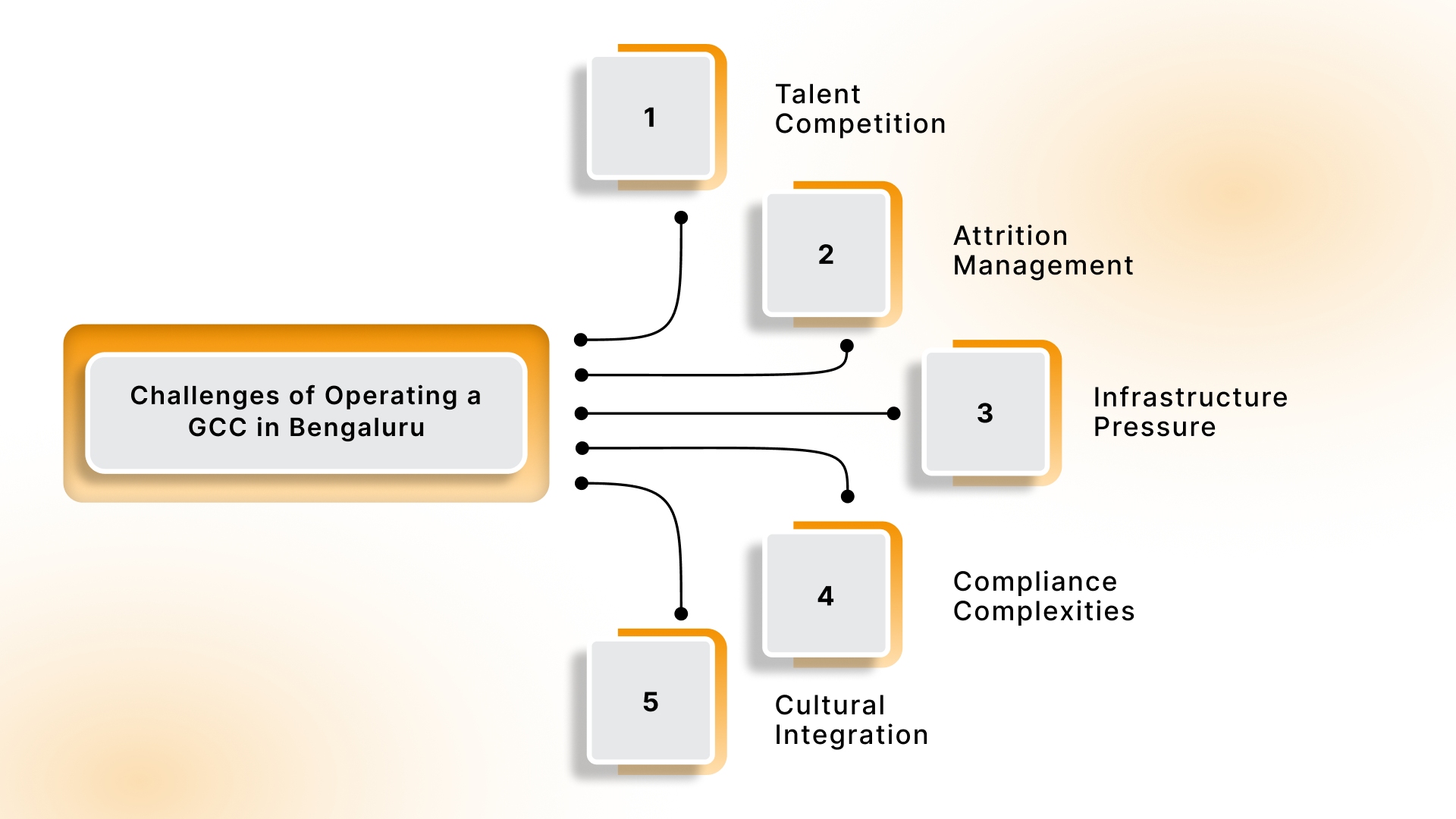
Despite its advantages, setting up and managing a GCC Bengaluru comes with challenges that companies must navigate:
- Talent Competition: High demand for skilled professionals, particularly in IT, analytics, and specialised finance roles, creates competition for talent. Organisations must adopt strong hiring strategies and retention plans.
- Attrition Management: Bengaluru's workforce is mobile, and high attrition can disrupt operations. Companies need proactive engagement, career development, and employee experience initiatives to retain talent.
- Infrastructure Pressure: Although the city has excellent IT infrastructure, rapid urbanisation can lead to traffic, real estate costs, and logistical challenges, which may impact operational efficiency.
- Compliance Complexities: Operating at scale entails navigating labour laws, data protection mandates, and multi‑layered regulatory obligations that vary by function and industry.
- Cultural Integration: Aligning GCC teams with parent company culture and processes demands careful planning and continuous engagement.
Understanding these challenges is essential for enterprises to build resilient, high-performing GCCs in Bengaluru.
How V3 Staffing Can Help You Build and Scale Your GCC in Bengaluru?
V3 Staffing, as a leading India-focused recruitment and workforce solutions provider, offers specialised services tailored for GCCs in Bengaluru.
Here's how we can support you:
- Permanent Recruitment: V3 Staffing sources and screens professionals for full-time positions, ensuring high-quality talent that aligns with business objectives.
- Temporary and Contract Staffing: Flexible workforce solutions help GCCs scale operations during peak demand or project-based initiatives, with full compliance and quick deployment.
- IT Staffing: For technology-intensive GCCs, V3 Staffing provides access to a curated pool of IT specialists, including cloud engineers, data scientists, DevOps professionals, and software architects.
- Recruitment Process Outsourcing (RPO): V3 Staffing manages end-to-end recruitment pipelines, embedded within the client's talent team. This SLA-driven model ensures consistent hiring outcomes and reduces internal recruitment load.
- Executive Search: For senior leadership roles, V3 Staffing conducts discreet and targeted searches to identify CXO, VP, and director-level talent, ensuring alignment with organisational strategy and culture.
By partnering with V3 Staffing, global enterprises can build future-ready GCCs in Bengaluru that are scalable, compliant, and aligned with corporate objectives.
Conclusion
Bengaluru's status as India's leading GCC hub is supported by its unmatched combination of talent, infrastructure, and innovation ecosystem. The city attracts multinational enterprises across IT, BFSI, engineering, and shared services sectors, providing access to specialised skills and operational excellence.
With the right ecosystem and recruitment partner, organisations can achieve operational efficiency, innovation, and long-term growth. Working with experienced recruitment firms like V3 Staffing ensures that organisations can establish future-ready GCCs that meet SLA commitments, access niche talent, and scale efficiently across multiple locations in India.
Contact us today to discover how V3 Staffing can help you establish and expand your GCC in Bengaluru with the right talent strategy and operational support.