
.svg)
.svg)
Introduction
Engineering leaders in 2026 face a familiar but intensifying squeeze: backlogs are growing, hiring cycles keep stretching, and every sprint planning session surfaces a gap that local recruiting can't close fast enough. iCIMS reported tech-role time-to-fill at 51 days in February 2025, up from 48 days the year before — and that's the average, not the worst case.
Offshore staff augmentation closes that gap. It puts pre-vetted engineers inside your team structure within days — not months — while keeping sprint ownership and architectural control exactly where they belong: with your team.
This guide focuses on making offshore augmentation work inside real Agile workflows — from standup scheduling to async code review. By the end, you'll know which engagement model fits your team, how to structure ceremonies across time zones, and what separates a genuine talent partner from a transactional staffing vendor.
Key Takeaways
- Retain full sprint ownership and architectural control — offshore staff augmentation embeds pre-vetted engineers directly into your existing team
- Integrate offshore engineers more smoothly with Agile: built-in two-week sprint reviews create natural checkpoints that waterfall projects lack
- India remains the top offshore destination for US enterprises in 2026, with nearly 1,700 of ~3,200 global GCCs based there
- Cut hiring timelines fast: quality partners deliver shortlists in 48–72 hours versus a 6–8 week local hiring cycle
- Choose partners over geography: SLA-backed delivery, structured onboarding, and proven Agile experience matter more than location
What Is Offshore Staff Augmentation and How Is It Different from Outsourcing?
Offshore staff augmentation is a capacity model where offshore engineers work under your direction, inside your tools and processes. You assign their tasks, set their sprint goals, and own the code they produce. The offshore partner supplies and supports the talent — they don't manage the work.
That's the core distinction from outsourcing. In a traditional outsourcing arrangement, the vendor owns execution and delivers results on their terms. In staff augmentation, you retain full management of activities — the offshore engineers are an extension of your team, not a separate delivery unit.
Three Common Engagement Models
| Model | Best For | Structure |
| Project-based | Short-term, scope-defined work (migration, audit, feature sprint) | Defined deliverable, fixed duration |
| Dedicated team | Long-term embedded extension of in-house unit | Ongoing, same engineers, integrated into ceremonies |
| Hybrid | Multi-track products with varying skill needs | Mix of steady core team plus on-demand specialists |
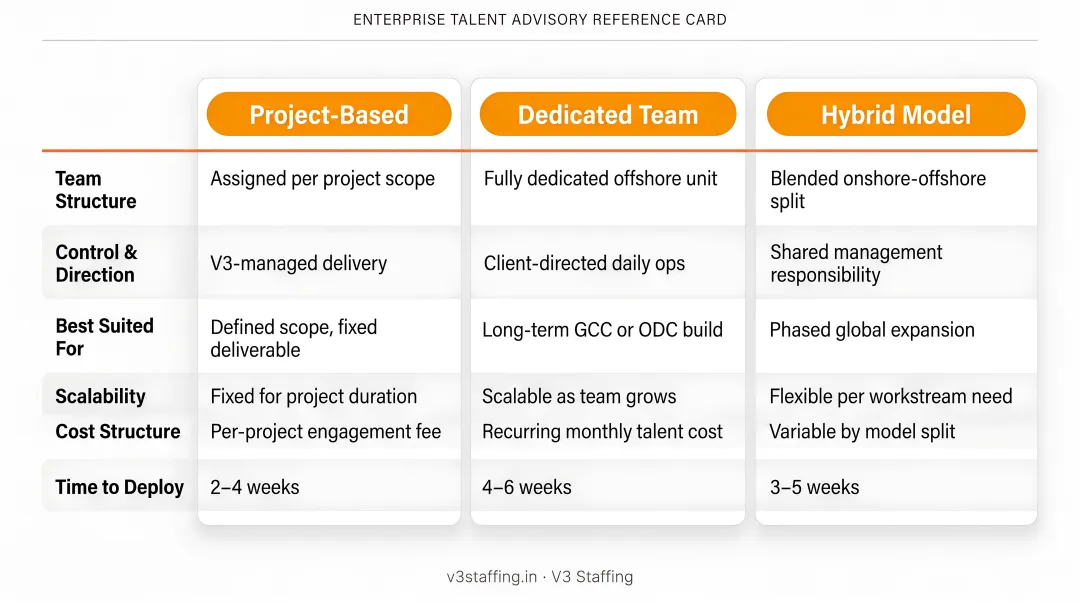
Choosing between these depends on where your team is right now:
- Early-stage teams do better with project-based engagements: lower commitment, faster proof of value before locking in a longer arrangement.
- Scaling teams with established Agile rhythms get more from dedicated models, where engineers accumulate context across sprints and velocity compounds over time.
Why Offshore Staff Augmentation Is a Natural Fit for Agile Teams
Agile's two-week sprint structure is, one of the best frameworks for managing distributed teams. Because work is scoped, reviewed, and reset on a fixed cadence, offshore engineers never operate in a black box for more than two weeks at a time.
Ceremony Integration by Role
Offshore engineers don't need to attend every meeting — they need to attend the right ones:
- Developers — sprint planning, daily standup (async or synchronous), retrospectives
- QA engineers — sprint review, bug triage, definition-of-done walkthroughs
- Architects/leads — backlog refinement, technical design sessions
This role-based approach keeps collaboration structured without demanding full timezone overlap.
The Follow-the-Sun Advantage
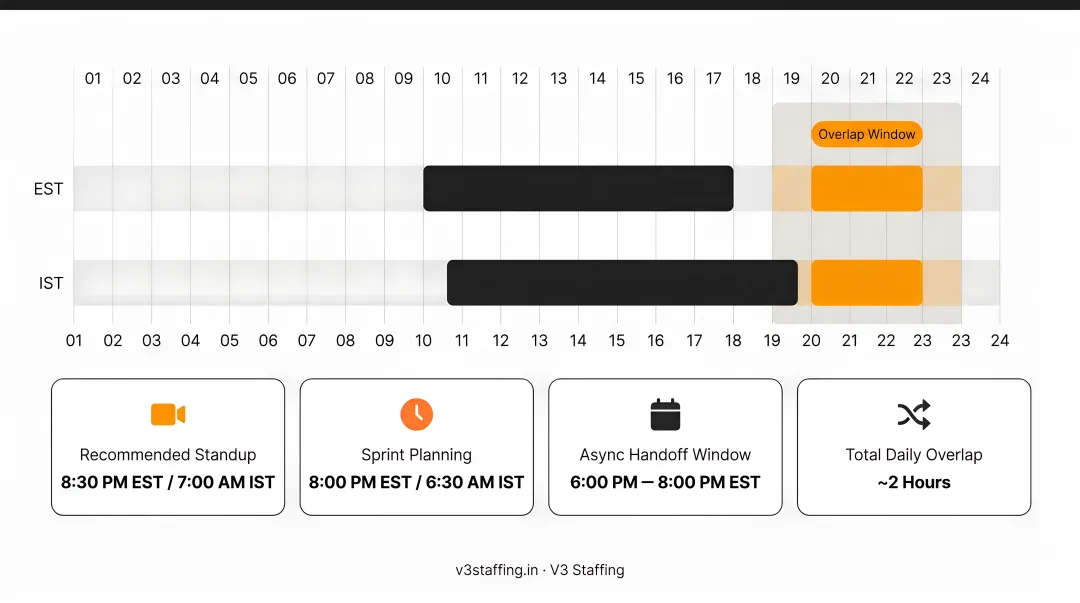
India Standard Time sits 9.5 hours ahead of US Eastern Daylight Time (10.5 hours during EST). That gap, often treated as a liability, can function as an asset. US teams close out their day with a handoff; Indian engineers pick up overnight and deliver resolved bugs, completed features, or reviewed PRs by the time the US team starts its morning standup.
The result is a compressed feedback loop — what would take two days in a co-located team can move in one.
Async-First as a Design Choice, Not a Workaround
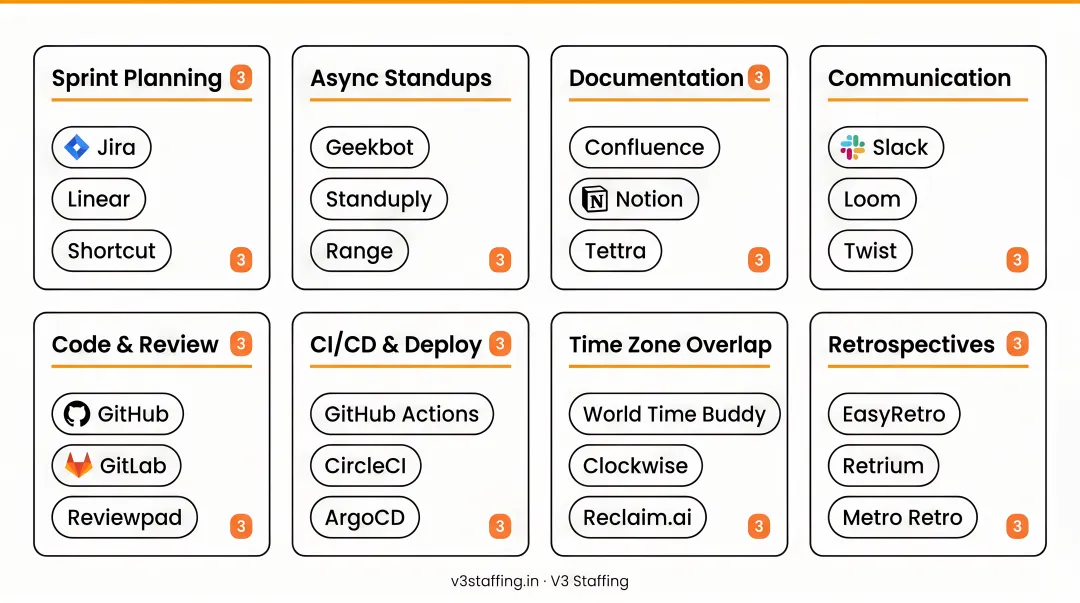
Realizing that follow-the-sun benefit requires deliberate workflow design. PMI's Disciplined Agile flags geographic distribution as increasing communication and temporal risk — the answer is building async workflows that don't depend on simultaneous presence:
- Confluence for sprint documentation, decisions, and architecture notes
- Jira for task state, blockers, and acceptance criteria
- Recorded sprint demos for async review and stakeholder sign-off
- Loom or equivalent for async standup updates on days with no overlap window
Augmentation also fits Agile's flexibility requirements directly. There's no long-term employment commitment: bring in a React Native engineer for one sprint, swap in a DevOps specialist the next.
Key Benefits of Offshore Staff Augmentation for Agile-Driven Organizations
Speed-to-Sprint
According to IDC, by 2026 more than 90% of organizations worldwide will be affected by IT skills shortages, with $5.5 trillion in projected losses from delays, quality issues, and missed revenue. Local hiring isn't keeping pace — iCIMS puts tech time-to-fill at 51 days and rising.
A quality offshore staffing partner closes this gap significantly. Structured vetting pipelines can deliver interview-ready shortlists within 48–72 hours — before a sprint even begins.
Access to Specialized Talent
That speed matters most for the roles that are hardest to fill locally — which is exactly where offshore talent pools run deep. IDC identifies AI as the most in-demand IT skill, followed by cloud architecture, data management, and software development. Gartner projects 90% of enterprise software engineers will use AI code assistants by 2028, up from under 14% in early 2024.
India's tech workforce now stands at approximately 5.8 million (NASSCOM FY2025 estimate), concentrated in Bengaluru, Hyderabad, Pune, Chennai, Delhi NCR, and Mumbai. NASSCOM data also shows AI/ML roles attract the highest compensation premiums in India — meaning the talent is there, competing for these roles seriously.
Scalability That Matches Sprint Cadence
Full-time local hiring doesn't flex. Offshore augmentation does:
- Scale up for a Q3 release push — add three engineers for six weeks
- Scale back post-launch without layoffs or HR overhead
- Swap specializations between sprint cycles based on what's actually on the backlog
Scrum's sprint capacity planning model assumes available hours shift each sprint. In practice, that only holds if you can actually add or remove engineers between cycles — which offshore augmentation makes possible without the 51-day local hiring lag.
Cost Efficiency Reinvested into Product
US software developers had a median annual wage of $133,080 as of May 2024 (BLS). India's engineering talent operates at structurally lower compensation levels, with savings that vary by role, seniority, and partner model.
The practical question isn't how much you save — it's where the freed budget goes. Most teams redirect it into additional sprint capacity, faster release cycles, or tooling they'd otherwise deprioritize.
Common Challenges and Agile-Specific Solutions
Time Zone Friction in Live Ceremonies
Daily standups are the most common pain point. Design a workable 30-minute overlap window, then use async tools to cover the gaps:
- Schedule standups at 8:30–9:00 AM EST / 6:00–6:30 PM IST for a daily synchronous touchpoint
- Use async video tools (Loom, Slack video) for days when the window doesn't work
- Rotate sprint planning sessions quarterly so the scheduling inconvenience isn't always borne by the same team
Communication Gaps and Cultural Misalignment
Feedback norms, documentation habits, and directness vary across teams — and vague sprint goals are where velocity quietly erodes. Front-load structure from day one:
- Write explicit sprint goals, not just ticket titles
- Define "done" in writing before the sprint starts — acceptance criteria, not assumptions
- Include a communication protocol in onboarding: how blockers get escalated, how feedback is delivered, how decisions get documented
Code Quality and Consistency
Goodwill doesn't scale across time zones — tooling does. Enforce shared standards at the infrastructure level:
- Mandatory pull request approvals via GitHub or GitLab before any merge
- Shared linting rules and CI/CD pipelines that catch issues before review
- Weekly pairing sessions between onshore leads and offshore engineers to transfer context and catch drift early
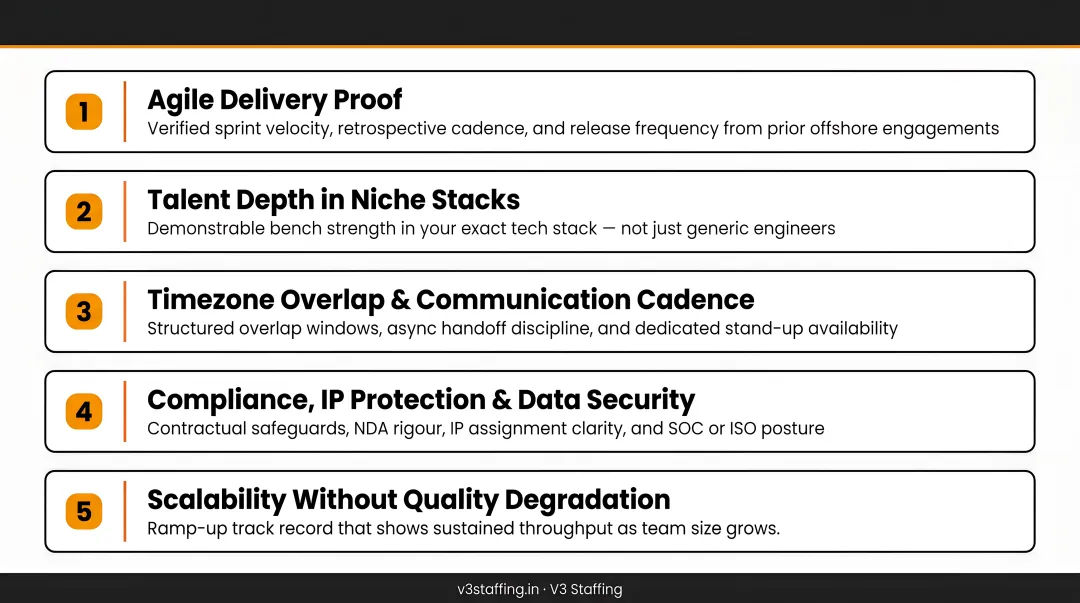
How to Choose the Right Offshore Staff Augmentation Partner for Your Agile Team
Agile Process Compatibility
Ask directly whether their engineers have worked inside Scrum or SAFe environments — not just delivered projects, but participated in ceremonies as embedded team members. Request references or sprint velocity data from embedded engagements specifically. A vendor who only has project-based delivery experience will struggle inside a Scrum team.
SLA-Backed Speed and Vetting Rigor
What separates a staffing vendor from a real talent partner is the work done before you ever see a resume. Look for:
- Pre-screened shortlists delivered within 48–72 hours of role confirmation
- Structured onboarding that gets engineers productive from day one, not week two
- Explicit SLA terms in the engagement agreement, not verbal commitments
V3 Staffing builds SLA-driven delivery and pre-vetted candidate pipelines into its core model, with 15+ years placing engineers inside large enterprises and GCCs across Bengaluru, Hyderabad, Pune, Chennai, Delhi NCR, and Mumbai.
Domain and Technology Match
Broad enterprise coverage matters more than generalist positioning. A firm that has placed engineers in your domain — fintech, healthcare, automotive, SaaS — is more likely to have pre-vetted talent ready than one positioning itself as industry-agnostic.
V3 Staffing's client work spans FactSet and RBL Bank (BFSI), Cotiviti and Zelis (healthcare technology), Johnson Controls, Stellantis, and Hyundai Mobis (automotive), and Google (enterprise technology) — verticals where Agile augmentation demand is consistently high.
Security and Compliance Posture
Before any engineer gets access to your codebase or tooling, confirm the partner:
- Requires NDA signing at engagement start
- Has role-based access control practices built into onboarding
- Has placed engineers in regulated environments requiring SOC 2, HIPAA, or GDPR compliance
Long-Term Partnership Potential
Compliance posture matters at placement, but partnership value shows up over time. Transactional fills create constant ramp-up overhead. A better model is a partner who tracks placement performance, manages retention proactively, and helps you plan headcount across quarters. Ask for retention metrics and average engagement duration. These numbers reveal whether the partner optimizes for long-term fit or just initial placement speed.