

.svg)
.svg)
India’s GCC ecosystem is entering a pivotal phase in 2026 as global companies expand their technology, R&D, and enterprise functions across Bengaluru, Hyderabad, Pune, Chennai, and other core hubs. With new centres opening and existing ones scaling rapidly, talent acquisition has become a central priority for every GCC leader.
Economic Times projects that the sector will create 4.25 to 4.5 lakh new jobs in 2025 alone, which means the competition for domain-specialised professionals is peaking.
As competition rises, hiring now requires more than speed. It demands a strategic approach that blends skills-based recruitment, advanced technology, and structured evaluation methods. This is where understanding market shifts, and adopting a public sector hiring tool GCC model becomes essential.
In this article, you will get valuable market insights to transform your hiring strategy for success.
Key Takeaways
If you’re short on time, here are the core takeaways:
- GCCs in India will create lakhs of jobs in 2025.
- Main challenges: niche talent shortages, mid-level leadership gaps, and attrition in critical roles.
- Tier-2 cities provide lower attrition and cost advantages for 2026 expansion.
- Hiring is shifting to a structured public sector hiring tool, GCC approach, using documented, standardised, audit-ready processes.
- AI-driven ATS and predictive analytics now power faster, more accurate hiring across GCC hubs.
What is the Global Capability Centre (GCC)?
A Global Capability Centre (GCC), often referred to as a Global In-house Centre (GIC) or Captive Centre, is a fully-owned strategic entity established by a multinational corporation (MNC) in an offshore or nearshore location. These centres are not third-party vendors, but integrated parts of the parent company.
Historically, GCCs focused primarily on basic back-office functions and cost savings. Today, however, they have evolved into high-value hubs. They deliver critical, strategic business services across multiple functions globally.
Also Read: How GCC Works: A Strategic Guide for Indian Enterprises
Core GCC Functions Today
The modern GCC is an innovation engine, controlling and executing key intellectual property and business processes. This is why their hiring focus has shifted dramatically to senior and niche roles across the six core hubs.
Key functions now fully owned by GCCs include:
- Technology & Software: Handling IT systems, digital transformation, and next-gen software development.
- Research & Development (R&D): Driving product innovation and intellectual property creation.
- Finance & Risk: Managing complex financial planning, analysis, and global compliance.
This control over strategic functions requires a dedicated, in-house workforce, often secured through targeted recruitment models like permanent recruitment. Let us now look at the headwinds facing this new strategic mandate.

Key Challenges in GCC Hiring in 2026

While the GCC mandate is strategic, the operational reality of securing high-end talent in India presents unique and pressing challenges. Successfully scaling your centre requires a clear-eyed view of these difficulties.
GCC leaders consistently cite three primary roadblocks to expansion:
1. The Niche Skills Gap
The demand for specialised technical and domain skills is outpacing the supply of industry-ready talent. Roles in GenAI, cloud architecture, and cybersecurity are foundational to the GCC 4.0 strategy but are scarce.
- A significant challenge remains the lack of upskilled talent, which 72% of GCC leaders cite as a top priority, as per NASSCOM.
- The market seeks depth over breadth, forcing GCCs to compete aggressively for a small pool of high-impact specialists.
Also Read: Key Niche Skills That Are Revolutionising the IT Industry
2. Leadership and Mid-Level Vacuum
There is a critical gap in the pipeline for mid-to-senior-level professionals (8-15 years of experience) who possess both technical depth and cross-functional leadership skills. This talent pool is essential for managing strategic innovation and mentorship.
Without this crucial layer, senior leaders become overwhelmed, and junior staff lack the necessary guidance, creating risks for long-term project stability in locations like Mumbai and Delhi NCR.
3. Retaining High-Impact Talent
While overall attrition has dropped from 19.4% in 2021 to 17.4% in 2024, according to the Economic Times, companies are still struggling with ongoing churn among their top-tier, high-impact talent. This group forms the core of organisational capability, and losing them has an outsized impact on business continuity, innovation, and future leadership pipelines.
Today’s talent isn’t driven by compensation alone; they’re seeking purpose-led roles, visibility with leadership, and opportunities to influence global decisions.
Are you struggling to quickly staff critical projects or find long-term specialists in emerging markets like Pune and Chennai? Contact V3 Staffing for tailored staffing and permanent recruitment solutions to accelerate your team expansion.
Addressing Core Hiring Challenges and Benefits
Effectively managing the talent pipeline requires proactively identifying core pain points and establishing predictable recruitment processes. The focus must be on mitigating risk and building long-term capability.
To convert hiring challenges into predictable outcomes, it helps to map each problem to a clear business benefit and the right service model. The framework below shows how GCCs can structure this thinking.
Also read: Executive Search Strategies to Find Top Talent in Competitive Markets.
Where to Find the Right Talent for Hiring in 2026?
To overcome the supply constraints in Tier-1 cities, GCCs must adopt a hub-and-spoke model that balances the strategic needs of metros with the talent and cost advantages of emerging centres. This is where geographical strategy meets talent acquisition.
1. Prioritising Core Hubs for Leadership
Cities like Bengaluru, Hyderabad, and Mumbai will continue to serve as the key Centres of Excellence (CoEs) for R&D and global leadership. They are essential for securing highly experienced professionals, often through executive search.
New GCC launches continue to gravitate toward these hubs, reinforcing their status as the primary locations for deep specialisation in AI, finance, and engineering.
2. Using Tier-2 Cities for Scale
The strategy must include the rapid expansion into Tier-2 cities, which are emerging as crucial talent reservoirs. These cities offer a 15–20% significant cost savings as per HR World.
- Tier-2 cities are showing a year-on-year hiring growth of 21%, as per Your Story.
- This growth presents a clear opportunity for GCCs to tap into new pools and mitigate fierce competition in Tier-1 locations.
This blended approach demands a flexible recruitment mix. For example, project-based demands in new geographies are best served by temporary staffing, while core team build-outs in established centres require permanent recruitment.
Fact: Vestian Research reports that India has emerged as the base for more than 53% of global GCCs.
With this location strategy in place, the next step is to design a recruitment model that can support different demand patterns across these hubs.
Also Read: Types of Staffing and Their Differences
Key Hiring Strategies for GCC Success
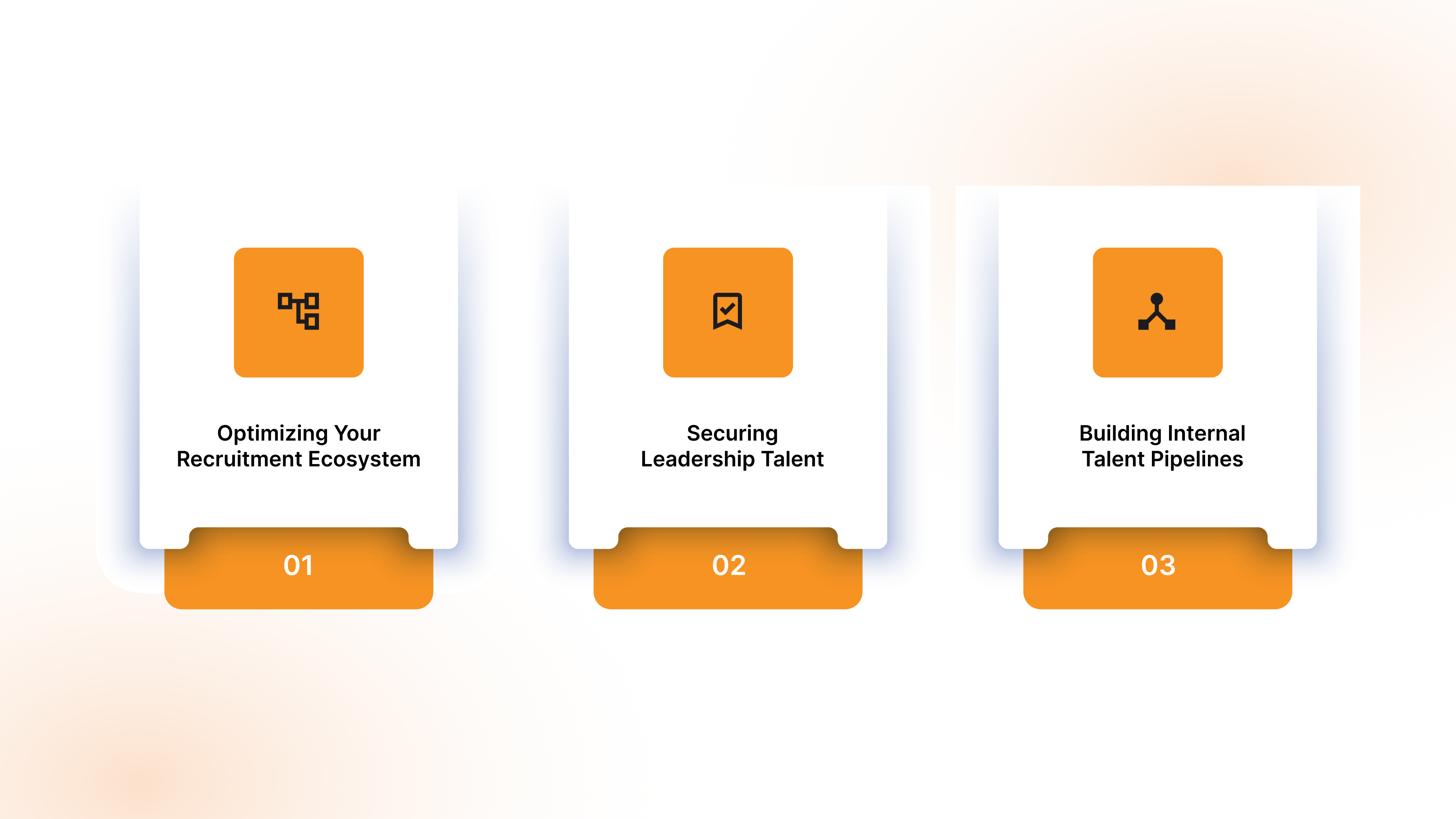
Successfully executing a multi-location, niche-focused hiring plan requires leveraging specialised expertise and modern recruitment frameworks. The focus must be on capability building, not just headcount scaling.
1. Optimising Your Recruitment Ecosystem
For critical, high-volume roles across the tech stack, a strategic IT staffing partner brings immediate access to niche talent pools, especially in areas like cloud engineering and DevOps. Their specialisation makes sure of precision in a highly competitive technical market.
For holistic support across multiple delivery hubs, particularly when setting up new centres in Hyderabad, Bengaluru, or Pune, a dedicated RPO (Recruitment Process Outsourcing) model offers predictable, SLA-driven outcomes. This allows you to scale quickly while maintaining compliance and brand consistency.
2. Securing Leadership Talent
As GCCs take on more global strategy and leadership pipeline development (35%), the need for high-impact senior hires becomes paramount, according to the Business Standard. Securing these key roles requires discretion and a deep network, which is best served by executive search professionals. This focused approach makes sure of cultural and technical alignment at the highest level.
3. Building Internal Talent Pipelines Alongside External Hiring
As GCCs move from pure scale to value creation, external hiring alone cannot close all skill gaps. A practical strategy combines selective external hiring with structured internal development to keep your CoEs in Bengaluru, Hyderabad, Chennai, and Pune future-ready.
Once GCCs have a clear internal talent plan, artificial intelligence becomes the multiplier, helping you predict talent needs, speed up screening, and protect the offer-to-join funnel.
Technology and Automation in GCC Hiring
The deployment of artificial intelligence is no longer a future goal; it is a current strategic tool actively used by GCC leaders. This is the difference between simply hiring and building a predictive, resilient workforce.
1. TS Platforms Enhanced by AI Intelligence
AI-integrated Applicant Tracking Systems (ATS) now strengthen the public sector hiring tool GCC approach by improving documentation, standardising assessments, and supporting audit-ready selection processes.
- Impact for GCCs: Resume matching improves by 35% as per NLB Services, leading to higher success rates at later hiring stages and freeing up recruiter time for high-touch engagement.
2. Job-Specific Screening Designed by AI
Generic filtering doesn’t work in today’s tech-hiring space. AI tools now dynamically generate questionnaires for specific job descriptions, automating first-level assessments while boosting recruiter efficiency.
- Impact for GCCs: This functionality reduces recruiter time spent assessing candidates by 40% while increasing alignment with job requirements as per Objectwin.
3. Chatbots to Bridge Candidate Engagement Gaps
Post-offer engagement is pivotal to reducing dropouts. AI engagement tools (like chatbots) initiate personalised touchpoints, nudge candidate communication, and predict joining intent.
- Impact for GCCs: According to Objectwin, chatbots reduce offer-to-join dropout rates by 25% and predict acceptance intent with 85% accuracy, particularly vital for talent based in Hyderabad or Pune.
4. Predictive Hiring Analytics for Proactive Decision-Making
With AI models that calculate joining probabilities, counteroffer risks, and attrition trends, GCC hiring teams can confidently plan backfills, mitigate risks, and achieve better workforce planning. These insights move TA from a responsive function to a predictive strategic partner.
5. The Rise of AI-Assisted Video Interviews
AI-powered video platforms analyse verbal and non-verbal cues in real time, offering valuable insights into culture fit and suitability for hybrid or leadership roles. This adds a critical layer of objectivity to assessment, especially for senior roles requiring executive search.
Ready to apply AI to your hiring, not just talk about it? V3 Staffing combines AI-led screening with human expertise to reduce drop-offs and improve offer-to-join outcomes for GCCs in Bengaluru, Hyderabad, Pune, Chennai, Delhi NCR, and Mumbai.

How V3 Staffing Helps GCCs Build Future-Ready Capabilities
Scaling your GCC from Delhi NCR to Mumbai relies on a partner who recognises the on-the-ground realities and variations across different markets, whether you are an international corporation or a multi-location Indian enterprise. V3 Staffing provides a high-touch, agile approach tailored to solve complex GCC pain points in core hubs.
We transform your recruitment function through these specialised offerings:
- Accelerated Volume Hiring via RPO: We embed a scalable and dedicated RPO unit within your team, making sure of continuous, SLA-driven delivery across cities like Bengaluru and Hyderabad. This reduces time-to-hire for high-volume roles.
- Precision for Leadership: Our focused executive search practice targets senior, cross-functional leaders (CXOs, VPs) who are crucial for driving the strategic mandate of your GCC.
- Agile Workforce Management: We support rapid scaling in new or temporary projects through our compliant temporary staffing solutions, offering flexibility without compromising on talent quality.
- Securing Permanent Talent: We use domain-specific recruiters for permanent recruitment across mid-to-senior levels, securing the long-term professionals needed for stable, high-impact teams.
- Niche Tech Sourcing: Our specialised IT staffing team maintains a curated pool of professionals in cutting-edge areas such as cloud, AI, and cybersecurity, ensuring technical fit.
By partnering with V3 Staffing, GCCs strengthen their workforce strategy and accelerate their readiness for the future.
Conclusion
The GCC environment in India is entering a new phase marked by rapid scale, niche skill shortages, and rising expectations around talent quality. To expand GCC operations successfully in 2026, organisations must adopt a mix of long-term talent planning, multi-location sourcing, and structured hiring governance.
This is why many leaders now rely on a public sector hiring tool GCC approach, a model that values documentation, standardised assessments, and audit-friendly practices supported by AI-enabled recruitment systems.
By adopting precision hiring methods, a diversified mix of permanent recruitment, temporary staffing, IT staffing, RPO, and executive search, you create the talent architecture required to expand GCC operations in India with confidence.
V3 Staffing is here to help you translate these trends into a practical hiring plan across Hyderabad, Bengaluru, Chennai, Pune, Delhi NCR, and Mumbai. We invite you to contact us today to build a resilient, high-impact workforce for 2026 and beyond.