
.svg)
.svg)
Hiring does not always slow down because candidates are unavailable. In many cases, the gap comes from inconsistent follow-ups, weak screening, or delays between interview stages. As roles start stacking up and timelines tighten, execution becomes just as important as sourcing.
A staffing recruiter owns this execution layer, and across fast-moving hiring markets, whether in India, the US, or the UAE, getting it right matters more than most employers expect.
At a Glance
- A staffing recruiter helps move hiring from requirement to closure: The role covers candidate sourcing, first-level screening, interview coordination, and follow-up across different hiring models.
- The role is most common in agency and staffing-led environments: It is usually tied to faster hiring cycles, multiple open positions, and stronger day-to-day recruitment execution.
- Staffing recruiters may support permanent, temporary, contract, bulk, or niche hiring: The exact work changes depending on the role type, urgency, and hiring model.
- Their value to employers is operational as much as strategic: Strong recruiters improve candidate flow, reduce hiring delays, and make multi-role recruitment easier to manage.
- Success in the role depends on more than speed: Communication, screening judgment, time management, market understanding, and stakeholder coordination all shape hiring outcomes.
What Is a Staffing Recruiter?
A staffing recruiter is a hiring professional who helps organisations fill open roles by sourcing, screening, and coordinating candidates through the recruitment process. The role is commonly associated with staffing firms, recruitment agencies, and hiring environments where multiple positions need to be managed at the same time.
In simple terms, a staffing recruiter connects employers with candidates who match a specific hiring requirement. Their work usually includes understanding the role, identifying suitable profiles, conducting initial screening, coordinating interviews, and helping move the hiring process forward until the position is closed.
How the Role Differs From a General Recruiter
A staffing recruiter usually works in a faster-paced, target-driven recruitment environment than a general recruiter. While a general recruiter may focus on internal hiring for one organisation, a staffing recruiter often works across multiple clients, roles, or hiring categories and is expected to manage a quicker turnaround and stronger pipeline movement.
The role is also more closely tied to external hiring delivery. In many cases, staffing recruiters support client organisations by shortlisting candidates, managing communication, and handling recruitment activity across permanent, temporary, contract, or volume hiring needs.
Also Read: Enterprise Hiring in 2026: What Actually Works for Scaling Teams
What Does a Staffing Recruiter Do?
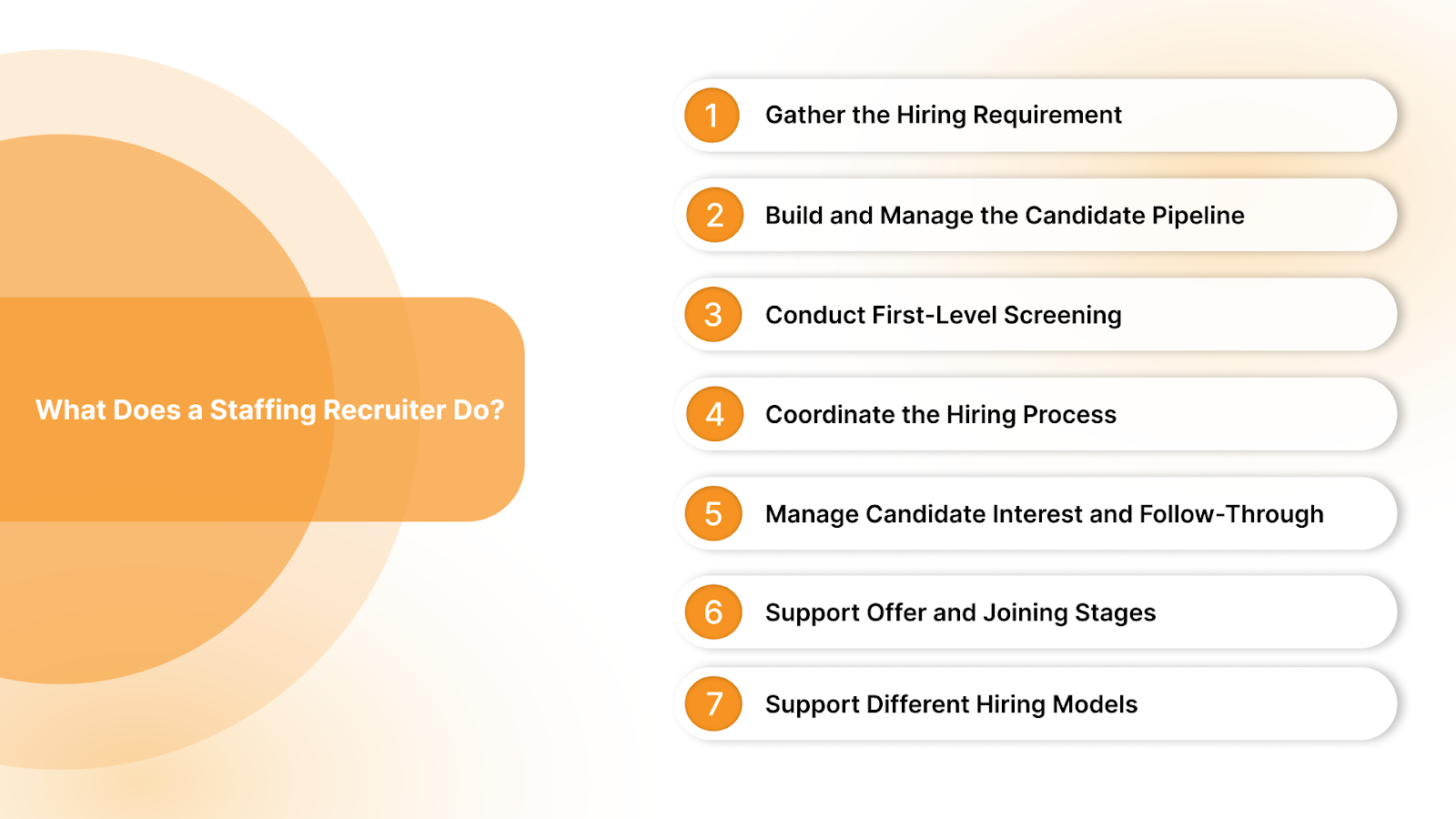
A staffing recruiter helps move hiring from requirement to closure in a structured and consistent way. The role covers more than sourcing profiles. It also includes screening candidates, coordinating interviews, managing follow-ups, and keeping hiring activity moving across open positions. This day-to-day execution becomes especially important when employers need faster turnaround, steadier candidate flow, and less process friction across the recruitment cycle.
1. Gather the Hiring Requirement
The recruiter starts by understanding the role in detail, including responsibilities, must-have skills, experience level, compensation range, location, notice period preference, and any hiring constraints. This helps reduce mismatch early and keeps the search more focused.
2. Build and Manage the Candidate Pipeline
Once the requirement is clear, the recruiter builds a pipeline using databases, job portals, referrals, social platforms, and internal networks. The focus is not only on finding profiles quickly, but also on maintaining a usable candidate flow as the role progresses.
3. Conduct First-Level Screening
Before profiles move to the employer, the recruiter checks for basic fit. This usually includes role relevance, communication level, availability, salary expectations, stability, and genuine interest in the opportunity. Better screening helps employers spend less time reviewing weak or misaligned profiles.
4. Coordinate the Hiring Process
Staffing recruiters help keep the process organised by scheduling interviews, sharing updates, collecting feedback, and following up across stages. This reduces delays between shortlist, interview, and decision-making, which is critical in time-sensitive hiring.
5. Manage Candidate Interest and Follow-Through
Candidates can lose interest when communication weakens or timelines become unclear. Recruiters help maintain engagement by clarifying role details, checking intent, handling follow-ups, and keeping candidates informed during key stages of the process.
6. Support Offer and Joining Stages
In many cases, the recruiter stays involved after interviews are completed. This can include offer communication, notice period tracking, joining confirmation, and follow-ups that help reduce last-minute drop-offs.
7. Support Different Hiring Models
Depending on the business requirement, staffing recruiters may work across permanent, temporary, contract, bulk, or specialist hiring. The hiring model may change, but the core role stays the same: keep recruitment moving with better coordination, more consistent candidate flow, and fewer process gaps.
This is what makes the role operationally important to employers. A staffing recruiter does not make the hiring decision, but helps make the process faster, more organised, and easier to manage, especially when several roles need to move at the same time.

Types of Hiring a Staffing Recruiter May Handle
The role of a staffing recruiter can change depending on the hiring model being used. Some recruiters work mostly on permanent positions, while others handle temporary, contract, or large-volume hiring where the pace, candidate pool, and employer expectations are different.
Permanent Hiring
In permanent hiring, the recruiter focuses on roles that are meant to be filled for long-term business needs. These searches usually require closer attention to experience fit, stability, compensation expectations, and the likelihood of long-term retention.
Temporary Hiring
Temporary hiring is used when a business needs short-term workforce support for a fixed period. In this model, recruiters often work on faster turnaround, shorter hiring cycles, and roles linked to workload spikes, employee absences, seasonal demand, or short-duration assignments.
Contract Hiring
Contract hiring applies when companies need professionals for project-based or time-bound work without moving immediately into permanent headcount. Across markets like India, the US, and the UAE, demand for contract staffing has grown significantly across IT services, GCCs, and project-led infrastructure work where headcount flexibility matters.
Bulk or Volume Hiring
Some staffing recruiters also support high-volume hiring where many positions need to be filled together. This is common in sectors where hiring happens at scale, such as customer support, operations, logistics, retail, or project-led workforce expansion.
Specialist or Niche Hiring
In some cases, staffing recruiters work on harder-to-close roles that need stronger market reach and closer screening. These may include technical, functional, or business-specific positions where the talent pool is smaller, and shortlist quality matters more.
This is why the role can look different from one hiring environment to another. The core responsibility stays the same, but the way a staffing recruiter works depends heavily on the hiring model, role type, and speed of recruitment.
Also Read: Building Scalable Recruitment Models: Key Strategies for Success
Skills Needed to Succeed as a Staffing Recruiter
Doing the job is one thing. Doing it well requires a specific mix of judgement, responsiveness, and people-handling ability. A staffing recruiter is often working in a fast-moving environment where small delays, weak communication, or poor profile judgment can affect hiring outcomes quickly.
Communication and Follow-Up
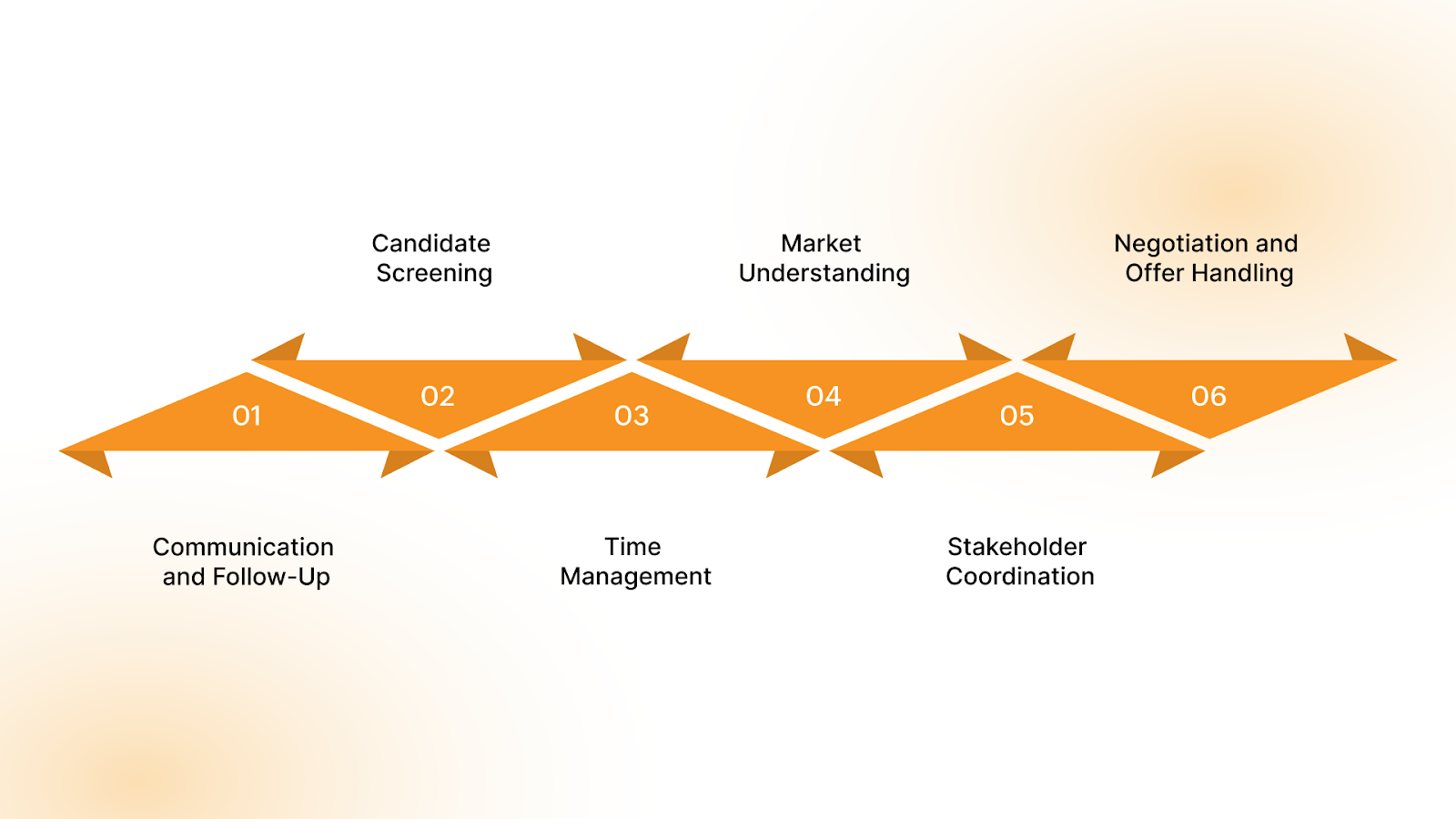
A staffing recruiter needs to communicate clearly with both employers and candidates, often within short timelines. Strong follow-up matters because recruitment progress can slow down quickly when updates are missed, expectations are unclear, or candidate interest is not managed properly.
Candidate Screening
Screening is not only about checking whether a candidate matches a job description. It also requires judgment around relevance, stability, intent, communication, and whether the profile is likely to move successfully through the process.
Time Management
Staffing recruiters often handle multiple roles, candidates, and stakeholder interactions at the same time. Good time management helps them prioritise urgent requirements, maintain follow-up discipline, and avoid losing momentum across open positions.
Market Understanding
A strong recruiter usually develops a practical sense of where talent is available, which roles are harder to fill, what compensation expectations look like, and how candidate movement changes across functions or industries. This helps them respond more realistically to hiring needs instead of working only from job descriptions.
Stakeholder Coordination
Recruitment often involves more than one decision-maker, especially when the hiring process includes business heads, line managers, HR teams, or external clients. A staffing recruiter needs to keep communication aligned across all sides so that the process moves with fewer gaps and fewer avoidable delays.
Negotiation and Offer Handling
Late-stage hiring often depends on how well expectations are handled. Recruiters need to manage compensation discussions, joining timelines, competing offers, and candidate hesitation without creating friction between the employer and the candidate.
A recruiter may know the process well, but these skills are what help them perform consistently under pressure. In practice, strong staffing recruiters are valued not only for speed, but for their ability to keep hiring stable, responsive, and commercially realistic.
Also Read: Top 10 Talent Acquisition Companies in India 2026
Common Challenges Staffing Recruiters Face
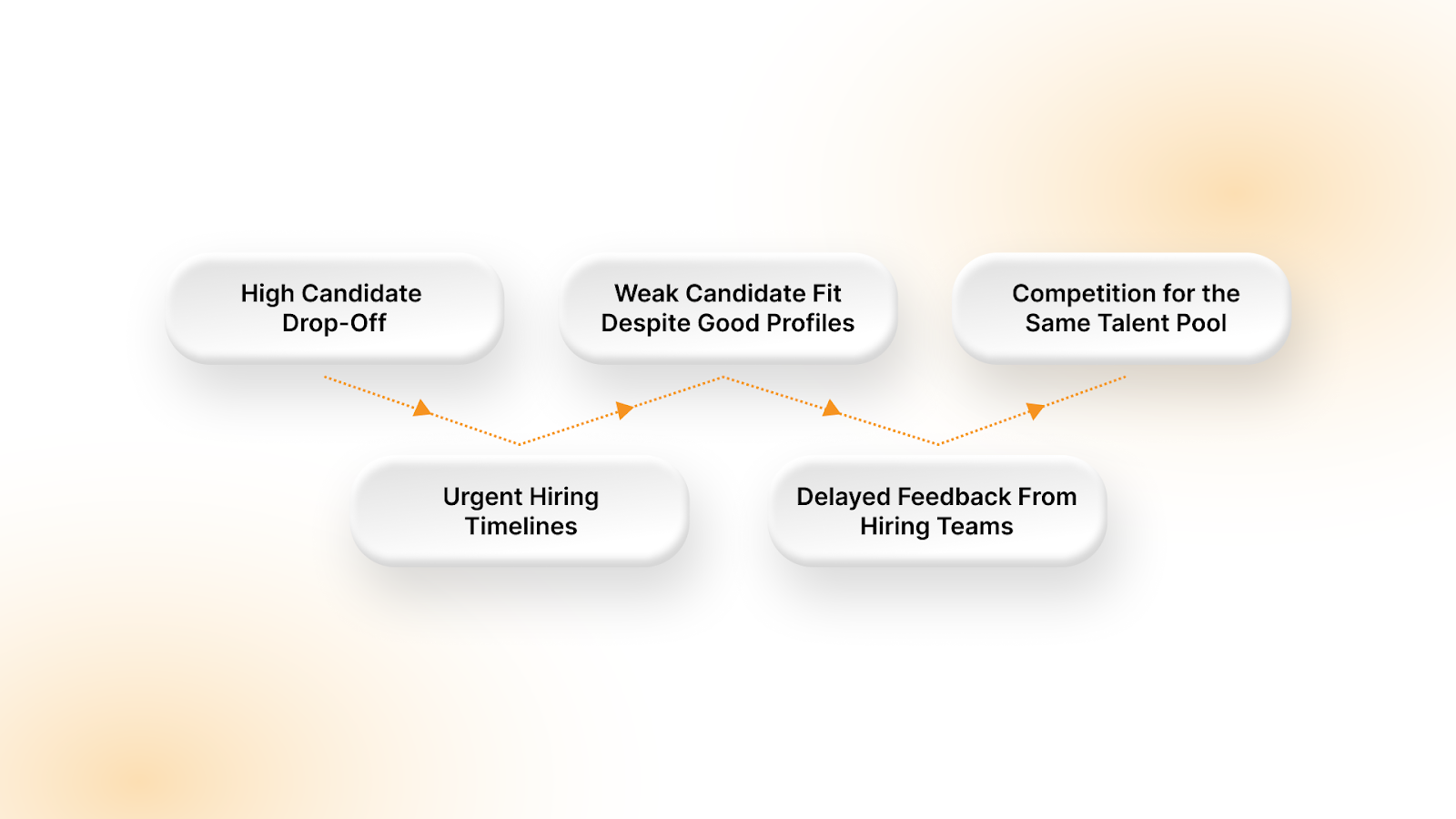
The difficulty of staffing recruitment often lies less in the number of openings and more in the number of moving parts around each one. Even when roles are clear, and candidate supply looks healthy, recruiters still have to manage timing gaps, expectation mismatches, and decision delays that can affect closure.
High Candidate Drop-Off
One of the most common challenges is losing candidates after initial interest has already been established. This can happen because of competing offers, unclear communication, delayed feedback, changing expectations, or simple loss of engagement during the process.
Urgent Hiring Timelines
Many staffing recruiters work on roles that need fast closure, but urgency often comes without fully prepared hiring inputs. When timelines are aggressive, and requirement clarity is still evolving, recruiters have to balance speed with accuracy under pressure.
Weak Candidate Fit Despite Good Profiles
A candidate may look suitable on paper but still not fit the role in practice. Differences in work style, stability, communication level, salary expectations, or actual role understanding can create mismatches that only become visible later in the process.
Delayed Feedback From Hiring Teams
Recruiters depend heavily on response speed from employers or internal stakeholders. When interview feedback, approval decisions, or shortlist reviews take too long, the process slows down, and candidate interest becomes harder to retain.
Competition for the Same Talent Pool
In many industries, several employers are often hiring for similar roles at the same time. This creates pressure on recruiters to move faster, position opportunities more clearly, and keep candidates engaged before the market pulls them elsewhere.
These challenges are part of why the role requires more than process handling alone. A staffing recruiter has to keep hiring stable even when candidate availability, employer readiness, and market conditions are all shifting at once.
Staffing Recruiter vs Recruitment Consultant vs Talent Acquisition Specialist
These roles are often used interchangeably, but they are not the same. The difference usually comes down to where the person works, how hiring is managed, and whether the focus is on delivery, advisory support, or long-term internal hiring.
Staffing Recruiter
A staffing recruiter is usually focused on filling open roles through active hiring execution. The role is closely tied to sourcing, screening, coordination, and closure across agency, staffing, or outsourced recruitment environments.
Recruitment Consultant
A recruitment consultant typically works in an external agency setup, but may play a more advisory role alongside hiring delivery. In many cases, the role includes client handling, market input, requirement shaping, and recruitment support across assigned accounts or industries.
Talent Acquisition Specialist
A talent acquisition specialist usually works within an organisation’s internal hiring team. The focus is often broader than immediate role closure and may include workforce planning, employer branding, hiring process design, and long-term talent strategy.
Key Differences at a Glance
In practice, the lines can overlap depending on the company and hiring model. Still, this distinction helps explain why the term “staffing recruiter” usually points to a delivery-focused role within faster-paced recruitment environments.

Industries Where Staffing Recruiters Are Commonly Needed
The need for staffing recruiters is usually higher in industries where hiring happens frequently, timelines are tighter, or workforce demand changes more often than internal teams can comfortably manage. In these settings, the recruiter’s value comes from handling hiring movement at a pace that matches business demand.
IT and Technology
Technology hiring often involves multiple openings across development, testing, infrastructure, support, and product-linked roles. Staffing recruiters are commonly used here because role requirements change quickly, and candidate availability is often highly competitive.
Manufacturing
Manufacturing businesses often need recruitment support across plant operations, production, maintenance, quality, procurement, and shop-floor-linked positions. Staffing recruiters become useful when these roles need to be filled steadily or across multiple locations.
BFSI
Banking, financial services, and insurance roles often require a mix of hiring speed, documentation discipline, and role-specific screening. Staffing recruiters are frequently involved in hiring for sales, operations, service, processing, support, and corporate functions in this sector.
Retail and Ecommerce
Retail and ecommerce businesses often hire in cycles linked to store operations, fulfilment, customer support, seasonal demand, and business expansion. Recruiters in this space usually need to handle frequent openings and faster replacement needs.
Logistics and Operations
Logistics-driven businesses often depend on timely hiring across warehouse support, dispatch, coordination, customer handling, and operational support roles. Staffing recruiters are valuable here because workforce gaps can affect daily movement and service continuity very quickly.
Pharma and Healthcare
Pharma and healthcare hiring may involve a mix of field roles, operations, compliance-sensitive positions, sales support, and specialised functional hiring. In these cases, staffing recruiters help manage pace and role coverage in sectors where hiring often combines volume with role-specific expectations.
This is why staffing recruiters are not limited to one type of business. They are most useful in industries where hiring needs to keep moving without long delays, inconsistent follow-up, or repeated process breakdowns.
When Businesses Typically Work With Staffing Recruiters
Businesses usually involve staffing recruiters when hiring needs become harder to manage through routine internal workflows. This is less about the company’s size and more about the hiring situation itself.
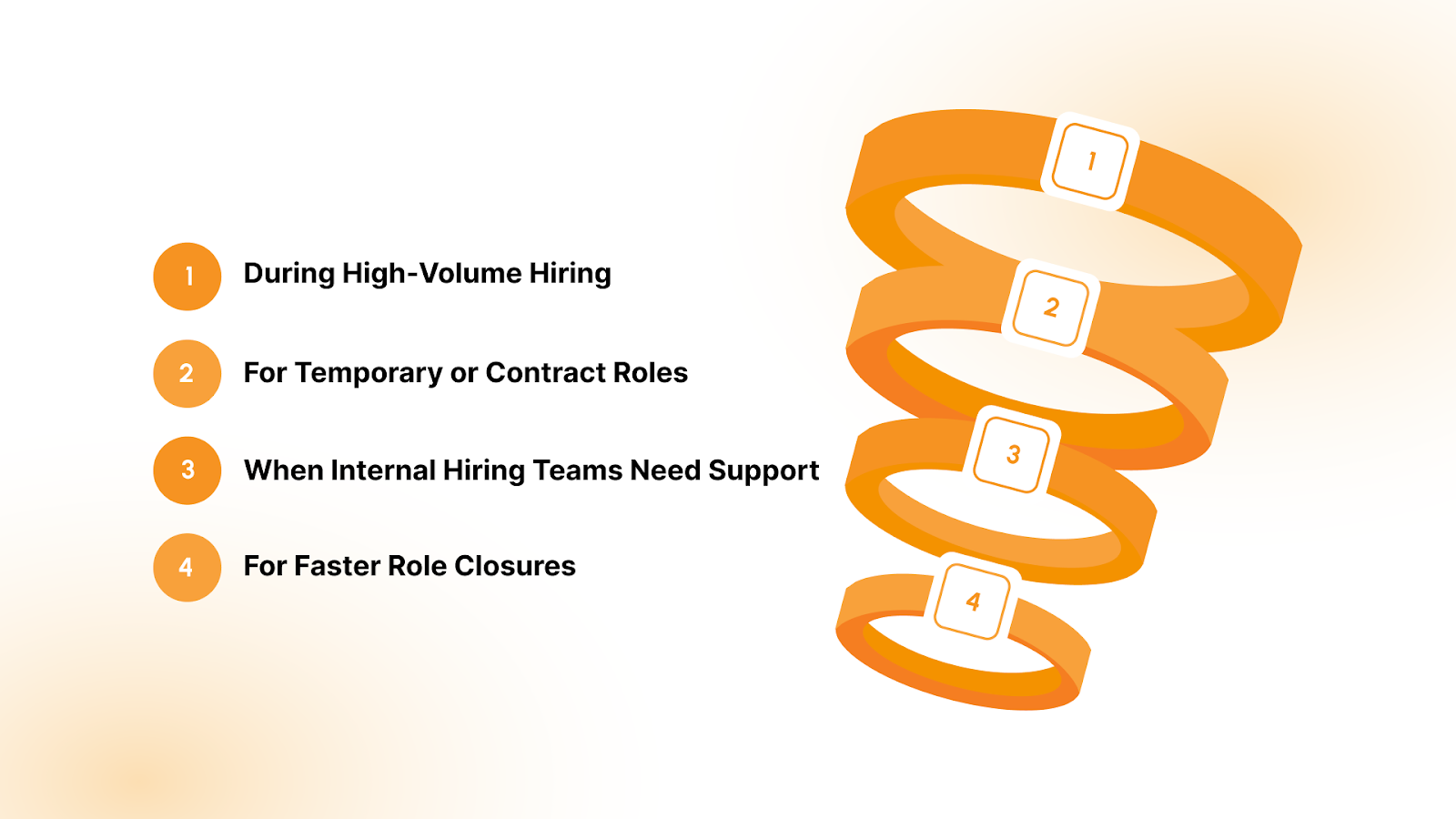
During High-Volume Hiring
When several roles need to be filled within a short period, internal teams often find it difficult to maintain speed and follow-through across every opening. Staffing recruiters are commonly brought in to handle the operational load and keep hiring activity moving across multiple positions at once.
For Temporary or Contract Roles
Short-duration roles often need quicker turnaround and more immediate candidate availability than standard permanent hiring. Businesses use staffing recruiters here because the hiring cycle is shorter and the requirement is often more execution-heavy.
When Internal Hiring Teams Need Support
Even companies with established HR or talent acquisition teams may need added recruitment capacity during hiring spikes, expansion phases, or repeated backfill requirements. In these cases, staffing recruiters help maintain hiring movement without forcing internal teams to absorb every stage themselves.
For Faster Role Closures
Some roles stay open not because the market lacks candidates, but because the process slows down between requirement, shortlist, feedback, and closure. Businesses work with staffing recruiters when they need more active hiring support to reduce those gaps and keep decisions moving.
This is where the role becomes commercially relevant. Staffing recruiters are often brought in when hiring needs more execution capacity, faster movement, or steadier follow-through than internal workflows can provide on their own.

How V3 Staffing Supports Businesses Through Staffing Recruitment
V3 Staffing supports businesses across a range of hiring needs, with recruitment delivery designed for faster movement, better-fit shortlists, and stronger execution support. This includes:
- Permanent recruitment support: For long-term hiring needs across business, technical, support, and specialist roles where shortlist relevance and closure discipline matter.
- Temporary and contract hiring support: For short-term, project-based, and urgent workforce requirements where businesses need quicker hiring turnaround and more flexible staffing support.
- Bulk and multi-role hiring support: For situations where multiple positions need to be filled together, including repeated openings and faster-moving recruitment demand across teams.
- Cross-functional recruitment support: For employers hiring across operational, technical, support, and corporate functions who need more flexible recruitment coverage across departments.
The focus is on helping employers improve hiring speed, strengthen shortlist quality, and add delivery support when internal teams need extra recruitment capacity.
Conclusion
A staffing recruiter plays a practical role in helping hiring move from requirement to closure in a more organised way. The role becomes especially important in environments where timelines are tight, hiring demand shifts quickly, or multiple positions need active follow-up at the same time.
For employers, staffing recruiters help bring more execution support into the hiring process. For candidates, they often shape the first real experience of screening, communication, and interview coordination.
As hiring models continue to shift across permanent, temporary, contract, and volume recruitment, the role of the staffing recruiter remains closely tied to how efficiently businesses respond to open positions. For organisations that need structured support across these hiring models, V3 Staffing works with employers to make recruitment more manageable and better aligned to business demand.