
.svg)
.svg)
Hiring becomes difficult the moment growth accelerates. Teams open multiple roles across engineering, product, and data, yet interview availability and approvals still move one decision at a time. The market moves faster than internal coordination. Research shows that top candidates remain available for only about 10 days, while the average hiring process globally takes 38 to 44 days.
That gap does not just lose candidates. It delays launches, increases workload on existing teams, and pushes delivery timelines. Enterprise hiring struggles less from talent shortage and more from slow internal alignment.
This blog explains how enterprise hiring actually works, where it slows down, when structured hiring models become necessary, and how organisations run consistent hiring globally.
Key Takeaways
- Enterprise hiring fails mainly due to internal coordination delays, not a lack of candidates, so ownership and decision timelines matter more than sourcing volume.
- Separate hiring tracks for engineering, product, data, cloud, and security roles improve accuracy and shorten interview cycles.
- Country-specific execution across India, the USA, and the UAE prevents late-stage drop-offs caused by notice periods and contract expectations.
- Structured models such as RPO, dedicated hiring pods, and hybrid recruitment create predictable hiring timelines and planning stability.
- Mature enterprise hiring improves project delivery reliability, certainty of joining, and visibility into workforce planning.
What Makes Enterprise Hiring Different From Regular Recruitment
Regular recruitment fills a vacancy. Enterprise hiring plans workforce capacity before delivery pressure begins. The process expands from recruiter activity to coordinated business execution.
Hiring speed now depends on how quickly leaders align decisions, not on how many applicants apply.
Average hiring cycles often run close to six weeks, yet many qualified candidates remain available for less than two weeks. The delay gap comes from internal coordination rather than talent shortage.
Hiring Volume vs Hiring Complexity
As hiring spreads across teams, the difficulty moves from sourcing to decision alignment. More roles mean more approvals, reporting changes, and compensation checks. Without structure, interviews repeat and offers restart late in the cycle.
Stabilising actions
- Assign one accountable decision maker per requisition
- Fix evaluation criteria before sourcing starts
- Limit interview rounds by seniority level
Multi-Role Hiring Across Functions
Enterprise hiring rarely focuses on one skill group. A release team may require engineers, product managers, analysts, and security specialists simultaneously.
Using identical interviews for all functions lowers accuracy and increases time to hire. Furthermore, specialised technical roles often take significantly longer to close when evaluation methods differ between interviewers.
Clear evaluation tracks prevent rework and shorten decision cycles.
Stakeholder Driven Decisions
Enterprise hiring decisions involve talent teams, hiring managers, and finance. Without authority clarity, each group waits for the other.
Decision control checklist
- Nominate the final approval authority
- Set a fixed feedback window after interviews
- Trigger escalation when the window passes
This prevents silent waiting periods inside the pipeline.
Also Read: What Is 360 Recruitment? A Complete Process Guide
What a Standardised Enterprise Hiring Process Looks Like
A standardised enterprise hiring process creates clarity and consistency across the organisation. It ensures every vacancy follows the same structure, every candidate is assessed fairly, and every hiring decision can be clearly justified.
In large organisations, this consistency is essential. Without it, hiring becomes fragmented, slow and exposed to unnecessary risk. The following core components form the foundation of a robust enterprise hiring system.
1. Applicant Tracking System (ATS)
The ATS is the central system where all recruitment activity is managed. Every vacancy, application and decision is recorded in one secure platform.
This provides:
- Clear visibility of hiring progress
- A single source of candidate data
- Controlled access for stakeholders
- Integration with HR and onboarding systems
For enterprise organisations operating across multiple teams or locations, centralisation prevents duplication, data loss and inconsistent practices.
2. Automation
Automation supports efficiency and consistency by reducing manual administration.
Typical examples include:
- Application acknowledgement emails
- Interview scheduling
- Stage progression updates
- Offer approval routing
- Generation of standard documentation
This ensures timely communication with candidates and reduces delays caused by manual processes.
3. Structured Scorecards
Structured scorecards standardise how candidates are assessed. Each role is aligned to defined competencies and measurable criteria.
This approach:
- Reduces subjectivity in interviews
- Enables fair comparison between candidates
- Encourages evidence-based decisions
- Creates a documented rationale for selection
Consistency in assessment strengthens both hiring quality and governance.
4. Defined Workflows
A defined workflow outlines each stage of the recruitment lifecycle and assigns accountability at every step.
Typical stages include:
- Workforce planning and approval
- Role briefing and advert approval
- Shortlisting
- Structured interviews and assessments
- Selection and approval
- Offer management
- Pre-employment checks
- Onboarding handover
Clear stage gates reduce ambiguity, limit delays and ensure proper oversight.
5. Reporting and Analytics
Enterprise hiring requires measurable performance indicators. Reporting provides insight into both efficiency and effectiveness.
Common metrics include:
- Time to hire
- Cost per hire
- Stage conversion rates
- Diversity representation
- Source performance
- Hiring manager satisfaction
Reliable data allows informed workforce planning and continuous improvement.
6. Compliance and Governance
Compliance is embedded throughout the process rather than addressed retrospectively.
Core controls include:
- Right-to-work verification
- Equal opportunity monitoring
- Documented approval trails
- Secure storage of candidate information
- Background screening documentation
These measures protect the organisation legally, safeguard candidate data and uphold organisational standards.
Where Enterprise Hiring Typically Slows Down
Hiring delays usually occur after candidates enter the interview stage rather than during sourcing. The following points repeatedly extend timelines.
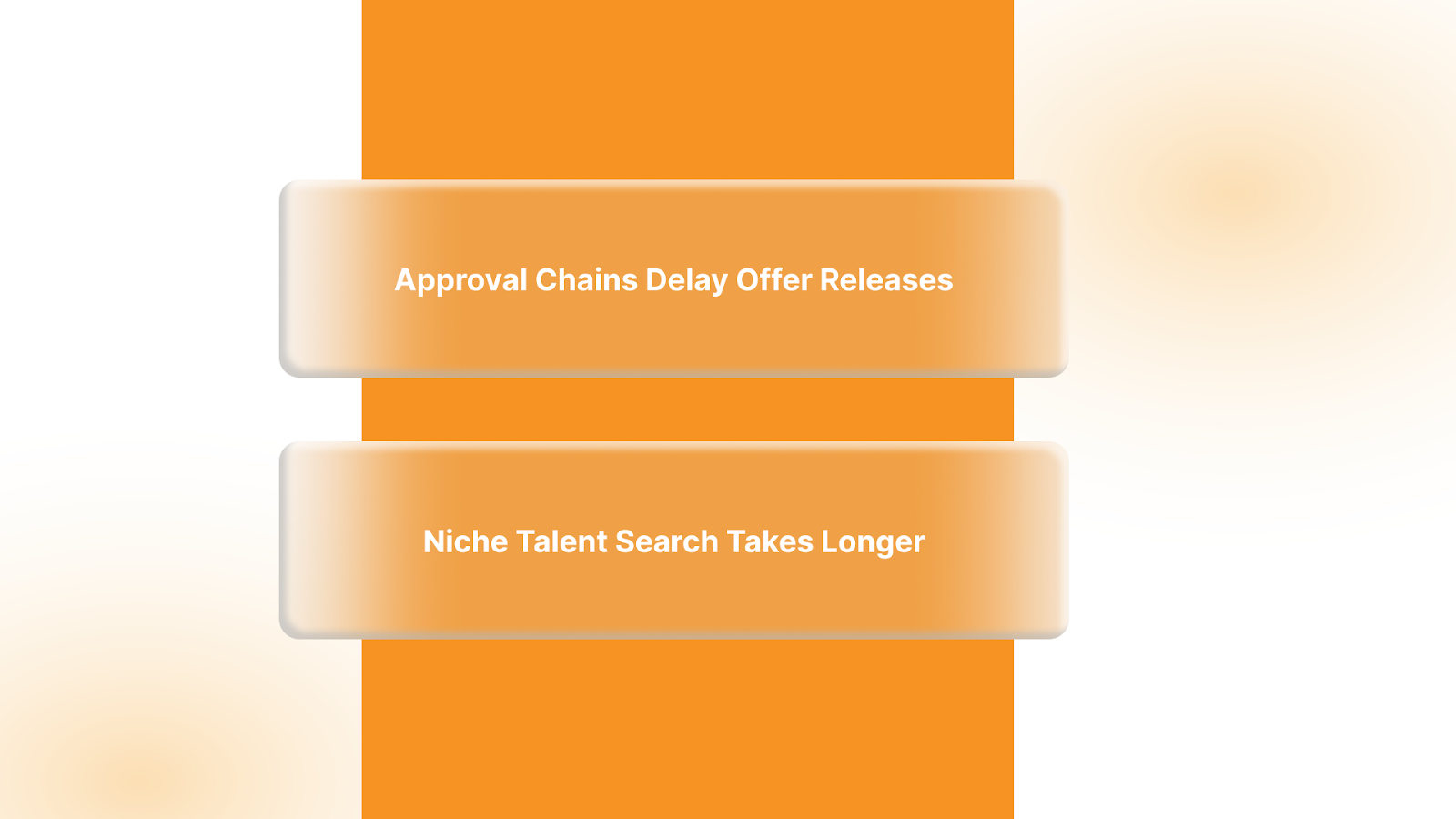
1. Approval Chains Delay Offer Releases
Candidates expect clarity soon after the final interview. When updates take too long, many assume they are being rejected and disengage. Most delays come from internal decision steps rather than candidate hesitation.
Common blockers
- Compensation approval rechecked after the final round
- Leadership sign-off delayed by scheduling conflicts
- Role scope reconsidered late in the process
2. Niche Talent Search Takes Longer
Roles in artificial intelligence, cloud architecture, and senior product leadership have smaller talent pools and longer evaluation cycles. Waiting to source only after opening the role increases time to hire.
Better handling
- Maintain a passive candidate pipeline before opening the role
- Involve technical evaluators during early screening
- Focus on targeted professional communities instead of general job boards
Interview Bandwidth Collapses
Hiring managers prioritise delivery work, and interviews lose calendar space. Scheduling gaps alone can extend hiring timelines even when candidates are ready.
Candidate Drop Off In Late Stages
Late-stage losses usually happen because of silence rather than compensation disagreement. Candidates disengage when they do not know where they stand in the process.
Retention practices
- Share the expected decision timeline after the final interview
- Provide weekly status updates even if there is no change
- Explain the compensation structure before issuing the formal offer
Clear communication builds trust and increases the probability of joining.
Open roles often remain unfilled longer than planned, impacting delivery timelines and business performance. V3 Staffing handles sourcing to deliver closure with SLA-tracked timelines and full pipeline visibility. We have helped 200+ organisations hire 10,000+ specialists with an average of 10 days time- to- hire. Contact us today.
Also Read: What is Lateral Hiring? Meaning & Definition
When Should Companies Move to Structured Enterprise Hiring Models
Organisations that rely on reactive hiring often find themselves firefighting. Vacancy-by-vacancy decisions become resource drains as plans scale. A structured hiring model becomes necessary when hiring demand consistently outpaces internal coordination and begins to affect delivery timelines, team productivity, and business outcomes.
Rapid Headcount Growth
Hiring pressure rises sharply when headcount grows beyond mid-sized teams. Headcount forecasting helps here.
Forecasting connects workforce plans with real-time budgets and helps hiring teams prioritise skills ahead of churn, rather than reacting to backlogs.
Structured hiring supports what forecasting predicts, when hiring needs turn from “a few replacements” to “strategic team builds out.”
Indicators you need structured hiring
- Hiring volume consistently exceeds projections
- Time to hire increases quarter on quarter
- Managers repeatedly escalate requisitions for priority roles
At this stage, it becomes essential to embed talent acquisition into workforce planning rather than treat it as a transactional function.
New Market Entry
Expanding into new geographies, such as setting up a product team in the USA or a shared service centre in India, changes the hiring context entirely. Each location brings distinct employment norms, compliance requirements, compensation expectations, and notice period norms.
Organisational structures that succeed locally do not automatically scale across regions without clear processes.
Checklist for market entry hiring
- Local compensation and offer templates prepared
- Country-specific compliance, labour law, and benefits mapped
- Local recruiter or partner aligned to operational obligations
When these fundamentals are missing, hiring timelines extend, and candidates disengage long before the offer stage.
Hiring Leadership Roles
Senior hires for Director, VP, or CXO roles rarely follow the same flow as volume roles. They require targeted search, competency alignment, and discrete assessment loops. Traditional, volume-oriented pipelines dilute effectiveness and time to hire balloons.
Role signals that need a structured search
- Leadership requisitions linger beyond the average time to hire
- Interview panels change between cycles
- Decisions revisit fundamentals after final interviews
For leadership roles, a specialised search process accelerates alignment on role expectations and candidate evaluation against strategic impact.
Repeated Hiring Delays
Operational delays that repeat across hiring cycles, such as delayed interview feedback, approval loops, or candidate communication gaps, signal deeper structural issues. Without a defined hiring engine, internal recruitment teams get overloaded, and hiring managers lose confidence in the process.
Patterns to watch
- Requisitions stay open longer than SLA targets
- Multiple reworks of the same job description
- Increased withdrawal rates in late stages
Structured hiring introduces accountability and predictable delivery without depending on individual efforts alone.
Which Enterprise Hiring Model Works Best
Selecting a hiring model depends on your workforce needs, business cadence, and organisational maturity. There is no one-size-fits-all.

Below are practical frameworks organisations increasingly adopt to balance speed, quality, and consistency.
Dedicated Hiring Pods
A dedicated hiring pod is an embedded team that focuses on building pipelines for specific functions or business units. Unlike ad hoc outsourcing, these pods align closely with business goals and hiring rhythms.
With dedicated recruiters continuously mapping the market and proactively engaging candidates, hiring accelerates and quality improves over time.
When to use
- High volume hiring in niche functions
- Multiple concurrent requisitions
- Need for consistent screening quality
Role-Based Hiring Tracks
Segmenting hiring by role clusters reduces confusion and improves evaluation accuracy. Engineering, product, data and leadership roles all require distinct assessment approaches.
Structured hiring tracks ensure that technical evaluations, stakeholder panels and test assessments match the competencies required for each cluster.
Benefits
- Faster pipeline progression
- Better interviewer preparation
- Clearer feedback loops
SLA Driven Hiring
Setting service level agreements (SLAs) for hiring stages brings accountability across functions. SLAs might define timelines for the first screen, interview scheduling, feedback deadlines, and offer delivery.
Tracking SLAs highlights bottlenecks and supports continuous improvement rather than episodic fixes.
Core metrics to track
- Days to first interview
- Interview to offer turnaround
- Offer acceptance rate
- Time to join
Hybrid Hiring Model
A hybrid model blends internal recruitment teams with external specialists where needed. Internal teams maintain institutional knowledge, culture fit, and continuity, while external partners extend capacity for surge hiring or hard-to-fill roles.
This combination offers flexibility, spreads risk, and prevents internal overload when hiring demand spikes.
Scenarios where hybrid works
- Seasonal or project-based spikes
- Niche skill pools with limited availability
- Markets with distinct local expectations
This balance ensures continuity of core hiring operations while scaling reach and specialist engagement as needed.
How Companies Execute Enterprise Hiring Across Countries
Running enterprise hiring across countries such as India, the USA, and the UAE requires operating discipline rather than a single global process. The same requisition behaves differently across markets.
Notice periods, offer expectations, documentation rules, and communication styles shape whether a candidate joins or drops out.
Teams that plan these differences early move faster and lose fewer candidates in the final stage.
Local Talent Market Differences
Every location has its own hiring rhythm. Ignoring it leads to incorrect timelines and unrealistic commitments to business leaders.
What hiring teams should do in practice
- Build timelines based on local notice expectations rather than global targets
- Align the offer validity period to the decision behaviour in each market
- Discuss relocation, benefits, and joining dates during early conversations
This prevents late-stage withdrawals caused by mismatched expectations.
Compliance and Offer Structures
Offer letters carry different weights in each country. Candidates interpret certainty through documentation quality.
Operational discipline reduces last-minute renegotiation. When offers match local employment standards, acceptance confidence increases, and joining dates remain stable.
Candidate Experience Consistency
Candidates compare experience across companies, not across locations. Even when hiring globally, communication must feel predictable.
Key practices
- Provide one recruiter contact throughout the process
- Share next step timelines after every interview
- Send role summary and expectations before the final round
Consistency builds trust. Candidates who feel informed stay engaged even during longer notice periods.
Reporting and Hiring Visibility
Enterprise hiring fails when leadership cannot see progress. Hiring dashboards replace assumptions with decisions.
Teams review these weekly and remove blockers immediately, rather than waiting until the quarter ends. Visibility turns hiring into a measurable operation rather than a reactive activity.
Need dependable hiring for enterprise engineering, product, data, cloud, AI ML, and cybersecurity teams across India, the USA, and the UAE? V3 Staffing delivers specialised sourcing with scalable RPO and contract hiring aligned to large team expansion plans.
What Results Should Leaders Expect From Mature Enterprise Hiring
When hiring shifts from reactive activity to structured execution, outcomes become measurable and consistent.

Reduced Time to Hire
Clear ownership, fixed decision windows, and prepared pipelines shorten hiring cycles. V3 Staffing maintains an average time-to-hire of 10 days for many specialised mandates through pre-aligned evaluation and early screening preparation.
Higher Offer Acceptance
Candidates accept offers when expectations are aligned before the final stage.
Actions that improve acceptance
- Compensation explained before formal offer
- Clear joining timeline
- Consistent communication
Better Role Fit
Structured assessments match skills to responsibilities rather than impressions.
Predictable Hiring Planning
Hiring becomes forecastable rather than reactive.
Benefits leaders observe
- Project timelines remain stable
- Workload distribution improves
- Expansion plans face fewer delays
Enterprise hiring maturity does not only fill positions. It stabilises operational planning and allows leadership to plan growth with confidence.
How V3 Staffing Supports Enterprise Hiring at Scale
Enterprise hiring breaks down when sourcing, coordination, and closure are handled by different partners. V3 Staffing operates as a single, accountable recruitment engine across India, the USA, and the UAE, aligning role definition, evaluation, and joining timelines within a single process. The focus is consistent delivery for specialised roles, not isolated placements. Some of the key services provided by V3 staffing include:
1. Permanent Recruitment
Structured sourcing and domain screening so hiring managers meet only relevant candidates. Reduces the need for repeated interview cycles and improves role fit for long-term positions.
2. Employer of Record
India EOR model manages the full employment lifecycle, including onboarding, payroll processing, statutory filings, benefits, and exits. Whether you are onboarding one remote professional or expanding a larger India team, it provides a compliant and scalable structure for hiring.
3. Contract Staffing
Deploys professionals for project-based needs and manages the full employment lifecycle during the engagement period, giving teams flexibility without HR overhead.
4. Executive Search
Targeted and confidential hiring for Director, VP, and CXO roles with competency-based evaluation and controlled stakeholder communication.
5. Recruitment Process Outsourcing (RPO)
We install recruitment teams that manage sourcing, coordination, and reporting dashboards, reducing internal workload while maintaining clear hiring timelines and visibility.
Conclusion
Enterprise hiring succeeds when it becomes an operating system rather than a series of approvals. The companies that scale smoothly treat hiring as capacity planning tied to product releases, expansion timelines, and leadership ownership.
Clear decision authority, role-specific evaluation, and location-aware execution prevent last-minute surprises and stalled projects. Once these elements are in place, hiring stops reacting to growth and starts enabling it.
If your teams are expanding globally and hiring needs to move with business speed, contact with V3 Staffing to run a structured recruitment engine.