
.svg)
.svg)
The success of a Global Capability Centre depends on how effectively its people are managed. Technology and scale are important, but it is human capital that determines whether a GCC can deliver lasting value. India’s GCC ecosystem has expanded at nearly 7% CAGR between FY20 and FY25, while the country ranks second globally in AI skill penetration, reflecting the depth of specialised talent available.
When we talk about GCC in HR, it is not only about recruitment. It covers the way HR shapes the identity of these centres, from building specialised teams to balancing global expectations with local realities.
As GCCs continue to expand across India’s hub cities, HR leaders are emerging as the architects of their long-term sustainability.
In a nutshell:
- GCC in HR now defines how workforce strategy, hiring speed, compliance, and leadership pipelines directly support global business delivery outcomes.
- India’s GCC ecosystem is expanding at nearly 7% CAGR, increasing pressure on HR teams to manage scale and execution effectively.
- Hiring models are shifting toward skills-based approaches, with 66% of GCCs prioritising GenAI roles and 58% focusing on data science capabilities.
- Four trends are reshaping how GCC HR operates in 2026: AI-assisted hiring, skills-based recruitment replacing role-based JDs, expansion into Tier-2 cities, and earlier succession planning for leadership roles.
- Key challenges include operating model misalignment, regulatory complexity, and the approval-reality gap between global hiring plans and local talent availability.
- Location strategy plays a decisive role, as cities like Bengaluru, Hyderabad, and NCR shape talent access, hiring speed, and leadership availability.
What GCC in HR Really Means?
The term “GCC in HR” reflects how human resources functions adapt within global capability centres. Unlike traditional corporate structures, HR in GCCs is not limited to administration; it drives workforce strategy, compliance, and long-term capability building.
In practice, this means HR leaders in GCCs must:
- Shape talent acquisition strategies aligned with global business needs.
- Manage engagement and retention in highly competitive industries.
- Balance global policies with India-specific workforce expectations.
- Build leadership pipelines and invest in continuous learning.
HR in GCCs is a strategic partner that ensures the centre’s objectives are met with the right people, culture, and practices.
Also Read: Top Trends of 2025 for GCCs in India
GCC HR Trends Shaping India in 2026
Workforce expansion in GCCs is now being shaped by how effectively HR can align hiring speed with evolving skill demand across locations. Hiring models are being redesigned to support distributed talent, AI integration, and deeper local leadership capability.
Five shifts matter most now:
- AI Hiring: AI is moving recruitment from manual screening to faster shortlist decisions, with 48% of GCCs planning AI-based hiring tools and 24% already using them in some form.
- Skills-Based Hiring: Hiring is shifting from role-based definitions to skill-level precision, with 66% of GCCs prioritising GenAI and prompt engineering roles and 58% focusing on data science capabilities, reflecting demand for micro-specialised talent.
- Tier-2 Growth: GCC job postings rose 12% year on year in July 2025, while Tier-2 cities grew 21% year on year and accounted for 9% of total GCC jobs.
- Local Leadership: India-based GCCs are gaining more strategic authority, so HR teams are being pushed to build succession depth earlier rather than later.
- Approval-Reality Gap: Global headcount approvals are increasingly disconnected from ground-level talent data, pushing GCC HR teams to build location-level feasibility inputs into planning cycles before approvals are finalised rather than after.
This broader role becomes clearer when seen against how HR responsibilities in GCCs have changed over time.
How HR’s Role in GCCs Has Evolved
Global Capability Centres in India have moved through clear phases over the past two decades, shifting from cost-focused offshore units to strategic business hubs.
- In the early phase, GCCs were set up primarily for cost arbitrage and back-office operations, so HR focused on payroll, compliance, and basic workforce administration.
- As GCCs scaled, the focus shifted to process efficiency and large-scale hiring, which expanded HR’s role into recruitment and retention management across growing delivery teams.
- When GCCs began handling advanced functions such as engineering, analytics, and R&D, HR moved into capability building and specialised talent acquisition for global roles.
- In the current phase, GCCs act as strategic and innovation hubs, where HR is expected to drive workforce strategy, leadership pipelines, and business-aligned hiring models
HR in GCCs moved from administration to scale, then to capability, and now to influence. That progression is what makes today’s GCC HR function so much more strategic than the old model.
These shifts explain why expectations from HR have changed, but they also bring a set of challenges that are harder to manage at scale.
Key HR Challenges Faced by GCCs in India
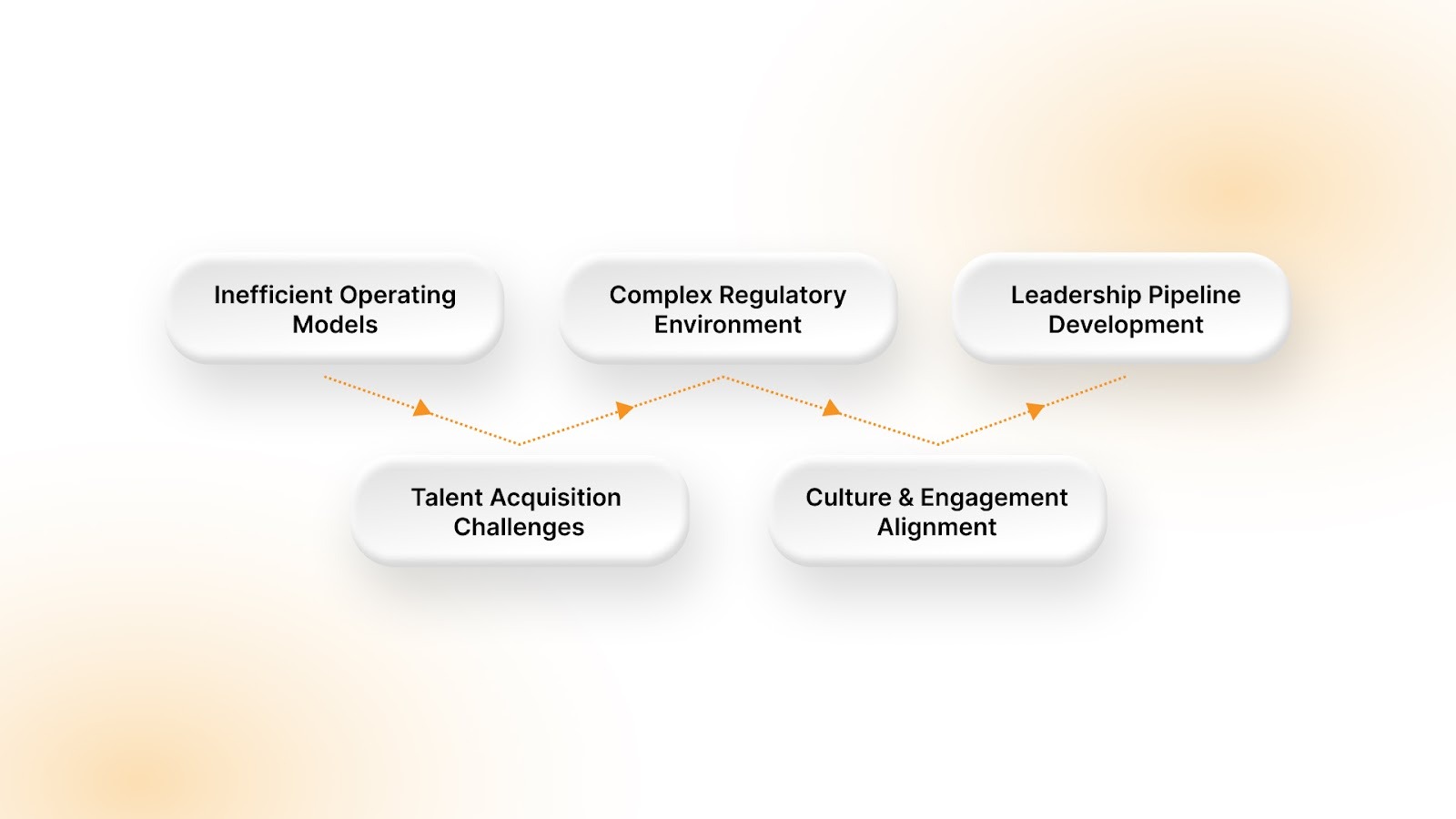
HR leaders in Indian GCCs encounter several strategic and operational challenges that can affect talent acquisition, employee retention, and overall efficiency. Below, each challenge is paired with actionable strategies to overcome it.
1. Inefficient Operating Models
Many GCCs still rely on structures that are not fully aligned with their parent organisations. This misalignment can create barriers in scaling operations, cost control, and talent retention.
How to Overcome:
- Design processes that integrate smoothly with global teams.
- Align roles and responsibilities with wider business objectives.
- Use performance metrics and data to track outcomes and ensure accountability.
- Review and refine structures regularly to optimise resources.
2. Talent Acquisition Challenges
India-based GCCs are expected to fill nearly 20,000 global roles by 2030 (Nasscom GCC 4.0 Report). Competition is intense, especially from established IT and tech companies that already have robust recruitment pipelines and university partnerships.
How to Overcome:
- Build targeted talent pipelines for critical skill areas.
- Use data-driven analytics to forecast hiring needs and reduce time-to-hire.
- Strengthen employer branding to stand out in a competitive market.
3. Complex Regulatory Environment
GCCs operating across multiple Indian states face a fragmented compliance environment that goes beyond standard corporate HR.
Key friction points include state-specific Shops & Establishments Act registrations, varying Professional Tax slabs, inconsistent contract labour regulations under the Contract Labour (R&A) Act, and EPFO/ESIC compliance across entities with different payroll structures.
For GCCs hiring contract or gig workers through staffing partners, misclassification risk adds another layer of exposure.
How to Overcome:
- Map compliance obligations by state and entity type: a GCC in Karnataka faces different thresholds and timelines than one in Telangana or Maharashtra.
- Clarify worker classification early: especially for contract staff, RPO hires, and project-based roles, where misclassification can trigger retrospective liability.
- Build compliance checkpoints into onboarding workflows, not as an afterthought but as a step that runs parallel to offer rollout.
- Audit staffing partner compliance: if you're using third-party vendors, their non-compliance becomes your risk under joint-employer principles.
If you are working with a staffing partner for contract or RPO hiring, ensure they manage payroll, statutory deductions, and compliance obligations end-to-end. V3 Staffing's EOR model handles the entire employee lifecycle, from offer and onboarding to payroll, tax filings, benefits administration, and exits.
So your GCC avoids joint-employer exposure without having to build internal compliance infrastructure for every engagement type.
4. Culture & Engagement Alignment
Balancing global corporate culture with local workforce expectations is critical for engagement and retention.
How to Overcome:
- Build employee value propositions that combine global standards with local relevance.
- Introduce DEI initiatives that resonate within the cultural context.
- Provide flexible work models, mentoring, and career development opportunities.
- Establish feedback channels to monitor engagement and make timely improvements.
5. Leadership Pipeline Development
As GCCs mature, there is growing pressure to develop strong leadership capabilities within India. Dependence on expatriate leadership or delayed decision-making can hinder growth and limit autonomy.
How to Overcome:
- Identify and nurture high-potential employees early through succession planning.
- Invest in leadership training tailored to GCC roles and global collaboration.
- Provide cross-functional opportunities to build well-rounded leaders.
- Encourage mentorship programmes that pair senior global leaders with emerging Indian talent.
These challenges show that HR leaders in GCCs are managing far more than operational tasks. To succeed, they must set clear strategic priorities that not only solve immediate issues but also prepare their workforce for sustained growth.
Also read: Banking GCC India: Talent Demand and Hiring Trends
While these responses improve execution, scaling hiring consistently often requires additional support.

How Staffing Partners Support GCC HR Leaders?
When hiring demand accelerates in GCCs, internal HR teams often face constraints in bandwidth, niche talent access, and execution speed across multiple roles. Staffing partners become relevant not as replacements, but as extensions that help maintain hiring momentum without disrupting internal priorities.

This is where external support aligns with GCC HR needs in a more execution-focused way:
- Speed Hiring: Staffing partners reduce time-to-hire by managing sourcing, screening, and coordination in parallel with internal HR workflows.
- Niche Talent: Access to pre-qualified talent pools helps close specialised roles faster, especially in IT, data, and engineering functions.
- Flexible Scale: Contract and temporary staffing models allow GCCs to respond to sudden project demands without long-term headcount commitments.
- Offer Conversion: Structured follow-ups and candidate engagement improve offer-to-join ratios and reduce last-stage drop-offs.
- Leadership Search: Executive hiring support helps secure senior roles with candidates who understand both global expectations and local execution.
- HR Bandwidth: Recruitment Process Outsourcing (RPO) models support high-volume hiring, allowing internal HR teams to focus on strategic priorities.
A good staffing partner like V3 Staffing operates as an integrated extension of your GCC HR function, not a vendor you chase for updates. With hiring support across India, the USA, and the UAE, the team brings location-level intelligence and execution accountability to every mandate.
Also read: ET GCC Growth Summit 2026: Key Highlights, Updates, and What to Expect
Strategic Priorities for HR Leaders in GCCs
To address the challenges of growth and complexity, HR leaders in GCCs are setting strategic priorities that strengthen both talent and operations. The most critical areas of focus include:
- Workforce Planning: Focus on forecasting skills demand and aligning workforce supply with GCC growth roadmaps.
- Agile Hiring Models: Blend permanent, contract, and RPO approaches for flexibility without compromising stability.
- Leadership Capability Building: Move from fixing pipeline gaps to creating structured succession plans, cross-functional development, and local leadership readiness.
- Employee Experience Design: Go beyond retention tactics to create holistic engagement frameworks, career pathways, and development-led EVP.
- Data-Driven HR: Use analytics for predictive hiring, attrition tracking, and performance dashboards that guide decision-making.
- Hub-and-Spoke Localisation: Use Tier-1 hubs for scale while building Tier-2 presence strategically for resilience and cost optimisation.
Also Read: Top HR Consultancy and Recruitment Services
These priorities take shape differently depending on where the GCC is located and the type of talent each city offers.
Why India's GCC Hubs Lead the Way?
Choosing the right location for a GCC in India has a direct impact on HR outcomes. Each hub offers distinct advantages for talent acquisition, retention, and workforce planning, helping HR leaders design more effective hiring strategies.
Two GCCs hiring for the same data engineering role in Bengaluru and Chennai will face different candidate expectations, notice period norms, competing offer volumes, and salary benchmarks.
- Bengaluru:
As the largest GCC hub with nearly 35-40%, it offers the deepest talent pool across IT, ER&D, and product engineering roles, making it ideal for high-scale and specialised hiring.
The trade-off for HR teams is intensity: attrition runs higher, lateral poaching is frequent, and compensation benchmarks move faster than most annual review cycles can accommodate.
- Hyderabad
With around 16% of GCC presence, it supports rapid team expansion with a strong pipeline in cloud, analytics, and digital services.
Infrastructure investment and state-level policy support have made it easier for GCCs to scale quickly, and compensation pressure, while rising, is still more manageable than in Bengaluru for mid-senior roles.
- Delhi NCR
Also holding close to 16% share, it is the strongest location for senior leadership, enterprise-facing, and consulting-aligned roles. HR teams building out GCC leadership layers or hiring for stakeholder-facing functions find a more experienced candidate pool here than in most other cities.
- Mumbai
With over 207 GCCs, it remains a strong base for BFSI and financial services hiring, especially for leadership and client-facing roles.
- Pune
Hosting nearly 178 GCCs, it supports engineering, automotive, and product-focused hiring with a growing talent pipeline.
- Chennai
With more than 162 GCCs, it offers workforce stability and lower attrition, making it suitable for long-term operational and engineering teams.
Top Industries Driving GCC Hiring in India
Location influences access to talent, but future readiness depends on how HR adapts to evolving workforce expectations and technologies.
Also Read: 5 Ways Recruitment Agencies Can Tackle High Attrition Rates

How V3 Staffing Supports HR Teams in GCCs?
HR leaders in GCCs are under pressure to deliver speed, quality, and long-term workforce stability. V3 Staffing supports this execution with over 16 years of industry experience, 3,000+ clients served, and 10,000+ specialists placed across roles.
V3 Staffing acts as an extension of the HR function, addressing these challenges with targeted solutions:
- Solving Talent Gaps: When GCCs need niche skills in IT, data, or engineering, our IT Staffing service provides access to a curated pool of specialists. helping close specialised roles faster with an average time-to-hire of around 10 days.
- Scaling at Speed: GCCs often face sudden spikes in hiring for new projects or global rollouts. With Contract and Temporary Staffing, we deploy fully compliant teams quickly, allowing you to meet deadlines without increasing permanent headcount.
- Reducing Attrition and Offer Drop-offs: High attrition can derail hiring plans. Through Permanent Recruitment, our domain-trained recruiters focus on cultural fit and engagement, improving offer-to-join ratios and reducing turnover.
- Strengthening Leadership Pipelines: Global firms setting up or expanding GCCs need strong local leadership. Our Executive Search helps you secure CXOs, VPs, and Directors who can lead with both global vision and local expertise.
- Supporting HR Capacity: Internal HR teams can get stretched managing high-volume or multi-location hiring. With Recruitment Process Outsourcing (RPO), we embed dedicated recruiters and SLA-driven delivery, freeing your team to focus on strategic priorities.
- Hiring Across Geographies: For GCCs with mandates beyond India, V3 Staffing's Global Hiring practice supports recruitment for roles physically based in the USA and the UAE.
At V3 staffing, we focus on speed, candidate quality, domain fit, and compliance, helping HR leaders in GCCs meet their hiring SLAs, reduce offer-drop rates, and scale teams without overhead burdens.
Conclusion
GCC growth in India is no longer defined by how many roles are opened, but by how effectively those roles are filled, structured, and sustained over time. HR sits at the center of that outcome, managing hiring speed, workforce planning, compliance, and leadership readiness in a single operating model. As GCCs expand across cities and functions, the difference between consistent delivery and constant hiring friction comes down to how well HR executes under pressure.
This is where the right staffing approach becomes critical, especially when internal teams are balancing scale with quality and timelines. V3 Staffing works as an extension of GCC HR teams, helping close niche talent gaps, improve hiring speed, and maintain offer-to-join consistency without adding internal strain. For GCC leaders looking to scale without operational slowdowns, having that level of focused support can make the difference between planned growth and delayed execution.
Ready to reimagine your GCC in HR? Partner with V3 Staffing to build teams that drive performance and sustain growth. Contact us today to start the conversation.