

.svg)
.svg)
Most release delays do not begin with a weak development effort. They begin when no one owns what happens between code commit and production stability, leaving organisations repeating outages, rollback cycles, and late-stage security surprises that slow every deployment.
If environments behave differently between testing and production, or if automation fails during scaling, the issue is usually a lack of clear responsibility rather than engineering capability.
A DevOps engineer connects development workflows with infrastructure reliability by managing CI/CD automation, maintaining infrastructure through code, improving deployment consistency, and working closely with QA, security, and platform teams to support stable releases.
Enterprise and GCC environments require governance-aligned automation across distributed systems. More than 80 percent of organisations now practise DevOps globally, making this role central to a predictable software delivery strategy.
This blog explains the core DevOps engineer roles and responsibilities, how expectations change across organisations, and what hiring teams should look for when defining the role.
Key Takeaways
- DevOps engineers keep releases moving. They manage CI/CD pipelines, infrastructure-as-code, Kubernetes platforms, monitoring systems, and security-aligned deployment workflows.
- Their role changes as teams scale. Startups build pipelines. SaaS teams run containers and observability stacks. Enterprises govern multi-region cloud environments.
- Automation sits at the centre of the job. Scripting, cloud provisioning, container orchestration, and telemetry pipelines reduce the risk of manual deployment.
- A clear role definition prevents hiring mistakes. Separating DevOps from SRE and platform engineering supports faster scaling across cloud and infrastructure teams.
What Does A DevOps Engineer Actually Do Day To Day?
DevOps engineers rarely operate inside a fixed checklist of tasks. Their daily work shifts depending on release cadence, infrastructure complexity, and reliability targets across environments.
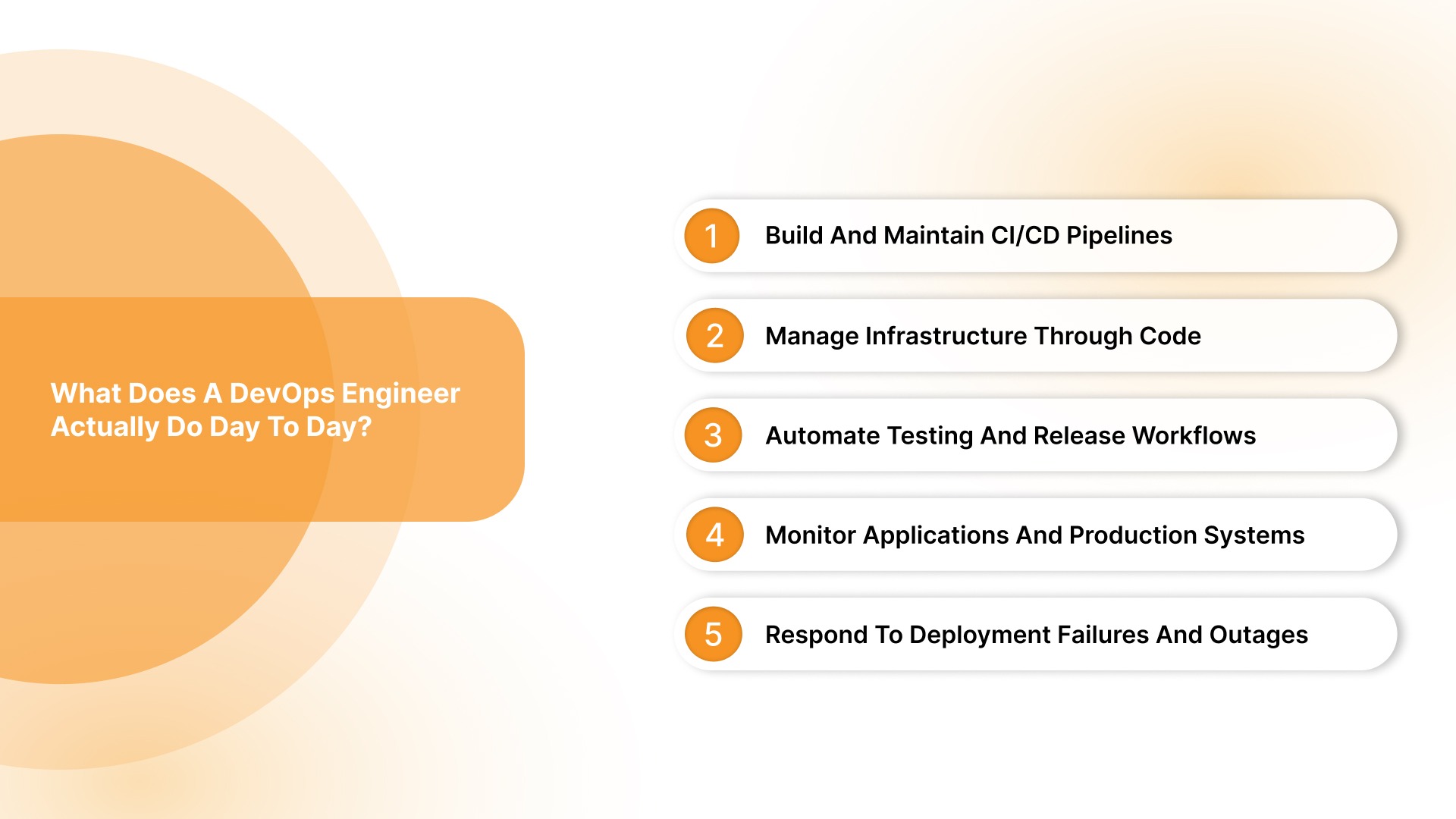
In mature engineering organisations, they maintain the automation backbone that keeps code flowing safely from commit to production while reducing deployment risk and operational friction.
1. Build And Maintain CI/CD Pipelines
CI/CD pipelines form the operational centre of modern delivery systems. DevOps engineers design and maintain workflows that automatically build, test, and deploy software so that integration issues surface early rather than during production rollout.
Typical responsibilities include:
- Automating build validation after each commit.
- Running integration tests before deployment approval.
- Managing deployment sequencing across environments.
- Maintaining rollback logic for failed releases.
- Reducing integration drift between staging and production.
Example:
A product team releasing twice weekly can move to daily deployment once pipeline automation removes manual packaging and environment configuration steps.
2. Manage Infrastructure Through Code
Infrastructure provisioning through code replaces manual configuration with version controlled automation that ensures consistent environments across teams. DevOps engineers define compute resources, storage layers, networking policies, and runtime dependencies using repeatable scripts rather than console actions.
Typical infrastructure ownership includes:
- Environment provisioning through Terraform or CloudFormation.
- Automated scaling configuration.
- Configuration drift detection.
- Multi-region environment replication.
- Version-controlled infrastructure changes.
This approach reduces configuration mismatch across staging and production environments.
3. Automate Testing And Release Workflows
Testing automation protects release quality by ensuring validation happens continuously rather than only before deployment milestones. DevOps engineers integrate automated checks into pipelines so that defects surface early and deployment confidence improves.
Daily release workflow automation includes:
- Unit test orchestration during integration cycles.
- Regression testing triggers after environment changes.
- Release validation checks before production approval.
- Deployment verification checkpoints.
- Automated rollback triggers after failed validation.
Teams with embedded pipeline testing typically experience significantly fewer post-release incidents than teams using manual release models.
4. Monitor Applications And Production Systems
Monitoring systems provide visibility into infrastructure health, application behaviour, and performance trends across environments. DevOps engineers maintain telemetry pipelines that surface failures before users experience disruption.
Monitoring responsibilities typically include:
- Log aggregation pipeline maintenance.
- Alert threshold configuration.
- Resource utilisation tracking.
- Availability measurement against service objectives..
- Latency trend analysis across deployments
Example:
A payments platform using structured monitoring dashboards can detect response degradation minutes after release, rather than hours after customer complaints.
5. Respond To Deployment Failures And Outages
Incident response remains a core operational responsibility in delivery-focused organizations. DevOps engineers investigate pipeline failures, infrastructure misconfigurations, and performance regressions to quickly restore service continuity.
Incident response ownership includes:
- Root cause investigation.
- Rollback execution.
- Environmental repair coordination.
- Deployment patch validation.
- Post-incident reporting for prevention planning.
Organisations with defined incident ownership reduce recovery timelines and avoid repeated deployment regressions.
Also Read: Building Scalable Recruitment Models: Key Strategies for Success

Top DevOps Engineer Roles And Responsibilities Across The Delivery Lifecycle
DevOps engineer roles and responsibilities span the full delivery loop from planning infrastructure to monitoring production behaviour.
The DevOps lifecycle itself includes eight continuous phases, such as plan, code, build, test, release, deploy, operate, and monitor, which means engineers support automation and reliability across every stage rather than working only inside deployment tooling.
Below are the five most consistently owned responsibility layers by DevOps engineers across modern engineering environments.
1. Infrastructure Automation Ownership
Infrastructure automation ensures environments remain reproducible across development, staging, and production systems. DevOps engineers manage infrastructure using machine-readable definitions rather than manual configuration, reducing the risk of downtime from configuration drift.
Typical ownership areas include:
- Infrastructure as code governance using version-controlled templates.
- Environment parity across testing and production systems.
- Autoscaling configuration aligned with traffic behaviour.
- Network policy automation across services.
- Disaster recovery environment readiness across regions.
Clear infrastructure ownership improves release predictability and reduces rollback frequency during production promotion cycles.
2. Release Pipeline Orchestration
Release pipeline orchestration ensures code moves safely from commit to deployment through automated validation checkpoints. Continuous integration and continuous deployment pipelines automate build validation, testing, packaging, and rollout workflows to shorten release cycles and detect defects earlier.
Pipeline responsibilities typically include:
- Continuous integration workflow maintenance.
- Automated deployment sequencing across environments.
- Release approval checkpoint configuration.
- Version traceability across repositories.
- Rollback automation during deployment failure.
Structured pipelines directly improve deployment frequency without increasing operational risk.
3. Cloud Environment Optimisation
Cloud optimisation focuses on maintaining performance reliability while controlling infrastructure usage. DevOps engineers monitor compute workloads, adjust scaling policies, and distribute services across regions to support predictable application availability during traffic variation.
Key optimisation activities include:
Cloud optimisation supports both operational continuity and financial efficiency.
4. Observability And Monitoring Systems
Observability systems allow engineering teams to detect performance degradation early and respond before service disruption affects users. DevOps teams monitor the entire delivery lifecycle including development, integration, deployment, and operations to maintain system reliability.
Observability ownership includes:
- Metrics pipeline configuration across services.
- Log aggregation strategy for incident diagnosis.
- Alert prioritisation based on service thresholds.
- Service level objective tracking against reliability targets.
- Deployment performance analytics across release cycles.
Strong monitoring coverage improves recovery speed during outages and strengthens production stability.
5. Security Integration Across Pipelines
Security automation is now embedded inside delivery pipelines rather than applied after release approval. DevOps engineers integrate validation checkpoints across build and deployment workflows so vulnerabilities are detected earlier in the lifecycle through shift-left security practices.
Security integration responsibilities typically include:
- Dependency vulnerability scanning during builds.
- Container image validation before deployment.
- Access control enforcement across environments.
- Compliance automation checkpoints inside pipelines.
- Artifact integrity verification across releases.
Embedding security inside pipelines reduces exposure risk during rapid release cycles and improves governance across distributed engineering environments.
Also Read: Leadership Hiring vs Executive Hiring: Key Differences Explained
Where DevOps Engineers Create The Most Business Impact
DevOps engineer roles focus on measurable delivery performance indicators rather than solely on technical workflow efficiency. Organisations that invest in structured DevOps ownership improve deployment predictability and operational continuity across distributed engineering environments.
Key business outcomes include:
Platform reliability improves when monitoring, automation workflows, and infrastructure provisioning operate as a coordinated lifecycle system rather than isolated tooling layers.
How DevOps Responsibilities Change Across Company Maturity Stages
DevOps responsibilities expand significantly as organisations move from early product delivery to distributed infrastructure scale. Hiring expectations change accordingly.
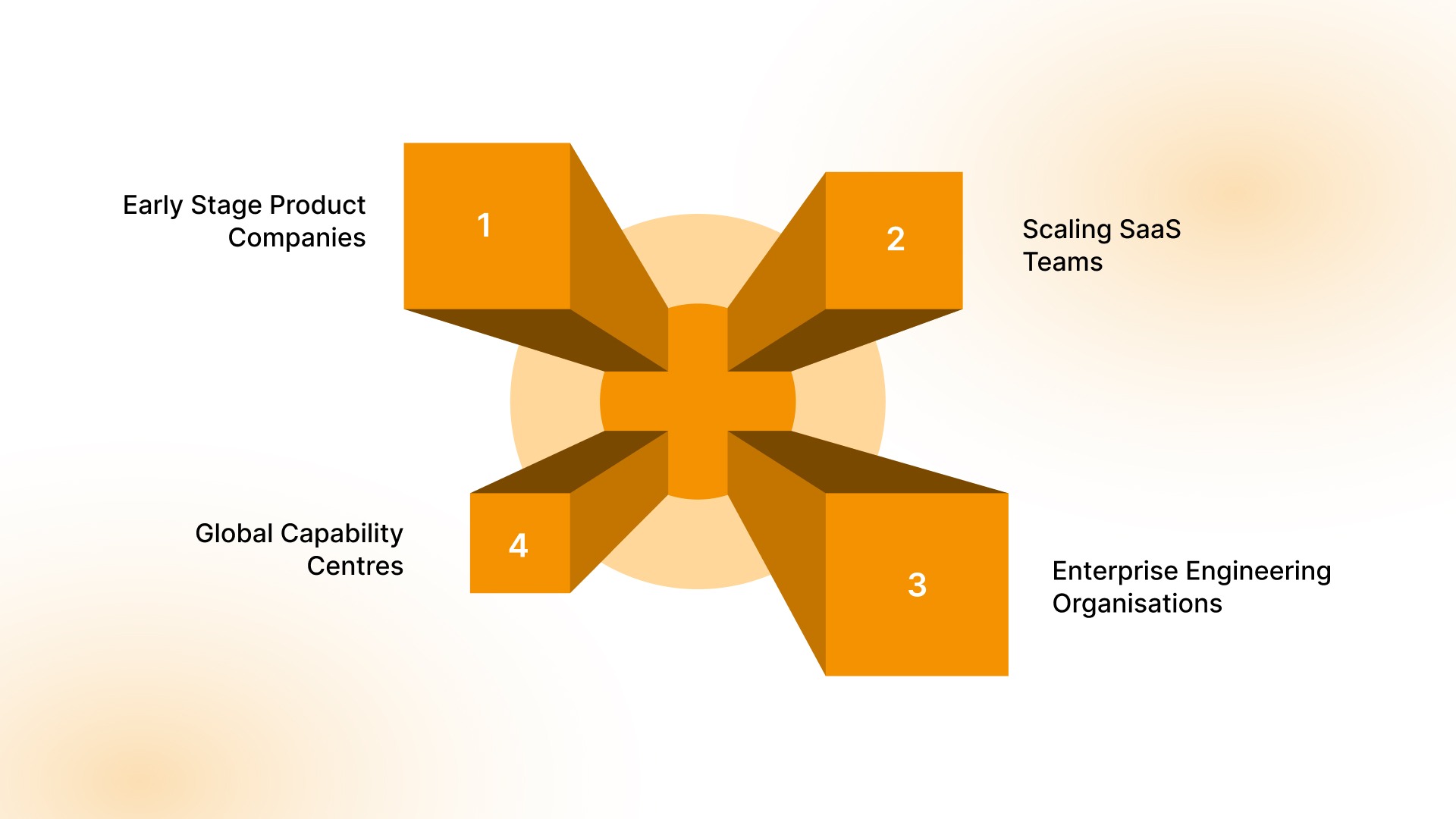
1. Early Stage Product Companies
In early-stage environments, DevOps engineers establish delivery foundations that allow engineering teams to release safely.
Typical ownership includes:
- Initial pipeline configuration.
- Cloud migration support.
- Environment provisioning automation.
- Deployment scripting frameworks.
- Version-controlled infrastructure templates.
Pipeline ownership directly determines release speed in early product teams.
2. Scaling SaaS Teams
Scaling SaaS environments requires structured automation across multiple deployment layers.
Responsibilities expand into:
- Multi-environment deployment orchestration.
- Container runtime configuration.
- Observability pipeline maturity.
- Infrastructure scaling policies.
- Release reliability enforcement.
Scaling SaaS teams depends heavily on container orchestration stability.
3. Enterprise Engineering Organisations
Enterprise engineering environments introduce governance requirements across infrastructure automation.
Responsibilities typically include:
- Platform engineering coordination.
- Compliance-aligned pipeline validation.
- Identity access integration across environments.
- Region-level infrastructure replication.
- Release audit traceability.
Enterprise environments prioritise deployment predictability across distributed systems.
4. Global Capability Centres
Global Capability Centres coordinate delivery across product portfolios and regions. DevOps engineers maintain consistency in automation across shared tooling layers.
Responsibilities include:
- Shared pipeline governance frameworks.
- Cross-team deployment automation standards.
- Multi-product environment orchestration.
- Release synchronisation across geographies.
- Infrastructure visibility dashboards.
For organisations expanding platform, cloud, or AI engineering capabilities, structured hiring support helps define role scope early when DevOps overlaps with infrastructure reliability and platform engineering responsibilities.
V3 Staffing supports enterprise and GCC teams globally in mapping these boundaries before scaling delivery capacity.
Also Read: Explore Types of Recruitment to Improve Hiring in 2026
Skills That Support DevOps Engineer Responsibilities
DevOps engineer roles and responsibilities involve combining automation, cloud infrastructure management, container runtime management, and observability across the delivery lifecycle.
Modern DevOps teams operate across scripting layers, cloud provisioning systems, monitoring pipelines, and release coordination workflows to maintain deployment consistency.
Industry surveys from HashiCorp’s 2024 State of Cloud Strategy report show that more than 85% of organisations now use infrastructure as code, making automation literacy a baseline expectation rather than a specialised skill.
The skill areas below reflect what engineering leaders typically expect when defining DevOps ownership scope.
1. Automation And Scripting
Automation scripting enables repeatable infrastructure provisioning and stable release pipelines across environments. DevOps engineers use scripting languages to connect tools, trigger workflows, and remove manual deployment dependencies.
Typical automation ownership includes:
- Writing Python scripts to orchestrate environment provisioning.
- Using Bash for server configuration and deployment execution.
- Managing YAML pipeline logic inside CI platforms.
- Automating regression testing triggers after code commits.
- Maintaining reusable configuration templates across repositories.
For example, teams running Git based pipelines often automate build validation after every commit, so integration defects appear early rather than during production release cycles.
Programming and scripting remain core DevOps skills because engineers must integrate source code changes with deployment automation and infrastructure updates.
2. Cloud Platforms
Cloud platform expertise allows DevOps engineers to maintain scalable infrastructure that supports distributed workloads across regions. Most organisations now expect familiarity with at least one major provider such as AWS, Azure, or Google Cloud.
Common responsibilities include:
- Configuring autoscaling compute workloads during traffic spikes.
- Managing identity and access policies across services.
- Deploying container clusters using managed orchestration services.
- Supporting multi-region availability strategies.
- Monitoring infrastructure usage through native dashboards.
Cloud platform literacy is essential because modern applications rely heavily on elastic infrastructure rather than fixed server environments.
3. Container Orchestration
Container orchestration improves application portability and deployment consistency across development and production systems.
Kubernetes has become one of the most requested capabilities in DevOps hiring environments, appearing in roughly 28 percent of DevOps job listings in 2024, reflecting its importance in modern infrastructure delivery.
Typical orchestration responsibilities include:
- Managing container lifecycle across clusters.
- Configuring service discovery inside microservice environments.
- Automating scaling policies for container workloads.
- Maintaining persistent storage mappings across deployments.
- Coordinating rolling updates without service interruption.
Container orchestration allows engineering teams to maintain predictable runtime behaviour across distributed environments.
4. Monitoring And Observability
Monitoring platforms provide visibility across infrastructure performance, application behaviour, and release stability. DevOps engineers design telemetry pipelines that allow teams to detect anomalies before they affect users.
Key observability ownership areas include:
- Aggregating logs across distributed services.
- Configuring performance metrics dashboards.
- Setting alert thresholds aligned with service objectives.
- Tracking latency trends after deployments.
- Analysing release performance across environments.
Observability tools support early detection of reliability regressions and strengthen operational decision-making across production systems.
5. Collaboration And Release Coordination
DevOps engineers coordinate across development, QA, operations, and security teams to maintain deployment continuity across environments. The role exists partly to remove workflow silos and improve delivery speed by aligning release ownership across functions.
Typical coordination responsibilities include:
- Managing release readiness checkpoints across teams.
- Documenting pipeline updates for distributed engineering groups.
- Supporting incident response communication during outages.
- Aligning security validation with deployment schedules.
- Maintaining version traceability across repositories.
Strong collaboration capability improves deployment reliability and reduces integration delays across distributed engineering organisations.
Also Read: GCC Outsourcing vs Traditional Outsourcing Explained
DevOps Engineer Vs SRE Vs Platform Engineer: What Hiring Teams Should Know
Many organisations treat DevOps, SRE, and platform engineering roles as interchangeable even though their ownership models differ significantly. Clear differentiation improves hiring precision.
Many scaling organisations hire across DevOps, SRE, platform engineering, and cloud infrastructure roles simultaneously. V3 Staffing supports hiring leaders in structuring these adjacent roles clearly when building engineering, cloud, and data platform teams across India, the USA, and the UAE.
Common Mistakes Companies Make When Defining DevOps Engineer Roles
Organisations frequently weaken DevOps impact by defining responsibilities too narrowly or too broadly. Clear scope alignment improves hiring outcomes and delivery performance.
Typical role definition mistakes include:
- Treating DevOps as tool ownership rather than lifecycle ownership.
- Combining SRE, DevOps, and cloud architecture responsibilities into one role.
- Missing observability ownership expectations.
- Ignoring pipeline security automation responsibilities.
- Hiring without a platform engineering roadmap.
Teams that define DevOps responsibilities clearly at the hiring stage avoid pipeline fragmentation later in the delivery lifecycle.

How V3 Staffing Supports DevOps Engineer Hiring At Scale

Hiring DevOps engineers often becomes difficult when responsibilities span infrastructure automation, cloud orchestration, monitoring systems, and security-aligned deployment workflows.
V3 Staffing supports enterprise and GCC teams by structuring DevOps hiring around delivery lifecycle ownership rather than tool-based job descriptions, helping organisations scale engineering capability with clearer role alignment.
Core hiring solutions include
- Permanent Recruitment for mid to senior DevOps engineers across cloud, infrastructure, and platform environments
- Contract Staffing for short-term pipeline modernisation and automation transformation initiatives
- Executive Search for platform engineering leaders and DevOps strategy roles
- Recruitment Process Outsourcing for high-volume engineering and cloud hiring programmes
- Employer Of Record Services to onboard DevOps talent compliantly without setting up a local entity
Conclusion
DevOps engineer roles and responsibilities are moving beyond pipeline maintenance. They now support a cloud-native delivery architecture built on Kubernetes orchestration, GitOps-based deployment workflows, infrastructure-as-code environments, and integrated DevSecOps release pipelines.
Engineering teams are adopting internal developer platforms to standardise environments and reduce deployment variability across services.
Organisations are also introducing policy-based automation, multi-cloud deployment governance, and observability-driven monitoring to support microservices-based systems at scale. These changes are shaping how teams manage release reliability, security validation, and platform consistency across regions.
If your organisation is preparing to scale DevOps, cloud, or platform engineering capability across India, the USA, or the UAE, connect with V3 Staffing to structure role definitions and build delivery-aligned engineering teams with confidence.