.svg)
.svg)
ET GCC Growth Summit 2026 is set for 18 March 2026 in Hyderabad, highlighting how global capability centres are becoming more intelligent, resilient, secure, and closely aligned with global business priorities.
The ET GCC platform is especially relevant this year as the conversation moves beyond expansion and shifts towards enterprise ownership, AI-led operations, cybersecurity, talent readiness, and sustainable scale. In this context, the 2026 edition gives GCC leaders, talent heads, and business decision-makers a clearer view of what is changing across the ecosystem.
This blog covers the key focus areas for 2026, what has changed since the 2025 editions, and why these updates matter now.
Key Takeaways
- ET GCC Growth Summit 2026 on 18 March in Hyderabad will focus on how GCCs are scaling with stronger ownership in AI, engineering, resilience, and digital trust.
- The 2026 agenda shifts from broad growth talk to execution-led scale, with emphasis on AI-native GCCs, secure operating models, and faster maturity from setup to scale.
- The 2025 Pune edition had already moved in this direction, with a stronger focus on tech depth, talent structure, data use, and higher-value GCC work.
- For GCC leaders, the event is a useful signal on what now matters most: technical ownership, sharper hiring plans, and tighter operating design.
- For businesses hiring across India, the USA, and the UAE, these themes connect directly to workforce planning, where structured partners like V3 Staffing become relevant.
What is the ET GCC Growth Summit 2026 About?
The ET GCC Growth Summit 2026 is the third edition of ETGCCWorld’s Hyderabad event and will be held on 18 March 2026 at Trident, Hyderabad. This year’s summit is built around a clear shift. GCCs are no longer being discussed as support centres built mainly for cost savings.
The focus is now on centres that own core business work such as engineering, data, cloud operations, cybersecurity, and AI-linked execution. The summit agenda reflects that shift directly.
The event format itself reflects the summit's scale and intent. It is positioned as a decision-maker forum rather than a broad awareness event.
- 3rd edition in Hyderabad, with a sharper focus on growth-stage GCCs and mature centres taking on wider mandates.
- 18 March 2026 at Trident, Hyderabad, which keeps the event anchored in one of India’s strongest GCC hubs.
- 10+ sessions, 45+ speakers, 400+ delegates, and 8+ hours of networking are already listed, signalling a packed agenda built for senior operators, not just for keynote visibility.
- India already has 1,800+ GCCs, which frames the summit around execution at scale rather than early market curiosity.
The 2026 Theme
This year’s theme is “Reinventing the enterprise backbone.” In practical terms, that means the summit is centred on how GCCs are being asked to run work that directly affects business continuity, product velocity, control, and risk.
- GCCs are moving beyond the older cost arbitrage model and taking on work tied to engineering ownership, data decisioning, cloud operations, platform stability, and digital trust.
- Studies have noted that Indian GCCs are now viewed as strategic bases supporting parent companies across operations, finance, and R&D, rather than as low-cost back offices.
- Hyderabad alone now has 300+ centres, many of which already run critical engineering, data, cloud, and cybersecurity functions. That is a strong signal that GCCs in the city are carrying heavier business responsibility.
What Makes This Edition Relevant Now
The 2026 edition matters since enterprise pressure has changed. The discussion is no longer limited to expansion or seat growth. The harder questions now are about control, operating resilience, AI execution, and secure scale.
- Modernisation pressure is rising: GCCs are expected to support platform shifts, data-led operations, and tighter integration with global business units, which raises the bar for operating discipline.
- Risk has moved to the centre of the agenda: Cybersecurity, cloud governance, and zero trust are no longer side conversations. They now sit close to growth planning since every expansion decision affects exposure, compliance, and resilience.
- AI is being judged on operating value: The event’s focus on AI-linked GCC models signals a shift from experimentation to measurable outcomes across workflows, delivery, analytics, and internal productivity.
- The market is still expanding: 110+ new GCCs were set up in India between early 2024 and late 2025, across 15+ countries, indicating that both new entrants and existing centres are shaping the next phase.
Also Read: GCC Consultancy That Helps You Build Right and Scale Fast
What Will Be the Biggest Talking Points at ET GCC 2026?
The main value of the ET GCC Growth Summit 2026 lies in what it prioritises. The listed tracks point to a more demanding GCC model: one that must launch faster, own more critical work, build secure systems, and operate with tighter alignment to global business goals.
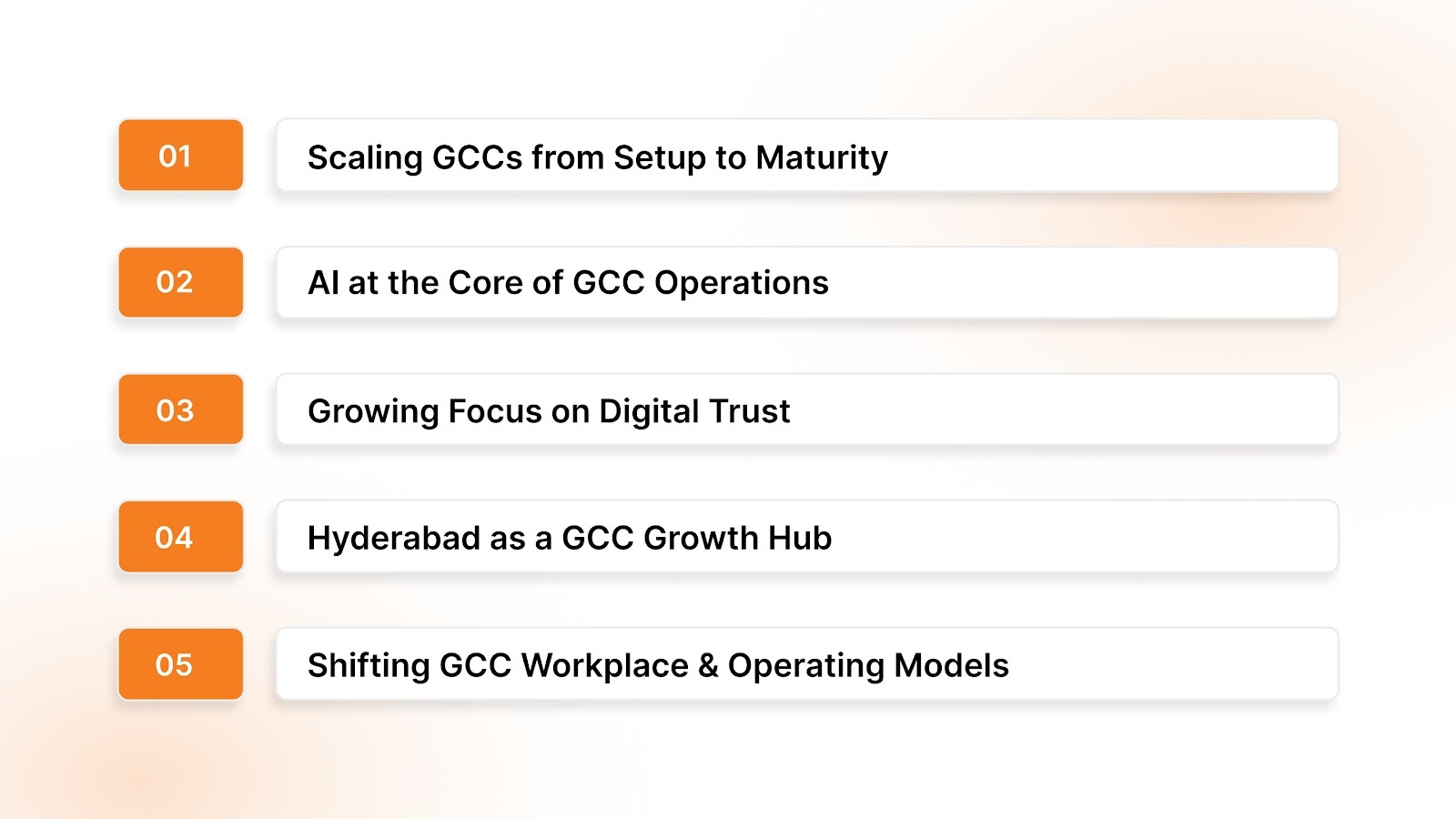
These are not broad theme labels. They map directly to the practical decisions GCC leaders are making in 2026.
Scaling GCCs From Setup to Maturity
One of the strongest signals in the 2026 agenda is the move from launch conversations to maturity conversations. The official 0 to 100 playbook theme points to a market where setup is only the first milestone.
The harder work starts once the centre has to scale, own critical functions, and justify wider charter expansion.
- New GCCs need a sharper launch model built around function mix, leadership design, compliance readiness, and early capability ownership, not just office setup and initial hiring.
- Growth-stage centres are being pushed to move from support mandates to engineering ownership, platform work, analytics, control functions, and business-critical operations. That changes org design and hiring mix.
- Mature centres are being judged on how much core work they own, how quickly they can absorb new mandates, and whether they can operate with less dependence on headquarters for day-to-day execution.
- This matters in a market where India already has 1,800+ GCCs, since the next wave of differentiation will come from operating quality and mandate depth, not from entry alone.
AI at the Core of GCC Operations
The summit’s focus on AI-native GCCs signals a more serious phase of AI adoption. The emphasis is no longer on isolated pilots. The priority now is to improve throughput, control, and decision speed within the operating model.
- In delivery teams, AI is increasingly tied to workflow acceleration, code support, issue triage, and faster resolution cycles.
- In engineering and product functions, the pressure is on using AI to improve build velocity, release discipline, and issue detection, not just experimentation.
- In data and analytics teams, the focus is shifting to faster interpretation, operational dashboards, and decision support linked to live business metrics.
- In shared service and internal support environments, AI is being applied to knowledge retrieval, request routing, and process handling, where measurable time savings can be tracked.
- The summit’s AI focus matters more in 2026, as enterprise teams are now under pressure to demonstrate how AI improves operational performance without weakening governance or data control.
Why Digital Trust Will Get More Attention
Security themes on the 2026 agenda are a direct response to how GCC charters are changing.
Once a centre handles engineering systems, enterprise data, cloud estates, and internal decision support, trust becomes an operating requirement rather than a compliance checkbox.
- The summit’s focus on cybersecurity, cloud, and zero trust points to a stronger link between growth and control. Expansion without a secure architecture now creates downstream risk.
- GCCs handling regulated workloads need tighter coordination across identity controls, cloud policy, access layers, incident handling, and audit readiness.
- This is especially relevant for centres moving into banking, healthcare, manufacturing, and platform-led product work, where system exposure and data sensitivity are much higher.
- Hyderabad’s 2026 event coverage already highlights that many local centres run cloud and cybersecurity functions at a critical level, making digital trust a frontline topic rather than an afterthought.
Why Hyderabad Stays Central to the GCC Conversation
Hyderabad’s role in the 2026 summit is not incidental. The city is being used as a live case study for what a highly functional GCC hub looks like when scale, specialised talent, and enterprise mandates start to cluster in one location.
- The city’s GCC base includes functions tied to engineering, data, cloud, and cybersecurity, which makes it relevant to the exact topics the summit is prioritising.
- Hyderabad continues to attract attention from enterprises seeking a mix of technical depth, low-friction expansion, and mature ecosystem support.
- The city’s strength in high-skilled delivery makes it useful for discussions around charter expansion, leadership hiring, and cross-functional buildout, which are central to this year’s summit agenda.
The Workplace and Operating Model Shift
A major undercurrent of the 2026 summit agenda is the rebuilding of GCC operating models. The discussion is no longer just about where teams sit. It is about how infrastructure, leadership structure, and cross-functional ownership support speed and control at scale.
- Infrastructure choices now shape operating performance more directly. Leaders are making more deliberate decisions about workspace design, site readiness, cloud connectivity, resilience planning, and secure access environments, as these affect delivery consistency.
- Leadership visibility is becoming more important in scale-up phases. GCCs with broader mandates need stronger site leadership, clearer reporting lines, and tighter alignment with business units outside India.
- Cross functional buildout is no longer optional once the centre moves beyond a narrow charter. Centres that own engineering, product support, analytics, platform operations, and risk functions need better cross-team coordination from the start.
- The 2025 summit themes in Hyderabad and Pune already showed this shift through discussions on future work environments, risk management, continuity, innovation, and strategic leadership. The 2026 agenda takes that further by tying these topics more tightly to enterprise backbone decisions.
Building or scaling a GCC in India? V3 Staffing helps you hire faster with SLA-led recruitment, domain-specific sourcing, and end-to-end pipeline management across Bengaluru, Hyderabad, Pune, Chennai, Mumbai, and Delhi NCR.
With 10,000+ specialists hired, 300+ clients served, 16+ years of experience, and an average time to hire of 10 days, V3 brings speed, clarity, and hiring accountability.
Also Read: How India's AI Workforce is Shaping the Future of Jobs in 2026
What the 2025 Hyderabad Edition Prioritised
The 2025 Hyderabad edition centred on GCCs that were already operational or in expansion mode. The conversation moved past the decision to enter India and focused on how organisations structure teams, leadership, and operating models once the centre is running.
- The summit targeted growth-stage GCCs and new entrants already building operations in India.
- Discussions focused on organisational change and evolving work environments as GCC teams scale.
- The overall narrative shifted from “Why build in India?” to “How should GCCs operate and grow once established?”
The 2025 Hyderabad Themes That Stood Out
Several themes appeared repeatedly across the discussions.
- Technology and innovation: GCCs are increasingly leading enterprise engineering, digital platforms, and transformation initiatives.
- Workplace transformation: Leaders discussed hybrid work models, agile teams, and evolving workplace structures.
- BFSI digitisation: Regulated industries are using GCCs for deeper technology execution and process ownership.
- AI, talent, and leadership: Talent strategy and technical capability are now closely linked in GCC operating models.
Also Read: Organizational Culture: Your Magnet to Attract and Retain Top Talent
What the 2025 Pune Edition Added
The Pune edition of the ET GCC Growth Summit, held on 7 May 2025 at Hotel Conrad, Pune, pushed the conversation beyond broad GCC growth and into sharper operational detail.
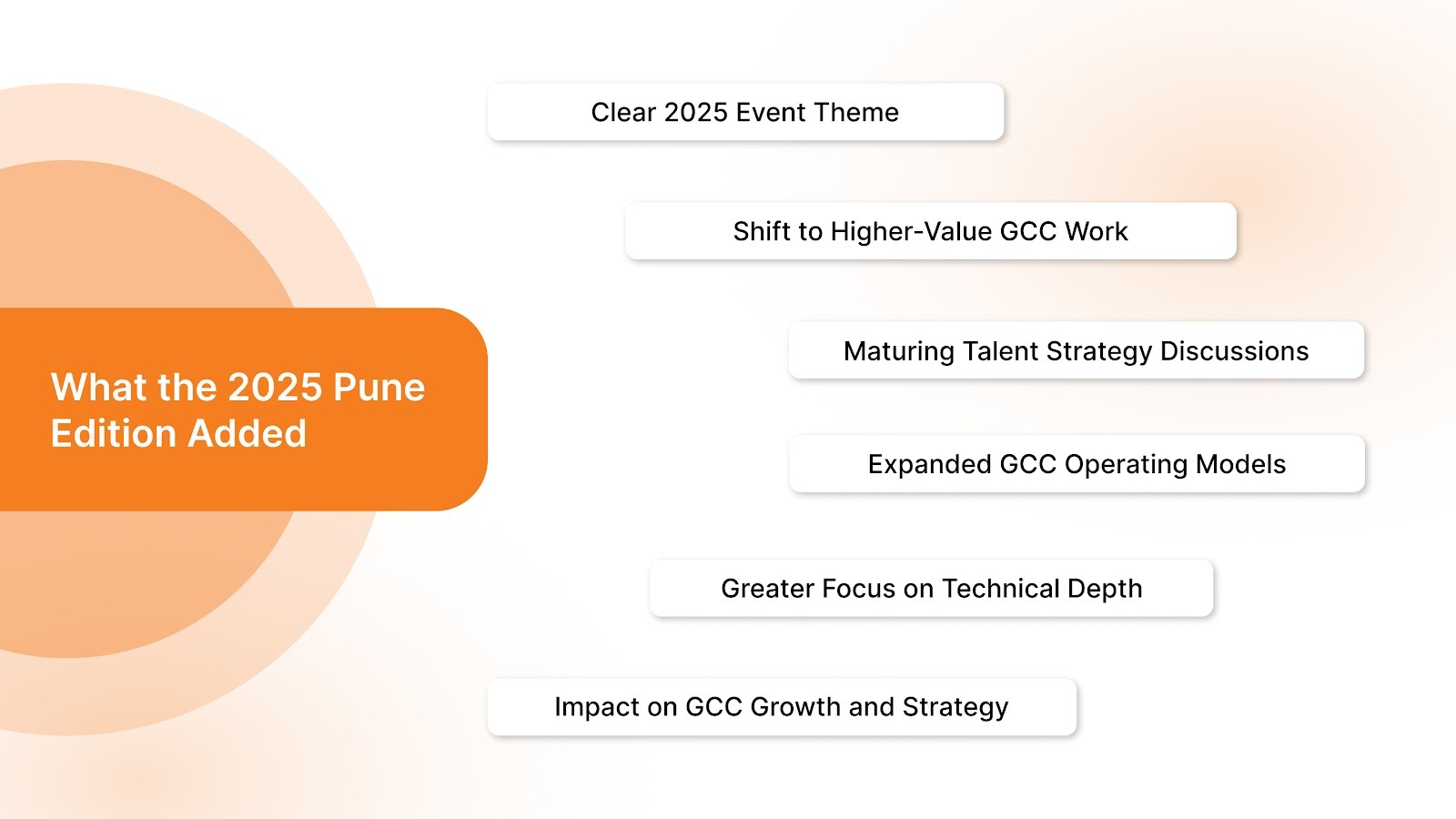
As the second edition of the summit, it gave more space to the structures that shape long-term GCC performance, especially in technology, talent, data, and scale.
- Clear 2025 theme: “Tech. Talent. Transformation” tied the event to three core drivers of GCC growth.
- Higher-value work: Sessions on innovation, R&D, and strategic leadership pointed to GCCs taking on more business-critical responsibilities.
- More mature talent discussion: Future of work and talent management linked hiring with capability planning, leadership buildout, and scale readiness.
- Wider operating model scope: Topics such as sustainability, compliance, and futuristic workspaces showed that the discussion had moved beyond hiring volume alone.
- More technical depth: Focused tracks like The Specialised Tech Era, The Talent Transformation, and Smart Data Play in GCCs added greater depth in technology and data.
- Why it mattered: The Pune edition helped connect GCC growth with the practical decisions that affect performance, ownership, and scale.
What Changed From 2025 to 2026
The shift from 2025 to 2026 is not a change in direction. It is a change in maturity. The same core themes remain, but the framing is tighter and more demanding in 2026.
The 2026 ETGCCWorld agenda makes that change visible.
- In 2025, the emphasis was on tech growth, talent structure, workplace change, leadership, and momentum among new entrants.
- In 2026, the language shifts to enterprise backbone, digital trust, resilience, and end-to-end business ownership, which is a stronger signal of an operating model.
- The 2026 agenda is more explicit about GCCs owning engineering excellence, AI-led productivity, and business ownership, not just contributing to shared operations.
- The discussion topics are now framed through sharper execution lenses such as Scaling GCCs: The 0-to-100 Playbook and AI-Native GCCs: Building With GenAI at the Core.

How V3 Staffing Supports GCC Growth
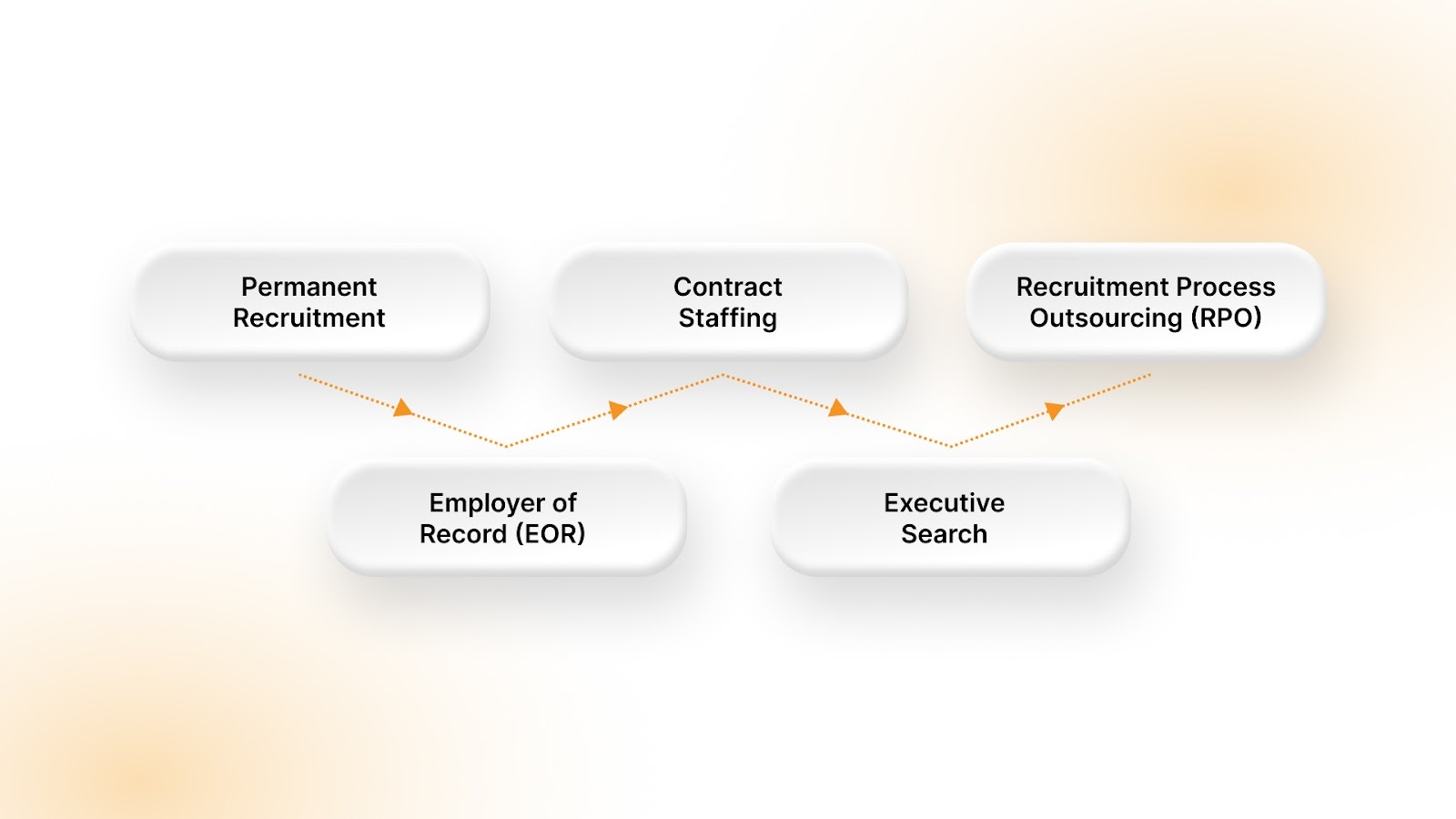
V3 Staffing is well aligned with the needs discussed at the ET GCC Growth Summit 2026. As GCCs expand and strengthen teams across India, the USA, and the UAE, they need faster hiring, stronger role fit, and more structured workforce planning.
V3 Staffing supports this with a high-touch, SLA-driven recruitment model built for specialised hiring, scale, and dependable delivery across these key markets.
Key services include:
1. Permanent Recruitment
V3 Staffing supports full-time hiring for GCCs, building long-term capability across core functions. This is useful for mid to senior-level roles where quality of hire, domain fit, and long-term team stability matter.
2. EOR
For companies entering new markets or building teams before establishing a full local structure, EOR support provides a compliant route to hire. It is useful for GCCs that need faster team setup without slowing early expansion plans.
3. Contract Staffing
Contract staffing helps GCCs handle project-based demand, urgent scale-ups, and short-term capability gaps. It is a practical option for teams that need flexibility across tech and non-tech functions without delaying delivery.
4. Executive Search
For leadership and business-critical roles, V3 Staffing supports targeted executive hiring. This is relevant for GCCs hiring CXO, VP, and Director-level talent where discretion, precision, and strategic fit are essential.
5. Recruitment Process Outsourcing (RPO)
RPO is useful for GCCs that need a more structured and scalable recruitment engine. V3 Staffing can support end-to-end hiring operations with dedicated delivery, stronger process control, and more predictable hiring outcomes.
Conclusion
The ET GCC Growth Summit 2026 highlights a clear shift in the GCC model. Growth is no longer defined solely by expansion. It now depends on stronger operating structures, deeper technical ownership, and better talent planning. As GCCs build and scale teams across India, the USA, and the UAE, the hiring approach becomes just as important as the business strategy. This is where the right recruitment partner can make a measurable difference.
With expertise across permanent hiring, EOR, contract staffing, executive search, and RPO, V3 Staffing supports GCCs that need structured, dependable hiring as they move into the next phase of growth. Contact us today to get started.