
.svg)
.svg)
Large‑scale recruitment is fundamentally different from routine hiring. Organisations today often need to hire hundreds or even thousands of employees within short windows to support rapid growth, new product launches, seasonal demand spikes, or expansion into new markets such as the USA and UAE.
Most internal HR teams are set up for occasional hires, not for campaigns that may involve hundreds or thousands of roles within tight timeframes. Data shows that 65% of companies today have high‑volume recruitment needs, and 82% are increasing investment in hiring technologies to manage this demand.
Traditional recruitment practices struggle under the weight of volume, slowing hiring, extending time to hire, and diluting candidate quality. To overcome these hurdles, organisations need structured planning, robust technology, and collaboration with external hiring partners.
This article provides actionable strategies to help you refine large-scale recruitment processes, reduce time to hire, and improve outcomes at scale.
Key Takeaways
- Large-scale recruitment requires clear strategy, aligned with business needs, to handle high volumes of candidates effectively.
- Technology (ATS, AI tools) optimises screening and shortlisting processes, reducing manual effort and improving speed.
- Employer branding plays a critical role in attracting quality candidates and reducing turnover during mass hiring.
- Diversity, Equity, and Inclusion (DEI) practices should be integrated into mass recruitment to attract a broader talent pool.
- KPIs such as time-to-hire, cost-per-hire, and quality-of-hire are essential for tracking the effectiveness of large-scale recruitment.
What Makes Large-Scale Recruitment Unique?
Large-scale recruitment differs significantly from more incremental hiring. In typical hiring, teams handle a modest volume of candidates, allowing time for detailed screening, repeated interviews, and iterative assessment.
In contrast, large-scale recruitment campaigns involve:
- Filling many positions concurrently
- Tight deadlines and business imperatives
- High application volumes that can exceed internal capacity
For many companies, a high‑volume hiring scenario can generate more than 250 applications per role, compared with the roughly 59 applications a standard job posting averages.
Across industries such as IT, retail, manufacturing, and shared services, rapid hiring demand puts pressure on existing workflows, making traditional processes inefficient. If the hiring process is slow, organisations risk losing top talent. Research shows that many high-quality candidates are off the market within just a few days.
At V3 Staffing, we’ve optimised our hiring process to deliver an average 10-day time-to-hire, enabling organisations to secure the best talent before they’re gone.
Key differences in large-scale recruitment include:
- Scale of volume: Instead of dozens, you may be handling hundreds of hires simultaneously.
- Compressed timelines: Business needs may demand rapid fulfilment.
- Candidate management intensity: Thousands of applicant submissions require structured tracking and prioritisation.
Also Read: How to Recruit Passive Candidates Successfully
Understanding these unique characteristics is essential before defining a large-scale recruitment strategy.

How to Build a Reliable Workforce Plan for Mass Hiring
Workforce planning for large‑scale recruitment should be systematic and anticipatory rather than reactive.

1. Forecast Strategic Talent Needs
Start by aligning hiring forecasts with business plans. This means connecting projected revenue targets or operational expansions with headcount models.
Workforce planning isn’t just about filling open roles. Rather, it focuses on anticipating where gaps will emerge as business priorities shift.
2. Identify Skill Gaps Early
Analyse existing talent pools to find where shortages are likely. This helps prioritise roles that require immediate sourcing versus those that can be filled through internal mobility or training programs.
3. Define Goals and KPIs
Recruitment objectives for mass hiring must be SMART: clear, measurable targets aligned with business outcomes. For example:
- Reduce average time‑to‑hire for frontline roles to under 30 days.
- Maintain offer acceptance rates above 80 % across regions.
- Achieve a first‑year retention rate above 85 % for new hires.
Having precise targets helps keep the entire workforce plan operationally grounded rather than aspirational.
4. Build Talent Pipelines Before They Are Needed
A consistent talent pipeline prevents crises when waves of hiring start. This includes:
- Engaging passive candidates through ongoing outreach.
- Using employee referrals for quicker referrals and faster screening.
- Hosting talent forums or recruitment events aligned with product launches or strategic roadmaps.
5. Clarify Team Accountabilities
Assign responsibilities to individuals or sub‑teams for sourcing, screening, interviewing, background checks, and candidate communications. A clear division ensures work does not bottleneck as volumes increase.
Need to Scale Your Workforce Quickly? V3 Staffing delivers tailored recruitment solutions to help you hire engineering, product, data, cloud, AI/ML, and cybersecurity talent efficiently at any scale, with speed and precision. Let us help you meet your hiring goals with speed and precision.
Also Read: Expand GCC in India: Key Trends and Opportunities for 2025
What Are the Key Challenges in Large-Scale Recruitment?
Large-scale recruitment faces challenges such as high applicant volumes, overwhelming screening capacity, and extended time-to-hire during demand spikes.
Without standardised workflows and reliable screening mechanisms, hiring teams struggle to maintain speed, accuracy, and legal adherence at scale.
1. Managing High Volumes Without Losing Quality
High application volumes make it difficult to ensure consistent evaluation standards. According to industry insights, automation of screening and ranking can reduce initial review time and improve match accuracy.
2. Maintaining a Consistent Candidate Experience
Candidate experience is now a quantifiable driver of hiring success.
- 66% of applicants accept offers due to a positive experience.
- 26 % reject offers due to poor communication or unclear expectations.
This makes structured process design and communication plans essential. Poor engagement not only reduces conversions but also harms an employer's reputation in crowded talent networks.
3. Aligning Recruitment With Business Timelines
Misalignment between business goals and recruitment pacing can stall project starts or operational readiness. Workforce planning must interface closely with operational planning cycles.
Also Read: Types of Staffing and Their Differences
How to Define a Clear Recruitment Strategy for Large‑Scale Hiring

A recruitment strategy for large‑scale hiring must move beyond posting jobs. It needs a structured framework encompassing attraction, assessment, selection, deployment, and candidate engagement, designed to operate at scale without compromising quality or candidate experience.
Effective large‑scale recruitment transforms hiring from a reactive task into a repeatable, measurable business process.
1. Set Clear, Outcome‑Driven Goals
Defining objectives with measurable targets is essential for aligning recruitment with business outcomes. Instead of activity metrics like number of posts, focus on outcomes such as:
- Time‑to‑hire improvements
- Offer acceptance rate
- Quality of hire
- Candidate satisfaction
These targets provide a quantifiable way to assess whether the strategy is working and where it needs refinement. Effective recruitment metrics improve hiring decisions and employer brand perception over time, rather than just tracking volume.
2. Adopt Multiple, Data‑Driven Sourcing Channels
Diverse sourcing channels reduce dependence on a single method and broaden the applicant pool. Combine:
- Talent platforms and niche job boards
- Employee referrals
- Social media and mobile recruiting
- Community and industry groups
Tracking performance across channels lets you identify which sources yield the best candidates, enabling optimisation over time.
Tools like applicant tracking systems (ATS) and recruitment analytics platforms automate sourcing, filtering, and performance reporting, helping you allocate effort where it’s most effective.
3. Cultivate and Maintain Talent Pools Continuously
A proactive recruitment strategy recognises that hiring at scale is often a recurring process. Building talent pools of pre‑qualified candidates for frequently hired roles allows faster movement from application to offer.
Engage these talent pools regularly with updates, events, and personalised communication to ensure candidates remain interested and aware of opportunities. This reduces time‑to‑hire and keeps a pipeline ready for urgent or seasonal hiring needs.
4. Build Cross‑Functional Clarity and Alignment
Before launching a high‑volume recruitment drive, secure alignment between HR, hiring managers, and business leaders on:
- Role definitions
- Success criteria
- Competency frameworks
- Timelines and priorities
Misalignment on any of these elements can delay hiring and dilute candidate quality. Structured role scorecards and validated competency models (e.g., interview scorecards and performance indicators) help ensure consistency and fairness in evaluations.
5. Integrate Technology and Predictive Analytics
Modern enterprise hiring demands technology support to manage scale efficiently. Two key components are:
- Applicant Tracking Systems (ATS): Automates job postings, resume parsing, candidate tracking, interview scheduling, and reporting. This reduces manual workload and creates a centralised view of candidates.
- Predictive Analytics: Tools that use historical and real‑time data to forecast hiring needs, optimise sourcing strategies, and predict candidate success also improve time‑to‑hire and quality of hire metrics. Organisations embedding predictive analytics into their recruitment workflows report improved efficiency and outcomes for high‑volume hiring programmes.
Balancing automation with human oversight ensures you retain cultural fit and evaluative depth while accelerating screening and shortlisting.
6. Prioritise Candidate Experience Throughout the Funnel
The recruitment process at scale should treat candidates as customers. Positive experiences improve employer brand and reduce drop‑off rates. Key practices include:
- Clear communication at every step
- Timely feedback and updates
- Streamlined application forms
- Mobile‑friendly platforms
Recruitment analytics show that candidate experience directly influences brand reputation and long‐term talent engagement, particularly when hiring volumes are high.
7. Standardise Evaluation and Hire with Consistency
When hundreds of roles are processed concurrently, standardisation becomes critical. Establish:
- Structured interview guides
- Role‑specific scorecards
- Assessment rubrics
- Evaluation templates
Standardisation ensures reliability, fairness, and comparability across candidates and teams, even under heavy volume.
Also Read: Top Tech Hiring Trends in GCC Countries 2025
What Role Does Technology Play in Scaling Recruitment?
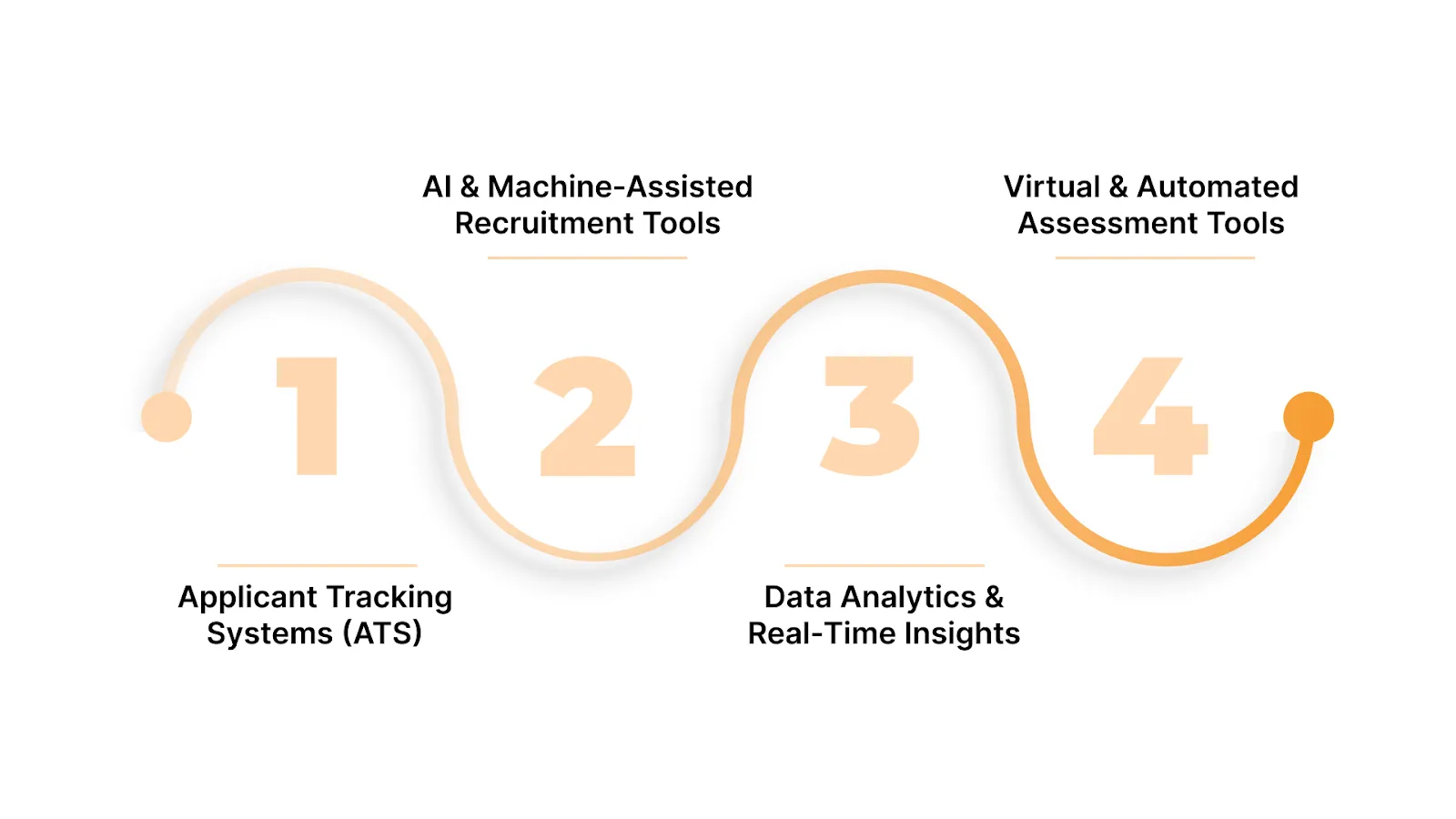
Technology is now central to handling volume and data complexity in modern recruitment. Applicant tracking systems, automation, and analytics help filter large candidate pools, standardise evaluations, and maintain compliance.
These tools also provide real-time visibility into hiring metrics, enabling faster decisions without sacrificing quality.
1. Applicant Tracking Systems (ATS)
Usage of ATS among large employers is nearly universal; for example, 97.8 % of Fortune 500 companies use an ATS to centralise hiring operations.
Benefits include:
- Centralised candidate records
- Workflow automation
- Reporting dashboards
2. AI and Machine‑Assisted Recruitment Tools
AI now powers significant aspects of screening and sourcing. Organisations using AI recruitment tools report improved efficiency in match quality and reduced manual workload.
Emerging ATS trends include predictive analytics, mobile‑first interfaces, and enhanced engagement features, which further accelerate hiring.
3. Data Analytics and Real‑Time Insights
Analytics tools can surface bottlenecks, track source effectiveness, and align workflows with performance targets. This moves recruitment from intuition to evidence‑backed decisions.
4. Virtual and Automated Assessment Tools
As candidate volumes rise, virtual assessments and automated interview scheduling cut down administrative effort, allowing recruiters to focus on high‑value activities.
Struggling to Find the Right Talent for Large-Scale Hiring? Partner with V3 Staffing for expert recruitment solutions that align with your business objectives. Get in touch today and discover how we can support your growth.
How to Use External Partners for Scalable Recruitment
External expertise, whether staffing partners, Recruitment Process Outsourcing (RPO) firms, or specialised agencies, can expand capacity and bring domain insights that internal teams might lack.
Advantages include:
- Access to broader candidate networks and niche talent pools.
- Flexible scaling of screening and assessment workloads.
- Faster pipeline build‑up based on partner experience in similar campaigns.
- Risk mitigation through vetted expertise and structured frameworks.
Also Read: Setting Up a Global Capability Center in India
What Metrics and KPIs Should You Use to Measure Recruitment Success?
Measuring outcomes ensures recruitment efforts deliver tangible business value. In high-volume and seasonal hiring, the right metrics help identify bottlenecks, control costs, and maintain hiring quality at scale.
Here are metrics that matter in 2026:
Using these data points regularly, weekly, or even daily during peak campaigns, enables rapid adjustments and continuous improvement.
Strengthening Employer Brand to Support Large‑Scale Recruitment
In mass hiring campaigns, your company’s reputation as an employer becomes a pivotal factor in both attracting more candidates and improving the quality of applications.
Strong employer branding directly influences candidate perceptions of your organisation and can reduce recruitment burdens by lowering time‑to‑hire and cost‑per‑hire.
Why employer branding matters in mass hiring
- Reduces turnover and hiring costs. Organisations with strong employer brands can see up to a 28% reduction in turnover and a 50% decrease in cost-per-hire compared with peers that lack employer-brand clarity.
- Improves candidate engagement. Candidates today research employers across multiple channels, including social media, reviews, and company content, before applying. A recognisable brand increases the likelihood that top talent explores and applies for your roles.
- Enhances conversion at every stage of the recruitment funnel by building familiarity and trust, especially in competitive markets such as the USA and the UAE.
Key elements of employer branding for large‑scale hiring
- Employee value proposition (EVP) that clearly states what sets your opportunities apart from competitors.
- Talent community engagement through newsletters, events, and social content to build interest before roles open.
- Metrics to track brand impact, including candidate net promoter score (NPS), brand search volume, and review sentiment across job platforms.
Employer branding metrics that matter
Also Read: How to Measure Success in Permanent and Contract Staffing
Integrating Diversity, Equity, and Inclusion (DEI) in Mass Recruitment
Large‑scale recruitment presents a strategic opportunity to advance diversity, equity, and inclusion objectives. Intentional DEI practices not only broaden your talent pool but also support long‑term retention and workforce performance.
Steps to embed DEI in your recruitment framework
- Set measurable diversity goals for representation across functions and levels.
- Eliminate bias in job descriptions and screening tools by reviewing language and criteria to avoid excluding diverse candidates.
- Use structured, competency‑based assessments that focus on objective evidence of skills rather than subjective impressions.
- Train recruiters and hiring managers to recognise and mitigate unconscious bias in candidate evaluation.
- Track representation metrics through your ATS to monitor progress and adjust sourcing as needed.
Benefits of DEI in large‑scale recruitment
- More diverse teams can enhance innovation and problem‑solving due to varied perspectives.
- A commitment to equity and inclusion strengthens an employer's reputation across multiple markets, such as the USA and the UAE, where candidates are attuned to workplace fairness and diversity practices.

Why V3 Staffing Is Your Strategic Partner for Large‑Scale Recruitment
When scaling recruitment efforts for mass hiring, companies need more than just a recruitment agency. They also need a trusted partner who understands the nuances of their business, culture, and operational demands.
V3 Staffing is a leader in providing tailored recruitment and workforce solutions across a range of industries, including IT, BFSI, engineering, automotive, and shared services.
With a strong focus on the Indian market, V3 Staffing has developed the expertise, frameworks, and strategies needed to help companies efficiently meet their recruitment goals at scale.
Here’s how our services can support your recruitment goals:

1. Permanent Hiring
We connect businesses with top-tier talent for long-term positions, ensuring a strong fit for both technical skills and company culture. Our permanent hiring solutions reduce turnover and build teams that contribute to long-term growth.
2. IT Staffing
V3 Staffing specialises in sourcing highly skilled IT professionals, from software developers to cybersecurity experts, for your technical projects. Our agile recruitment approach ensures that your IT teams are staffed quickly with the right talent to meet project deadlines.
3. Contractual Staffing
We provide flexible staffing solutions for short-term needs, seasonal demands, or specific projects, ensuring you can scale your workforce efficiently. Our candidates integrate seamlessly into your teams, maintaining productivity while meeting temporary requirements.
4. RPO (Recruitment Process Outsourcing)
V3 Staffing’s RPO solutions handle the full recruitment process, from sourcing to onboarding, allowing you to focus on your core business. We manage recruitment at scale, ensuring consistency and efficiency across all hiring stages.
5. Executive Search
We identify and recruit senior leadership talent who align with your organisation’s strategic objectives and values. Our executive search service ensures your leadership team drives business success and growth by bringing the right expertise at the highest level.
With these tailored services, V3 Staffing is here to ensure your large-scale recruitment efforts are efficient, high-quality, and aligned with your business goals
Conclusion
Large‑scale recruitment demands clarity, structure, and speed. Organisations that prepare comprehensive high‑volume hiring plans avoid common pitfalls such as poor candidate experience, inconsistent screening, and delayed timelines, all of which can derail hiring efforts and weaken productivity.
A well‑executed mass-recruitment approach includes defining clear requirements, aligning hiring with business needs, standardising evaluation, and maintaining active communication with candidates throughout the process.
Effective strategies also balance automation with human judgment to handle high applicant volumes while still assessing fit and capability thoughtfully.
Thinking about scaling your recruitment with strategic support? Reach out to V3 Staffing to explore how our tailored workforce solutions can help you achieve your large‑scale hiring goals.