
.svg)
.svg)
Leadership hiring doesn’t usually break all at once. It shows up in small ways first, roles staying open longer than expected, interview loops going in circles, and strong candidates not quite fitting what the business needs.
For Talent Acquisition Heads and GCC leaders, this is when hiring starts losing direction. Research shows that replacing a senior employee can cost up to 200% of their annual salary, which makes delays and misjudgments at this level hard to absorb.
Leadership hiring means recruiting senior professionals such as directors, vice presidents, business heads, and CXOs for roles that influence strategy, team direction, and business outcomes. Unlike regular recruitment, leadership hiring focuses on judgement, ownership, and long-term fit, not just role-based skills.
This article breaks down how leadership hiring works in practice and how enterprise teams can handle it with more control when progress slows down.
Key Takeaways
- Leadership hiring focuses on appointing directors, vice presidents, and CXOs who directly influence execution, team direction, and long-term business performance.
- The leadership hiring model differs from traditional recruitment through targeted search, deeper evaluation, and access to passive senior talent.
- Leadership hiring becomes critical when roles impact scale, transformation, or require specialised expertise not easily found through standard hiring channels.
- A structured leadership hiring process depends on a clear role mandate, market mapping, discreet outreach, and context-based assessment.
- Effective leadership hiring decisions reduce risk by evaluating how candidates perform in real operating environments, not just their past roles or company backgrounds.
What Is Leadership Hiring?
Leadership hiring is the strategic recruitment of senior professionals, such as directors, VPs, and CXOs, who shape business strategy, culture, and long-term performance. Unlike routine recruitment, it focuses on leaders with the experience, judgement, and alignment needed to drive transformation, execution, and sustained organisational growth.
Who Is Hired Through Leadership Hiring?
Leadership hiring typically includes roles where individuals are responsible for owning outcomes, managing teams, and driving business direction across functions or regions.
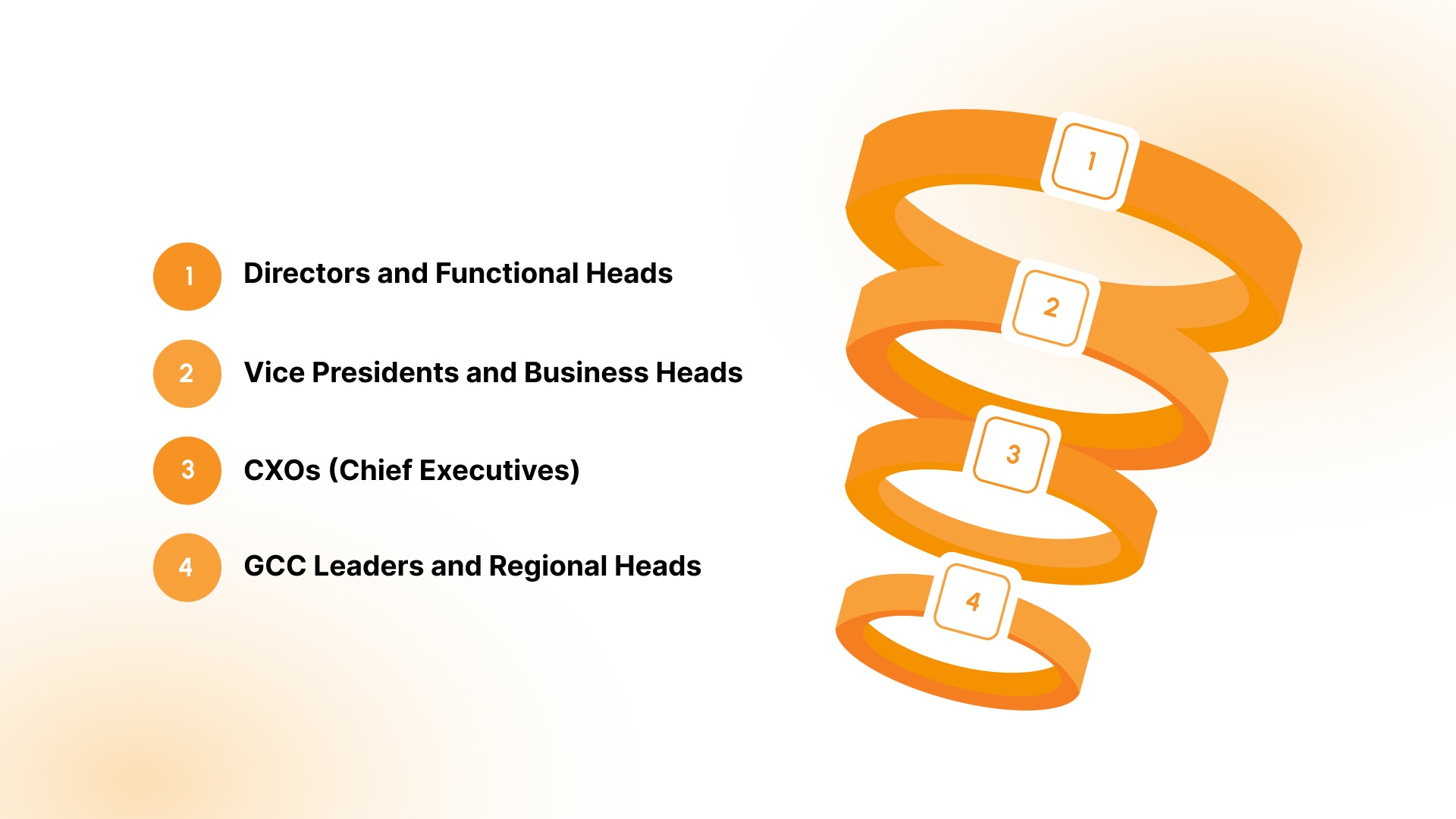
- Directors and Functional Heads: Leaders responsible for managing specific business units such as engineering, product, finance, or operations.
- Vice Presidents and Business Heads: Senior leaders overseeing multiple teams or functions, often accountable for revenue, delivery, or growth targets.
- CXOs (Chief Executives): Top-level leaders such as the CEO, CFO, CTO, or CHRO who define strategy and guide organisation-wide decisions.
- GCC Leaders and Regional Heads: Leaders managing Global Capability Centres or geographic operations, aligning local execution with global expectations.
This level of hiring focuses on roles where leadership decisions directly influence business outcomes, not just day-to-day execution.
Leadership Hiring vs Executive Search vs Traditional Recruitment
Leadership hiring is used for senior roles that shape function-level strategy and execution. Executive search is a confidential, research-led approach for C-suite and board mandates. Traditional recruitment is built for faster closure of operational and mid-level roles through open-market hiring channels.
Quick comparison across role level, search style, and business use case.
Choose the model based on role impact, confidentiality needs, and how much leadership judgement the business needs to assess before making the hire.
If you are evaluating which model fits your mandate better, it is worth breaking down Leadership Hiring vs Executive Hiring: Key Differences Explained
The Leadership Hiring Process Step by Step in 2026
Leadership hiring works best as a structured search, not a fast replacement exercise. For enterprise and Global Capability Centre, or GCC, roles, the process should define business outcomes, map the right talent market, assess leadership fit in context, validate past impact, and support joining stability.
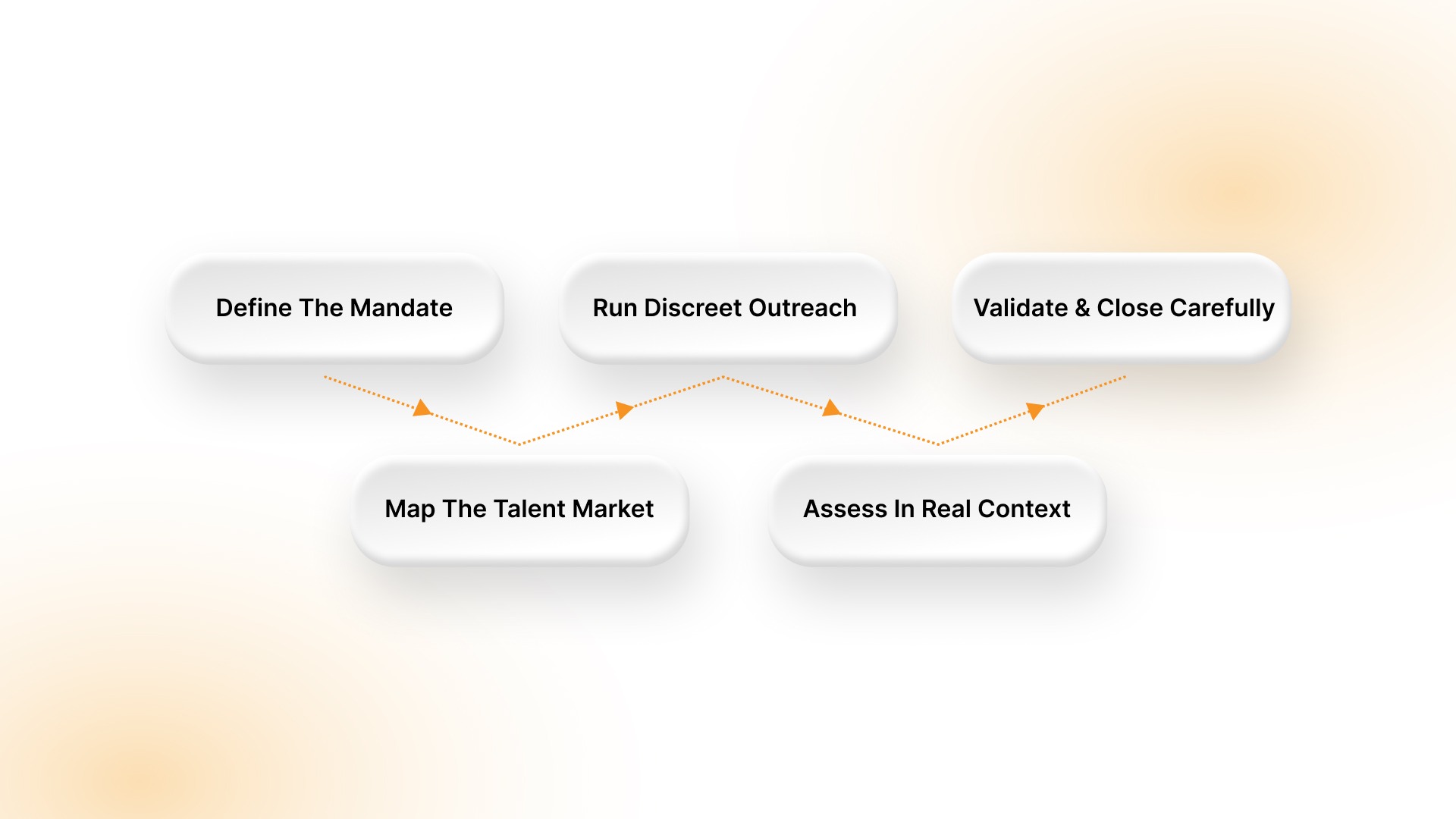
Each stage is designed to reduce hiring risk before a senior appointment is made.
1. Define The Mandate
Set first-year outcomes, reporting lines, team scope, and business priorities before the search begins, so the role is built around what the leader must deliver.
2. Map The Talent Market
Identify target companies, comparable leadership pools, compensation ranges, and location feasibility to avoid running a search on assumptions.
3. Run Discreet Outreach
Approach passive candidates confidentially with a clear business case, so the conversation starts with role relevance, not generic employer branding.
4. Assess In Real Context
Test judgement, team-building, stakeholder handling, and operating fit through structured interviews tied to real business situations the leader will face.
5. Validate And Close Carefully
Check references thoroughly, align expectations on mandate and success measures, and support offer closure and onboarding to reduce drop-off risk.
A strong leadership hiring process creates clarity before selection, not after. That is what helps enterprise and GCC teams hire leaders who can deliver with less risk.
What to Assess Beyond Experience in Leadership Hiring
In leadership hiring, experience shows where a candidate has worked, not how they will lead in your business. Enterprise and GCC teams should assess how the person thinks, handles change, uses data, fits the operating style, and influences stakeholders across functions, regions, and leadership layers.
The strongest assessments look at how a leader will perform once the title, brand, and resume polish are stripped away.
- Digital Judgement: Check whether the leader has used data and technology to change decisions, improve execution, or guide teams through artificial intelligence adoption.
- Culture Fit: Test whether their leadership style suits your pace, governance model, decision-making norms, and internal expectations.
- Builder Mindset: Assess whether they have built teams, systems, or functions, not just managed mature setups.
- Change Handling: Look at how they responded when plans failed, priorities shifted, or pressure rose.
- Stakeholder Influence: Evaluate how they align global leaders, local teams, and cross-functional peers without creating friction.
Strong leadership assessment predicts fit in your environment, not just success in someone else’s. That is what helps enterprise teams hire with more confidence.
Real-Life Examples of Leadership Hiring
Leadership hiring shows up clearly when companies bring in senior leaders to handle scale, fix execution gaps, or lead a new business phase. These real-world examples highlight how organisations use leadership hiring to solve specific business challenges.
Common real-life leadership hiring scenarios:
- Microsoft Hiring Satya Nadella as CEO: Satya Nadella was appointed CEO of Microsoft in 2014 to shift the company toward cloud computing, leading to strong growth in Azure and enterprise services.
- Google Hiring Sundar Pichai as CEO: Sundar Pichai became CEO of Google in 2015 to streamline product strategy and scale global operations across platforms like Android and Chrome.
- Tata Sons Appoints Natarajan Chandrasekaran as Chairman: Natarajan Chandrasekaran was brought in to lead Tata Sons through restructuring and improve governance after a leadership transition.
- Infosys Hiring Salil Parekh as CEO: Salil Parekh was hired by Infosys to stabilise operations and rebuild client confidence following a period of leadership uncertainty.
- Uber Hiring Dara Khosrowshahi as CEO: Dara Khosrowshahi joined Uber to address governance issues, improve culture, and prepare the company for its public listing.
These examples show how leadership hiring is used to drive transformation, restore stability, and guide companies through critical growth or transition phases.

When Do Companies Need Leadership Hiring Support?
Companies need leadership hiring support when a senior role affects expansion, transformation, confidentiality, or investor outcomes, and internal hiring methods are too narrow for the mandate. It becomes necessary when the business needs proven leaders for scale, new market entry, GCC growth, or specialised roles such as Chief Digital Officer.
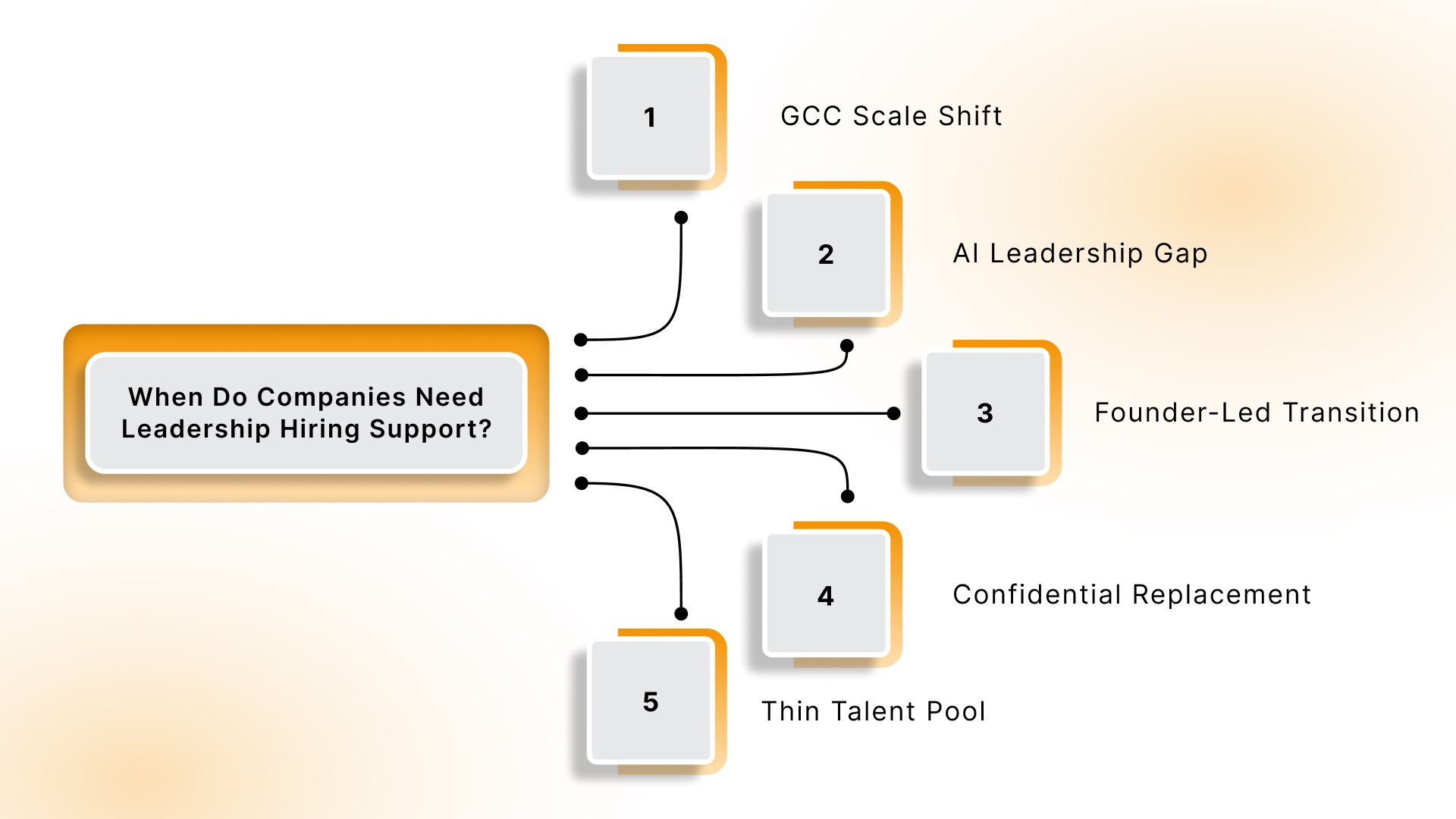
Typical triggers show when internal hiring stops being enough.
- GCC Scale Shift: When a Global Capability Centre moves from delivery support to product, engineering, or global function ownership.
- AI Leadership Gap: When artificial intelligence adoption needs a leader who has already run enterprise-wide change, not just technology implementation.
- Founder-Led Transition: When the business needs a functional head who can formalise teams, reporting lines, and decision ownership.
- Confidential Replacement: When replacing an incumbent without market noise, internal disruption, or early stakeholder speculation.
- Thin Talent Pool: When internal talent acquisition cannot reach niche senior candidates in cybersecurity, semiconductors, or data leadership.
V3 Staffing supports these mandates with structured leadership search, discreet outreach, and stronger market visibility, helping enterprises appoint senior leaders with less hiring risk.
If your team is weighing internal vs external hiring support, it helps to review the Benefits of Staffing: Process and Advantages in 2026
Common Leadership Hiring Mistakes That Delay or Derail the Search
Leadership hiring breaks down when expectations are unrealistic, evaluations lack structure, or decisions rely on signals that do not predict performance. These mistakes extend timelines, create stakeholder confusion, and increase the risk of costly mis-hires in enterprise and GCC environments where senior roles carry business-critical impact.
This table highlights where leadership hiring commonly goes wrong and what it leads to.
Avoiding these mistakes requires clarity, discipline, and structured evaluation. That is what keeps leadership hiring aligned with business outcomes rather than short-term closure pressure.
If these patterns are showing up in your hiring cycles, it helps to look deeper at Challenges in Leadership Hiring: Common Issues and Solutions

Why Leadership Hiring Matters for Enterprise and GCC Teams
Leadership hiring becomes critical when gaps in senior ownership start affecting execution, decision-making, and team alignment. It ensures the right leaders are in place to manage scale, handle change, and maintain clarity as business complexity increases. India’s 12.1% rise in C-suite hiring in 2025 reflects this growing need.
Key situations where leadership hiring directly impacts business outcomes:
- Preventing Execution Slowdown: Hiring early ensures decisions do not get delayed when teams expand, and ownership becomes unclear across functions.
- Restoring Clear Ownership: Strong leaders bring accountability across teams, reducing overlap and confusion in how priorities are set and executed.
- Protecting Critical Functions: Roles in finance, risk, or compliance require timely leadership to avoid operational gaps that can affect reporting, control, and external trust.
- Managing Organisational Change: During restructuring, expansion, or leadership exits, the right hire stabilises teams and maintains continuity in decision-making.
- Handling Growth Complexity: As businesses scale across teams, regions, or functions, leadership hiring ensures alignment between strategy and execution without overloading existing leaders.
Leadership hiring matters because business momentum usually slows through small gaps in ownership and delayed decisions. The right hire restores clarity before those gaps impact performance.
As GCC roles expand beyond delivery, understanding their impact on hiring becomes easier with GCC in HR: Transforming Talent Strategy for India's Enterprises
Leadership Hiring Challenges in India
Leadership hiring in India is constrained by a limited pool of ready senior leaders, longer decision cycles, and rising global demand for proven executives. Enterprise and Global Capability Centre, or GCC, teams face added pressure to find leaders who can handle scale, digital change, and global stakeholder expectations simultaneously.
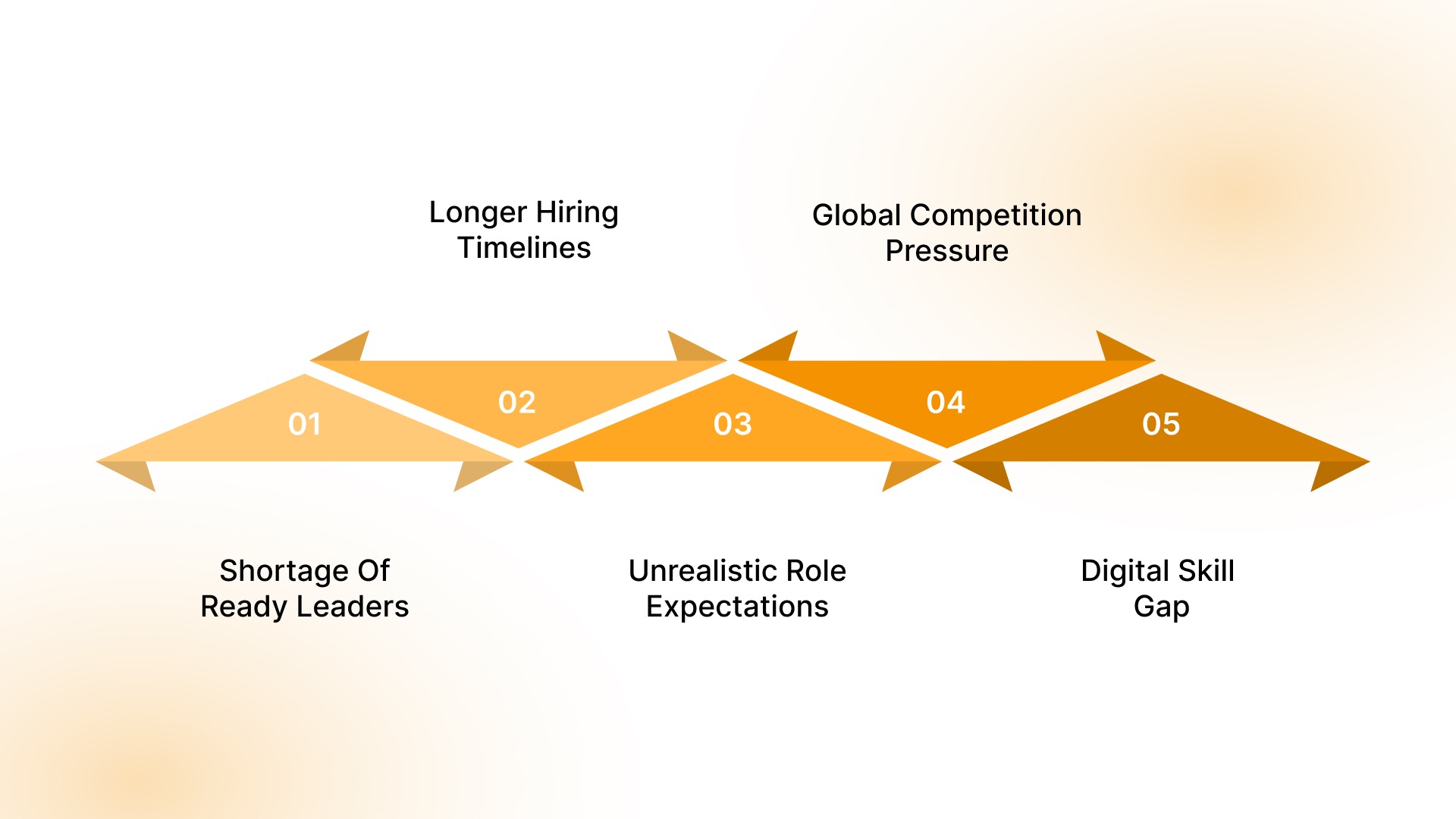
This pressure is increasing as leadership demand grows. Leadership roles in India’s GCC ecosystem have expanded from around 6,500 to over 30,000 in recent years, reflecting how quickly organisations are scaling senior teams to support global mandates.
1. Shortage Of Ready Leaders
Few candidates have end-to-end ownership experience, for example, leaders who have scaled teams, handled P&L (profit and loss), and managed global stakeholders together.
2. Longer Hiring Timelines
Senior roles often take over a few months due to multiple stakeholder approvals, slowing decision-making and increasing the risk of losing strong candidates mid-process.
3. Unrealistic Role Expectations
Mandates combine conflicting requirements, for example, deep AI expertise, global exposure, and founder-style agility in a single role.
4. Global Competition Pressure
Indian leaders are actively targeted by global firms, driving compensation expectations higher and reducing availability for domestic enterprise and GCC roles.
5. Digital Skill Gap
Many senior leaders lack hands-on exposure to AI, data, or automation, creating gaps when businesses need leaders who can drive technology-led change.
Leadership hiring in India requires sharper mandate definition, faster decisions, and stronger market access.
How to Choose the Right Leadership Hiring Partner
Choosing the right leadership hiring partner depends on their ability to understand your business mandate, access hard-to-reach senior talent, and run a structured search process. The right partner reduces hiring risk, improves candidate quality, and ensures alignment with business goals, not just role requirements.
Key factors that differentiate strong leadership hiring partners from transactional recruiters.
- Mandate Understanding: Partner defines first-year outcomes, not just job descriptions, ensuring candidates are evaluated on expected business impact.
- Market Access Depth: Ability to reach passive candidates, meaning leaders not actively applying but open to the right opportunity.
- Assessment Discipline: Uses structured evaluation methods to test decision-making, leadership style, and team-building capability in real scenarios.
- Stakeholder Handling: Manages alignment across hiring managers, HR, and leadership teams to prevent delays and conflicting decisions.
- Confidential Search Capability: Handles sensitive roles discreetly without exposing the mandate internally or externally.
A strong leadership hiring partner acts as an extension of your team, helping you hire leaders who can deliver results, not just fill senior positions.
How V3 Staffing Supports Leadership Hiring
V3 Staffing supports leadership hiring through structured search methods, market intelligence, and access to senior talent across industries. With 16+ years of experience and operations across India, the United States, and the UAE, the focus is on aligning leadership hires to clear business outcomes and reducing uncertainty in senior hiring decisions.
Core services that support leadership hiring outcomes across enterprise and GCC environments.
- Leadership Hiring: CXO, vice president, and senior roles filled through confidential, research-led search, supported by a track record of 10,000+ specialists hired across client mandates.
- RPO Support: Recruitment Process Outsourcing integrates into internal Talent Acquisition teams, helping manage multi-role hiring demand and maintain consistent delivery across leadership mandates.
- Permanent Hiring: Role and culture-aligned hiring designed for long-term ownership, backed by domain-specialised recruiters across industries such as technology, BFSI, and engineering.
- Global Hiring: Cross-border leadership hiring across India, the United States, and the UAE, supported by local market knowledge and access to international talent pools.
- EOR Services: Employer of Record enables compliant hiring without setting up a local entity, helping enterprises expand faster into new markets.
V3 Staffing works as a hiring partner, not a vendor, helping enterprises secure leadership talent with better alignment, faster decisions, and stronger long-term outcomes.
Final Thoughts!
Leadership hiring is where internal hiring models often start to strain, not due to lack of effort, but because senior roles require clearer mandates, stronger judgement, and access to less visible talent. For enterprise and GCC teams, the shift is from reactive hiring to more deliberate, outcome-linked selection.
V3 Staffing supports this by bringing structure to leadership decisions, from defining role expectations to managing stakeholder alignment and accessing relevant talent pools.
Explore how your team can approach leadership hiring with more clarity and control by speaking with V3 Staffing’s hiring specialists. Get in touch with us!