

.svg)
.svg)
Hiring remote workers in India in 2026 is becoming a smart choice for companies that want flexible and cost-effective teams. Remote work is no longer a short-term fix. Many businesses now use it as a long-term way to find skilled talent. In fact, 60 to 90 million people in India are expected to work remotely, showing how fast this trend is growing.
The focus has also changed. Companies are no longer just outsourcing work. They are building strong remote teams, managing work across time zones, and improving communication and data security. Remote hiring is now a key part of business planning.
In 2026, companies are paying closer attention to improving hiring processes, enhancing screening, and maintaining the engagement of remote employees.
This blog covers the main trends, what has changed in recent years, and why it matters for your hiring strategy today.
Key Takeaways
- Remote Hiring Is Now a Core Strategy: Hiring remote workers in India is no longer just about saving costs. It is now a key part of how companies build flexible and scalable teams.
- Structured Processes Matter More Than Ever: Successful remote teams depend on clear hiring steps, strong communication, and defined performance tracking systems.
- Access to a Large Skilled Talent Pool: India offers a wide range of skilled professionals, especially in tech roles, making it easier to hire for both general and specialised positions.
- Flexible Hiring Models Support Growth: Using a mix of permanent, contract, and IT staffing helps you manage both long-term roles and short-term project needs efficiently.
- Right Hiring Partner Simplifies Scale: Working with partners like V3 Staffing helps you handle compliance, speed up hiring, and manage remote teams smoothly across regions.
What Is Remote Hiring?
Hiring remote workers means building a distributed workforce where employees operate from different locations while staying aligned with your organisation’s goals, processes, and delivery timelines. These professionals contribute across key functions such as engineering, product, data, customer support, and operations without being tied to a physical office.
However, this model is not just about flexibility in location. To make it work effectively, companies need a structured approach to sourcing, evaluation, onboarding, compliance, and performance management. Clear workflows, defined communication systems, and strong accountability frameworks ensure that teams remain productive and aligned.
As a result, remote hiring is widely adopted by mid to large enterprises, GCCs, and product organisations that want to scale efficiently while accessing high-quality talent across regions.
For example, a global SaaS company may build a remote team of developers, DevOps engineers, and support specialists to accelerate product releases. With the right structure in place, teams continue to deliver consistently, even when working from different locations.
Also Read: GCC Consultancy That Helps You Build Right and Scale Fast
Why Hiring Remote Workers Matters in 2026?
In 2026, businesses are under pressure to scale faster, control costs, and access specialised skills without delays. Hiring remote workers in India has become a strategic solution to meet these demands while maintaining operational efficiency.
India offers one of the largest pools of skilled professionals across technology and business functions, making it a preferred choice for building remote teams. However, the real value comes from how effectively companies structure and manage this workforce.
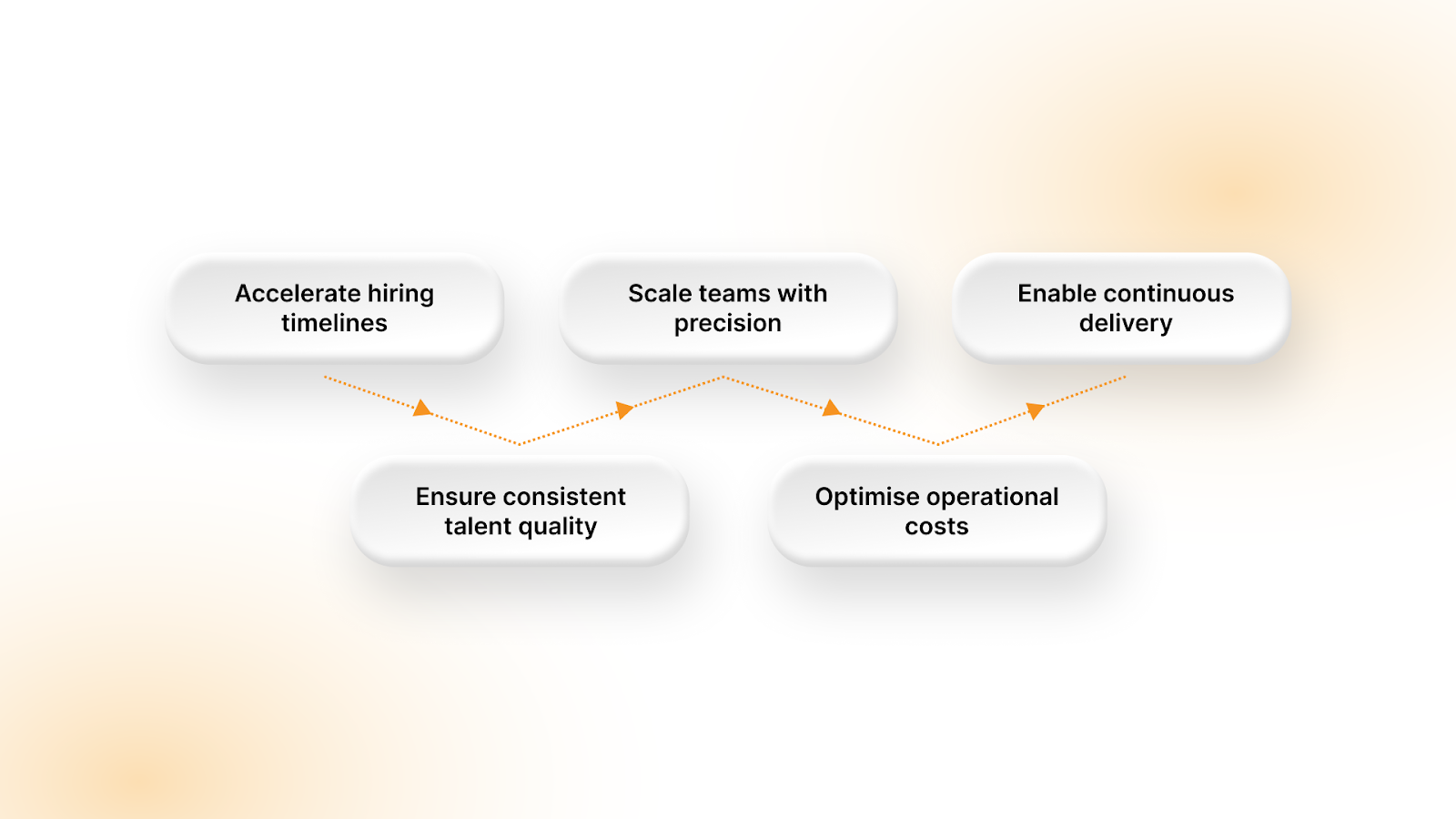
By adopting a well-planned remote hiring approach, organisations can:
- Accelerate hiring timelines: Access talent across multiple cities and reduce dependency on a single location, helping fill critical roles faster.
- Ensure consistent talent quality: Standardised screening, technical assessments, and structured interviews help maintain uniform hiring standards across all roles.
- Scale teams with precision: Expand or reduce team size based on project demands, product cycles, or business growth without disrupting operations.
- Optimise operational costs: Lower infrastructure and overhead expenses while continuing to hire skilled professionals who deliver strong results.
- Enable continuous delivery: Distributed teams working across time zones support faster turnaround, better customer response, and uninterrupted workflows.
Because of these insights, remote hiring is now a key approach in industries such as IT, SaaS, fintech, e-commerce, and shared services, where speed, flexibility, and access to skilled talent directly impact business performance.
Ultimately, when supported by the right processes and structure, remote hiring helps organisations build teams that are not only efficient but also ready to scale with long-term business goals.
In-Demand Remote Tech Jobs for 2026: Hiring Models to Build Strong Teams
As demand for remote tech jobs in India continues to grow in 2026, companies are adopting structured hiring models to build reliable and skilled teams.
India is projected to have over 57.5 million developers by 2030, making it one of the largest tech talent hubs globally. This scale gives organisations a strong advantage when building remote teams across multiple domains.
Below are the most effective ways organisations are hiring remote tech talent in India:
1. Permanent Recruitment for Remote Tech Roles
Permanent remote hiring focuses on building stable, long-term teams that contribute directly to business growth. These professionals work as an extended part of your organisation and take ownership of key functions such as product development, engineering, and operations.
This model works best when consistency, domain knowledge, and long-term contribution are important. Over time, these employees become deeply aligned with company goals, processes, and team culture.
Benefits:
- Strong alignment with long-term business goals
- Better team integration and collaboration
- Consistent performance and ownership of work
- Access to specialised skills with long-term value
Ideal for: Core roles across software development, product management, data engineering, finance, and operations where continuity and accountability are critical.
2. Temporary and Contract Staffing for Flexible Tech Needs
Contract staffing allows companies to bring in skilled professionals for specific projects or short-term requirements. This model is widely used when there is a need to scale quickly without adding long-term headcount.
It provides flexibility to manage changing workloads, especially during product launches, system upgrades, or high-demand phases. Teams can expand or reduce based on project timelines without affecting overall structure.
Benefits:
- Faster hiring and onboarding for urgent roles
- Lower fixed employment costs
- Flexibility to scale teams based on project needs
- Reduced long-term commitment risks
Ideal for: Short-term projects, product releases, cloud migrations, testing cycles, and temporary workload spikes.
3. IT Staffing for Specialised Remote Tech Roles
IT staffing focuses on hiring highly skilled professionals for specific technical roles. As technology demands become more advanced in 2026, companies require niche expertise in areas such as cloud computing, AI/ML, cybersecurity, and data engineering.
This model helps organisations access a wider talent pool and quickly fill critical skill gaps without long hiring cycles. It also supports global operations by enabling teams to work across time zones.
Benefits:
- Access to specialised and hard-to-find tech talent
- Faster hiring for niche and high-demand roles
- Strong support for global and distributed teams
- Improved delivery speed for technical projects
Ideal for: Engineering roles, product development, data science, cloud infrastructure, AI/ML initiatives, and cybersecurity functions.
Choosing the right hiring model plays a key role in building efficient remote tech teams in India. With a balanced approach, organisations can scale faster, manage costs effectively, and maintain high-quality delivery across projects.
Want to grow your remote team in India quickly and easily? V3 Staffing helps you hire the right people fast, with clear steps, skill-based screening, and smooth management across India, the USA, and the UAE.
With 16+ years of experience, 10,000+ hires, and 300+ clients served, why wait when you can hire smarter with V3?
Also Read: How India's AI Workforce is Shaping the Future of Jobs in 2026
Key Benefits of Hiring Remote Workers for Business Growth
Hiring remote workers is no longer limited to flexibility alone. It now supports faster team building, better cost control, and access to skilled talent without location constraints.
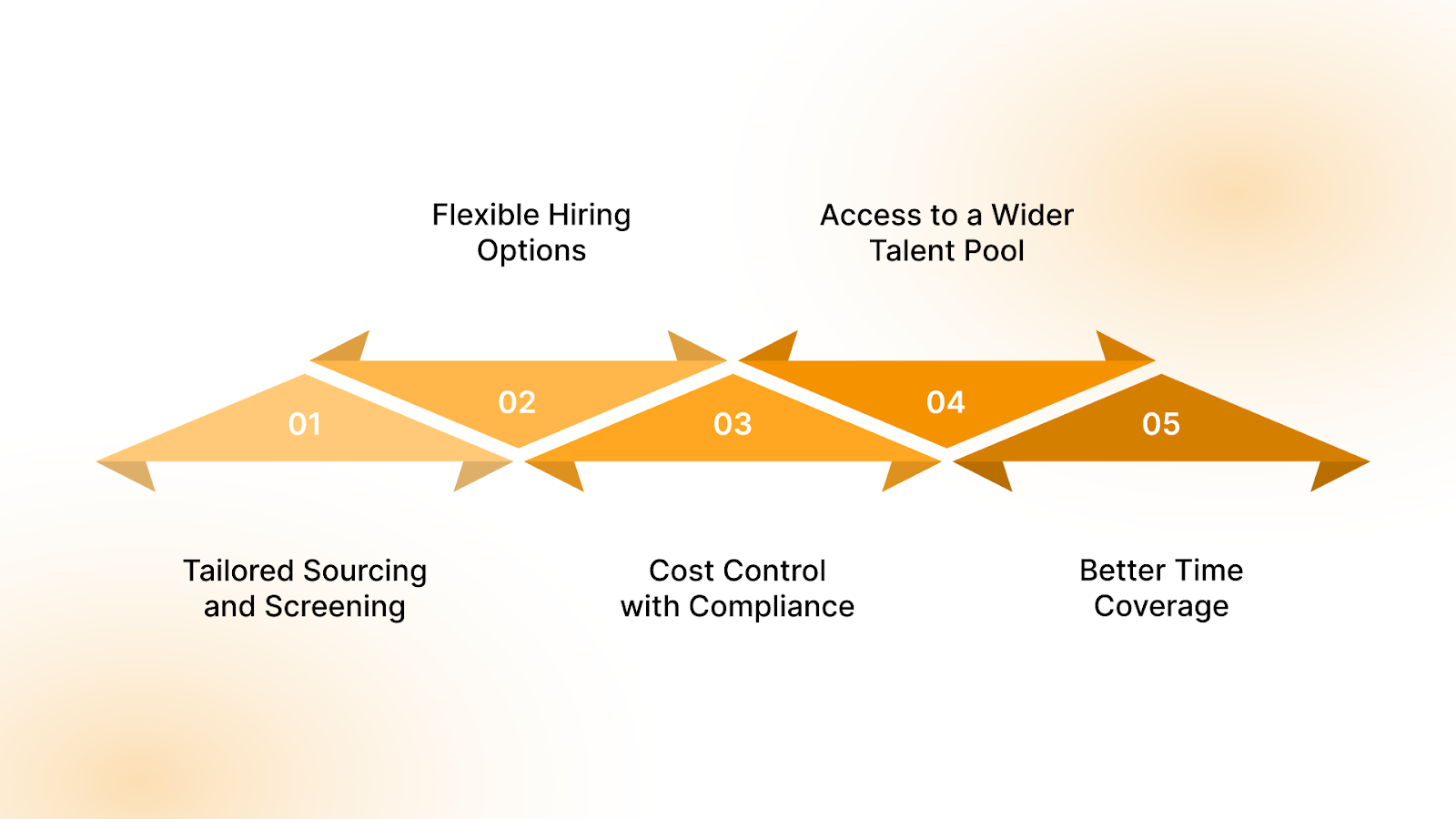
When planned properly, this approach helps you meet both immediate hiring needs and long-term business goals. Here are the key benefits that make it effective:
1. Tailored Sourcing and Screening
Hiring becomes more precise when candidates are selected based on clearly defined role requirements. Each profile is sourced and screened with a focus on skills, experience, and role fit. This improves hiring quality from the start and reduces the chances of mismatched hires.
2. Flexible Hiring Options
Different hiring models allow you to adapt based on your business needs. Full-time roles support long-term stability, while contract professionals help manage short-term projects or sudden workload increases. This flexibility makes it easier to scale teams without delays.
3. Cost Control with Compliance
Lower operational costs are a key advantage, especially when there is no need for physical office space or infrastructure. At the same time, proper handling of payroll, taxes, and labour laws ensures that hiring remains compliant and free from legal risks.
4. Access to a Wider Talent Pool
Talent is no longer limited to a single location. You can reach skilled professionals across multiple cities and regions, making it easier to find the right fit for specialised roles.
5. Better Time Coverage
Teams working across different time zones help extend working hours. This improves turnaround time, supports global clients more efficiently, and keeps projects moving without unnecessary delays.
With the right structure in place, hiring remote workers helps build teams that are flexible, efficient, and aligned with business needs, giving organisations a clear advantage in scaling operations.

How to Choose the Right Remote Hiring Approach?
Selecting the right way to hire remote workers plays a key role in how efficiently your team performs and scales. A well-planned approach helps reduce hiring delays, avoid compliance risks, and ensure you bring in the right talent for your needs.
To make the right decision, focus on a few key factors that directly impact hiring success:
1. Define Your Hiring Requirement Clearly
Start by identifying whether the role is long-term, short-term, or highly specialised. Full-time hiring works well for core roles that require stability and long-term contribution.
Contract staffing is more suitable for project-based needs or when you need to scale quickly without long commitments. Clear role definition ensures you choose the right hiring model from the beginning.
2. Align Hiring with Business Priorities
Your hiring approach should reflect what matters most to your business—speed, quality, or cost control.
For example, if quick scaling is the priority, contract or RPO models can help. If consistency and long-term performance matter more, permanent hiring becomes the better option. Setting clear expectations and timelines improves hiring outcomes and reduces delays.
3. Use Expert Support to Simplify Hiring
Managing remote hiring in India involves compliance, payroll, and local regulations. Working with experienced staffing partners or using an Employer of Record (EOR) helps you handle these areas smoothly.
This allows you to focus on team performance while ensuring all legal and operational requirements are covered.
Also Read: How to Approach Leadership Hiring for Organisational Success
5 Proven Best practises for Managing High-Performing Remote Teams
Sustaining a high-performing remote workforce requires more than basic coordination. Industry leaders focus on structured communication, secure systems, and clear accountability frameworks to ensure consistent delivery across distributed teams.
To achieve this, organisations need to build strong operational foundations that support both productivity and employee experience.
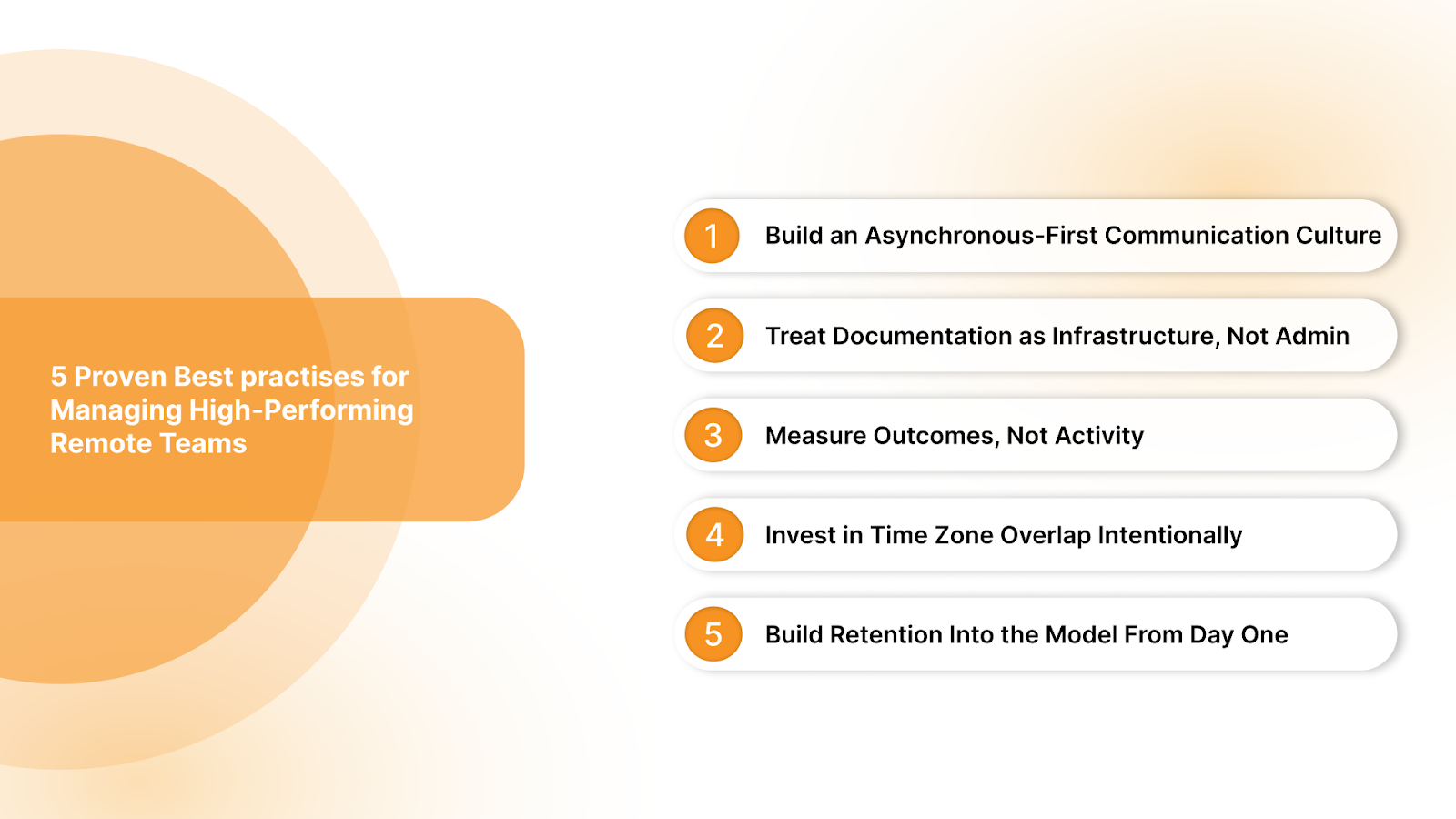
1. Build an Asynchronous-First Communication Culture
One of the most common mistakes companies make when managing remote teams in India is over-relying on live meetings to stay aligned. When your team spans multiple time zones, synchronous communication creates dependency on specific overlapping hours, which creates bottlenecks.
High-performing teams in 2026 default to async-first communication. This means:
- Documenting decisions in shared threads rather than resolving them only on calls
- Using Loom or similar tools for recorded walkthroughs instead of live explanations for every update
- Defining which channel handles what: Slack for quick queries, Notion or Confluence for knowledge, Jira or Asana for task tracking
- Setting clear response time expectations per channel (e.g., Slack responses within 4 hours, email within 24 hours)
The benefit is significant. Teams that operate async-first are not waiting for individuals to be online. Work moves forward continuously, and your India-based team is not stuck in a pattern of late-night calls to match a Western schedule.
2. Treat Documentation as Infrastructure, Not Admin
Remote teams that perform consistently share one trait: their knowledge lives in systems that anyone can access at any time.
This matters especially in India-based remote teams, where high attrition rates in tech roles are a real operational risk. When a senior developer leaves and their knowledge is undocumented, onboarding their replacement takes weeks instead of days.
Invest in building:
- An internal engineering or operations wiki covering processes, tools, and decisions
- Architecture decision records (ADRs) for technical teams, so future hires understand why decisions were made, not just what was decided
- Onboarding documents specific to each role, not just a general company overview
- A log of recurring issues and their resolutions, so teams do not solve the same problem twice
One practical benchmark: if a new hire cannot become independently functional within two weeks using your documentation alone, the documentation is insufficient.
3. Measure Outcomes, Not Activity
Tracking hours or using activity monitoring software is one of the fastest ways to lose top remote talent. Skilled professionals in India's tech sector have no shortage of options, and surveillance-based management signals distrust.
What actually works is outcome-based performance management:
- Define clear deliverables and deadlines at the sprint or monthly level
- Set measurable KPIs tied to business impact, not hours logged
- Use tools like Linear, Jira, or GitHub for transparent progress tracking without micromanagement
- Conduct regular performance conversations that focus on output quality, blockers, and growth, not attendance records
When people understand what success looks like and are trusted to get there, engagement and accountability both improve. This is also far more defensible legally and operationally when managing contract staff across India's varied labour law landscape.
4. Invest in Time Zone Overlap Intentionally
India's IST time zone offers a genuine advantage for global companies: meaningful overlap with both European and US working hours is achievable when structured correctly. But this advantage disappears if it is not planned.
A US East Coast team and an India-based team share roughly 4 hours of natural overlap (around 12 PM to 4 PM EST). To make the most of this:
- Schedule daily stand-ups and critical reviews within the overlap window only
- Use handoff documents at the end of each team's working day so the other team can pick up without delays
- Avoid scheduling ad-hoc calls outside overlap hours unless urgent; this is a common cause of burnout on India-side teams
- For European companies, the overlap with IST is even more generous and should be used for real-time collaboration, with the remaining hours dedicated to independent work
Companies that structure this deliberately often find they can run near-continuous delivery cycles without anyone working unsocial hours.
5. Build Retention Into the Model From Day One
Remote hiring in India is not difficult. Keeping strong talent is where most companies struggle. India's tech sector remains competitive, and remote professionals have access to global opportunities from their desktops.
Retention in a remote setup requires a proactive strategy:
- Career growth visibility: Remote employees who cannot see a clear progression path leave. Define what the next role looks like and what it takes to get there, in writing.
- Recognition systems: Acknowledge strong work publicly in team channels. In a remote environment, contributions can be invisible. Making them visible matters.
- Learning budgets: Even a modest annual budget for courses, certifications, or conferences signals investment in the person. It also directly improves the team's capability.
- Manager quality: The biggest driver of attrition in remote teams is not pay; it is poor management. Train your managers on remote-specific skills, including async communication, outcome-setting, and building trust without proximity.
- Regular pulse checks: Short, anonymous surveys (monthly or quarterly) give you early signals on disengagement before it becomes resignation. Act on the findings visibly.
By focusing on communication, security, and performance, organisations can maintain productivity while effectively scaling remote teams.

How V3 Staffing Helps You Hire Remote Workers in India?
Hiring remote workers in India is not just about finding people. You need a clear hiring process, proper compliance, and a way to manage teams smoothly from different locations.
As companies build remote teams across tech roles such as engineering, data, cloud, and AI, the focus is on hiring faster, staying compliant, and ensuring consistent output.
V3 Staffing helps companies hire remote workers across India, the USA, and the UAE through simple, structured hiring solutions.
With 16+ years of experience, 10,000+ hires, and 300+ clients, V3 works as a reliable hiring partner for companies building remote teams.
Here’s how V3 Staffing supports remote hiring in India:
- Permanent Recruitment: V3 Staffing helps you hire full-time remote employees for mid to senior roles. They use structured screening and skill-based evaluation to make sure you hire the right people who can work well in remote setups.
- Temporary & Contract Staffing: If you need people for short-term projects or urgent work, V3 provides contract staffing. You can quickly hire professionals without long-term commitment, while staying fully compliant.
- IT Staffing: V3 Staffing helps you hire skilled IT professionals like developers, cloud engineers, data scientists, and QA testers. You get access to a strong talent pool and faster hiring for tech roles.
- Recruitment Process Outsourcing (RPO): V3 can manage your entire hiring process with dedicated recruiters. This helps you hire faster, manage multiple roles easily, and keep the process organised.
- Executive Search: For senior roles such as CTOs, VPs, and Directors, V3 provides focused hiring support. They handle sourcing, evaluation, and selection for leadership positions.
- Employer of Record (EOR) Services: V3 helps you hire remote employees in India without setting up a company here. They take care of payroll, taxes, compliance, and contracts, so you can focus on work.
- Global Hiring: V3 supports hiring across India, the USA, and the UAE. They help you build remote teams across different regions with the same hiring standards.
With the right hiring partner, building remote teams in India becomes easier and more reliable. V3 Staffing helps you hire, manage, and grow your remote workforce without complications.
Conclusion
The remote hiring ecosystem in 2026 reflects a clear shift in how companies build and manage global teams. Hiring remote workers in India is no longer driven only by cost efficiency. It now depends on structured hiring models, strong compliance processes, and long-term workforce planning. As organisations scale distributed teams across India and other global markets, hiring strategy plays a critical role in ensuring consistency, productivity, and business continuity. This is where the right recruitment partner creates a measurable impact.
With expertise in permanent hiring, Employer of Record (EOR), contract staffing, executive search, and RPO, V3 Staffing enables companies to build and manage remote teams in India with reliability and scale. Contact us today to get started.