
.svg)
.svg)
Hiring large numbers of employees at once is becoming a go-to strategy for companies looking to grow quickly without compromising quality. In 2026, bulk hiring trends are shaping how businesses in IT, BFSI, engineering, and shared services scale teams to meet project deadlines and keep operations running smoothly.
Around 59% of mid to large organisations plan to increase high-volume hiring this year, showing just how important it is to bring in the right talent at the right time. By onboarding multiple skilled professionals together, companies can reduce delays, manage costs more effectively, and ensure teams are ready to handle critical projects.
This article explores why businesses are choosing large-scale recruitment, the advantages it brings, the common challenges, and practical ways to manage high-volume hiring efficiently.
Key Takeaways
- Bulk hiring accelerates team growth across technical, product, AI/ML, cloud, and cybersecurity roles, keeping projects on track.
- Structured processes and technology ensure quality: Standardised assessments, AI-driven screening, and analytics dashboards maintain consistent hires.
- Different hiring models suit different needs: Permanent, contract, RPO, and EOR approaches support scaling efficiently while ensuring compliance.
- Global coordination is critical: Centralised scheduling, virtual assessments, and standardised onboarding maintain consistency across locations.
- Cost efficiency and retention improve: Hiring multiple employees simultaneously saves recruitment costs, speeds onboarding, and strengthens long-term workforce planning.
What Is Bulk Hiring?
Bulk hiring is the process of filling multiple positions at once, often in response to project launches, operational expansion, or seasonal workforce spikes.
Compared to traditional recruitment, bulk hiring requires a structured approach to maintain quality, efficiency, and candidate experience. It is particularly relevant for mid to large enterprises, GCCs, and product organisations that need to scale teams across multiple geographies.
For instance, a GCC in Hyderabad may need to recruit 50+ engineers and data analysts simultaneously to meet the timeline for a cloud migration project. Bulk hiring ensures the process is structured, fast, and consistent.
Why Bulk Hiring for Your Workforce Is Important in 2026?
In 2026, businesses face rapid growth, tight deadlines, and rising demand for specialised talent. Bulk hiring is no longer just an option; it is a strategic necessity. By recruiting multiple employees at once, you can:
- Fill critical roles quickly: Get technical, product, or operational teams up and running without delays.
- Ensure consistent talent quality: Standardised assessments and structured evaluations keep every hire aligned with your company’s standards.
- Adapt to changing business needs: Scale teams efficiently for seasonal peaks, new projects, or expansion plans.
This approach is especially valuable in sectors such as IT, BFSI, engineering, logistics, and shared services, where speed and precision in hiring directly affect performance and growth.
Also Read: Organisational Culture: Your Magnet to Attract and Retain Top Talent
7 Key Bulk Hiring Trends Businesses Should Know in 2026
In 2026, companies are putting more thought into how they hire at scale, focusing on long-term workforce planning rather than short-term demand. Here are some of the key trends influencing bulk hiring today:
1. Building Talent Pipelines in Advance
Instead of starting fresh every time there’s a hiring need, companies are creating ongoing talent pipelines, with research showing this approach can reduce time-to-hire. This includes staying connected with past candidates, referrals, and passive job seekers.
Why it matters: When hiring demand suddenly increases, you already have a ready pool of pre-qualified candidates, making the process faster and more reliable.
2. Expanding Campus and Early Talent Hiring
Many organisations are expanding their campus hiring efforts to onboard fresh talent at scale, driven by the growing belief that AI can enhance upskilling for entry-level roles, with 61% of respondents supporting this view and 66% among those aged 25 to 34. As a result, early talent now makes up nearly 25% of entry-level hiring in large enterprises, with structured training aligned to business needs.
Why it matters: It helps build a steady talent pipeline while keeping hiring costs manageable over time.
3. Focusing on Internal Hiring and Upskilling
Instead of looking outside for every new role, companies are increasingly upskilling existing employees and moving them into new positions in batches, leading to up to 56% of employees staying longer and being more open to trying new approaches.
Why it matters: This reduces hiring pressure, improves retention, and ensures employees grow along with the organisation.
4. Mixing Full-Time and Project-Based Hiring
Bulk hiring today often includes a mix of full-time employees and project-based or gig workers, with the gig workforce projected to reach 24 million by 2030, reflecting a steady shift toward more flexible employment models. This approach allows companies to tap into specialised skills on demand while maintaining a stable core workforce.
Why it matters: It gives organisations the flexibility to scale teams up or down without long-term constraints.
5. Investing in Employer Branding for Hiring Drives
Companies are putting more effort into how they present themselves during large hiring campaigns, especially as around 75% of job seekers consider employer brand before applying. This includes social media, career pages, and hiring events.
Why it matters: A strong employer brand attracts better candidates faster, especially when hiring in large numbers.
6. Making Diversity a Core Hiring Focus
Diversity is becoming an important part of bulk hiring strategies, with studies showing diverse teams can outperform peers by up to 39% in performance and innovation outcomes. Companies are setting clear goals to build more inclusive teams.
Why it matters: Balanced teams bring different perspectives, which improves collaboration and innovation.
7. Aligning Hiring Closely with Business Needs
Organisations are planning hiring more carefully to match actual project timelines and workload demands, especially as only 19% of business executives and 23% of workers believe work is best structured through traditional job roles.
Why it matters: This avoids over-hiring or delays, ensuring teams are productive from the start.
These trends show that bulk hiring is becoming more structured and thoughtful. But to make the most of these approaches, having the right processes in place is equally important.
Also Read: How India's AI Workforce is Shaping the Future of Jobs in 2026
10 Strategic Advantages of Scaling Recruitment in 2026
Growing businesses often face tight deadlines, new projects, and skill shortages. Expanding teams quickly and effectively is not just about filling positions, it is a key factor for keeping operations smooth and teams productive.
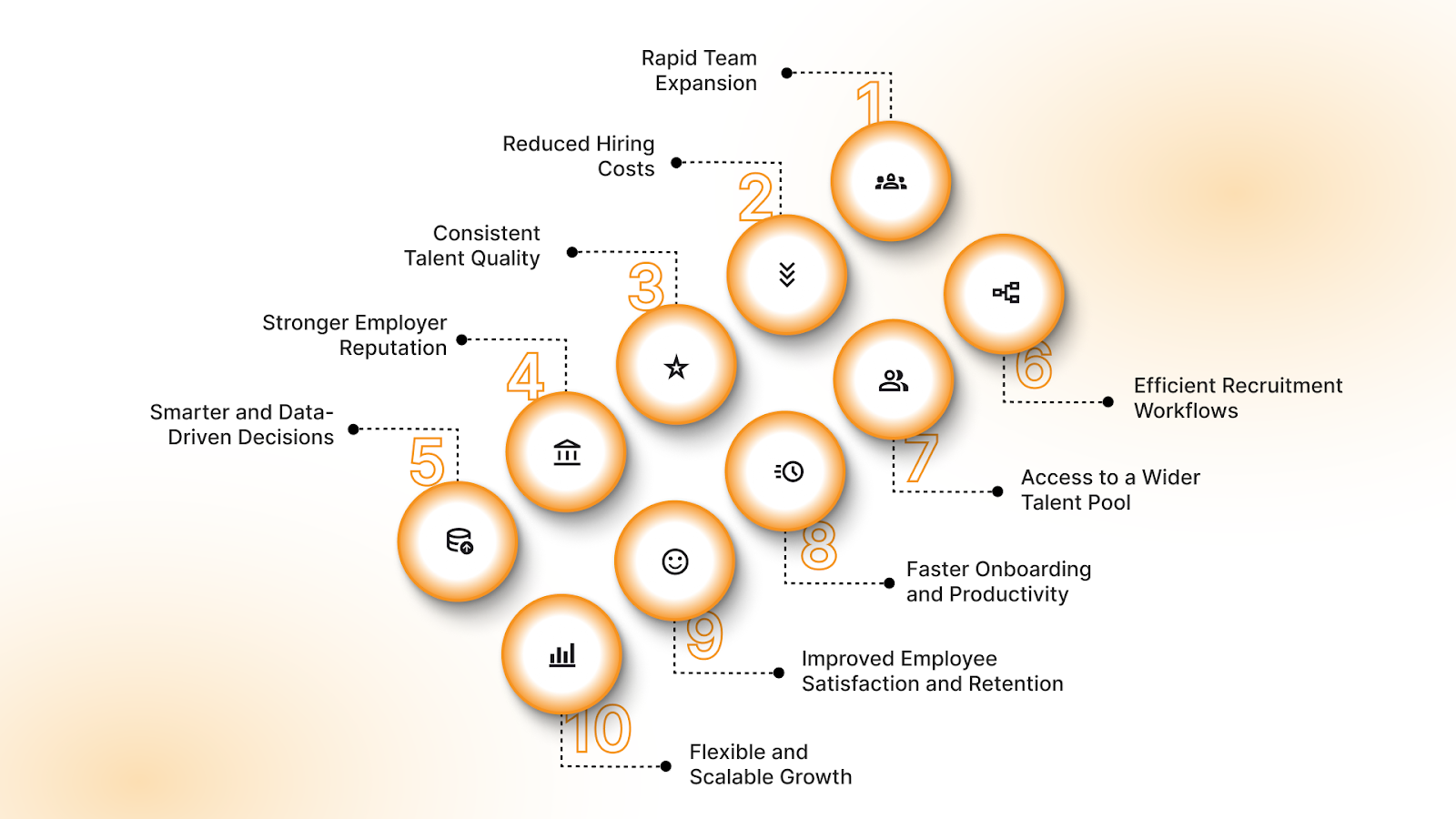
Here’s a closer look at the main benefits and practical ways to achieve them:
1. Rapid Team Expansion
Businesses often face sudden projects, tight deadlines, or market opportunities, making fast team expansion critical to success. Bringing multiple employees on board at once ensures teams are ready to deliver without delays.
How it works: Coordinated sourcing, AI-assisted candidate screening, and batch scheduling accelerate hiring timelines and allow organisations to meet urgent workforce needs efficiently.
Example: A SaaS company needed 70 cloud engineers within six weeks. By using virtual interviews and structured assessments, they onboarded the team on schedule and avoided project delays.
Why it matters: Fast expansion keeps projects on track, prevents bottlenecks, and ensures operational continuity.
2. Reduced Hiring Costs
Recruiting individually for each role can quickly become expensive due to repeated job ads, multiple rounds of interviews, and administrative work. Handling multiple hires together lowers the per-hire cost while maintaining quality.
How it works: Centralised recruitment platforms, automated assessments, and outsourcing repetitive tasks simplify the process and reduce operational expenses.
Example: An IT consulting firm hired 50 AI/ML specialists simultaneously, saving 35% in hiring costs compared to filling roles one by one.
Why it matters: Savings can be redirected to employee training, tools, or other strategic initiatives that strengthen the business.
3. Consistent Talent Quality
When hiring at scale, there is a risk of uneven skills and performance levels. A structured approach ensures that every new employee meets the same technical and behavioural standards.
How it works: Competency-based interviews, coding tests, and AI-assisted evaluation tools maintain uniformity across hires and protect overall team performance.
Example: A cybersecurity firm evaluated 60 new analysts using standardised problem-solving tests, ensuring the team could handle complex security challenges consistently.
Why it matters: Maintaining consistent quality reduces corrective training needs and protects the success of critical projects.
4. Stronger Employer Reputation
A smooth and professional recruitment experience reflects positively on the company and enhances its reputation in the job market. This helps attract better talent in future hiring rounds.
How it works: Clear communication, transparent timelines, and structured onboarding ensure candidates feel valued and informed throughout the process.
Example: A cloud services company onboarded 100 engineers across multiple locations. Candidate feedback highlighted clear processes and timely communication, enhancing the company’s brand image.
Why it matters: A strong employer reputation makes it easier to attract skilled professionals and reduces time-to-hire in subsequent recruitment cycles.
5. Smarter and Data-Driven Decisions
Managing multiple hires generates a wealth of recruitment data. Analysing this data allows companies to improve sourcing strategies, refine selection methods, and optimise onboarding Practises.
How it works: Recruitment dashboards and analytics tools track metrics like time-to-hire, candidate quality, and source effectiveness, providing actionable insights for decision-making.
Example: An IT firm analysed performance and retention data for 200 hires and discovered that employee referrals consistently produced top performers, guiding future recruitment strategy.
Why it matters: Data-driven hiring improves long-term outcomes, reduces hiring errors, and helps plan for future workforce requirements.
6. Efficient Recruitment Workflows
Handling hundreds of candidates manually is time-consuming and prone to errors. Structured processes ensure smooth workflows and reduce the burden on internal HR teams.
How it works: Centralised applicant tracking, automated interview scheduling, and standardised assessments simplify operations and minimise administrative effort.
Example: A global capability centre coordinated 400 interviews across different time zones in two weeks without conflicts or delays.
Why it matters: Efficient workflows allow HR teams to focus on strategic tasks rather than repetitive administrative work.
7. Access to a Wider Talent Pool
Bringing in multiple hires at once allows organisations to tap into a broader, more diverse talent base, improving team capabilities and promoting inclusion.
How it works: Multi-channel sourcing, AI-based candidate matching, and virtual recruitment drives expand the reach of hiring campaigns beyond traditional networks.
Example: A multinational IT company hired 60 AI/ML engineers from diverse backgrounds, strengthening the team’s innovation and problem-solving capabilities.
Why it matters: Access to a broader talent pool ensures teams have the skills to meet evolving business demands and adapt to complex projects.
8. Faster Onboarding and Productivity
Quickly filling roles ensures that teams remain productive and operations continue without disruption. Efficient onboarding accelerates integration and helps employees contribute faster.
How it works: Batch onboarding, virtual training sessions, and clear documentation simplify the process and reduce the learning curve.
Example: A logistics company hired 120 operations staff for the holiday season, achieving full productivity within weeks.
Why it matters: Faster onboarding prevents revenue loss due to understaffing and keeps project timelines intact.
Also Read: How to Approach Leadership Hiring for Organisational Success
9. Improved Employee Satisfaction and Retention
Understaffed teams face high workloads, stress, and burnout, leading to attrition. Hiring balances workloads strategically and creates a healthier work environment.
How it works: Structured role allocation, mentorship programmes, and planned onboarding improve engagement and help new employees integrate smoothly.
Example: A healthcare analytics firm onboarded 50 data analysts simultaneously, reducing overtime, improving morale, and lowering attrition.
Why it matters: Satisfied employees are more productive, engaged, and likely to stay longer, thereby reducing future recruitment pressure.
10. Flexible and Scalable Growth
Businesses must adjust team sizes to match project demands, seasonal peaks, or expansion plans. A structured approach allows scaling without affecting quality or efficiency.
How it works: Cloud-based HR platforms, flexible staffing models, and recruitment outsourcing enable organisations to scale teams up or down as needed.
Example: An e-commerce company hired 200 IT and warehouse staff for peak season and scaled down afterward without operational disruptions.
Why it matters: Flexibility ensures businesses can respond to market changes quickly while maintaining team productivity and quality.
When executed systematically, it ensures teams are skilled, cohesive, and ready to deliver, supporting both short-term operational needs and long-term organisational growth.
Need to hire large teams fast without overloading your HR or compromising on quality? V3 Staffing offers end-to-end bulk hiring solutions in India, combining SLA driven recruitment, structured assessments, and fully managed onboarding. Scale your workforce efficiently with permanent, contract, IT, and executive hiring while staying compliant and project-ready.
Also Read: GCC Consultancy That Helps You Build Right and Scale Fast
6 Essential Steps Involved in Effective Bulk Hiring
Hiring many employees at once can be challenging, but with the right approach, you can maintain quality, speed, and consistency. Following a clear process ensures new team members integrate smoothly and projects stay on track.
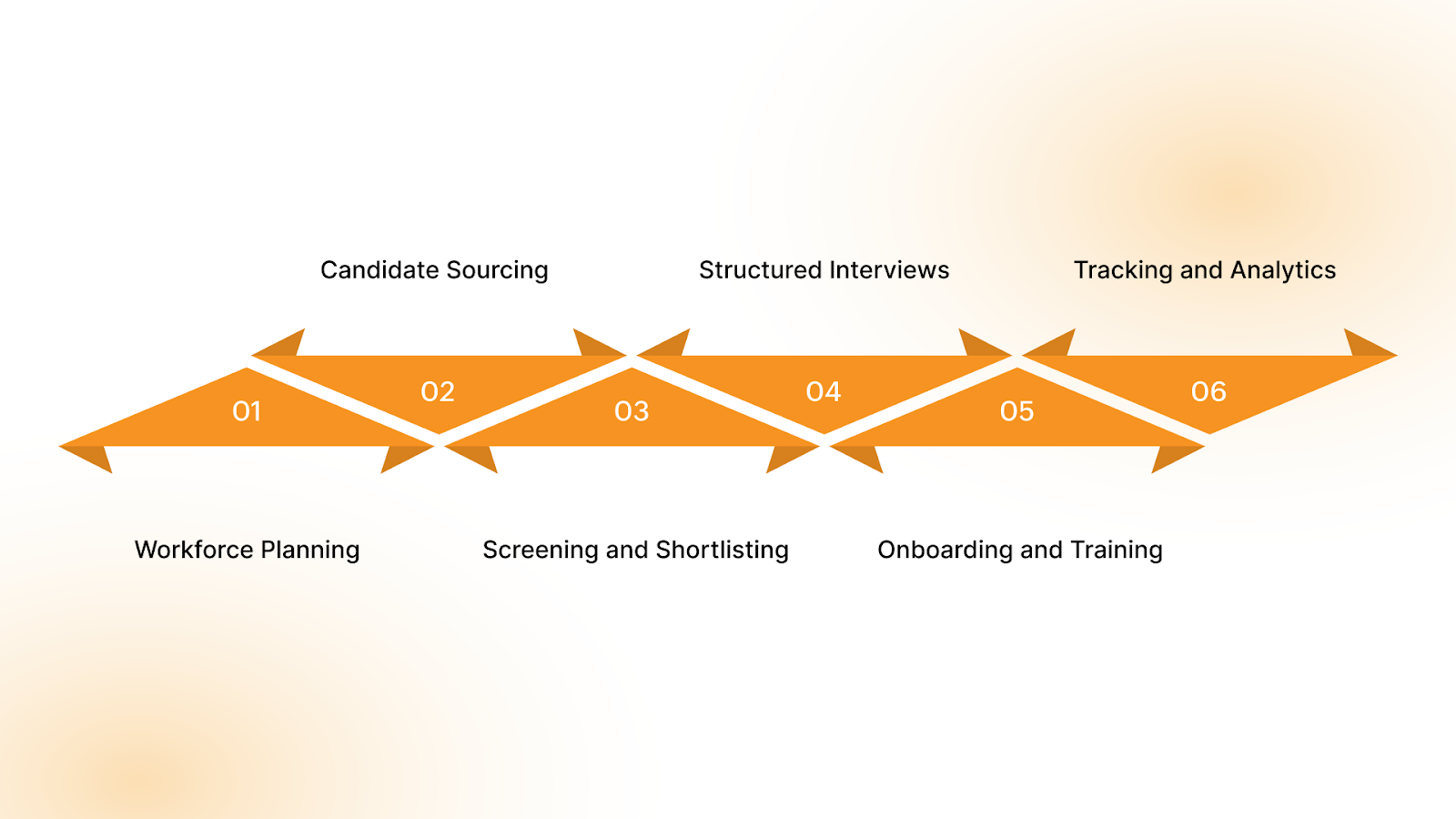
Here are some practical steps to managing high-volume recruitment effectively:
- Workforce Planning: Begin by mapping out the roles, number of hires, and key skills needed. This ensures recruitment aligns with business goals and prevents skill gaps.
- Candidate Sourcing: Reach out to a broad talent pool through multiple channels, including job boards, referrals, social media, and professional networks. Casting a broad net increases the chances of quickly finding the right candidates.
- Screening and Shortlisting: Use standardised assessments and automated tools to efficiently filter qualified candidates. This keeps the process fair and focused on skills that matter.
- Structured Interviews: Use panel interviews or virtual assessment centres to evaluate candidates consistently. A uniform evaluation process ensures fairness and quality across all hires.
- Onboarding and Training: Provide structured onboarding, role-specific documentation, and training programmes. This helps new hires adapt faster and contribute effectively from day one.
- Tracking and Analytics: Monitor metrics like time-to-hire, cost per hire, and candidate quality. Analytics help refine recruitment strategies, address bottlenecks, and improve outcomes for future drives.
Following a structured approach transforms large-scale recruitment from a complex challenge into a smooth, predictable process. It ensures teams are ready, skilled, and productive, supporting both immediate projects and long-term growth
Difference Between Bulk, Mass, and Volume Hiring
When it comes to growing your workforce, not all hiring strategies are the same. Companies need to choose the approach that matches their goals, whether it’s steady growth, rapid expansion, or scaling multiple roles at once.
The table below breaks down volume, mass, and bulk hiring to highlight how each approach works and when it’s most effective.
From gradually filling positions to quickly onboarding large teams, understanding the differences helps you plan efficiently, manage costs, and maintain quality.
Also Read: 7 Mass Hiring Companies in India for IT, GCC, and Shared Services Teams
How Technology Makes Bulk Hiring Faster and Smarter?
Growing teams quickly without losing quality is a major challenge for enterprises, GCCs, and product organisations across India, the USA, and the UAE. Modern recruitment tools make bulk hiring faster, more accurate, and consistent, helping companies meet workforce demands while saving time and resources.
To achieve these benefits, organisations rely on specific technology solutions that simplify every step of the bulk hiring process:
- Applicant Tracking Systems (ATS): ATS platforms consolidate candidate information, automate messaging, and manage schedules. This ensures large numbers of applications are handled efficiently without delays.
- AI Screening Tools: These tools help quickly select suitable candidates for specialised roles such as cloud engineers, data scientists, AI/ML specialists, and cybersecurity experts. This reduces manual work and improves hiring accuracy.
- Virtual Onboarding: Online onboarding allows new employees to receive the same training no matter where they are. Teams across locations can start smoothly and get up to speed faster.
- Analytics Dashboards: Track key metrics such as time-to-hire, cost per hire, and candidate quality. Organisations can use this data to improve processes, make informed decisions, and better plan large-scale hiring.
By using these tools, companies can hire more people quickly without compromising quality, making bulk recruitment a strong strategy for growth and consistency.
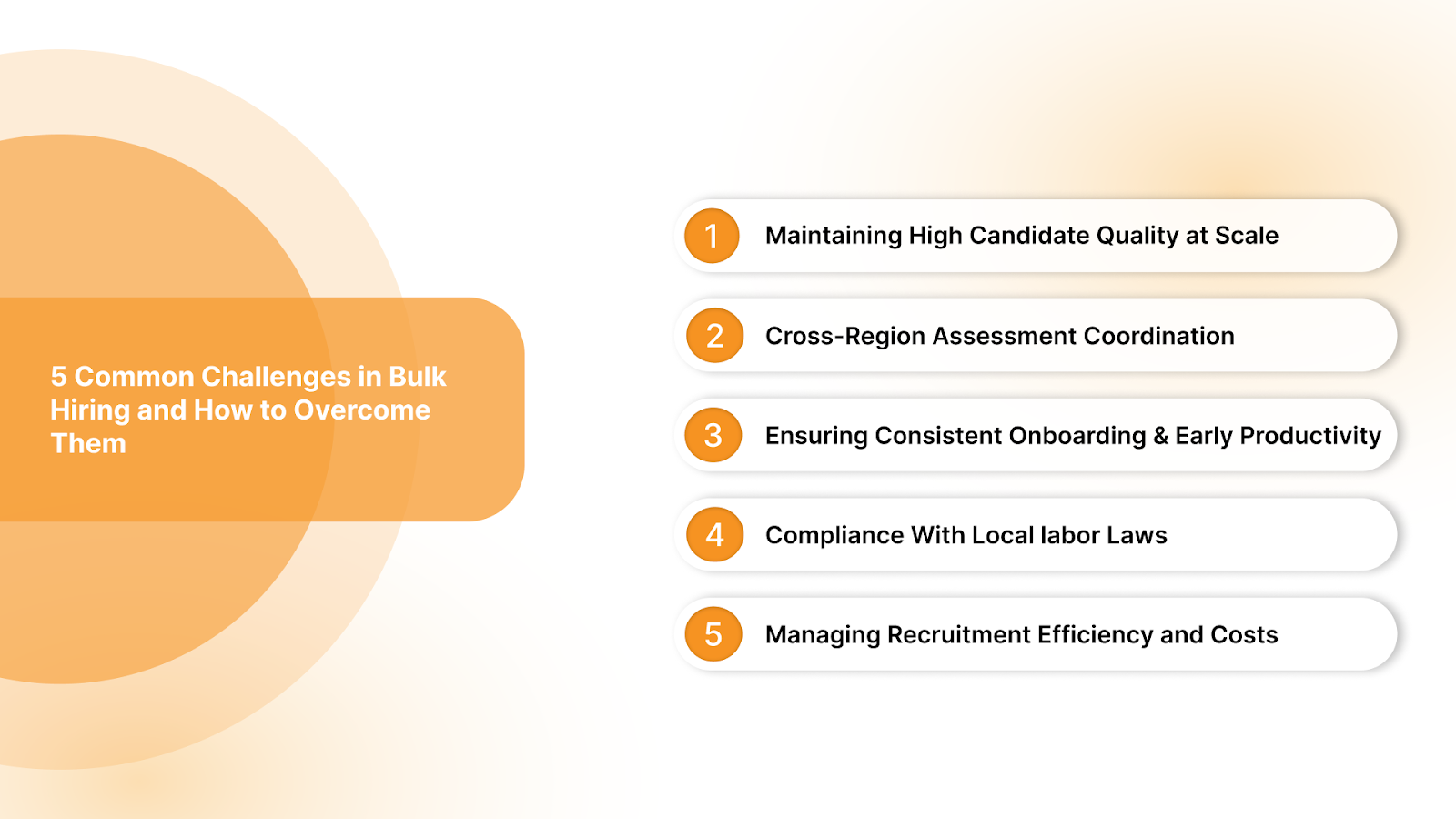
5 Common Challenges in Bulk Hiring and How to Overcome Them
Scaling recruitment across multiple locations is never without hurdles. Enterprises, GCCs, and product organisations must navigate these challenges to ensure quality, speed, and compliance. Here’s a detailed look at the key obstacles and best practises to tackle them.
1. Maintaining High Candidate Quality at Scale
Hiring a large number of employees at once can lead to inconsistent skill levels and performance. This is especially critical for specialised roles such as cloud engineers, AI/ML, DevOps engineering roles, data scientists, and cybersecurity experts.
Best Practise:
- Standardise assessments, coding tests, and interview questions.
- Use structured evaluation rubrics to measure both technical and behavioural competencies.
- Partner with recruitment specialists like V3 Staffing to ensure role-to-talent alignment.
2. Coordinating Assessments and Interviews Across Geographies
Scheduling interviews, aligning time zones, and maintaining a consistent evaluation process across India, the USA, and the UAE can be complex. Misalignment can delay hiring or lead to inconsistent candidate experiences.
Best Practise:
- Centralise scheduling through applicant tracking systems (ATS).
- Conduct panel interviews or virtual assessment centres to maintain uniformity.
- Use AI-assisted screening tools to shortlist qualified candidates efficiently.
3. Ensuring Consistent Onboarding and Early Productivity
Large-scale onboarding can overwhelm teams, leading to delayed productivity or uneven integration of new hires.
Best Practise:
- Implement structured virtual onboarding programmes to deliver training simultaneously across locations.
- Provide clear documentation of workflows, tools, and role expectations.
- Assign mentors or buddy systems to support faster integration.
4. Compliance With Local labor Laws
Hiring across multiple countries introduces legal complexity. Differences in labor regulations, payroll, and statutory requirements must be carefully managed.
Best Practise:
- Engage partners familiar with local regulations in India, the USA, and the UAE.
- Consider Employer of Record (EOR) solutions for legal compliance and payroll management.
- Conduct periodic audits to ensure adherence to statutory norms.
5. Managing Recruitment Efficiency and Costs
Bulk hiring can strain internal HR teams with repeated postings, scheduling, and follow-ups, leading to higher costs and slower timelines.
Best Practise:
- Centralise sourcing, screening, and assessment processes.
- Adopt SLA-driven recruitment models to ensure predictable hiring outcomes.
- Use recruitment process outsourcing (RPO) to handle volume without compromising quality.
By addressing these challenges strategically, organisations can ensure efficient bulk hiring, maintain consistent candidate quality, and build high-performing teams that deliver results.
How V3 Staffing Aligns with Bulk Hiring Trends?
When companies need to hire many employees quickly, managing the process can be challenging. You need faster hiring, better role fit, and an organised approach that aligns with current bulk hiring trends while maintaining quality across multiple roles.
With over 16 years of experience, V3 Staffing has successfully hired 10,000+ specialists for 300+ clients globally. Their SLA-driven approach, combined with expertise in specialised IT, product, AI/ML, cloud, and cybersecurity roles, and presence across India, the USA, and the UAE, enables enterprises to adapt to modern bulk hiring trends and scale teams efficiently.
Here are some services that make bulk hiring easier:
1. Permanent Recruitment
V3 Staffing helps companies hire multiple full-time employees across mid to senior levels. Their domain-experienced recruiters provide tailored sourcing and screening, delivering high-quality talent across India.
2. Temporary & Contract Staffing
For project-based demands, peak seasons, or interim staffing, V3 Staffing offers a scalable contract staffing model. Candidates are deployed quickly across tech and non-tech roles, with the entire hiring lifecycle fully compliant.
3. IT Staffing
Finding specialised tech talent can be tough. V3 Staffing sources cloud engineers, DevOps experts, data scientists, software architects, and QA specialists. Agile hiring models and a curated tech talent pool make filling IT roles faster and more precise.
4. Recruitment Process Outsourcing (RPO)
For organisations with continuous or large-scale hiring needs, V3 Staffing provides end-to-end RPO services. Dedicated teams handle the full recruitment process with SLA-driven delivery, ensuring cost-effective, predictable outcomes.
5. Executive Search
V3 Staffing conducts targeted searches for leadership roles, including CXO, VP, and Director-level positions. Their discreet approach, competency-based evaluation, and strategic sourcing ensure critical roles are filled with the right talent.
6. Employer of Record (EOR) Services
For companies expanding into India or hiring remote talent, V3 Staffing’s EOR services manage hiring, payroll, and statutory compliance. This allows fast onboarding without setting up a local entity.
7. Global Hiring
V3 Staffing supports international hiring across the United States and the UAE. With local market insights and structured evaluation, they ensure consistent candidate quality while enabling easy global workforce expansion.
With V3 Staffing’s support, companies can scale their workforce efficiently, maintain high hiring standards, and meet business goals even during large recruitment drives.
Conclusion
Bulk hiring is becoming an essential approach for companies looking to scale quickly and efficiently. Success in bulk hiring is no longer just about filling positions. It now relies on structured processes, timely recruitment, and ensuring the right talent joins at the right time. How you approach bulk hiring can directly impact team performance and long-term business growth.
With expertise across permanent hiring, contract staffing, executive search, and large-scale talent acquisition, V3 Staffing supports companies that need organised, reliable bulk hiring solutions. Contact us today to simplify your hiring process and build strong teams for the future.