
.svg)
.svg)
India’s GCCs are no longer hiring only for support or standard tech execution. Many now handle product engineering, cloud, cybersecurity, analytics, automation, and AI-led work tied directly to global business priorities. That shift has made hiring more specialised and far more capability-driven.
The policy push is also getting stronger. The Government of India approved the IndiaAI Mission with an outlay of ₹10,371.92 crore over five years, signalling how seriously the country is backing AI capability, infrastructure, talent, and innovation. As GCCs in India take on more AI and digital mandates, demand is naturally moving toward talent that can build and scale these functions, not just fill generic tech roles.
That is why AI and digital hiring has become a GCC priority in India. The challenge is no longer only about hiring fast. It is about finding people with the right depth in AI, data, digital platforms, and cross-functional execution without slowing down growth or stretching internal hiring teams.
Key Takeaways
- GCCs in India are expanding hiring beyond support functions and building teams across AI, cloud, cybersecurity, analytics, product, and digital transformation.
- The shift toward higher-value work is increasing demand for specialised talent that can support innovation, scale, and business-critical delivery.
- AI and digital hiring is harder than standard technology hiring because it requires deeper technical fit, faster execution, and stronger screening discipline.
- Different hiring models support different GCC needs, which is why many organisations use a mix of permanent hiring, contract staffing, RPO, and executive search.
- Strong hiring outcomes depend on aligning role strategy, location strategy, and screening quality with the stage and complexity of GCC expansion.
The AI and Digital Roles GCCs in India Are Hiring For
AI and digital hiring in India’s GCC ecosystem has become far more specialised. Companies are no longer building teams only for broad technology support. They are hiring for functions that can drive applied AI use cases, manage enterprise data systems, strengthen cloud environments, support digital products, and secure platforms at scale.
The most in-demand roles typically include:
- AI and ML engineers for model development and applied AI solutions
- LLM engineers and GenAI specialists for enterprise AI adoption
- Data engineers for pipeline design, data processing, and analytics readiness
- Cloud and platform engineers for infrastructure and system scalability
- MLOps professionals for deployment, monitoring, and model reliability
- Cybersecurity specialists for governance, risk, and secure AI environments
- Product managers and digital transformation professionals for execution across business functions
This hiring pattern shows how GCCs in India are evolving. The focus is no longer on filling technical vacancies at volume. It is on building teams that can support innovation, improve digital execution, and take ownership of high-value global work.
What Makes AI Digital Hiring in GCCs So Difficult
AI and digital hiring for GCCs in India is growing quickly, but specialised roles remain difficult to close. Demand is rising across AI, data, cloud, cybersecurity, and digital functions, while the supply of job-ready talent in these areas is still limited. That gap makes hiring more complex than standard technology recruitment.
Some of the main challenges include:
Limited Niche Talent Pools
Roles in AI, GenAI, cloud, cybersecurity, and advanced data engineering require specialised expertise that is not widely available in the market. This reduces the pool of qualified candidates for GCCs hiring at scale.
Longer Evaluation Cycles
These roles often need deeper technical assessment, structured screening, and stronger validation of applied experience. As a result, hiring cycles tend to be longer than they are for broader technology roles.
High Competition for Specialised Talent
GCCs are often competing with global enterprises, product companies, startups, and digital-first businesses for the same candidates. That competition makes it harder to secure experienced professionals in high-demand skill areas.
Offer Drop-Offs and Delayed Joining
Candidates with strong AI and digital profiles often have multiple options at the same time. This can lead to offer declines, delayed joining, and more uncertainty during the final stages of hiring.
Leadership Hiring Gaps
As GCCs expand, they also need experienced leaders who can build teams, guide capability development, and align delivery with business priorities. These roles are harder to fill because they require both technical depth and leadership maturity.
That is what makes AI digital hiring in GCCs a precision challenge, not just a scale challenge. The companies that hire well are usually the ones that define roles clearly, assess applied capability properly, and move fast enough to secure the right talent before the market does.
Also Read: Expand GCC in India: Key Trends and Opportunities for 2026
Best Hiring Models for GCCs Building AI and Digital Teams in India
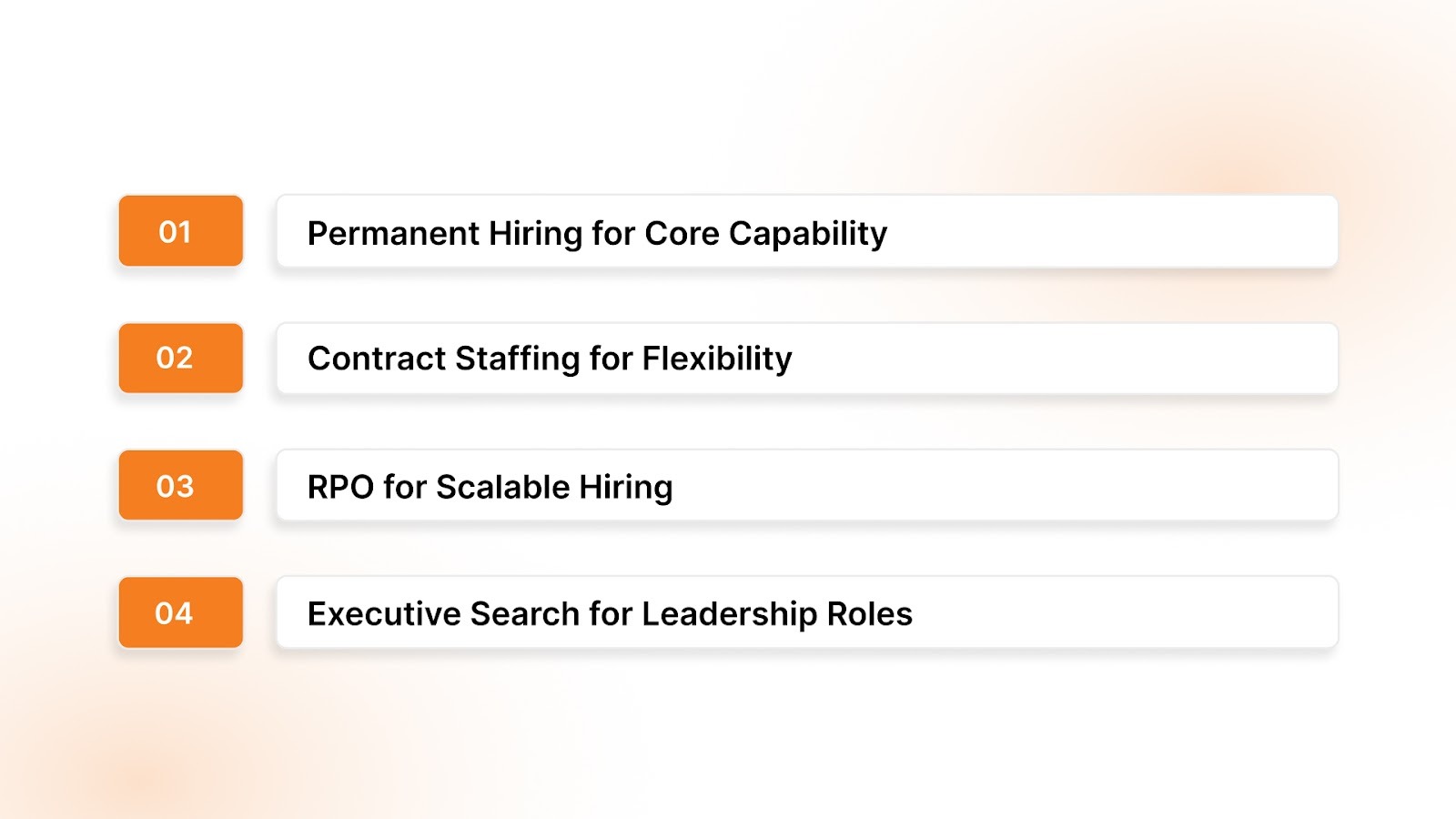
The right hiring model depends on the role, the urgency, and the stage of GCC expansion. For AI and digital teams, most centres do not rely on a single approach. They usually combine different models to balance speed, capability building, and hiring complexity.
Permanent Hiring for Core Capability Building
Permanent hiring is best suited for roles that support the GCC’s long-term mandate. These are usually positions tied to AI capability, platform ownership, data infrastructure, product continuity, and cybersecurity. It works well when the goal is to build stable in-house teams that will continue to support business-critical functions over time.
Typical roles include:
- AI and ML engineers
- Data engineers
- Cloud and platform specialists
- Product managers
- Cybersecurity professionals
Contract Staffing for Speed and Flexibility
Contract staffing is useful when GCCs need specialised talent quickly or want to support project-specific work without extending permanent hiring cycles. It helps teams respond faster to urgent delivery needs while keeping workforce planning flexible.
This model is often used when:
- delivery timelines are tight
- niche skills are needed for a defined period
- project demand increases suddenly
- the business wants flexibility before making permanent hires
RPO Support for Multi-Role Hiring at Scale
When GCCs are hiring across several teams or functions at once, internal recruitment bandwidth can become a constraint. Recruitment Process Outsourcing helps bring more structure to sourcing, screening, coordination, and pipeline management across larger hiring programmes.
RPO becomes more useful when:
- multiple AI and digital roles need to be filled together
- internal talent teams are operating with limited bandwidth
- hiring volume is rising across teams or locations
- the business needs a more consistent recruitment process
Executive Search for Leadership and Strategic Roles
Senior hiring usually requires a more focused search process. Leadership roles need stronger market mapping, deeper evaluation, and closer alignment with the GCC’s business and team-building goals.
This model is commonly used for:
- GCC heads
- AI practice leaders
- digital transformation leaders
- engineering leaders
- senior product and platform heads
In most cases, GCCs use a mix of these models rather than depending on just one. A centre may use permanent hiring for core AI and digital roles, contract staffing for urgent delivery needs, and RPO or executive search support as hiring becomes more complex. For GCCs hiring in India, V3 Staffing supports these requirements through permanent recruitment, contract staffing, RPO, executive search, and IT staffing based on the structure and stage of the hiring need.
Also Read: How GCC Works: A Strategic Guide for Indian Enterprises
Top Cities for AI and Digital GCC Hiring in India
Location strategy plays a direct role in how GCCs build AI and digital teams. Some cities offer deeper access to AI, product, and platform talent, while others are better suited for scalable engineering, digital operations, or leadership hiring. Choosing the right market depends on the type of capability the GCC wants to build.
The right city strategy depends on the kind of team the GCC is trying to build. Centres focused on AI-led innovation may prioritise Bengaluru or Hyderabad, while those scaling broader engineering, platform, or digital teams may also find strong value in Pune, Chennai, or Delhi NCR. For multi-city hiring in India, V3 Staffing can support city-specific talent mapping and help GCCs align role strategy with the right hiring market.
Also Read: GCC Outsourcing vs Traditional Outsourcing Explained
How to Build an AI and Digital Hiring Strategy for a GCC in India
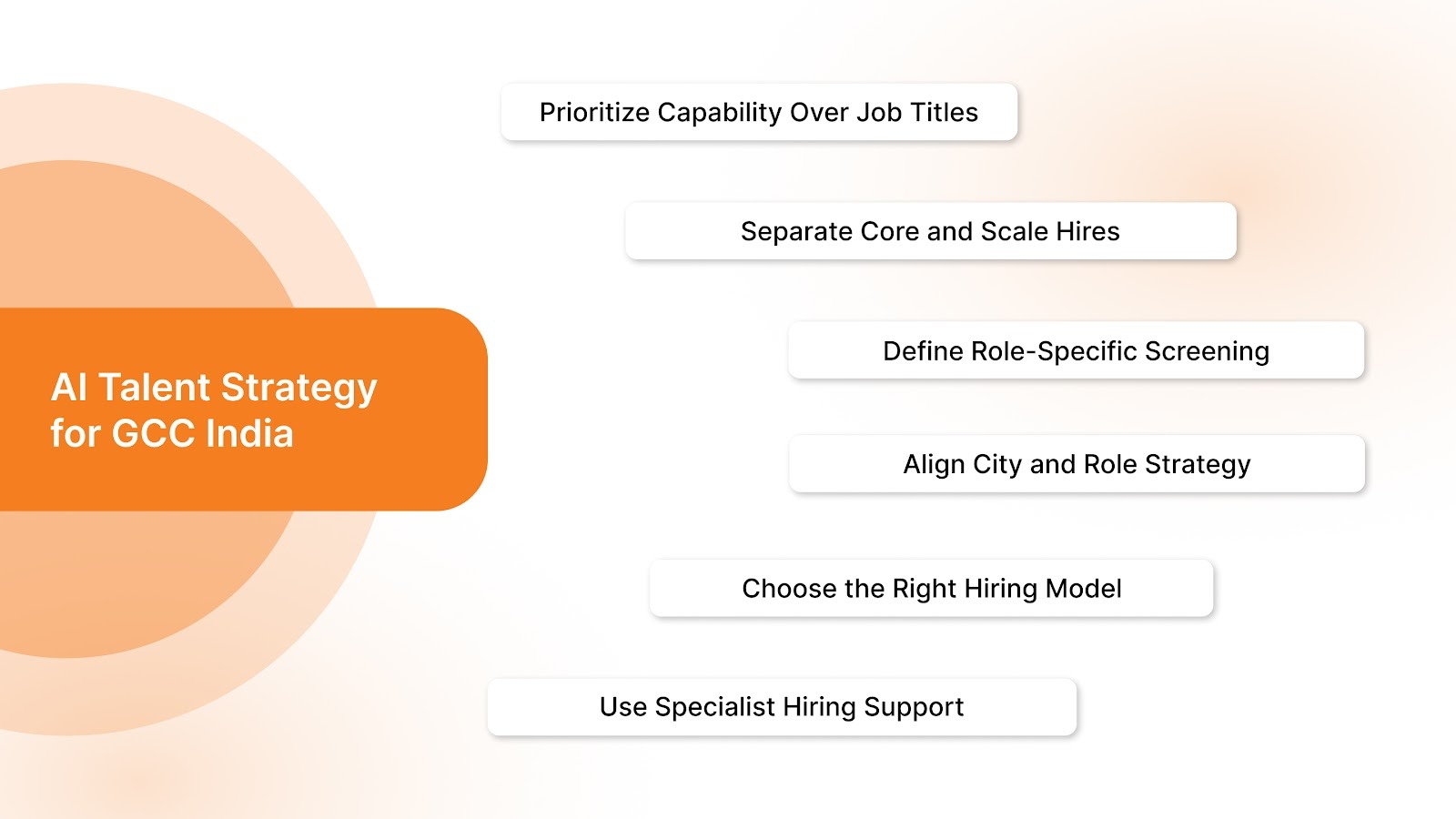
A strong hiring strategy starts with business priorities, not just open roles. GCCs tend to hire better when role planning is tied to capability building, delivery ownership, and expansion goals from the beginning.
Start with Capability, Not Just Job Titles
Before opening multiple positions, define what the GCC is expected to own. A team focused on AI product development will need a different talent mix from one supporting analytics, cloud operations, or digital transformation. This helps identify which roles are business-critical, which capabilities need to be built in-house, and which positions can be phased over time.
Separate Core Hires from Scale Hires
Not every role needs the same level of urgency or the same hiring model. Some positions are central to long-term capability, while others support immediate delivery or expansion. Splitting core hires, scale hires, and strategic hires creates a more structured plan and avoids treating every opening the same way.
Build Role-Specific Screening Criteria
AI and digital roles are harder to evaluate when screening stays too broad. These positions often need assessment beyond résumés and keyword matching. Stronger hiring strategies test for technical depth, applied problem-solving, business context, cross-functional collaboration, and readiness to work in a GCC environment.
Align City Strategy with Role Strategy
Different hiring markets support different goals. Some cities are stronger for deep-tech and AI talent, while others offer better access to scalable engineering, platform, or cross-functional hiring. GCCs usually get better outcomes when they decide which roles should be concentrated in one city and which can be distributed across locations.
Use the Right Hiring Model for Each Phase
A well-planned strategy does not depend on one route alone. Permanent hiring, contract staffing, RPO, and executive search each serve different needs. Using the right model for the right phase helps GCCs move faster on urgent roles, maintain quality for specialised hiring, and reduce pressure on internal recruitment teams.
Bring in Specialist Support Where Needed
As hiring becomes more niche or multi-layered, external support can help maintain speed and screening quality. This becomes especially useful when several AI and digital roles need to be filled together or when leadership hiring requires deeper search capability. For GCCs in India, V3 Staffing can support this process through role-based hiring, market mapping, and recruitment support across permanent, contract, RPO, and executive search mandates.
A strong hiring strategy does more than reduce time-to-fill. It helps GCCs build the right mix of AI and digital talent while reducing delivery risk, hiring gaps, and expansion friction.
When to Work With a Specialist Hiring Partner for GCC Talent in India
Not every GCC needs external hiring support at the beginning. But once hiring becomes more specialised, time-sensitive, or spread across multiple roles, internal teams can struggle to maintain both speed and quality. That is usually when a specialist hiring partner becomes more valuable.
When Niche Roles Are Hard to Close
AI and digital hiring often includes roles that are harder to assess and slower to fill than standard technology positions. This is common in areas such as AI engineering, data platforms, cloud, cybersecurity, product, and digital transformation. When these roles remain open for too long, they can affect delivery timelines, team structure, and capability building.
When Multiple Roles Need to Be Filled Together
GCC hiring rarely happens one role at a time. Many centres hire across functions, seniority levels, or locations in parallel. That creates an execution challenge as much as a recruitment challenge. External support becomes more useful when multiple AI and digital roles open at once and internal teams need a more structured hiring pipeline.
When Speed Matters but Quality Cannot Drop
Hiring quickly is important, but poor role fit creates long-term issues. In GCC environments, weak hiring decisions can delay projects, increase backfilling, and affect team stability. A specialist hiring partner becomes relevant when the business needs faster movement without compromising screening quality.
When Leadership Hiring Becomes Important
Senior roles need a more focused search process. Hiring for positions such as GCC heads, AI leaders, engineering heads, or digital transformation leaders usually requires deeper market mapping, stronger evaluation, and closer alignment with long-term business goals.
The right time to bring in specialist support is usually before hiring delays start affecting growth, delivery, or expansion plans.
Also Read: GCC in HR: Transforming Talent Strategy for India’s Enterprises
How V3 Staffing Supports AI and Digital Hiring for GCCs in India
Building AI and digital teams inside a GCC often requires more than a standard recruitment process. The challenge usually involves niche skill demand, faster timelines, multi-role hiring, and the need to align talent decisions with broader business goals. That is where specialist hiring support becomes more relevant.
Support Across Different Hiring Models
GCC hiring needs vary by role, team structure, and stage of expansion. Some businesses need permanent talent for long-term capability building, while others need contract support for immediate delivery or executive search for leadership mandates. V3 Staffing supports these requirements through permanent recruitment, contract staffing, IT staffing, RPO, and executive search, depending on the hiring need.
Coverage Across Specialised AI and Digital Roles
As GCCs take on more advanced mandates, hiring becomes more role-specific. Instead of broad technology recruitment, the focus shifts to talent that can support AI deployment, enterprise data systems, cloud platforms, cybersecurity, digital products, and transformation initiatives. V3 Staffing supports hiring across AI, machine learning, data engineering, cloud, product, cybersecurity, and related digital functions.
Better Alignment Between Speed and Hiring Quality
One of the biggest challenges in GCC hiring is maintaining pace without weakening screening quality. AI and digital roles need sharper sourcing, stronger evaluation, and better role fit from the start. V3 Staffing helps support this through more structured hiring processes that are built around market availability, business urgency, and the level of technical specialisation required.
Support for Growth-Stage and Enterprise Hiring
For GCCs expanding in India, hiring is often tied to broader plans such as new team setup, capability expansion, or stronger delivery ownership. In these situations, the goal is not only to fill vacancies but to build the right team mix with more planning and consistency. V3 Staffing supports this through hiring models that can adapt to different stages of GCC growth.

Conclusion
AI and digital hiring has become a strategic priority for GCCs in India as these centres take on more responsibility across product engineering, cloud, cybersecurity, analytics, automation, and applied AI. The hiring challenge is no longer only about filling roles quickly. It is about building the right capability mix with enough speed, structure, and market alignment to support long-term growth.
That usually requires more than a standard recruitment approach. GCCs need clearer role planning, stronger screening, the right hiring models, and access to talent across the cities and skill clusters that matter most. For businesses hiring across AI and digital functions in India, V3 Staffing supports this through permanent recruitment, contract staffing, RPO, executive search, and IT staffing based on the stage and complexity of the requirement.
Partner with V3 Staffing to hire AI and digital talent for your GCC in India through a more structured process that supports capability building, delivery, and expansion.