
.svg)
.svg)
Scaling a SaaS product is rarely limited by ideas or market demand. More often, the real constraint is access to specialised engineering talent. As SaaS companies expand their platforms, launch new features, and serve customers across multiple markets, internal development teams can quickly reach capacity. Traditional hiring cycles are often too slow to keep pace with rapid product development needs.
Recent industry research highlights how widespread this challenge has become. According to the ManpowerGroup Global Talent Shortage Survey, more than 72% of organisations report difficulty finding skilled technology professionals, particularly in areas such as cloud engineering, AI development, cybersecurity, and data infrastructure. For SaaS businesses that rely on continuous innovation, these talent gaps can delay product roadmaps and slow global expansion.
As a result, many technology leaders are turning to SaaS team augmentation as a strategic workforce solution. By extending internal teams with specialised external professionals, companies can quickly scale engineering capacity while maintaining control over development processes.
In this blog, we will explore what SaaS team augmentation is, how it differs from traditional outsourcing, its key benefits, implementation strategies, common challenges, and when it becomes the right approach for growing SaaS organisations.
Quick Overview
- SaaS team augmentation allows companies to add specialised engineers to internal teams for rapid scaling and niche skill support.
- Right for businesses accelerating product roadmaps, expanding globally, or needing temporary expert roles in Engineering, Cloud, AI/ML, Cybersecurity, Data, or Product.
- Difference from outsourcing: augmented teams integrate directly into workflows, retain internal control, and scale flexibly, unlike traditional project-based outsourcing.
- Key benefits include faster time-to-market, access to specialised skills, flexibility in team size, cost efficiency, and enhanced product delivery.
- Implementation essentials: identify skill gaps, choose a trusted augmentation partner, integrate teams into development cycles, and monitor performance with SLAs and KPIs.
- Challenges to anticipate: remote team management, knowledge transfer, cultural alignment, maintaining productivity, and security/compliance adherence.
- Global expertise with V3 Staffing: SLA-driven delivery, domain-specialised recruiters, and support across India, the USA, and the UAE to scale SaaS engineering teams effectively.
What is SaaS Team Augmentation?
SaaS companies often need to expand their engineering capacity quickly to meet product development timelines. However, recruiting permanent employees can take several months, particularly when specialised technical expertise is required. SaaS team augmentation provides a practical way for organisations to extend their existing product and engineering teams without going through long hiring cycles.
In simple terms, SaaS team augmentation is a workforce model where external technology professionals join an organisation’s internal development team and work alongside in-house employees. These professionals follow the company’s tools, workflows, and product roadmap while remaining employed by a staffing partner. This model allows SaaS businesses to add experienced developers, engineers, or architects whenever additional expertise is required.
For large SaaS enterprises and scaling startups, this approach supports faster product development while maintaining full control over the engineering process. Instead of outsourcing an entire project, companies retain ownership of their platform and integrate specialised professionals into their existing teams to support global product growth.
When is SaaS Team Augmentation Right for Your Business?
SaaS team augmentation becomes particularly valuable when organisations must increase development capacity or gain specialised technical expertise within a short timeframe.
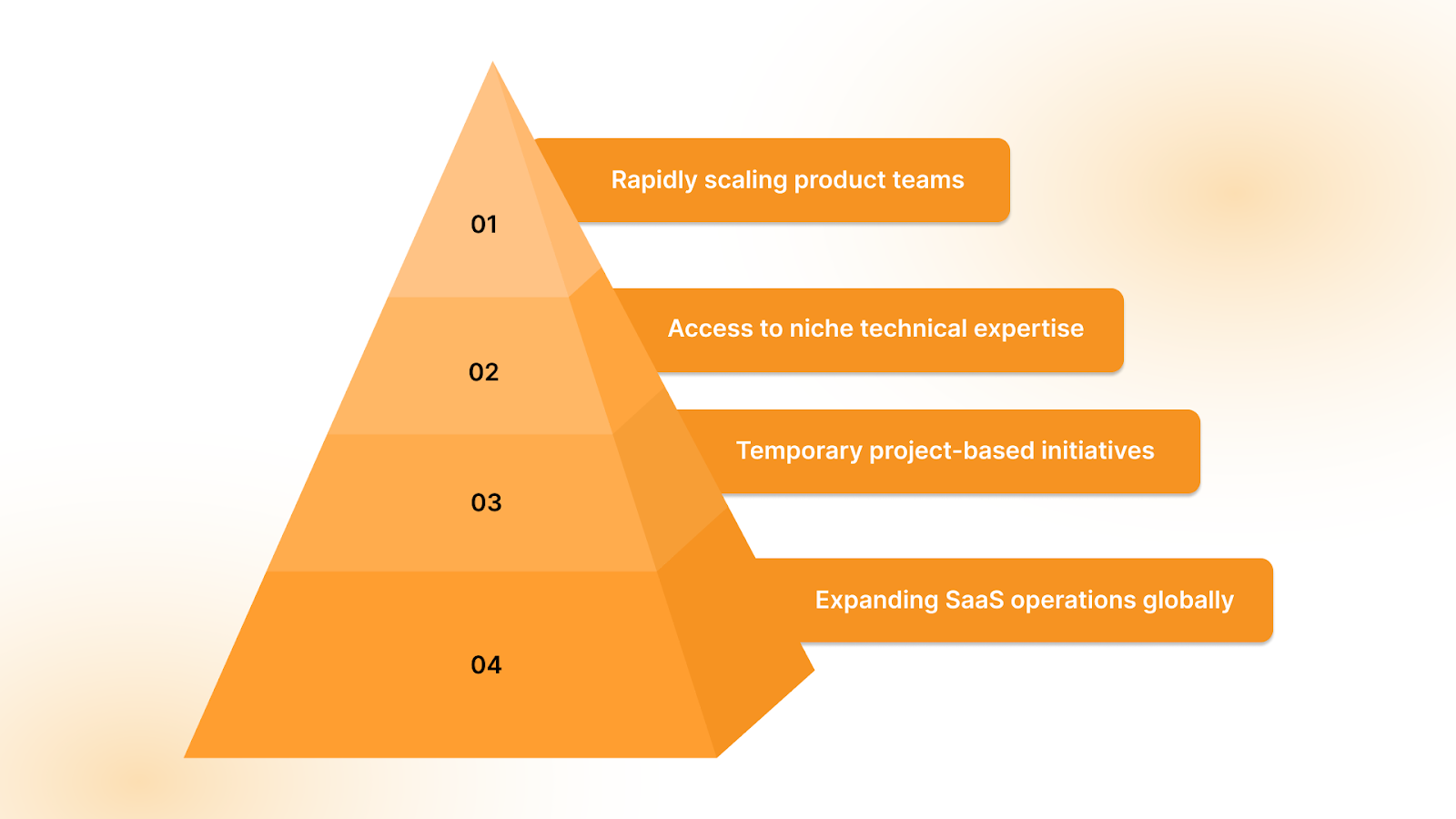
- Rapidly scaling product teams: When product roadmaps accelerate, and internal engineering teams cannot meet development timelines.
- Access to niche technical expertise: When organisations require specialists in areas such as cloud engineering, AI/ML, cybersecurity, DevOps, or data infrastructure.
- Temporary project-based initiatives: When companies need additional developers or architects for a specific technology project, such as cloud migration or platform modernisation.
- Expanding SaaS operations globally: When organisations scale their SaaS platforms into international markets such as the USA, UAE, or India and require additional engineering support.
In these situations, SaaS team augmentation helps organisations maintain development speed while keeping full visibility and control over their technology roadmap.
Also read: How India's AI Workforce is Shaping the Future of Jobs in 2026
Difference Between SaaS Team Augmentation and Traditional Outsourcing
SaaS companies often explore different workforce models when expanding their engineering teams. Two common approaches are SaaS team augmentation and traditional IT outsourcing. Although both involve working with external technology professionals, the level of control, collaboration, and flexibility they offer can vary significantly.
For organisations building and scaling SaaS platforms, understanding these differences helps leaders choose the model that best supports product development speed, technical ownership, and long-term growth. The table below explains the key distinctions between the two approaches.
Understanding this distinction helps technology leaders choose the right approach when expanding global SaaS teams and managing complex product development cycles.
Key Benefits of SaaS Team Augmentation
SaaS companies must constantly improve their platforms, release new features, and maintain system reliability while responding to market demands. However, expanding engineering capacity through traditional hiring can slow down product development. This is why many organisations adopt SaaS team augmentation to extend their technical teams while keeping full control of product development.
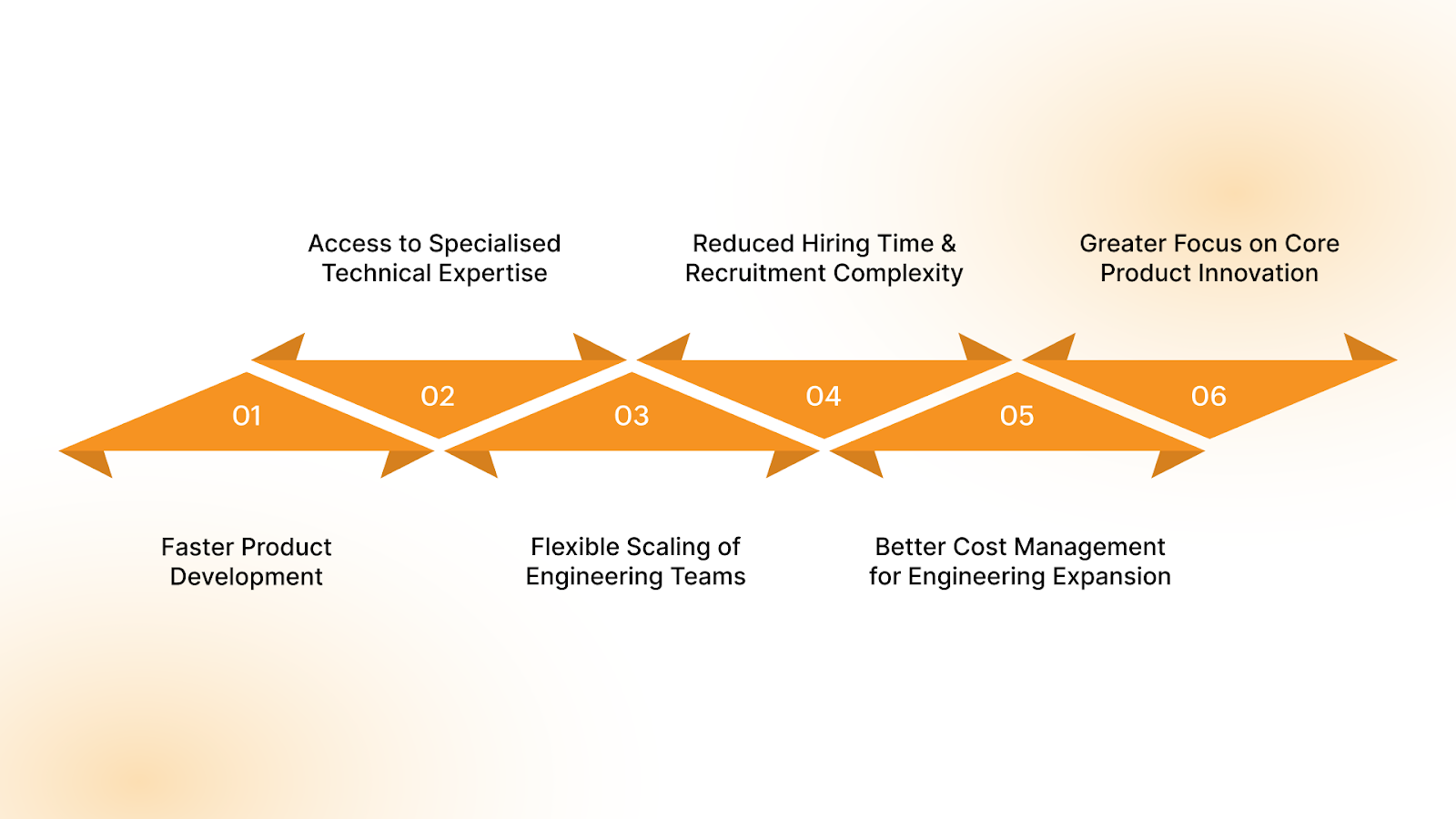
Below are the most important benefits SaaS organisations gain when they adopt this approach.
1. Faster Product Development and Time-to-Market
Speed plays a critical role in SaaS success. When companies introduce new features faster than competitors, they gain stronger user adoption and market advantage.
Key ways SaaS team augmentation supports faster development include:
- Immediate access to experienced developers, reducing long recruitment timelines.
- Additional engineering capacity during sprint cycles helps teams complete more development tasks in each release.
- Faster delivery of new product modules, integrations, and updates without overloading internal teams.
- Reduced development bottlenecks, especially when multiple product initiatives run simultaneously.
2. Access to Specialised Technical Expertise
Modern SaaS platforms depend on multiple advanced technologies, many of which require highly specialised professionals. Recruiting these niche experts internally can be difficult and time-consuming.
SaaS team augmentation allows companies to bring in professionals with expertise in areas such as:
- Software engineering for large-scale SaaS platforms
- Cloud infrastructure and DevOps environments
- AI and machine learning integration for product features
- Data engineering and analytics platforms
- Cybersecurity and platform security architecture
- Product engineering for scalable SaaS applications
This allows organisations to add niche capabilities exactly when the project requires them.
3. Flexible Scaling of Engineering Teams
SaaS development workloads often change based on product releases, system upgrades, and customer demand. Permanent hiring may not always provide the flexibility needed to respond to these fluctuations.
With SaaS team augmentation, companies can scale engineering teams more easily by:
- Adding developers during high-development phases, such as product launches or platform upgrades.
- Expanding specialised teams temporarily for complex engineering projects.
- Adjusting team size based on sprint or product roadmap requirements.
- Reducing team size after project completion, avoiding unnecessary long-term payroll commitments.
4. Reduced Hiring Time and Recruitment Complexity
Hiring highly skilled engineers can take weeks or months, particularly when companies require specialised experience in emerging technologies.
SaaS team augmentation simplifies this process by:
- Providing access to pre-vetted technology professionals who are ready to join projects quickly.
- Reducing internal recruitment workload, allowing HR and talent teams to focus on strategic hiring.
- Shortening the time required to fill critical technical roles.
- Helping organisations maintain development continuity when urgent projects arise.
5. Better Cost Management for Engineering Expansion
Scaling a full-time engineering team can significantly increase operational expenses. In addition to salaries, companies must account for benefits, recruitment costs, infrastructure, and long-term employment commitments.
SaaS team augmentation helps manage these costs through:
- Paying only for the required talent and project duration.
- Avoiding long-term employment obligations for short-term initiatives.
- Reducing recruitment and onboarding costs.
- Allowing companies to allocate resources to product innovation rather than hiring overhead.
6. Greater Focus on Core Product Innovation
When internal teams spend too much time managing hiring, training, and resource gaps, product innovation can slow down. Engineering leaders often prefer to keep their core teams focused on strategic development work.
SaaS team augmentation supports this by:
- Allowing internal engineers to concentrate on architecture and product strategy.
- Assigning specific development tasks to augmented professionals.
- Reducing operational pressure on core teams during intensive development cycles.
- Maintaining consistent progress on the product roadmap.
Also read: Building Scalable Recruitment Models: Key Strategies for Success - V3Staffing
How to Implement SaaS Team Augmentation
Adopting SaaS team augmentation requires more than simply hiring external developers. Successful implementation depends on careful planning, clear role definition, and structured collaboration between internal and augmented teams. When implemented correctly, augmentation allows SaaS companies to increase engineering capacity while maintaining control over product development and delivery.
Below are the key steps that technology leaders follow to implement SaaS team augmentation effectively.
1. Identify Skill Gaps and Roles
The first step in implementing SaaS team augmentation is identifying where the internal team lacks capacity or specialised expertise. Organisations should analyse their existing engineering structure, product roadmap, and upcoming technical requirements to determine which roles must be augmented.
Key actions typically include:
- Assess internal engineering capabilities to identify missing or overloaded roles.
- Define specific responsibilities for internal engineers and augmented professionals to avoid duplication of work.
- Prioritise critical technical skills required for upcoming projects, such as:
- Software engineering for SaaS platforms
- Cloud infrastructure and DevOps
- AI / ML feature development
- Data engineering and analytics pipelines
- Cybersecurity and platform security
- Product engineering and architecture
- Align augmented roles with the product roadmap, ensuring the added engineers contribute directly to development goals.
Staff augmentation strategies commonly begin by evaluating existing team capabilities and identifying the additional skills required to achieve business objectives.
2. Choose the Right Augmentation Partner
Selecting the right augmentation partner plays a major role in determining whether the engagement will succeed. Companies should evaluate potential partners not only for their talent pool but also for their ability to support long-term engineering collaboration.
Important evaluation criteria include:
- Proven experience in SaaS and technology hiring
- Access to a specialised global talent pool across engineering and infrastructure roles
- Clear SLA commitments for hiring timelines and candidate quality
- Transparent communication and reporting structures
- Ability to support global hiring across regions such as India, the USA, and the UAE
A reliable staffing partner should provide access to vetted professionals who can integrate quickly with internal teams and contribute to ongoing product development.
For example, specialised recruitment partners such as V3 Staffing support SaaS organisations by sourcing experienced engineers, cloud specialists, data professionals, and product developers through structured IT staffing models. Their recruitment processes focus on aligning talent with project requirements while maintaining delivery timelines and hiring quality.

3. Onboarding and Integration with Development Teams
Once augmented professionals are selected, a structured onboarding process is essential for ensuring they integrate smoothly with existing development teams. Without proper onboarding, external developers may struggle to understand product architecture, development workflows, or collaboration processes.
Effective onboarding typically includes:
- Providing access to development environments, repositories, and collaboration tools such as Jira, Slack, or Git-based systems.
- Sharing product documentation and architecture overview to help augmented developers understand the SaaS platform.
- Introducing them to internal teams, including product managers, QA teams, and DevOps engineers.
- Integrating them into Agile workflows, including sprint planning, stand-ups, and retrospectives.
Structured onboarding significantly improves collaboration and reduces ramp-up time for augmented engineers.
4. Monitoring Performance and Delivery Metrics
Once augmented engineers are integrated into development teams, companies must track performance to maintain accountability and project progress. Clear performance metrics help organisations evaluate the effectiveness of the augmentation model and identify areas for improvement.
Typical performance monitoring practices include:
- Tracking project milestones and sprint deliverables to ensure development timelines are maintained.
- Monitoring engineering productivity indicators, such as code commits, feature completion rates, and bug resolution metrics.
- Maintaining SLA dashboards for hiring timelines, candidate quality, and engagement outcomes.
- Conducting regular check-ins and sprint reviews to address challenges early and maintain alignment across teams.
- Collecting feedback from internal teams and augmented professionals to refine the collaboration model.
Tracking performance through KPIs and regular reviews helps organisations measure the contribution of augmented staff and improve project outcomes.
5. Maintain Communication, Security, and Compliance
For SaaS companies handling sensitive customer data and proprietary platforms, governance is a critical part of augmentation programs. Strong communication practices and security policies help maintain trust and protect intellectual property.
Best practices include:
- Establishing clear communication channels and regular team check-ins to maintain transparency.
- Implementing NDAs and data protection policies for all augmented professionals.
- Ensuring compliance with relevant data protection regulations, depending on the operating region.
- Documenting development processes and decisions to maintain knowledge continuity.
Regular communication, structured documentation, and security protocols significantly improve the success rate of staff augmentation engagements.
Also Read: Key Steps and Best Practices for Successful Manpower Planning in 2026
Key Challenges of SaaS Team Augmentation
Implementing SaaS team augmentation brings significant advantages, but scaling product engineering with external talent introduces operational challenges that can impact delivery, productivity, and security. Organisations that do not proactively manage issues like team integration, performance tracking, and compliance often face delays, misalignment, and increased overhead. Recognising these challenges upfront allows companies to implement mitigation strategies and extract maximum value from augmented teams.
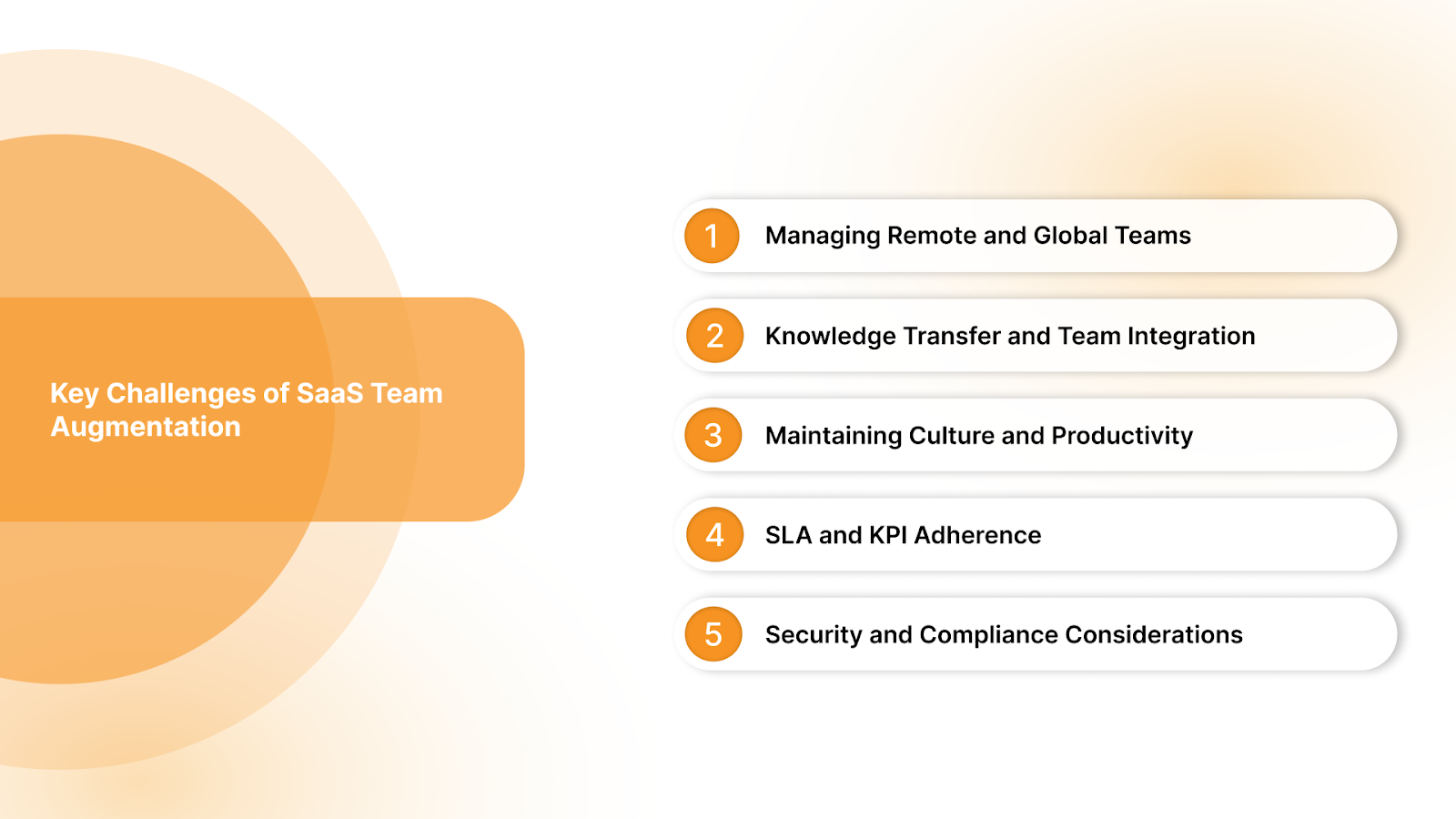
Below are the most significant challenges SaaS companies face when adopting team augmentation:
- Managing Remote and Global Teams: Coordinating engineers across global teams can create communication gaps and slow decision-making. Clear processes and structured collaboration are essential to maintain alignment and sprint velocity.
- Knowledge Transfer and Team Integration: Transferring domain knowledge and onboarding external developers takes effort. Without structured processes, ramp-up time increases and early productivity can be limited.
- Maintaining Culture and Productivity: Augmented engineers may not immediately adapt to internal norms and workflows. This can affect coding consistency, team cohesion, and overall productivity if not addressed early.
- SLA and KPI Adherence: Ensuring external teams meet delivery metrics requires consistent tracking and transparent reporting. Lack of oversight can lead to missed deadlines and reduced output quality.
- Security and Compliance Considerations: External engineers must follow strict security protocols and comply with internal and industry standards. Governance lapses can expose platforms to data risks and regulatory issues.
By addressing these challenges proactively, organisations can maximise the benefits of SaaS team augmentation while ensuring seamless delivery, high productivity, and robust security across global teams.
Why Choose V3 Staffing for SaaS Team Augmentation
Scaling SaaS teams globally requires speed, specialised expertise, and reliable delivery. V3 Staffing helps companies overcome hiring delays and build high-performing engineering teams without compromising quality. Their approach combines domain-focused recruitment, SLA-driven processes, and global reach to keep your SaaS product development on track.
Key Advantages
- SLA-Driven, High-Touch Delivery: Structured processes and SLAs ensure timely hiring of qualified candidates with consistent oversight and accountability.
- Domain-Specialised Recruiters: Recruiters focus on Engineering, Cloud, AI/ML, Data, Cybersecurity, and Product roles, matching candidates to precise technical needs.
- Global Hiring Coverage: Supports SaaS hiring across India, the USA, and the UAE, ensuring compliance, cultural alignment, and seamless integration of augmented teams.
- Proven Enterprise Success: Delivered staffing solutions for mid-sized and large SaaS companies, reducing time-to-hire, improving retention, and strengthening product development capacity.
V3 Staffing combines expertise, speed, and global reach, making it the preferred partner for companies looking to scale SaaS teams effectively.
Conclusion
SaaS team augmentation enables companies to scale product engineering rapidly while maintaining high-quality standards. By understanding its scope, knowing when it is the right fit, and addressing challenges like global team coordination, knowledge transfer, and performance tracking, organisations can ensure that external teams integrate smoothly with internal workflows. This approach helps accelerate product delivery, access specialised technical talent, and maintain consistency across development cycles.
V3 Staffing helps SaaS companies build and scale global teams efficiently, with SLA-driven processes and domain-specialised recruiters. Our experience in Engineering, Cloud, AI/ML, Data, Cybersecurity, and Product roles ensures you get the right talent for your specific technical needs. With global delivery across India, the USA, and the UAE, we provide end-to-end staffing support that aligns with your business goals.
Connect with our experts to design your customised SaaS team augmentation strategy and start scaling your engineering teams today.