
.svg)
.svg)
Global Capability Centres are under pressure to do more than support delivery. Many now lead work across AI, machine learning, data, cloud, cybersecurity, and product engineering. That creates a hiring problem most internal teams struggle to solve: niche roles stay open too long, hiring cycles slow down, and critical programmes lose momentum.
According to NASSCOM, India hosts more than 1,700 GCCs employing over 1.9 million professionals. As these centres expand across India, the USA, and the UAE, demand for specialised AI talent is rising faster than traditional hiring pipelines can keep up with. That is why many enterprises turn to an AI ML outsourcing company for GCCs to access qualified talent faster and build stronger teams without slowing business growth.
In this article, we explore how outsourcing partners help GCCs build AI and machine learning teams and address the hiring challenges organisations face when sourcing specialised talent.
Key Takeaways
- GCCs are becoming AI innovation hubs. Many enterprises now use Global Capability Centres to build AI products, data platforms, and advanced engineering solutions.
- Hiring specialised AI talent is complex and competitive. Roles such as machine learning engineers, MLOps specialists, and AI architects often require niche expertise that is difficult to source through traditional hiring pipelines.
- AI talent outsourcing helps GCCs scale technology teams faster. Recruitment partners provide access to curated talent pools and structured hiring processes for specialised technology roles.
- Enterprises outsource recruitment to access global AI talent markets. Hiring networks across India, the USA, and the UAE allow organisations to source specialised engineers across multiple locations.
- Structured recruitment models support long-term AI team building. Approaches such as IT staffing, contract staffing, and recruitment process outsourcing help organisations scale engineering teams for large technology programmes.
What Is an AI ML Outsourcing Company for GCCs?
An AI ML outsourcing company for GCCs helps enterprises build internal AI capability by hiring specialised talent for Global Capability Centres. The focus is not on delivering an outsourced AI product. It is on helping the GCC hire the engineers, architects, data specialists, and product talent needed to own AI execution in-house.
That distinction matters because “outsourcing” can mean different things in enterprise conversations. Some partners build AI systems for clients. Others support hiring so the enterprise can build and run those systems within its own GCC setup. For companies expanding AI capability across engineering, data, cloud, and product teams, the second model is often the more relevant one.
To make this clearer, here is how the common models differ:
For GCCs, the requirement is often not outsourced AI development. It is recruitment support that helps internal teams hire faster, screen better, and build capability across AI, data, cloud, security, and product without slowing growth plans.
Also Read: Expand GCC in India: Key Trends and Opportunities for 2025
When Should a GCC Work With an AI ML Outsourcing Partner?
Not every GCC needs external hiring support at the start. But there are certain points where internal hiring teams begin losing speed, visibility, or screening quality, especially when AI hiring demand expands faster than recruiter bandwidth.
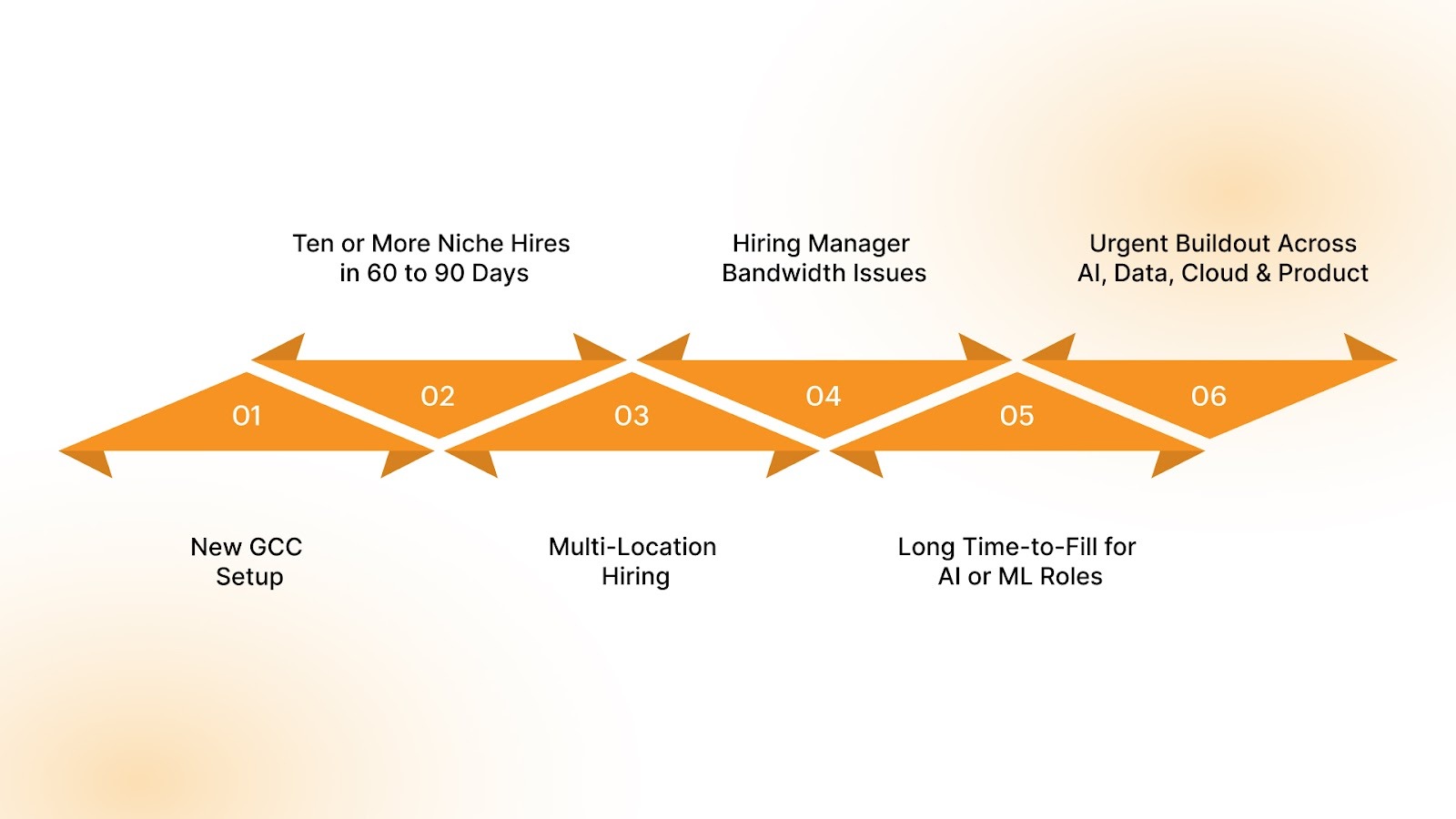
1. New GCC Setup
A new GCC rarely hires one capability at a time. It often needs to stand up multiple functions together across AI, data, engineering, cloud, and product. In this stage, hiring delays can affect both delivery timelines and leadership planning, which is why outside recruitment support becomes useful early.
2. Ten or More Niche Hires in 60 to 90 Days
A high-volume requirement for specialised roles changes the nature of recruitment. It is no longer just about sourcing candidates. It becomes a coordination problem across screening, stakeholder management, and decision speed.
3. Multi-Location Hiring
Hiring across India, the USA, and the UAE introduces different salary expectations, availability patterns, and market dynamics. A partner with multi-location hiring capability can help the GCC maintain consistency while adapting to local conditions.
4. Hiring Manager Bandwidth Issues
When engineering and product leaders spend too much time reviewing weak profiles or repeating interviews for the same role, the problem is usually upstream. Better recruiter screening and tighter hiring coordination can reduce that load.
5. Long Time-to-Fill for AI or ML Roles
If AI architects, MLOps engineers, or ML engineers remain open for too long, that usually points to three issues: weak talent access, generic screening, or slow process movement. A specialised hiring partner can help address all three.
6. Urgent Buildout Across AI, Data, Cloud, and Product
When the requirement spans multiple capability areas, internal teams often struggle to prioritise, sequence, and close roles efficiently. A partner helps create more structure around role coverage, pipeline building, and hiring progression.
Why GCCs Are Outsourcing AI and ML Talent Hiring
GCCs outsource AI and ML hiring because specialised technology hiring is harder to manage through general recruitment workflows. The problem is not only finding candidates. It is finding the right candidates fast enough, evaluating them properly, and moving them through the process before competing offers do.
1. Faster Team Buildout
AI initiatives usually depend on several roles being hired in sequence, not in isolation. If model engineers are hired before data pipelines are ready, or product hiring lags behind engineering, programme timelines begin to slip.
2. Access to Hard-to-Reach Talent
Specialised recruiters often have stronger access to talent pools that are not consistently visible through job boards or standard inbound channels. This matters more in roles such as AI architecture, LLM engineering, MLOps, and AI infrastructure.
3. Better Hiring Coordination Across Functions
Large AI programmes involve overlapping needs across data, engineering, cloud, platform, product, and security. Recruitment partners help reduce fragmentation when different hiring managers are working toward the same buildout.
4. More Flexible Hiring Models
Not every role needs to be filled the same way. Some must be permanent from day one, some are better suited to contract staffing, and some require a broader outsourced recruitment setup through RPO. That flexibility is harder to manage internally when hiring demand spikes.
5. Less Strain on Internal Teams
When internal HR and TA teams are already supporting broader business hiring, specialised AI hiring can become an execution burden. External support helps protect hiring quality without forcing internal teams into constant firefighting.
A 2025 EY GCC Pulse Survey found that 58% of GCCs in India are investing in agentic AI, while two-thirds are creating dedicated innovation teams. That signals a broader shift toward more specialised AI hiring demand inside GCC environments.
Many organisations also explore scalable hiring frameworks to support technology expansion. You can read more about recruitment strategies used by large enterprises.
AI and ML Roles GCCs Commonly Outsource
AI hiring in GCCs has become broader and more layered. Enterprises are not only hiring model builders. They are building capability across infrastructure, deployment, governance, product, and analytics so AI can move from experimentation to enterprise use.
The broader the AI initiative, the more these roles begin to depend on each other. That is why GCCs often outsource hiring support not only for hard-to-fill roles, but also for role clusters that need to be built together.
Also Read: Top 10 GCC Companies in India Transforming Business
Hiring Models GCCs Use for AI and ML Team Expansion
Different hiring needs call for different recruitment models. GCCs usually get better results when they choose the model based on role criticality, urgency, and how stable the requirement is over time.
- Permanent Hiring suits long-term capability building where the business needs sustained ownership across AI, data, cloud, cybersecurity, and product.
- Contract Staffing works better when the GCC needs niche specialists quickly for a fixed phase, urgent milestone, or project-led buildout.
- Contract-to-Hire is useful when the business wants flexibility before committing to a long-term role, especially for niche technical positions where fit is difficult to assess on paper.
- RPO for GCCs is most relevant when hiring is spread across functions, geographies, or multiple open roles over a sustained period. It helps create structure, visibility, and process consistency at scale.
- Executive Search for AI Leadership is used for senior roles such as AI heads, engineering directors, platform leaders, and transformation leads, where hiring requires deeper mapping, stronger evaluation, and closer alignment with long-term team design.
The key advantage of using the right model is not only better hiring speed. It is a better hiring fit, lower process friction, and clearer alignment between recruitment effort and business need.
Organisations often combine these hiring approaches with structured recruitment frameworks. See how the V3 Staffing recruitment process supports enterprise hiring programmes.
Biggest Hiring Challenges in GCC AI Expansion
AI hiring in GCCs becomes difficult when specialised demand meets general recruitment processes. Most hiring delays in this space come from a combination of weak market access, screening gaps, and decision-making friction.
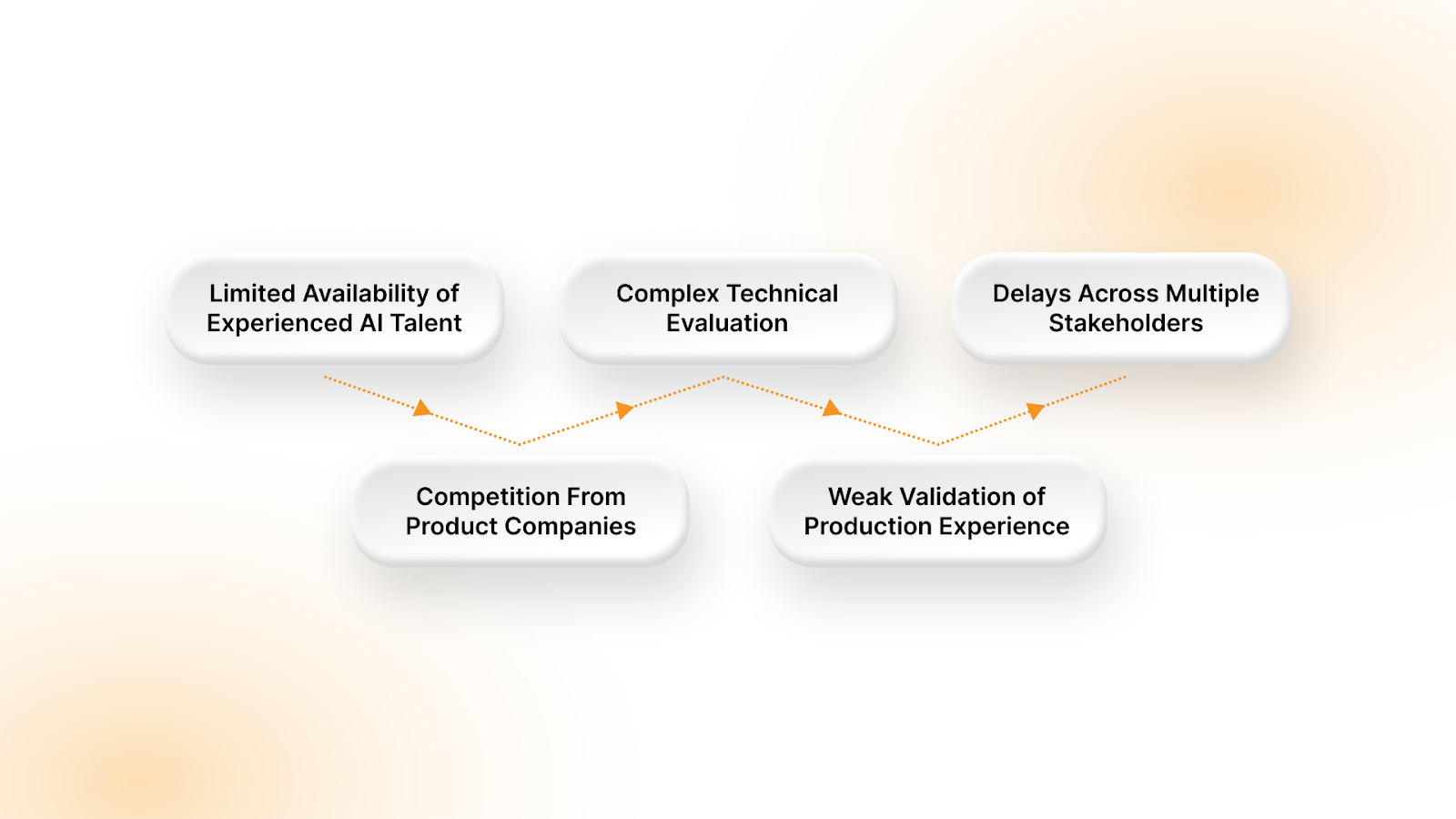
1. Limited Availability of Experienced AI Talent
Production-ready AI talent remains limited, particularly in areas like MLOps, LLM engineering, AI architecture, and governance-heavy roles. Many candidates understand concepts well but have not worked in enterprise-scale delivery environments.
2. Competition From Product Companies and AI Startups
The same candidates are often being targeted by high-growth startups, product firms, research-focused teams, and enterprise modernisation programmes. This reduces the decision window for GCCs and increases the cost of slow hiring.
3. Complex Technical Evaluation
AI hiring cannot rely only on resume screening or generic coding rounds. Roles often need evaluation across modelling, deployment, data systems, infrastructure, and business applications, which makes the process longer and more stakeholder-dependent.
4. Weak Validation of Production Experience
A candidate may have built models in controlled settings but still lack real exposure to deployment trade-offs, observability, retraining, governance, or scale. Distinguishing between theoretical competence and production readiness is one of the hardest parts of hiring in this space.
5. Delays Across Multiple Stakeholders
AI hiring often involves engineering leaders, data teams, product stakeholders, and hiring managers all weighing in at different stages. Without tighter coordination, even strong pipelines slow down before the offer stage.
These hiring issues usually do not come from one problem alone. In most GCC environments, the real bottleneck is the combination of limited access to niche talent, slower shortlist movement, and inconsistent coordination across teams and locations.
That is why many GCCs bring in specialised recruitment support when AI hiring starts affecting delivery timelines. A stronger hiring model can improve access to hard-to-reach talent, tighten screening quality, and bring more consistency into permanent, contract, or RPO-led hiring across India, the USA, and the UAE.
How to Choose the Right AI ML Outsourcing Company for a GCC
Many enterprises lose time by treating all hiring partners as interchangeable. The right AI ML outsourcing company for a GCC should be able to handle role complexity, stakeholder coordination, and delivery scale, not just send profiles faster.
1. Proven GCC Hiring Experience
Has the partner supported enterprise hiring in environments where teams are being built across functions, locations, and leadership layers? GCC hiring requires more than standard staffing capability.
2. Role Coverage Across AI, Data, Cloud, Cybersecurity, and Product
A useful partner should be able to support the wider capability mix that AI expansion requires. Otherwise, hiring becomes fragmented across too many vendors or internal teams.
3. Screening Process for Niche Talent
The real question is not whether the partner understands job titles. It is whether they can assess production-level relevance in roles such as ML engineering, LLM workflows, AI infrastructure, or cloud governance.
4. Global Hiring
If the GCC operates across multiple hiring markets, the partner should be able to maintain process consistency while adapting to local talent conditions.
5. SLA and Reporting Discipline
Clear timelines, structured reporting, and shortlist quality discipline matter because specialised hiring can become opaque very quickly without process control.
6. Ability to Scale From Pilot Hiring to Full Programme Support
Some engagements begin with a few niche roles and expand into a broader hiring programme. A strong partner should be able to scale with that shift without rebuilding the entire recruitment model.
How V3 Staffing Supports GCC Hiring for AI, Data, Cloud, and Product Teams
Building AI, data, cloud, and product teams inside a GCC requires more than general recruitment support. V3 Staffing helps enterprises manage specialised hiring through IT staffing, RPO services, contract staffing, leadership hiring, and global hiring services, depending on the role mix, hiring urgency, and team expansion plan.
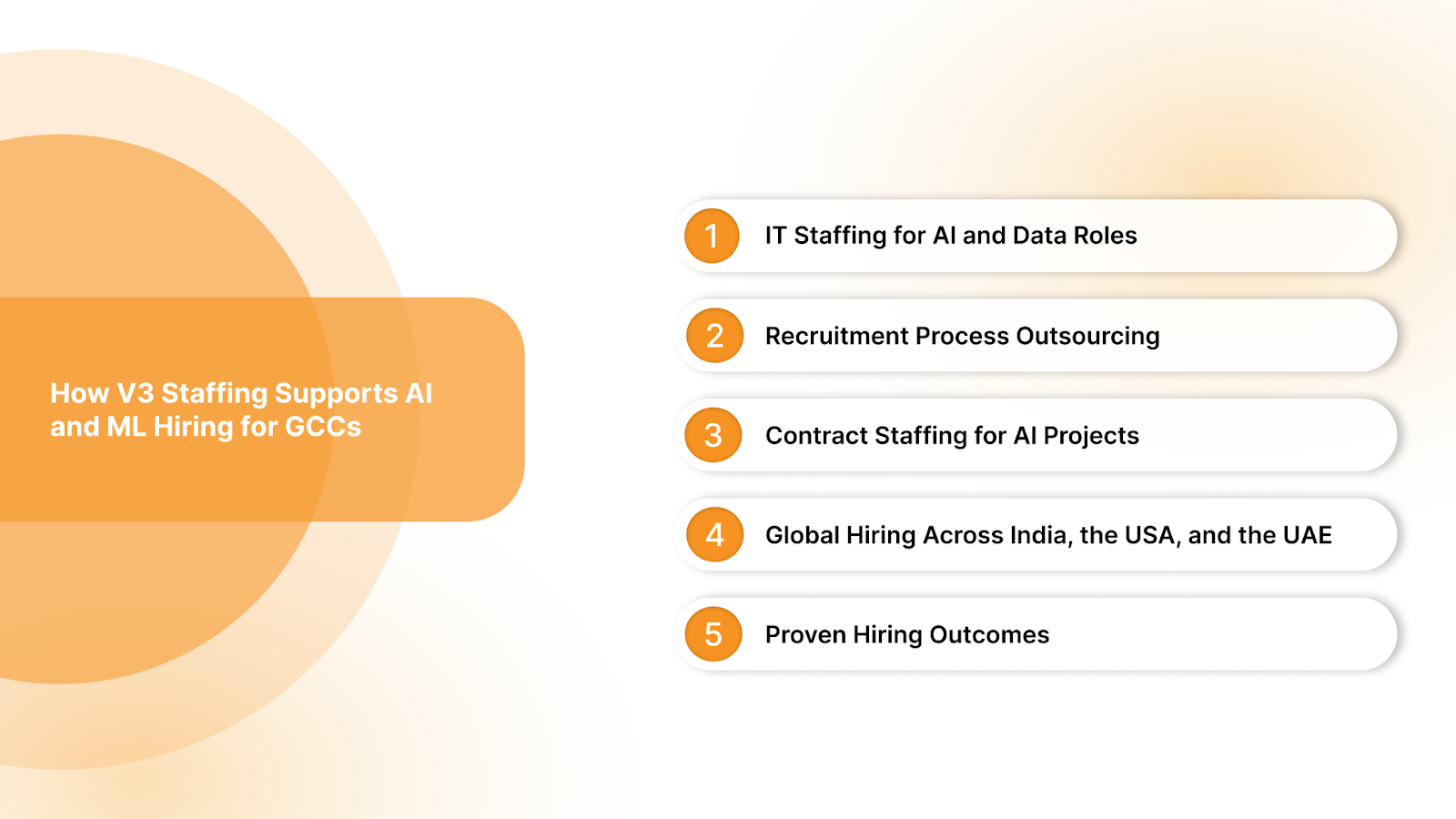
1. IT Staffing AI and Data Roles
V3 Staffing supports niche hiring across machine learning, AI engineering, data engineering, cloud infrastructure, and cybersecurity roles. This helps GCCs fill technical positions that need stronger screening, better role alignment, and candidates who can work in enterprise delivery environments.
2. Recruitment Process Outsourcing for Ongoing GCC Hiring
When hiring demand spans multiple roles or teams, V3 Staffing supports GCCs through RPO services that bring more structure into sourcing, screening, interview coordination, and reporting. This is useful for enterprises that need a steadier recruitment process across ongoing AI, data, cloud, and product hiring.
3. Contract Staffing for Project-Led Buildouts
Some AI initiatives need specialists for fixed phases such as model deployment, platform setup, data pipeline work, or cloud support. Through contract staffing, V3 Staffing helps GCCs bring in experienced professionals for time-bound requirements without relying only on permanent hiring.
4. Leadership Hiring for AI and Product Expansion
As GCCs mature, they often need senior talent to lead AI, engineering, platform, and product functions. V3 Staffing supports this through leadership hiring, helping enterprises identify leaders who can build teams, guide capability growth, and support long-term execution.
5. Global Hiring Across India, the USA, and the UAE
Many GCCs hire across more than one market, especially when talent demand stretches across delivery hubs and leadership locations. Through global hiring services, V3 Staffing supports recruitment across India, the USA, and the UAE while helping enterprises maintain more consistent hiring standards across locations.
6. Proven Hiring Outcomes
V3 Staffing’s delivery model is backed by measurable outcomes that matter in GCC hiring:
- 10,000+ specialists hired
- 300+ clients served
- Average time to hire: 10 days
These outcomes reflect experience across specialised recruitment, large-scale team expansion, and structured hiring support for enterprise environments.
Conclusion
For GCCs building AI capability, the hiring challenge is no longer limited to finding candidates. It is about closing specialised roles fast enough, screening them properly, and keeping multi-team hiring plans on track across functions and locations.
That is where a specialised hiring partner can make a real difference. V3 Staffing helps GCCs hire across AI, data, cloud, cybersecurity, and product teams through structured recruitment support designed for niche roles, ongoing hiring demand, and business-led expansion.
Contact V3 Staffing to build stronger GCC teams with recruitment support aligned to your AI hiring goals.