
.svg)
.svg)
Scaling organisations cannot afford hiring delays when business growth depends on specialised talent. Yet many enterprises still approach recruitment reactively, beginning the search only after a vacancy arises. For MNCs and fast-growing startups with a workforce of over 100 employees, this often results in prolonged hiring cycles, higher cost per hire, and disruption to delivery timelines.
According to the ManpowerGroup 2025 Talent Shortage Survey, 80% of employers in India are struggling to find skilled talent, which is higher than the global average of 74% reporting similar challenges. The shortage is particularly visible in technology, data, engineering and leadership roles across India, the USA and the UAE, where demand continues to outpace supply.
This is why hiring pipeline development is no longer optional but strategic. A structured hiring pipeline enables organisations to identify, nurture and assess qualified professionals before critical roles become urgent. In this blog, we will define what a talent pipeline means, explore why internal teams struggle to sustain one, outline its business benefits, and provide a practical framework to build a strong and sustainable hiring pipeline.
Key Takeaways
- A hiring pipeline is a proactive, structured system for identifying, assessing, and nurturing talent before roles become urgent.
- It is different from a recruitment funnel (role-specific and reactive) and a talent pool (passive database of profiles).
- Internal teams often struggle due to reactive cycles, limited bandwidth, niche skill shortages, multi-geo complexity, and weak engagement systems.
- A strong pipeline improves hiring predictability, quality-of-hire, offer acceptance rates, and workforce planning accuracy.
- The 10-step framework includes role prioritisation, proactive sourcing, early vetting, segmentation, continuous engagement, technology integration, and performance measurement.
- Recruitment technology (ATS–CRM integration, dashboards, analytics, AI screening) enables visibility, forecasting, and structured pipeline governance.
What Is a Hiring Pipeline?
Many organisations use the terms hiring pipeline, recruitment funnel and talent pool interchangeably. This often creates confusion at the leadership level, especially when workforce planning decisions are being made. A clear distinction between these concepts is essential for an enterprise-level hiring strategy.
A hiring pipeline is a structured system for continuously identifying, engaging, and assessing potential candidates for future hiring needs. It is proactive, long-term and aligned with business growth plans rather than immediate vacancies.
Hiring Pipeline vs Recruitment Funnel
While both are part of the broader talent acquisition ecosystem, they serve different purposes and operate at different stages of the hiring cycle.
Hiring Pipeline Development
Hiring pipeline development is the strategic process of building, segmenting and maintaining a pool of pre-qualified talent aligned to anticipated business demand. It involves workforce forecasting, ongoing sourcing, passive candidate engagement, employer branding, and structured relationship management. The focus is long-term capability building rather than filling a single vacancy.
Recruitment Funnel
The recruitment funnel begins only after a role is formally approved and opened. It represents the step-by-step process candidates move through, including sourcing, screening, interviews, assessments and final selection. The objective is immediate role closure within defined timelines.
In simple terms, the recruitment funnel is transactional and role-specific, whereas hiring pipeline development is strategic and continuity-driven. Organisations that depend only on funnels often face hiring delays, while those with mature pipelines maintain hiring readiness even during sudden growth phases.
Despite understanding this distinction, many internal talent teams struggle to consistently maintain a strong hiring pipeline. Let us examine why.
Also Read: 10 High-Volume Recruitment Strategies for Efficient Hiring in 2026 - V3Staffing
Why Internal Teams Struggle to Maintain a Strong Hiring Pipeline
Internal talent teams often struggle to maintain a strong hiring pipeline, especially in organisations scaling engineering, data, cloud, AI/ML, and product teams across multiple regions like India, the USA, and the UAE. These challenges resonate strongly with CHROs, Talent Acquisition Heads, and BU leaders managing complex hiring needs.
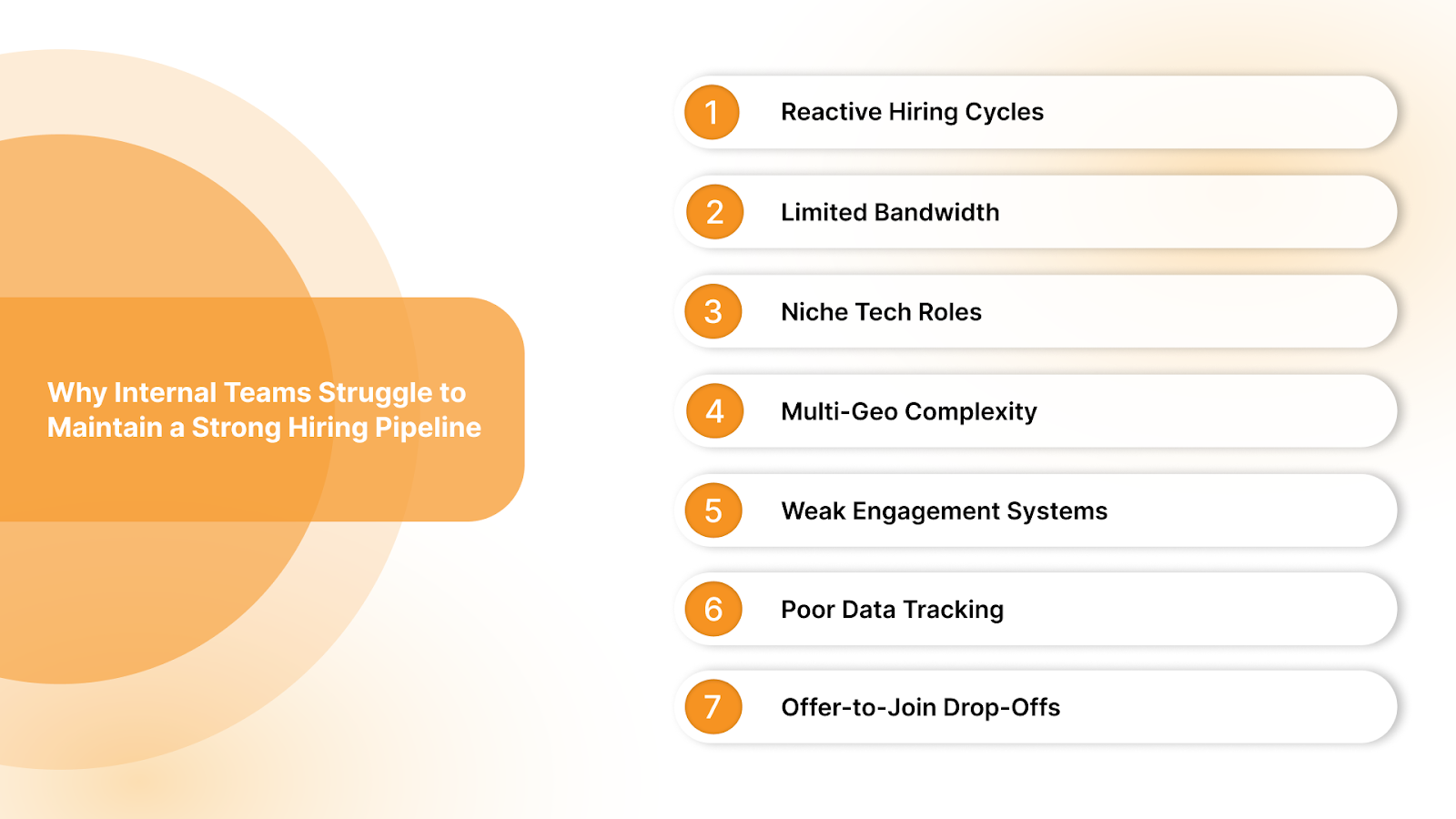
- Reactive Hiring Cycles: Teams focus on filling open roles instead of planning ahead, causing delays when hiring demand spikes.
- Limited Bandwidth: Recruiters are stretched with daily operational hiring, leaving little time for proactive candidate sourcing and engagement.
- Niche Tech Roles: Hard-to-fill positions like AI/ML engineers, cloud specialists, and senior product leads require expert sourcing networks that internal teams often lack.
- Multi-Geo Complexity: Hiring across India, the USA, and the UAE adds compliance, market, and coordination challenges that slow pipeline building.
- Weak Engagement Systems: Without structured workflows or automated tools, passive candidates can lose interest over time.
- Poor Data Tracking: Lack of dashboards or metrics makes it hard to monitor pipeline health, conversion rates, and stage bottlenecks.
- Offer-to-Join Drop-Offs: Candidates sometimes decline offers or delay joining, disrupting planned pipeline forecasts.
To overcome these challenges, many organisations partner with experienced recruitment providers like V3 Staffing. With dedicated domain recruiters, SLA-driven processes, and multi-country sourcing expertise, V3 helps maintain a reliable and responsive hiring pipeline, even when internal teams are stretched.
Despite these challenges, a structured pipeline delivers measurable business advantages.

Benefits of a Strong Hiring Pipeline
A well-structured hiring pipeline transforms recruitment from a reactive process into a strategic advantage. Globally, organisations that build and maintain pipelines can fill critical roles faster, hire better talent, reduce costs, and plan workforce growth with confidence.
- Faster Time-to-Hire: Pre-qualified candidates reduce delays and prevent project disruptions. This allows teams to maintain continuity and avoid productivity losses even during peak hiring periods.
- Higher Quality Hires: Early engagement and assessment ensure candidates have the right skills, experience, and cultural fit. This reduces turnover risk and improves team performance over time.
- Better Workforce Planning: Visibility into future talent availability supports strategic resource allocation and succession planning. It helps leadership anticipate skill gaps before they impact business operations.
- Lower Recruitment Costs: Reduces reliance on expensive last-minute agency hires or job postings. Long-term candidate pipelines spread sourcing costs and improve recruitment ROI.
- Improved Offer Acceptance: Continuous engagement with candidates keeps them committed and reduces the likelihood of declining offers. This ensures that talent pipelines translate into actual hires efficiently.
- Stronger Employer Brand: Consistent communication and nurturing position the organisation as a preferred employer in competitive markets. It also drives higher inbound interest from top-tier talent.
- Rapid Scaling Across Units & Regions: Ready talent pools enable smooth expansion of teams across business units and geographies. Organisations can scale quickly without compromising on skill quality or time-to-productivity.
Building a strong hiring pipeline enables organisations to stay ahead of talent demand, make informed hiring decisions, and ensure teams are fully equipped to meet business goals.
Also Read: Benefits of Staffing: Process and Advantages in 2026 - V3Staffing
How to Build an Effective Talent Pipeline (10-Step Framework)
Building an effective talent pipeline is a structured, long-term capability. It reduces reactive hiring, improves quality-of-hire, shortens time-to-fill, and creates predictable access to critical skills. The goal is not to collect resumes, but to maintain a segmented, qualified, and engagement-ready talent bench aligned with business strategy.
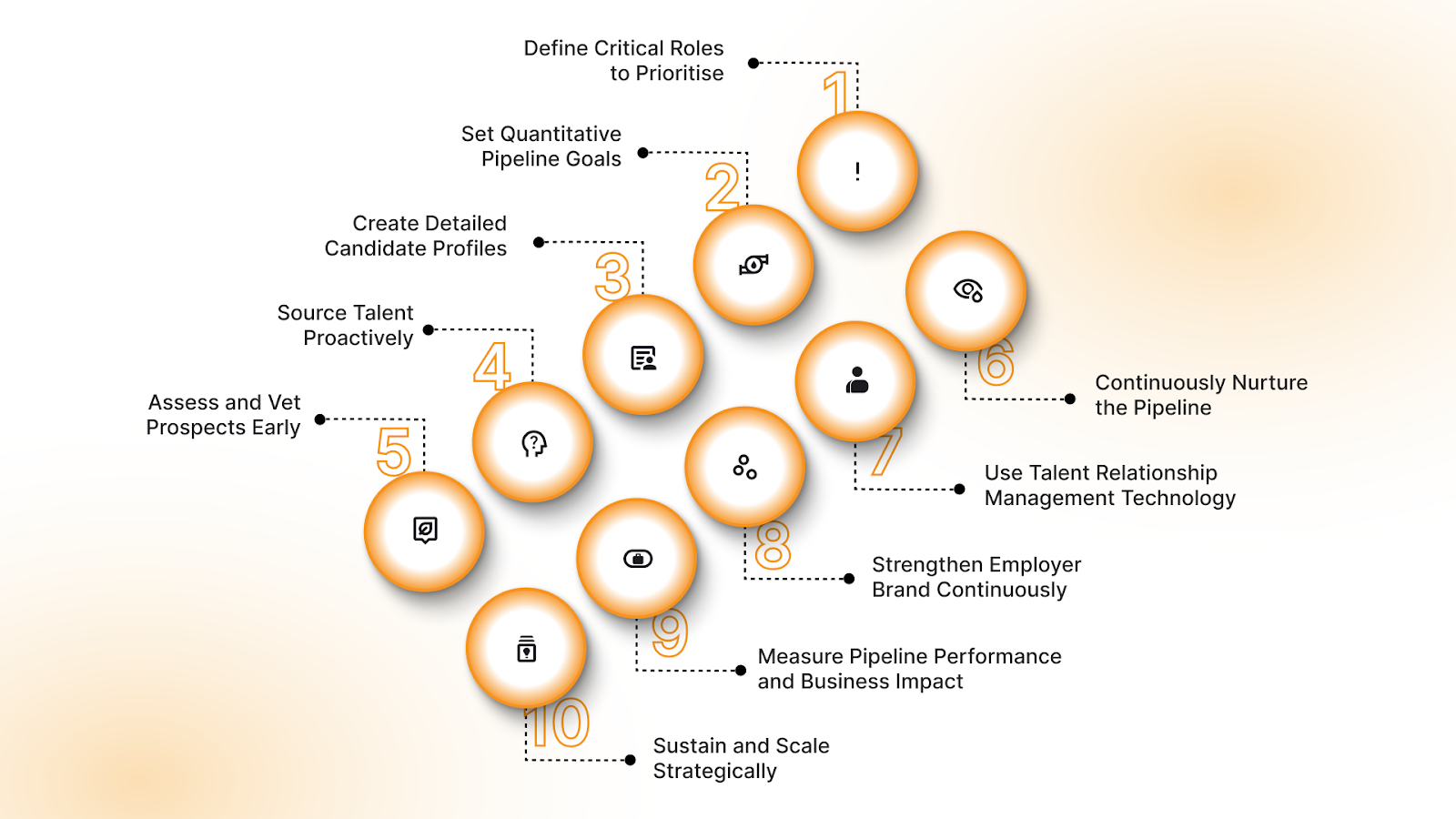
Below is a detailed 10-step framework with practical depth.
1. Define Critical Roles to Prioritise
Pipeline efforts should focus on roles that materially impact business performance or are consistently difficult to fill.
Prioritise:
- Scarce technical roles (e.g., AI/ML, Cloud, Data, Cybersecurity)
- Revenue-driving functions (enterprise sales, product leadership)
- Leadership and succession-critical positions
- Roles with historically long time-to-fill
- High-growth business units
Go beyond job titles. Define:
- Business impact of the role
- Revenue or operational risk if left vacant
- Replacement difficulty
- External market availability
This ensures the pipelining effort is concentrated where it creates measurable ROI.
2. Set Quantitative Pipeline Goals
Without defined targets, pipelines become passive databases.
Establish measurable objectives such as:
- Monthly qualified additions per role segment
- Target percentage of hires sourced from the pipeline
- Maximum ageing threshold for inactive candidates
- Engagement touchpoints per quarter
- Conversion rate from pipeline to interview
Review metrics monthly. If a segment fails to convert, refine sourcing quality rather than increasing volume. Goals create operational discipline.
3. Create Detailed Candidate Profiles
Define the ideal candidate blueprint before sourcing begins.
Document:
- Required technical capabilities
- Years and type of experience
- Industry exposure
- Leadership or stakeholder complexity
- Problem-solving expectations
- Cultural alignment indicators
Include negative criteria as well, such as deal-breaker skill gaps or misaligned career trajectories.
A structured candidate profile prevents subjective screening and improves consistency across recruiters.
4. Source Talent Proactively
Reactive job advertising captures only active applicants. Effective pipelines rely on outbound sourcing.
Build talent streams through:
- Structured employee referral programs
- Professional communities and technical forums
- University partnerships and alumni networks
- Industry conferences and meetups
- Social platforms such as LinkedIn
Segment sourcing strategies by role. For example:
- Use technical communities for engineers
- Target industry-specific networks for niche domain experts
- Build leadership networks for succession roles
Quality sourcing reduces downstream assessment effort.
5. Assess and Vet Prospects Early
Qualification should begin before vacancies arise.
Use:
- Structured screening interviews
- Role-based technical assignments
- Case simulations
- Behavioural interviews using predefined scoring frameworks
Create weighted evaluation criteria such as:
- Technical accuracy
- Analytical depth
- Stakeholder communication
- Strategic thinking
- Scalability of impact
Segment candidates into:
- Ready now
- Ready within 6–12 months
- Long-term strategic potential
Early vetting reduces hiring cycle time when demand arises.
6. Continuously Nurture the Pipeline
Engagement must be structured and relevant, not generic.
Develop segmented communication plans:
- Quarterly technical insights by skill cluster
- Leadership updates for senior talent
- Industry reports for niche specialists
- Invitations to invite-only technical roundtables
Track engagement metrics:
- Open rates
- Event participation
- Response rates
- Reactivation rates
Remove consistently inactive profiles to maintain pipeline quality. Engagement quality matters more than frequency.
7. Use Talent Relationship Management Technology
Technology should enhance visibility and decision-making.
Best practices include:
- Integrating ATS with CRM systems
- Maintaining a centralised candidate history
- Automating follow-ups triggered by engagement behaviour
- Implementing pipeline scoring models
Use dashboards to monitor:
- Stage conversion rates
- Diversity representation
- Source performance
- Pipeline ageing
Quarterly system audits help remove duplicates, update skills, and maintain data integrity.
8. Strengthen Employer Brand Continuously
Employer brand influences pipeline inflow and responsiveness.
Move beyond job advertisements. Showcase:
- Employee career journeys
- Innovation stories
- Leadership visibility
- Learning and development initiatives
- Flexible work models
Encourage authentic employee advocacy rather than scripted messaging. A credible employer brand shortens engagement cycles and increases offer acceptance rates.
9. Measure Pipeline Performance and Business Impact
Measurement validates pipeline effectiveness.
Key metrics:
- Cost per pipeline addition
- Time-to-interview from the pipeline
- Interview-to-offer ratio
- Offer acceptance rate
- Quality-of-hire (performance ratings at 6–12 months)
- Retention rate of pipeline hires
- Hiring manager satisfaction
Link post-hire performance data back to sourcing channels and assessment scores. Optimise based on evidence rather than assumptions.
10. Sustain and Scale Strategically
Pipelines degrade without ownership and refresh cycles.
Ensure:
- Clear accountability for each talent segment
- Quarterly segment reviews
- Annual expansion aligned with workforce planning
- Proactive creation of new segments for emerging skills
When entering new markets or launching new service lines, build pipeline segments 6–9 months in advance.
Sustainable pipelines reduce hiring volatility, minimise dependency on urgent sourcing, and create long-term talent stability.
An effective talent pipeline is not a static database. It is a structured system built on prioritisation, qualification, engagement, measurement, and accountability. Organisations that operationalise these ten steps create predictable access to high-quality talent and gain a measurable competitive advantage in hiring.
Also Read: Building Scalable Recruitment Models: Key Strategies for Success - V3Staffing
Role of Technology in Hiring Pipeline Development
Digital maturity in recruitment is defined by structured systems, unified data visibility, and measurable hiring predictability. A strong hiring pipeline relies on technology not for automation volume, but for precision in segmentation, assessment tracking, engagement management, and workforce forecasting.

- ATS and CRM Integration
A connected Applicant Tracking System and Candidate Relationship Management platform ensures a single source of truth for every candidate. This enables seamless movement from passive pipeline to active hiring, preserves engagement history, and reduces repeated evaluation effort. - Talent Intelligence Dashboards
Real-time dashboards provide visibility into pipeline depth by role segment, readiness categorisation, stage conversion ratios, ageing profiles, and diversity tracking. Segmented reporting allows early identification of bottlenecks in evaluation cycles or sourcing effectiveness. - Automated Candidate Nurturing
Structured automation supports skill-based communication workflows triggered by candidate behaviour and engagement recency. This keeps priority talent segments active while maintaining relevance and avoiding generic outreach. - AI-Supported Resume Screening
AI tools assist in ranking candidates against predefined competency criteria and identifying required skill alignment. With structured human review and bias safeguards, AI improves screening efficiency without replacing recruiter judgment. - Analytics for Workforce Planning
Integrated recruitment analytics connect hiring data with attrition trends, growth projections, and time-to-fill benchmarks. This enables predictive pipeline building, ensuring pre-qualified talent is available ahead of anticipated demand.
-
How V3 Staffing Strengthens Your Hiring Pipeline
A strong hiring pipeline depends on reliable access to pre‑qualified talent and a recruitment partner that can respond quickly to evolving workforce demands. V3 Staffing combines deep domain expertise with structured hiring solutions to support organisations as they build and sustain a robust talent pipeline that aligns with long‑term business goals.
- Permanent Recruitment: V3 Staffing identifies and places full‑time professionals who are technically skilled and culturally aligned, helping organisations build stability through continuous talent availability.
- Temporary & IT Staffing: Flexible staffing models provide organisations with short‑term or project‑based talent, keeping pipelines active for roles that require rapid deployment or specialised technical skills.
- Recruitment Process Outsourcing (RPO): With SLA‑driven RPO solutions, V3 manages the full recruitment cycle, creating sourcing continuity and reducing internal hiring burden.
- Executive Search & Niche Roles: Targeted headhunting for leadership and niche technical positions ensures the pipeline includes strategic talent for high‑impact roles.
- Domain‑Focused Expertise: V3 staffing covers key sectors such as technology, shared services, engineering, finance, and BFSI, delivering talent that matches both technical requirements and business context.
V3 Staffing applies structured talent mapping, specialised sourcing methodologies, and workforce-aligned hiring execution to build domain-focused talent pipelines for enterprises managing complex and niche skill requirements.

Conclusion
Organisations that fail to plan often face delays, higher hiring costs, and gaps in critical roles. A well-structured hiring pipeline ensures that the right candidates are ready when needed, keeping teams productive and projects on track. By systematically defining priority roles, sourcing proactively, and nurturing talent over time, businesses gain predictability in hiring and reduce dependency on last-minute searches. Measured, strategic pipeline management transforms recruitment from a reactive task into a continuous, high-value process that directly supports growth objectives.
When hiring demand grows or specialised roles become difficult to fill, working with an experienced recruitment partner can strengthen execution. V3 Staffing supports organisations with structured recruitment services, domain-focused sourcing expertise, and scalable hiring solutions that help maintain consistent access to high-quality talent.
Contact our talent specialists to explore how V3 Staffing can optimise your hiring processes and support a reliable, high-quality talent pipeline.