
.svg)
.svg)
Contingent labor management is how businesses control external workforce hiring across temporary staff, contractors, consultants, freelancers, and agency-supplied talent. The focus is not only on filling short-term roles, but on managing external workforce demand with better visibility, stronger compliance, and clearer operational control.
This becomes more important when contingent hiring starts spreading across teams, vendors, or business units without a consistent process in place. At that point, the challenge is no longer just staffing. It becomes a question of governance, spend, onboarding discipline, worker classification, and workforce visibility.
In this guide, we explain what contingent labor management includes, why businesses rely on it, what usually breaks down, and how employers can manage contingent workforce demand more effectively.
At a Glance
- Contingent labor management is broader than short-term staffing: It covers how businesses manage external workers across sourcing, onboarding, compliance, vendor coordination, spend visibility, and offboarding.
- The biggest risks usually appear when contingent hiring scales without a standard process: Common issues include worker classification gaps, fragmented vendor use, poor visibility into workforce cost, and inconsistent governance across teams.
- Businesses use contingent labor to stay flexible, fill short-term skill gaps, and respond to changing demand: This makes it useful for project-based work, demand spikes, temporary coverage, and specialist requirements.
- A strong contingent labor program depends on visibility, process discipline, and role clarity: The goal is not only to bring in external workers quickly, but to manage them in a way that reduces risk and improves workforce control.
- Different models solve different parts of the problem: Internal management, staffing partners, MSPs, and VMS tools each play a role depending on workforce volume, complexity, and governance needs.
What Is Contingent Labor Management?
Contingent labor management is the operating framework businesses use to handle non-permanent workers in a controlled way. It brings structure to how external talent is requested, approved, onboarded, tracked, paid, and offboarded so that workforce flexibility does not create process gaps or unmanaged risk.
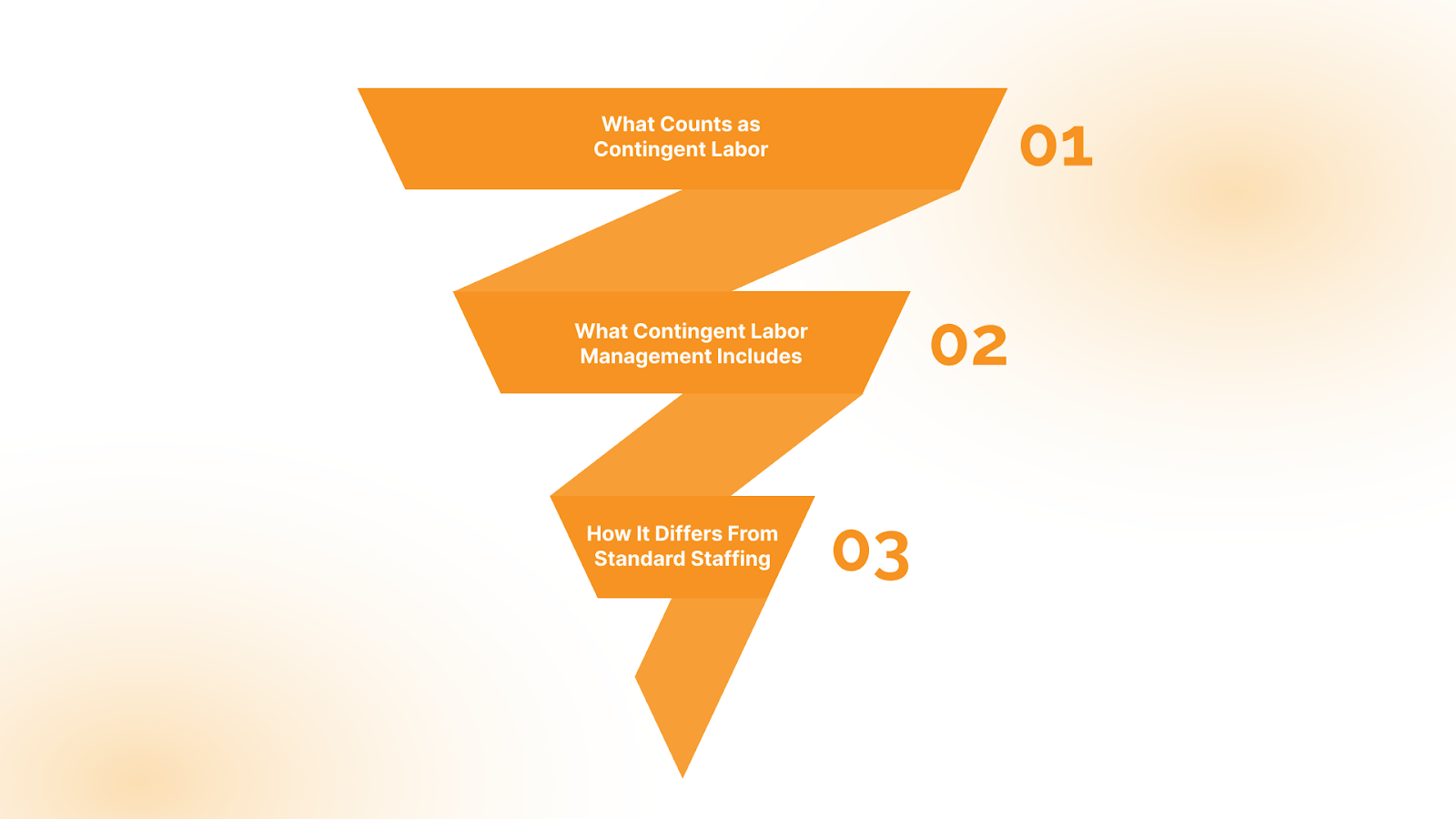
What Counts as Contingent Labor
Contingent labor usually includes workers who are engaged for a defined period, project, assignment, or service need rather than as permanent employees. This often covers temporary staff, contract workers, freelancers, consultants, agency-supplied workers, and other forms of external talent brought in for business support.
The exact mix can vary by company. In some organisations, contingent labor is mostly temporary and contract hiring. In others, it may also include specialist consultants, project-based talent, or externally managed workforce categories that sit outside standard employee headcount.
What Contingent Labor Management Includes
Managing contingent labor involves more than filling roles. It usually includes workforce request intake, hiring approvals, vendor coordination, contract terms, onboarding checks, documentation, time and cost tracking, access control, performance visibility, and exit handling.
The goal is to make sure external workers are not being managed in disconnected ways across departments. A structured contingent labor process helps businesses understand who is working, why they were hired, how long they are engaged for, which vendor or hiring route they came through, and what operational or compliance obligations apply to them.
How It Differs From Standard Staffing
Standard staffing is usually focused on filling a role. Contingent labor management is focused on controlling the broader system around external workforce use.
That difference matters when contingent hiring starts spreading across teams, vendors, and work types. A staffing process may help close the requirement, but contingent labor management is what helps the business govern how those workers are brought in, monitored, and managed over time.

Why Businesses Use Contingent Labor
Businesses use contingent labor when workforce demand does not fit neatly into long-term headcount planning. In many cases, the requirement is real and immediate, but the business may not need a permanent employee for the full duration or scope of the work.
Workforce Flexibility
One of the main reasons companies use contingent labor is to adjust workforce capacity without making permanent hiring decisions too early. This gives teams more room to respond when business activity changes faster than internal hiring plans can.
Faster Access to Skills
Some roles need specialised capability for a limited period rather than long-term team ownership. In those cases, contingent labor allows employers to bring in external talent for a defined need without waiting for a full permanent hiring cycle to run its course.
Project-Based Hiring
Projects often create temporary demand that does not continue after the work is complete. Businesses use contingent labor here to support implementation phases, transformation work, migrations, audits, launches, or function-specific deliverables where the workload is time-bound.
Demand Spikes and Short-Term Coverage
Contingent labor is also used when the business needs additional support for a short period due to seasonal peaks, employee absence, workload surges, or short-cycle operational pressure. This helps teams maintain continuity without changing long-term workforce structure for a temporary problem.
Cost Structure and Workforce Agility
In some situations, the business needs more flexibility in how workforce costs are allocated and managed. Contingent labor can help employers respond to demand with a more adjustable workforce model, especially when work volume, timing, or skill requirements are still evolving.
This is why contingent labor is often a workforce planning choice, not only a hiring shortcut. It gives businesses a way to match external talent use more closely to business timing, project demand, and operational variability.
Also Read: How Fast-Growing Companies Build Scalable Hiring Solutions in 2026
What Makes Contingent Labor Management Difficult?
Contingent labor usually becomes difficult to manage when external workers are being used across different teams, vendors, and business needs without one shared operating model. The issue is rarely the workforce category itself. It is the lack of consistent oversight around how that workforce is classified, tracked, approved, and governed over time.
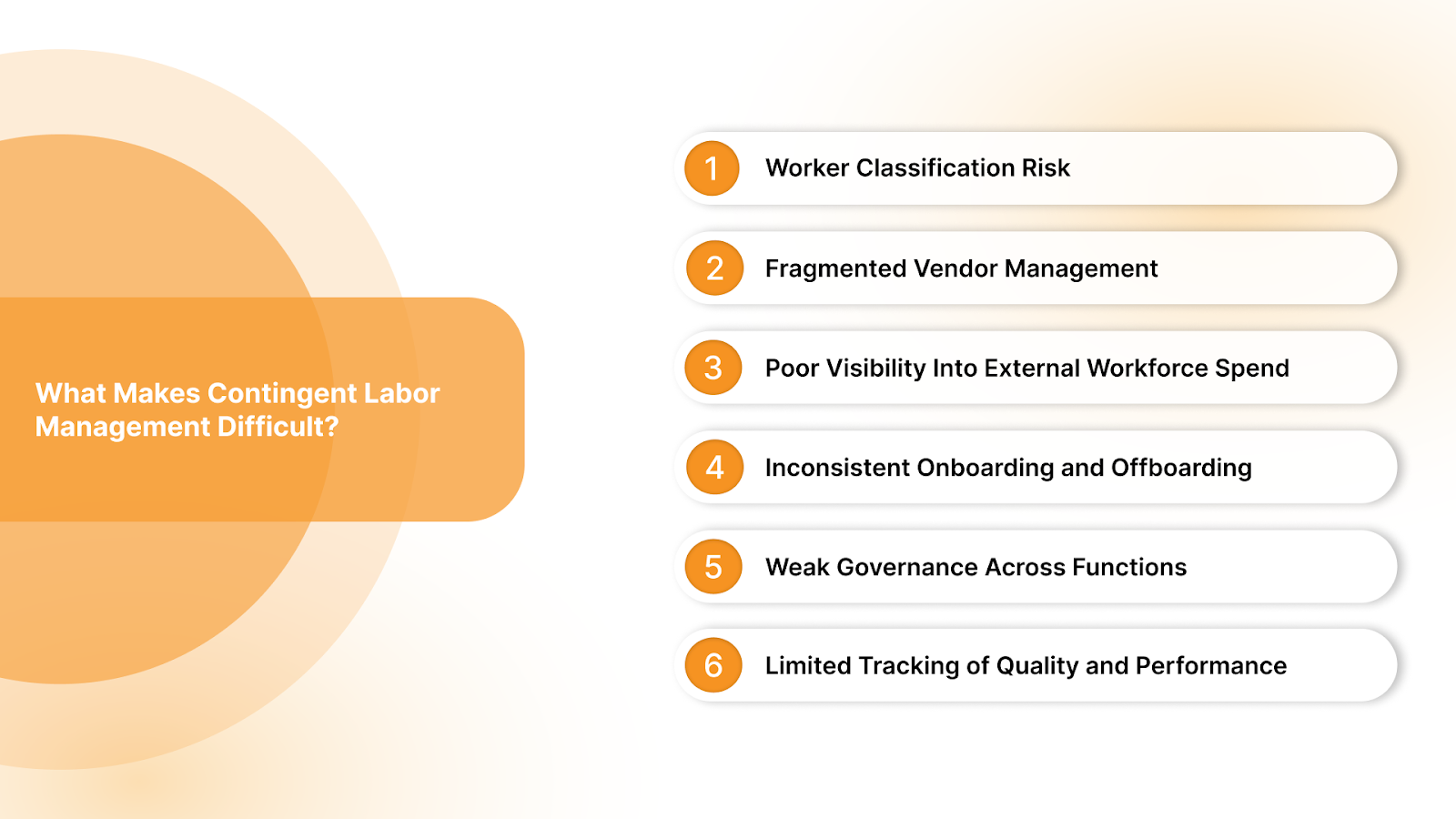
Worker Classification Risk
One of the biggest challenges is deciding how external workers should be classified in the first place. If contractors, temporary staff, consultants, or agency workers are not engaged under the right structure, the business can face tax, compliance, legal, and audit exposure later.
Fragmented Vendor Management
As contingent hiring grows, different teams often start using different staffing vendors or external hiring routes without shared controls. This makes it harder to compare quality, enforce service expectations, and maintain consistency across the broader external workforce program.
Poor Visibility Into External Workforce Spend
Many businesses know they are using contingent labor, but still do not have a clear view of how much is being spent, which teams are using the most external support, or where that spend is increasing without enough oversight. This creates problems when leadership needs accurate workforce cost data for planning or review.
Inconsistent Onboarding and Offboarding
If contingent workers are brought in through different channels without standard onboarding and exit steps, businesses can face avoidable issues around documentation, access, handover, system usage, and risk closure. These gaps often become visible only after the worker has already started or left.
Weak Governance Across Functions
Contingent labor often sits across HR, procurement, finance, legal, operations, and business teams at the same time. When ownership is spread out but process accountability is unclear, decisions become inconsistent and external workforce use becomes harder to control.
Limited Tracking of Quality and Performance
Many organisations track fill speed or vendor activity, but not enough of the deeper indicators that show whether the contingent workforce model is actually working. Without better tracking of tenure, output, role continuity, quality of hire, and fulfilment reliability, it becomes harder to improve the program over time.
These are the issues that usually make contingent labor management more complex than expected. The challenge is not just bringing in external workers. It is creating enough structure around the program so that flexibility does not come at the cost of control.

Core Elements of an Effective Contingent Labor Management Program
A contingent labor program works better when it is built around a few clear control points rather than handled through ad hoc decisions across teams. The goal is to create a model that supports workforce flexibility while keeping approvals, vendor use, worker records, and operational accountability aligned.
Clear Worker Classification Rules
The program should define how different types of external workers are classified before engagement begins. This creates a stronger foundation for contracts, compliance checks, tax treatment, access decisions, and role ownership.
Centralised Requisition and Approval Flow
A clear intake and approval process helps the business control why contingent workers are being brought in, which team is requesting them, and whether the engagement fits workforce policy. This reduces unplanned hiring activity and gives leadership better visibility into external workforce demand.
Standard Vendor Governance
Contingent labor programs are easier to manage when vendors are assessed through one set of service expectations rather than through disconnected department-level arrangements. Standard governance helps the business compare vendor performance, reduce duplication, and keep hiring quality more consistent.
Consistent Onboarding and Compliance Checks
Every contingent worker should move through the same core onboarding steps, regardless of which team requested the role or which vendor supplied the worker. This helps protect the business from avoidable gaps in documentation, access, readiness, and policy compliance.
Time, Cost, and Role Visibility
A strong program makes it easier to see who is working, what role they are supporting, how long they are engaged, and how much that engagement is costing. This visibility is important not only for budgeting, but also for workforce planning and program review.
Offboarding and Risk Closure
A contingent labor program should also define how assignments end. Clear offboarding steps help the business close access, recover assets, complete documentation, and reduce the risk of workers remaining active in systems or processes after the engagement is over.
These elements are what turn contingent hiring from a reactive staffing activity into a more manageable workforce model. Without them, businesses may still fill external roles, but they will struggle to control the program as it grows.
Also Read: Understanding Payroll Deductions and Their Types
Common Models Used to Manage Contingent Labor
Businesses do not manage contingent labor in the same way at every stage of growth. The right model usually depends on how much external workforce demand exists, how many teams are involved, how complex vendor usage has become, and how much internal oversight the business can realistically maintain.
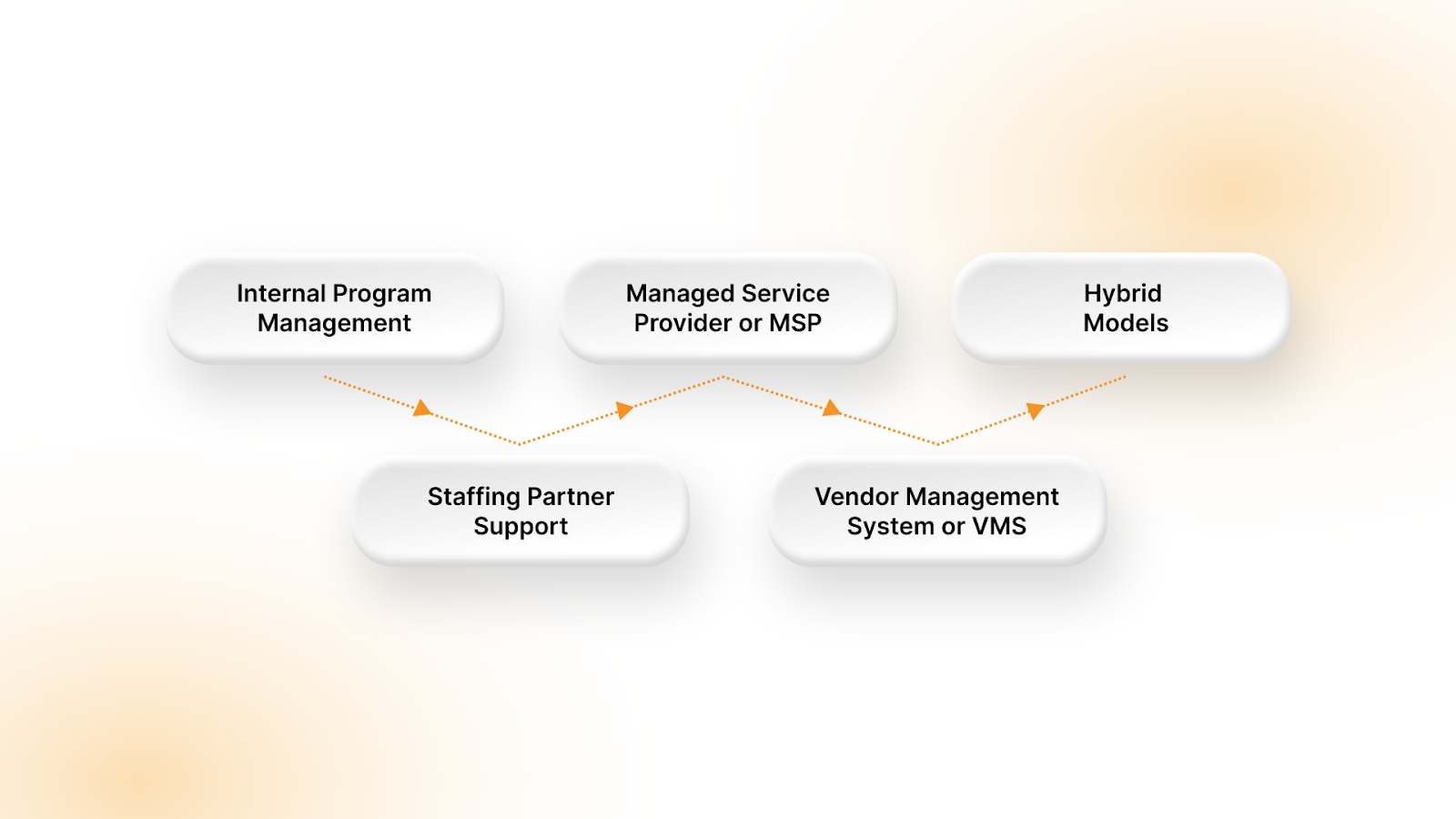
Internal Program Management
Some organisations manage contingent labor internally through HR, procurement, or workforce operations teams. This model can work when external hiring volume is still manageable and the business has enough internal discipline to control approvals, vendor use, documentation, and worker records without adding too much operational strain.
Staffing Partner Support
A staffing partner is often used when the business needs help filling temporary, contract, or contingent roles but does not need a fully managed program. In this model, the partner supports the hiring side of external workforce demand while the company retains more direct control over approvals, policies, and broader workforce governance.
Managed Service Provider or MSP
An MSP model is used when contingent labor has grown beyond what disconnected vendors and internal teams can manage efficiently. It brings more central oversight into external workforce operations by helping standardise vendor coordination, service expectations, reporting, and program governance across the contingent labor structure.
Vendor Management System or VMS
A VMS is typically used when the business needs stronger system-level visibility into contingent labor activity. This model is useful for tracking requisitions, approvals, vendor submissions, worker records, spend, and overall program activity through one shared platform rather than through scattered tools and manual tracking.
Hybrid Models
Many businesses use a mix of approaches rather than relying on one model alone. For example, a company may retain internal ownership of policy and approvals, work with staffing partners for fulfilment, and use technology or an external program structure to improve visibility and control as contingent demand grows.
The model matters because contingent labor management is not only about who supplies workers. It is about how the business chooses to control the broader external workforce program as complexity increases.
Signs Your Contingent Labor Program Needs Improvement
A contingent labor program does not always fail in obvious ways. In many organisations, the warning signs appear as recurring friction points that teams learn to work around instead of fixing. Over time, those patterns make external workforce demand harder to manage and more difficult to justify at a leadership level.
You Cannot Accurately Track External Workforce Headcount
If the business cannot quickly answer how many contingent workers are active, where they are deployed, or how long they have been engaged, the program is already operating with weak control. Limited headcount visibility usually signals that workforce decisions are happening across teams without one consistent reporting view.
Different Teams Use Different Vendors With No Shared Standards
When departments choose vendors independently and manage external hiring in different ways, the program becomes harder to compare, govern, or improve. This often leads to uneven service quality, duplicate effort, and inconsistent worker experience across the business.
Compliance Checks Happen Too Late
If worker classification, documentation, access review, or contractual checks happen only after the worker has started or when an issue is raised, the program is relying too heavily on correction instead of control. That usually means compliance is being handled as an exception process rather than as a built-in operating discipline.
Temporary and Contract Hiring Feels Reactive
A contingent labor model should help the business respond to changing demand with more structure. If temporary or contract hiring still feels rushed, unclear, or dependent on last-minute escalations, the issue is usually not workforce demand itself but the lack of a stable process around it.
Spend Is Rising Without Better Visibility
If contingent workforce costs are increasing but leadership still cannot clearly see which teams are driving usage, which vendors are involved, or whether the spend is producing consistent workforce value, the program needs tighter oversight. Rising spend without stronger insight usually points to weak governance rather than simple demand growth.
Business Teams Keep Escalating Workforce Gaps
When line managers or operations teams repeatedly escalate workforce shortages, delayed fulfilment, or weak vendor response, it often shows that the contingent labor program is not giving the business enough reliability. A stronger model should reduce those repeated escalations, not normalise them.
These signs matter because contingent labor programs often look workable until the business tries to scale them. The earlier these warning points are identified, the easier it becomes to correct the program before external workforce use turns into a larger control problem.
Also Read: 7 Mass Hiring Companies in India for IT, GCC, and Shared Services Teams
Contingent Labor Management Best Practices
Once the program structure is in place, the next challenge is keeping it effective over time. Best practices help businesses maintain control as contingent hiring expands, vendor relationships evolve, and workforce demand changes across functions.
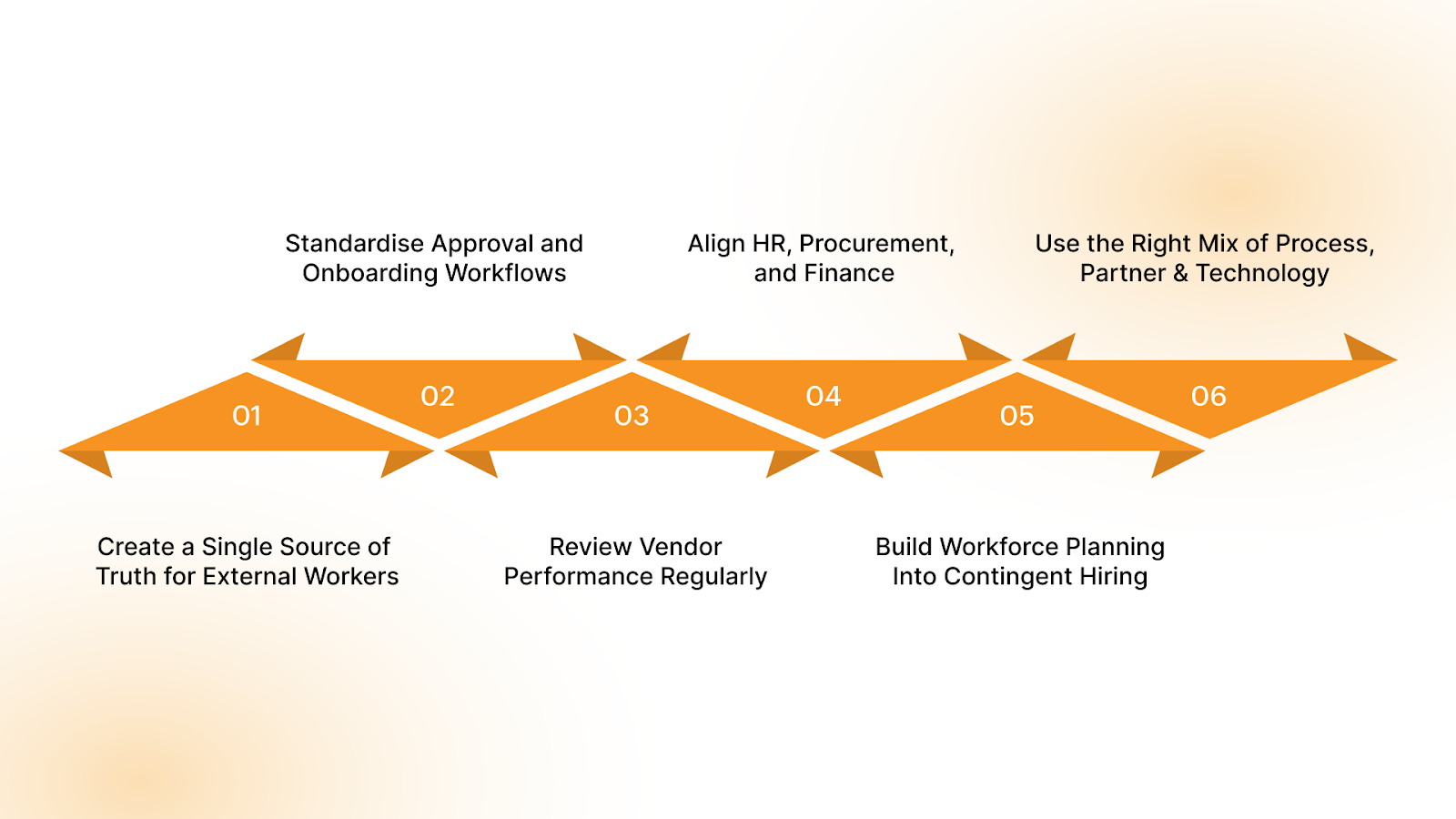
Create a Single Source of Truth for External Workers
A contingent labor program works better when workforce records are not scattered across spreadsheets, inboxes, departments, or vendor-owned reports. A single source of truth helps the business review worker status, engagement terms, vendor source, cost, and role coverage without relying on fragmented updates.
Standardise Approval and Onboarding Workflows
Consistency matters more as contingent demand increases. Standard workflows make it easier to prevent exceptions from becoming normal practice and help the business handle external hiring with fewer delays, fewer missed checks, and less confusion between departments.
Review Vendor Performance Regularly
Vendor relationships should be managed as part of program performance, not only as a fulfilment source. Regular review helps the business understand which vendors are meeting expectations on responsiveness, role fit, workforce quality, and operational reliability over time.
Align HR, Procurement, and Finance
Contingent labor programs usually become harder to manage when every function works with a different view of the workforce. Better alignment across HR, procurement, and finance helps the organisation make more consistent decisions about approvals, spend, documentation, and external workforce control.
Build Workforce Planning Into Contingent Hiring
Contingent labor is often used to solve immediate business needs, but repeated patterns usually point to broader workforce demand that should be planned more intentionally. Businesses get better results when contingent hiring is reviewed as part of workforce planning instead of being treated as a recurring short-term exception.
Use the Right Mix of Process, Partner, and Technology
No single tool or vendor solves every contingent labor challenge. Stronger programs usually come from using the right process discipline internally, the right partner support where hiring execution is needed, and the right level of technology when workforce visibility and coordination become more complex.
These practices help contingent labor management stay stable even as external workforce demand grows. Without that discipline, the program may still function, but it becomes much harder to improve, scale, or govern with confidence.

How V3 Staffing Supports Contingent Workforce Hiring
Some businesses need contingent labor support mainly at the hiring stage, while others need more structure around repeated external workforce demand. V3 Staffing supports this through hiring models that help employers manage temporary, contract, and time-bound workforce needs with clearer coordination and more consistent execution.
Contract Staffing for Time-Bound Workforce Needs
V3 Staffing supports businesses that need professionals for defined project periods, specialist assignments, or temporary workload support without moving immediately into permanent headcount. This is useful when workforce demand is linked to delivery timelines, fixed-duration needs, or changing business priorities.
Temporary Staffing for Short-Cycle Demand
Where the need is more immediate or operationally driven, V3 Staffing helps employers bring in temporary workforce support for shorter-duration roles. This can help businesses respond more effectively when external hiring needs rise because of short-term coverage gaps, recurring workload pressure, or flexible staffing requirements.
Structured Recruitment Support for Repeated External Hiring
Some organisations do not struggle with one contingent hire at a time. The difficulty appears when temporary and contract hiring starts repeating across departments, teams, or business units. V3 Staffing helps bring more structure into that hiring flow so recruitment activity is easier to manage from one requirement cycle to the next.
Better Hiring Coordination Across Business Functions
Contingent workforce demand often shows up across operations, support teams, technical functions, or business-critical projects at the same time. V3 Staffing supports employers with a more organised hiring approach across these needs, helping reduce execution pressure when workforce demand is spread across different parts of the business.
This is where contingent workforce support becomes more useful from an employer perspective. It gives businesses a way to respond to temporary and contract hiring needs with more consistency, without having to manage every external hiring cycle in a disconnected way.
Conclusion
Contingent labor can give businesses more workforce flexibility, faster access to external talent, and better support for changing operational demand. But the value of that model depends on how well the business controls approvals, vendor activity, worker classification, onboarding, spend, and program visibility as contingent use grows.
That is why contingent labor management is not only a staffing issue. It is a workforce operations issue that affects compliance, cost control, governance, and workforce reliability across the business.
For employers that need more structure around temporary, contract, and recurring external hiring needs, V3 Staffing helps bring more consistency into contingent workforce execution through staffing support aligned to business demand.