
Mass hiring has become a priority for mid-sized and large Indian enterprises, as well as multinational organisations with India-based delivery units, including those headquartered in the USA or UAE. This expansion spans Global Capability Centres, banking and finance, technology, engineering, and shared services.
India’s job market registered a 23% increase in hiring activity in 2025, signalling strong demand for talent across multiple industries.
Scaling recruitment for hundreds or thousands of roles adds coordination, assessment, and onboarding pressure that many internal TA teams cannot absorb. Documentation delays and joining drop-offs often stall fulfilment even when sourcing is strong.
Talent leaders address this by partnering with mass-hiring companies that can deliver volume within defined timelines, uphold screening standards, and track offer-to-join conversions.
These firms combine sector knowledge with structured processes and multi-city reach, allowing enterprises to scale without overloading internal HR teams.
The following sections explain why enterprise mass hiring differs from standard recruitment and how to assess providers before engagement.
Key Takeaways
- Mass Hiring Requires Structure: Volume hiring is not basic sourcing. It demands coordinated screening, documentation, onboarding and joining control across multiple locations.
- Sector Fit Matters for Outcomes: Enterprises should prioritise providers with proven experience in their sector (GCC, BFSI, Tech, Engineering, Shared Services) instead of choosing on cost alone.
- Multi-City Delivery Is a Core Requirement: Mass hiring fails without active hiring presence in major hubs. India-first providers with on-ground teams in key cities deliver more reliable fulfilment.
- Hiring Models Differ by Business Need: Permanent, Contract, IT Staffing, RPO and Executive Search serve different volume scenarios. The right model accelerates fulfilment and reduces internal workload.
What Makes Mass Hiring Different for Enterprises
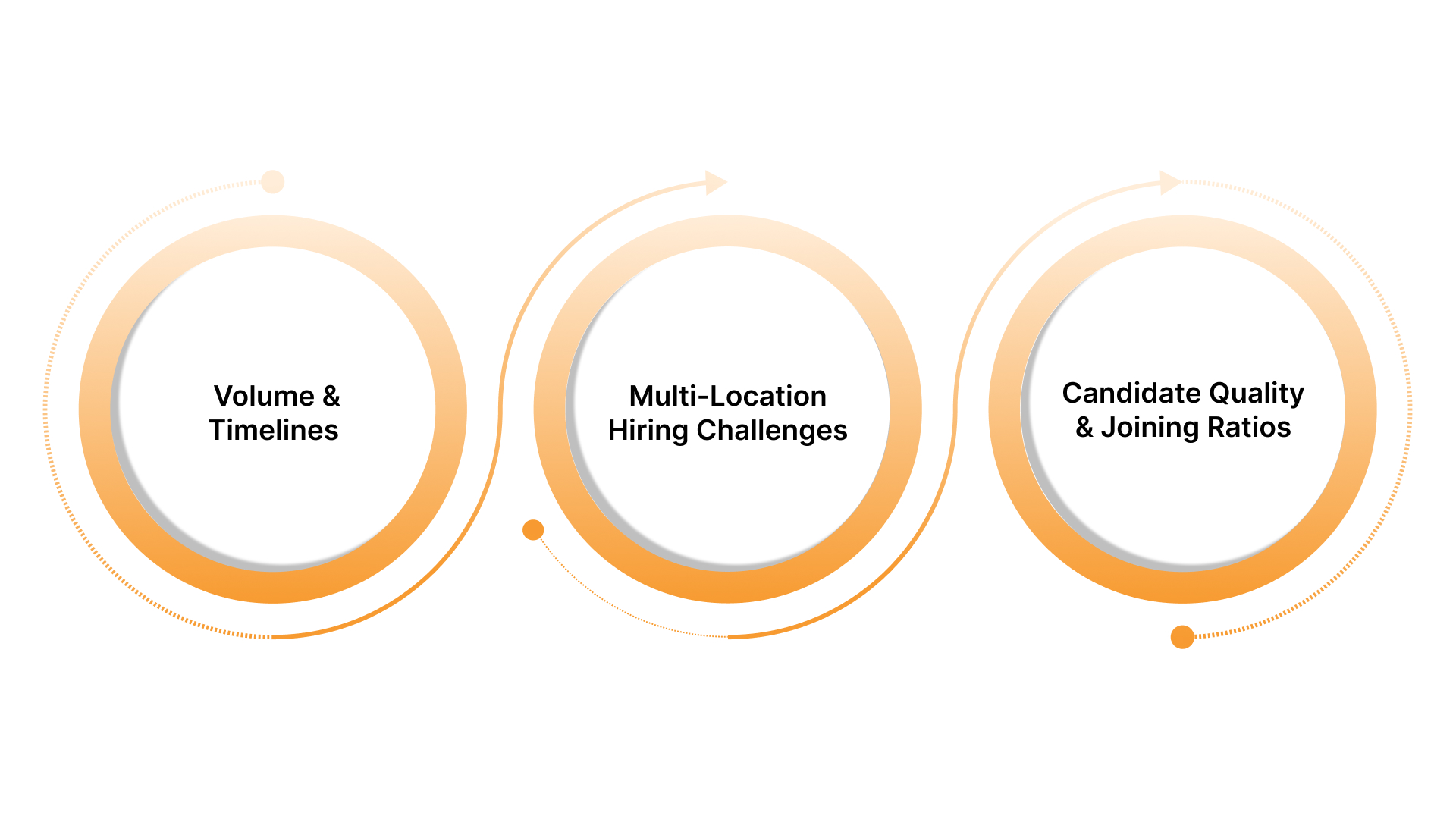
Enterprise mass hiring is not a linear sourcing exercise. It requires managing volumes, timelines, multi-location delivery, compliance, onboarding readiness, and joining outcomes.
Unlike niche hiring, there is no room for misalignment, as hiring delays directly affect business operations, ramp-up timelines, and service levels.
1. Volume and Timelines
Volume hiring is driven by expansion cycles, project requirements, or seasonal workloads. Examples include GCCs adding new LOBs, BFSI institutions expanding regional call centres, or IT services providers onboarding delivery teams for new client accounts.
The challenge lies in moving large numbers of candidates through sourcing, assessments, documentation, and onboarding without delay. Missed hiring windows can result in idle infrastructure or reduced delivery capacity.
2. Multi-Location Hiring Challenges
Enterprises rarely scale in one city. They distribute operations across hubs such as Hyderabad, Bengaluru, Chennai, Pune, Delhi NCR, and Mumbai. Each hub has different demand patterns, compensation expectations, mobility preferences, and compliance rules.
Providers need sourcing networks, assessment capabilities, and onboarding support in each location to consistently meet volume targets.
3. Candidate Quality and Joining Ratios
Filling roles at volume does not permit compromises on capability. Enterprises require specific competency levels, documented experience requirements, language skills and cultural fit criteria. Beyond selection, a key determinant of partner performance is the joining ratio.
A partner may quickly line up talent, but if 30-40 percent of selected candidates drop out before joining (a common figure cited by BFSI and BPO leaders), the hiring pipeline collapses. Tracking offer acceptance, documentation completion, and onboarding attendance is central to this category.
These differences require a structured evaluation rather than vendor selection based solely on price.
Need a partner who can handle high-volume hiring across functions and locations? V3 Staffing supports enterprises with permanent, contract, IT staffing, RPO, and executive search across major India hubs.
Speak with V3 Staffing to plan workforce expansion with accuracy and accountability
Also Read: GCC Hiring Trends And Strategies In India 2026

How to Assess Mass Hiring Companies in India
Talent acquisition heads, HR directors, founders, and GCC leaders often find it challenging to choose the right staffing partner due to the diverse landscape of the Indian staffing market.
This market includes firms that specialise in niche IT hiring, general staffing firms focused on flex-workforce supply, and process-driven volume-hiring firms.
Selection mistakes often occur when decision-makers overlook sector capability, delivery footprint, or joining performance.
Below are the evaluation criteria that matter for enterprise mass hiring:
Sectors and Profiles Served
Enterprises should check whether a provider covers the required sector verticals and role categories. Example formats that help define fit:
| Capability Area | Volume Role Examples | Sector Fit |
| Operations | Customer support, claims, onboarding, and tele-sales | BFSI, Telecom, GCC |
| Technical | Service desk, testing, network, infra | Tech, GCC |
| Back-office | Finance ops, HR ops, fulfilment | Shared Services |
| Field and Production | Technicians, assembly, QA | Engineering & Manufacturing |
A provider that cannot support the full mix may meet sourcing demand but fail to support operational continuity.
Tech vs Non-Tech Support Capability
Most enterprises require a blend of technical and non-technical talent. Providers that handle only one category increase vendor management complexity and slow down ramp-ups.
Firms supplying both improve alignment, screening, and onboarding reliability.
Delivery Hubs and Regional Coverage
Regional presence matters more than generic “pan-India” claims. Coverage requires sourcing teams, assessment infrastructure, and compliance teams across multiple hubs.
Indian flex-staffing volume growth projections of 17.3 percent CAGR through FY27 indicate sustained hiring across multiple regions rather than centralised sourcing alone.
Offer-to-Join and Retention Metrics
Enterprises should request data on:
- Screening pass percentage
- Offer acceptance percentage
- Documentation completion percentage
- Joining day attendance percentage
- First 90-day retention
These metrics provide valuable insights into funnel health and your hiring provider’s maturity. Without them, mass hiring becomes unpredictable. At V3 Staffing, we streamline the process with an average 10-day time-to-hire, ensuring your organisation secures top talent quickly, increases offer acceptance, and improves retention from day one.
Reporting and SLA Structures
Mass hiring companies that succeed with enterprises typically present:
- Weekly hiring dashboards
- SLA-based timelines for sourcing and onboarding
- Drop-off reports
- Compliance documentation status
- Backfill commitments
This level of reporting gives TA teams visibility and reduces last-minute pressure.
Also Read: Challenges in Leadership Hiring: Common Issues and Solutions
Top 7 Mass Hiring Companies in India for 2026
Mass hiring companies vary in scale, sector expertise, delivery footprint, and service models. Selection here is based on the ability to support enterprise requirements across IT, BFSI, shared services, and captive centres.
It also includes delivery infrastructure across major Indian hubs and experience in handling high-volume recruitment with high-quality outcomes.
1. V3 Staffing
V3 Staffing combines an India-first operational focus with support for international organisations operating in India. Its mass-hiring capability spans hiring models and sectors, and it partners with HR leadership to consistently deliver high-volume outcomes.
Sectors Served
- Information Technology and GCCs
- BFSI and Fintech operations
- Engineering and ground operations
- Shared services including HR, finance and support functions
Hiring Models Supported
- Permanent recruitment for volume roles
- Flexible contract staffing for peak demand
- Recruitment process outsourcing for embedded support
Key Strengths
- Active delivery in Hyderabad, Bengaluru, Chennai, Pune, Delhi NCR and Mumbai
- Structured offer-to-join tracking and reporting
- Dedicated teams for IT and non-IT volume roles
- Experience with multinational companies expanding in India
2. Adecco India
Part of a global workforce solutions network, Adecco India brings international process standards to Indian hiring volumes. Despite broader IT hiring softening for some organisations, Adecco’s experience across sectors enables it to maintain diverse mass-hiring support for enterprise clients.
Sectors Served
- IT services & products
- Consumer goods and retail
- BFSI operations
- Logistics and warehousing
Hiring Models Supported
- Temporary and contract staffing
- Permanent workforce placement
Key Strengths
- Global delivery frameworks adapted to Indian conditions
- Temporary staffing strength, especially during festive demand surges
3. Randstad India
Randstad combines global HR consulting with local sourcing strength. It is known for structured staffing processes and enterprise alignment across IT, BFSI and shared services roles.
Sectors Served
- Financial services
- Information Technology
- Manufacturing & industrial services
Hiring Models Supported
- Recruitment process outsourcing
- Contract and permanent staffing
Key Strengths
- Cross-industry recruitment experience
- Emphasis on compliance and candidate screening
4. TeamLease Services
One of India’s largest staffing companies, TeamLease, supports widespread mass hiring with compliance frameworks and digital tracking.
Sectors Served
- BFSI
- Technology services
- Telecom & consumer segments
Hiring Models Supported
- Temporary staffing
- Permanent hiring
- Compliance and payroll support
Key Strengths
- Broad client base across 28 states
- End-to-end staffing services and compliance support
5. Quess Corp
Quess is recognised as one of India’s largest staffing players and holds a significant market share with a wide network. Its workforce platform supports high-volume staffing, gig workforce enablement, and integrated workforce management.
Sectors Served
- Industrial & engineering
- IT services
- Shared services
- Logistics & warehouse operations
Hiring Models Supported
- Managed workforce programmes
- Temporary and contract staffing
- Payroll and compliance
Key Strengths
- Gig worker integration for flexible mass hiring
- Broad sector exposure with workforce management solutions
6. CIEL HR Services
CIEL focuses on full-spectrum recruitment support, blending volume hiring with candidate readiness and retention measures. It maintains strong networks across sectors and role levels.
Sectors Served
- BFSI
- Retail and operations
- IT hiring support
Hiring Models Supported
- Permanent and contract staffing
- Candidate training and readiness programmes
Key Strengths
- Emphasis on screening accuracy
- Roles across technical and non-technical categories
7. ManpowerGroup India
Global staffing leader with local execution capability. ManpowerGroup India serves enterprise clients with both volume and specialist hiring across functions.
Sectors Served
- IT & software services
- BFSI
- Shared services
- Industrial services
Hiring Models Supported
- Permanent recruitment
- Contract staffing
- Workforce solutions
Key Strengths
- Expertise in multinational engagements
- Global delivery standards
Also Read: Permanent Staffing in the Tech Industry: Challenges and Opportunities
What Should Enterprises Ask Before Choosing a Mass Hiring Partner
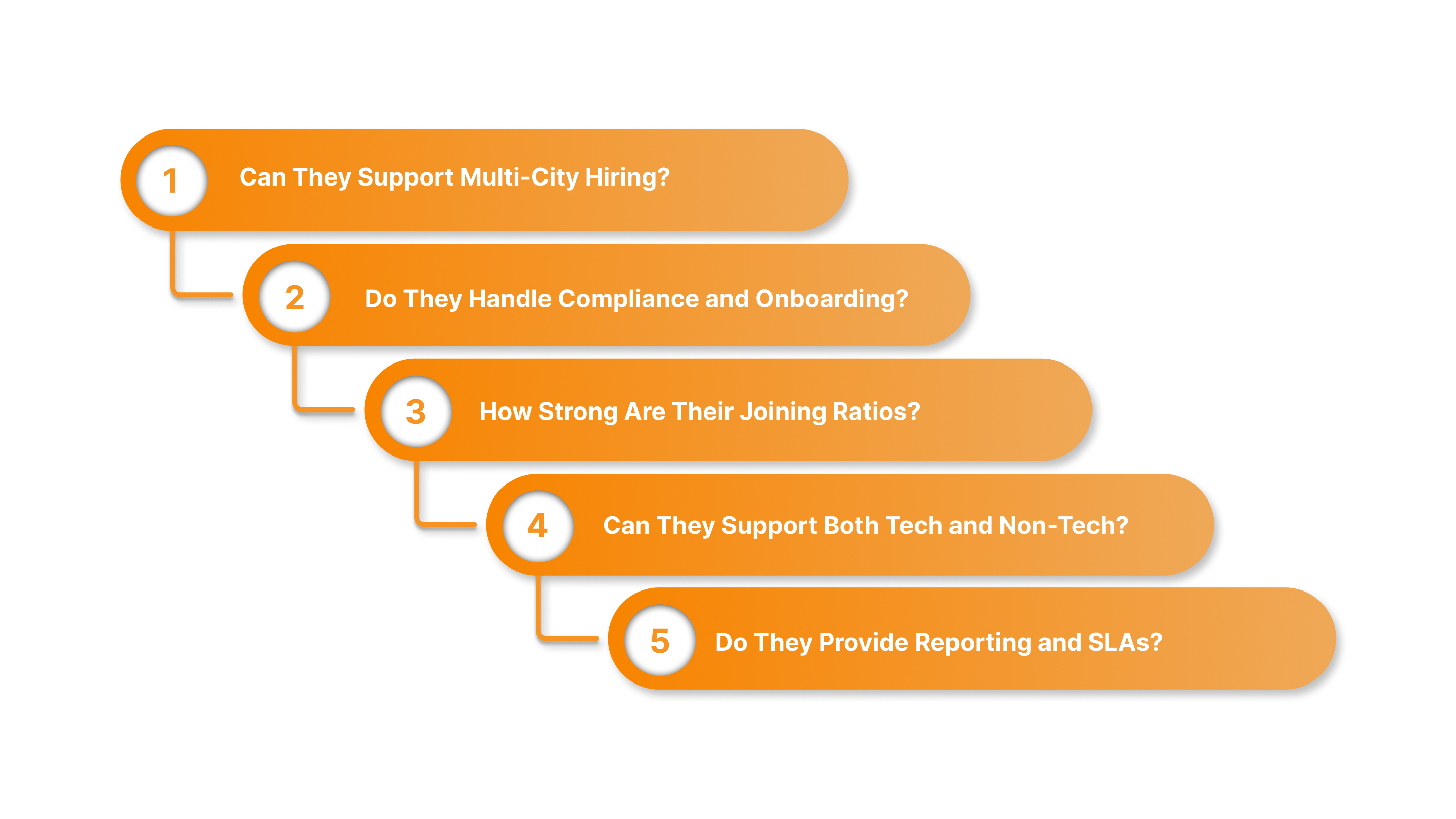
Before committing to a partner, talent leaders should test operational readiness, delivery footprint, funnel performance, and accountability mechanisms. Below is a practical checklist used by enterprise TA leaders during procurement rounds.
Can They Support Multi-City Hiring?
Enterprises rarely scale in a single location. Vendors should demonstrate sourcing and onboarding strength across major hubs such as Hyderabad, Bengaluru, Chennai, Pune, Delhi NCR, and Mumbai, as well as Tier-II reach, depending on the sector.
Without multi-city capability, volume fulfilment fails at the regional level, even with strong central coordination.
Do They Handle Compliance and Onboarding?
Mass hiring is not complete at the offer stage. Providers should support document collection, compliance checks, background verification, and onboarding support where applicable. This reduces delays and ensures day-one readiness for operations teams.
How Strong Are Their Joining Ratios?
Offer rollouts mean little without conversion. Enterprises should request historical data on offer acceptance, documentation completion, and joining-day attendance.
Weak joining ratios indicate screening issues, counteroffer risk, or insufficient alignment between the offer and the joining.
Can They Support Both Tech and Non-Tech?
GCCs and BFSI institutions often need a mix of service desk engineers, analysts, customer support roles, telesales, and back-office operations.
Using separate vendors for each category slows down hiring cycles and complicates vendor management. A partner supporting blended roles reduces fragmentation.
Do They Provide Reporting and SLAs?
Enterprise hiring requires visibility. Providers should deliver dashboards, funnel metrics, backlog reports, and agreed SLAs for sourcing and onboarding speed.
Reporting creates accountability and helps business units plan utilisation.
Also Read: How to Measure Success in Permanent and Contract Staffing
How Much Do Mass Hiring Services Cost in India
Pricing for mass hiring varies by sector, role category, delivery cities, sourcing effort, screening complexity, compliance requirements, and hiring model.
Enterprises should avoid standardising cost-per-hire without considering these factors because volume hiring funnels have multiple operational layers.
Below are the common pricing formats used across the Indian staffing market:
| Pricing Basis | Model Description | Typical Use Case |
| Percentage-based | Percentage of annual CTC for permanent roles | Mid-level permanent hiring |
| Fixed fee | Fixed cost per hire or per batch | Entry-level campus or bulk drives |
| Monthly retainer | Monthly fee for embedded RPO units | GCC scale-ups and shared services |
| Mark-up model | Wage cost plus mark-up for contract staff | BFSI ops, logistics, seasonal demand |
Other factors influencing cost beyond sourcing include documentation, compliance, onboarding support, and backfill commitments.
While enterprises often begin discussions with rate cards, experienced TA leaders map vendors to operational outcomes rather than to cost alone.

V3 Staffing: India-First Mass Hiring Support for Enterprise Needs
V3 Staffing provides mass-hiring support through sector depth, scalable delivery models, and a high-touch engagement style suited to enterprise hiring cycles.
The company positions itself as a dependable workforce partner for mid- to large-sized enterprises operating in India, including multinational organisations with domestic offices.
V3 Staffing’s service stack spans five primary categories, each relevant to different mass hiring demand cycles:
Full-time workforce expansion across mid and senior levels, driven by domain-specific recruiters and structured sourcing. Suited to enterprises building stable teams within India.
2. Temporary and Contract Staffing
Flexible deployment for project spikes, seasonal loads, and interim requirements, covering sourcing, deployment, and compliant workforce management.
Technical hiring for cloud, DevOps, data science,, QA and architecture roles. Relevant for product firms, IT services, and GCCs with continuous delivery needs.
4. Recruitment Process Outsourcing (RPO)
Embedded hiring units that manage sourcing, screening, and SLA-based fulfilment to reduce internal TA load and support rapid scale.
Targeted headhunting for CXO, VP, and Director roles to address leadership layers that accompany large workforce expansions.
Conclusion
Mass hiring is now a strategic capability for enterprises expanding across India. The right partner accelerates workforce deployment, stabilises joining ratios, reduces administrative load, and safeguards quality across multiple locations and functions.
Mass hiring companies play a crucial role in screening, documentation, onboarding, and compliance, allowing internal HR to focus on retention, culture, and business alignment.
As enterprises scale GCC operations, expand shared services or widen BFSI and tech functions, choosing a structured and accountable hiring partner becomes essential.
If your organisation is preparing for scale and needs dependable workforce support, speak with V3 Staffing to explore suitable hiring models.
FAQs
Q: How early should enterprises engage a mass hiring partner before expansion?
A: Ideally 60–90 days before the hiring ramp begins. This allows partners to prepare sourcing funnels, align job specifications, and build assessment workflows. Engaging too late forces rushed interviewing and onboarding, which increases drop-offs and lowers match quality.
Q: Are mass hiring engagements suitable for remote or hybrid workforce models?
A: Yes, provided the roles have clearly defined output and compliance criteria. Many GCC and tech firms blend on-site and remote volumes, but still rely on structured hiring partners to manage screening, documentation and joining processes, which remain consistent in hybrid models.
Q: What onboarding support should enterprises expect from a mass hiring provider?
A: At minimum, documentation checks, compliance assistance, background verification coordination and joining-day coordination. Mature providers also track readiness milestones, help reduce no-shows and maintain communication with candidates between offer and start date.
Q: What internal teams should be involved when selecting a mass hiring partner?
A: Talent Acquisition is primary, but Procurement, HR Operations, Compliance and Business Delivery teams also play roles. Delivery teams ensure the job specifications match operational realities, while procurement manages contracts and SLAs for longer-term engagements.
Q: Do mass hiring companies work with staffing MSPs or VMS platforms used by enterprises?
A: Many do, especially when supporting multinational clients or structured workforce programs. Compatibility with MSP or VMS systems helps enterprises track requisitions, compliance, onboarding and billing, and keeps reporting consistent across multiple vendors.
