
.svg)
.svg)
A role stays open for 45 days, not because you lack candidates, but because you don’t trust the decision. A contractor delivers results from week one, yet converting them feels like a calculated risk you’re not fully prepared to take.
For a Talent Acquisition Head or HR Leader, this is a pattern. Hiring cycles stretch, candidates hesitate over unclear employment models, and internal teams carry the cost of uncertainty. Contract roles solve speed. Permanent hiring solves stability. But neither fully addresses the risk of a mis-hire.
Contract-to-hire offers a middle ground. It lets you assess talent in real work conditions before making a long-term commitment, without slowing down execution. Recent industry data from ISF shows flexi staffing headcount rising from nearly 1.83 million to 1.91 million within just one quarter of FY26, signaling a clear shift toward more flexible workforce strategies.
This blog breaks down what contract-to-hire means, how it works, and where it fits in your hiring strategy.
Key Takeaways:
- Contract to hire meaning: A candidate joins on a fixed-term contract first, with the option to move into a full-time role later if performance and business needs align.
- Typical duration: Most contract-to-hire roles last 3 to 6 months, though some may extend up to 12 months depending on the role and company needs.
- Who pays salary: During the contract period, the candidate is usually on the staffing partner’s payroll, even though they work for the client company.
- Can it become permanent? Yes, contract-to-hire roles can convert into full-time employment after the evaluation period if the candidate is a good fit.
- In India, payroll, registration, contractor licensing, wage responsibility, PF, and ESI checks need to be structured properly from the start.
What is Contract-to-Hire?
Contract to hire means a hiring model where a person joins on a fixed-term contract first, with the possibility of becoming a permanent employee later. In India, this often means the worker is on the staffing agency’s payroll during the contract period while working for the client company. Companies use this model to reduce hiring risk and test fit before making a full-time offer.
How Contract-to-Hire Works in Practice
Contract-to-hire follows a structured lifecycle that aligns hiring, evaluation, and conversion into one continuous process. For enterprise organisations, this structure helps maintain accountability and predictability.
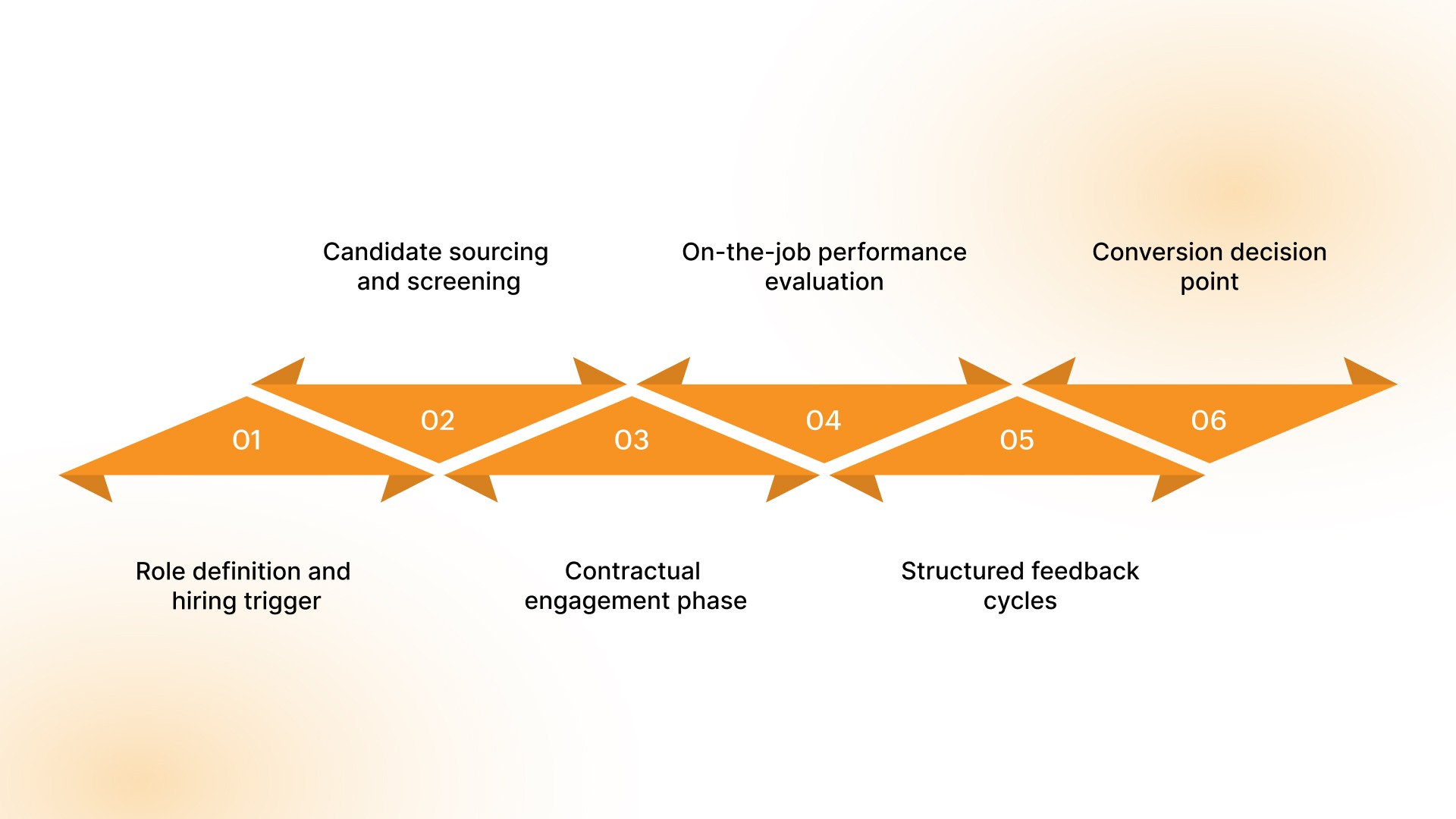
Key steps involved:
- Role definition and hiring trigger: The process begins when a clear hiring need is identified due to skill gaps, project deadlines, or scaling requirements. Along with job responsibilities, organisations also define how performance will be evaluated during the contract phase.
- Candidate sourcing and screening: Candidates are sourced through staffing partners or internal channels and evaluated for immediate job readiness. The focus is on technical capability, relevant experience, and the ability to contribute from day one.
- Contractual engagement phase: Selected candidates join on a fixed-term contract, usually ranging from 3 to 6 months. During this period, they work within the team structure and contribute to real project outcomes.
- On-the-job performance evaluation: Performance is assessed in real working conditions instead of simulated interviews. Managers track delivery quality, collaboration, adaptability, and consistency against predefined expectations.
- Structured feedback cycles: Regular feedback sessions help both the organisation and candidate stay aligned. This ensures performance gaps are addressed early and expectations remain transparent throughout the engagement.
- Conversion decision point: At the end of the contract period, the organisation decides whether to convert the candidate into a full-time employee. The decision is based on documented performance, role fit, and long-term hiring needs.
Also Read: Hiring Remote Workers in India: Trends, Models, and Best Practises
Contract-to-Hire vs Direct Hire vs Temporary Staffing
Not all flexible hiring models serve the same purpose. Understanding the difference helps you choose the right approach based on role urgency, hiring risk, and long-term workforce goals.
For enterprise teams, the choice between these models depends on the nature of the role, the level of uncertainty involved, and the organisation's long-term hiring goals. Contract-to-hire sits between direct hire (maximum commitment) and temporary staffing (no commitment); it is the risk-managed middle path.
Pros of Contract-to-Hire
Contract-to-hire offers several advantages for organisations looking to balance speed, quality, and flexibility in hiring. It is particularly useful in scenarios where role clarity or candidate availability is uncertain.
1. Reduced Hiring Risk
Allows you to assess a candidate in a real working environment before making a full-time commitment. It shifts the decision from interview assumptions to actual on-the-job performance.
- Why it matters: A wrong permanent hire costs time, money, and team stability. This model reduces that risk by adding an evaluation window before conversion.
- If it is not used well: Teams may still make rushed conversion decisions without clear review criteria.
- Who benefits most: Hiring managers, TA leaders, and business teams filling critical or difficult roles.
2. Faster Access to Skilled Talent
Helps organisations bring in capable professionals more quickly by shortening the path between sourcing and onboarding. It is especially useful when business needs are urgent and open roles cannot stay vacant for long.
- Why it matters: Delayed hiring can slow project delivery, increase pressure on existing teams, and create revenue or execution gaps.
- If it is not managed well: Speed may come at the cost of role clarity, which can create mismatched expectations later.
- Who benefits most: Teams hiring for urgent projects, niche functions, or time-sensitive business goals.
3. Better Role Fit Validation
Gives employers a chance to validate not just skills, but also work style, team compatibility, and adaptability in actual business conditions. This creates a more complete picture than interviews alone.
- Why it matters: A candidate may perform well in assessments but struggle in the day-to-day realities of the role.
- If it is not assessed properly: Conversion decisions may still rely on subjective impressions rather than structured evaluation.
- Who benefits most: Organisations hiring for cross-functional, collaborative, or evolving roles.
4. Flexible Workforce Planning
Makes it easier to adjust hiring based on changing workloads, budgets, or project requirements. It gives businesses room to scale without locking into immediate long-term commitments.
- Why it matters: Not every hiring need starts with complete certainty. Some roles need short-term execution first and long-term commitment later.
- If it is overused: Teams may remain in a temporary hiring cycle for too long instead of building stable workforce plans.
- Who benefits most: Enterprises in growth phases, project-led teams, and businesses handling demand fluctuations.
5. Reduced Internal Hiring Load
Takes pressure off internal HR and TA teams by simplifying parts of sourcing, screening, onboarding, payroll, and early-stage coordination. This helps internal teams focus on decision-making instead of only execution.
- Why it matters: High-volume or specialised hiring can drain internal bandwidth quickly. Contract-to-hire can reduce that operational burden.
- If it is not structured well: Handoffs between staffing partners and internal teams may become unclear and slow the process.
- Who benefits most: Lean HR teams, enterprise TA functions, and companies hiring across multiple roles at once.
6. Access to Niche and Hard-to-Fill Talent Pools
Improves access to professionals who may not be immediately available or interested in direct full-time roles. It opens doors to talent segments that prefer to evaluate the opportunity before making a long-term move.
- Why it matters: Some specialised candidates are more open to a lower-risk entry point than a direct permanent switch.
- If the model is poorly positioned: Strong candidates may still choose employers offering direct clarity and stability from day one.
- Who benefits most: Employers hiring for engineering, data, cybersecurity, cloud, and other skill-shortage functions.
Cons of Contract-to-Hire
While contract-to-hire offers clear advantages, it also comes with certain limitations that organisations need to evaluate carefully. These challenges often relate to candidate expectations, process complexity, and conversion uncertainty.
1. Conversion Uncertainty
A contract-to-hire role does not guarantee a permanent offer at the end of the evaluation period. Final decisions may change due to budget shifts, internal priorities, or candidate preferences.
- Why it matters: Uncertainty can affect workforce planning and make long-term role continuity harder to predict.
- If it becomes frequent: Organisations may lose strong candidates after investing time in training and integration.
- Who is affected most: Hiring managers, workforce planners, and candidates seeking stability.
2. Candidate Hesitation
Some candidates are cautious about accepting a role that begins on contract terms, even if full-time conversion is possible later. Concerns usually relate to job security, benefits, and career planning.
- Why it matters: Candidate hesitation can reduce the available talent pool and create drop-offs during the hiring process.
- If it is not addressed early: Employers may struggle to attract experienced or in-demand professionals.
- Who is affected most: Recruiters, hiring managers, and roles competing with direct permanent offers.
3. Expectation Misalignment
Problems can arise when the employer, candidate, and staffing partner are not aligned on role scope, evaluation criteria, timeline, or conversion terms. Even a good hire can become a poor experience if expectations differ from the start.
- Why it matters: Misalignment weakens trust and can turn the evaluation phase into confusion rather than clarity.
- If it is left unresolved: Disputes may emerge around performance reviews, contract duration, or permanent hiring decisions.
- Who is responsible: HR, hiring managers, recruiters, and staffing partners collectively.
4. Higher Overall Cost in Some Cases
While contract-to-hire may reduce short-term risk, it can sometimes increase total hiring costs depending on agency fees, extended contract periods, and conversion structures. The model is not automatically cheaper than direct hiring.
- Why it matters: Cost efficiency depends on how the arrangement is designed, how quickly decisions are made, and how often conversions succeed.
- If costs are not tracked carefully: Organisations may spend more than expected without improving hiring outcomes.
- Who should monitor it: TA leaders, finance teams, and procurement or staffing governance stakeholders.
5. Compliance and Management Complexity
Contract-to-hire involves more than just filling a role. It brings legal, payroll, classification, documentation, and regulatory responsibilities that must be handled correctly from the start.
- Why it matters: Poor compliance can lead to administrative issues, legal exposure, and reputational risk.
- If controls are weak: Misclassification, payroll errors, or contract disputes may create avoidable problems.
- Who owns it: HR, legal, finance, and staffing partners working in coordination.
6. Impact on Team Continuity
Because the role starts in a temporary structure, there is always a chance the person may exit before full integration or not convert at all. This can disrupt continuity in teams that depend on long-term context and knowledge retention.
- Why it matters: Team stability matters in roles tied to ongoing projects, internal processes, or client relationships.
- If turnover is repeated: Teams may face knowledge gaps, repeated onboarding cycles, and lower collaboration consistency.
- Who is affected most: Project managers, functional leaders, and teams working on long-duration or mission-critical work.
Understanding these limitations helps organisations use the model more strategically.
Also Read: 10 High-Volume Recruitment Strategies for Efficient Hiring in 2026
Which Industries Use Contract-to-Hire Model?
Contract-to-hire is most commonly used in sectors where skills are specialised, project timelines are defined, or workforce demand fluctuates:
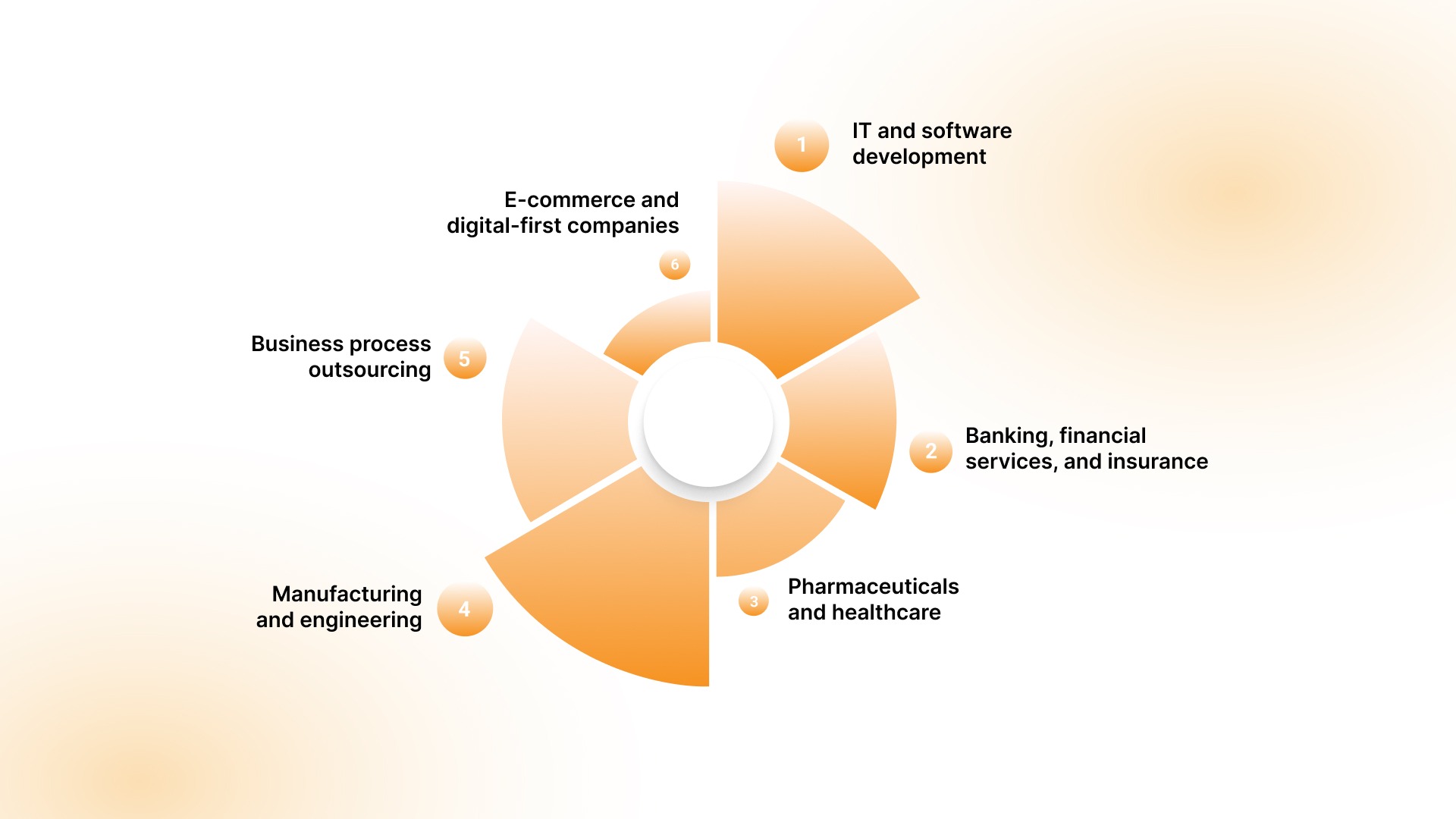
- IT and software development: Cloud, DevOps, AI/ML, and cybersecurity roles are the most active C2H segments in India, particularly across GCCs in Bengaluru, Hyderabad, and Pune.
- Banking, financial services, and insurance (BFSI) : Used for risk, compliance, and technology transformation roles where performance validation matters before commitment.
- Pharmaceuticals and healthcare: Regulatory and clinical research functions with defined project cycles use C2H to manage headcount flexibility.
- Manufacturing and engineering: Especially for design, quality, and automation roles where technical output can be assessed quickly.
- Business process outsourcing (BPO/KPO): High-volume C2H hiring for analytics, operations, and domain-specific support functions.
- E-commerce and digital-first companies: Product, data, and growth roles often begin as C2H arrangements in fast-scaling startups and GCCs.

Legal and Compliance Rules for Contract-to-Hire
When adopting a contract-to-hire model in India, it's essential for companies to comply with specific legal and regulatory requirements.
Here’s what businesses must consider:
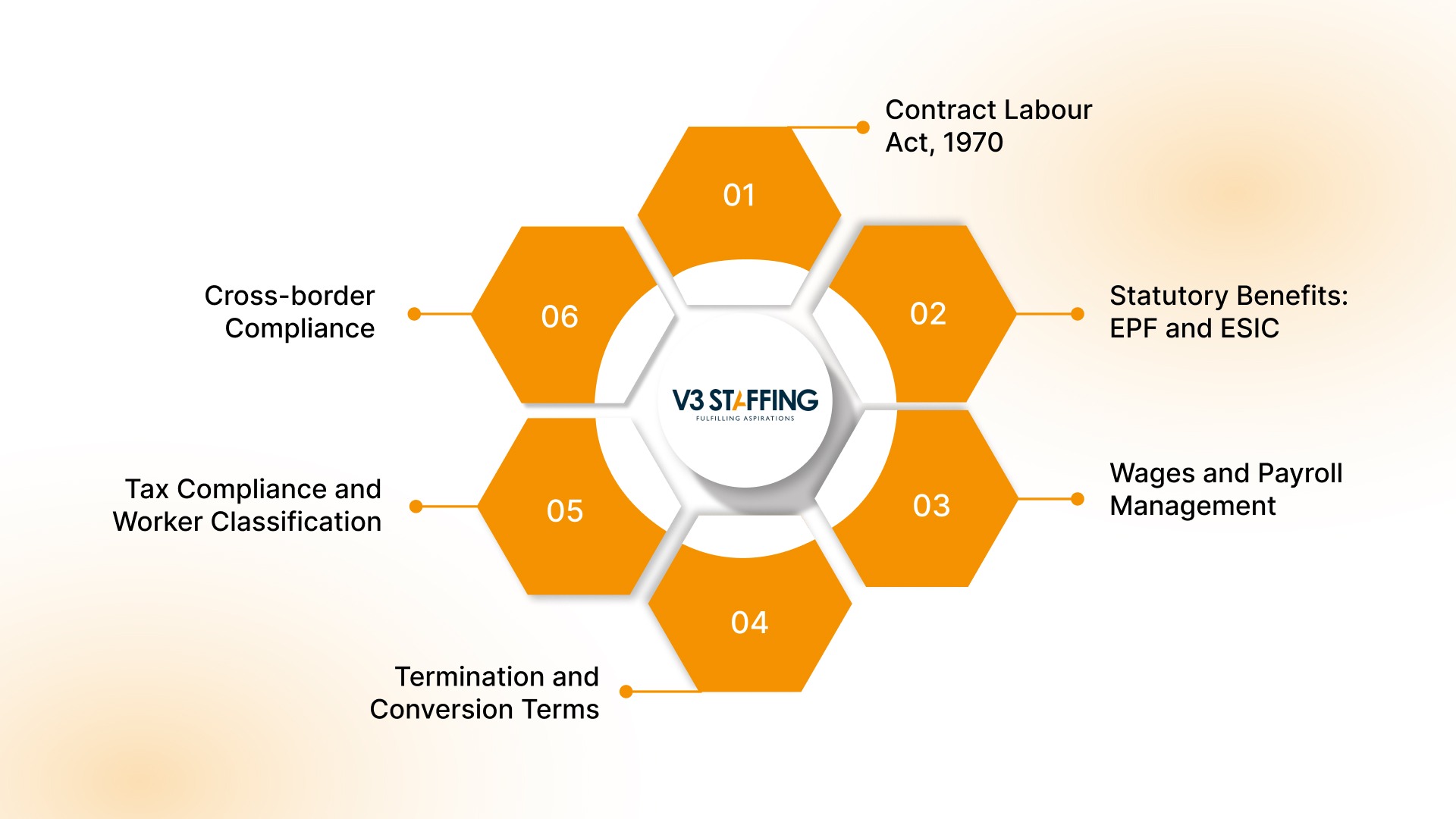
- Contract Labour (Regulation and Abolition) Act, 1970: This Act generally applies to establishments and contractors that employed 20 or more contract labour on any day in the preceding 12 months, so registration, licensing, and wage-compliance checks should be reviewed before using the model.
- Statutory Benefits: EPF and ESIC: The principal employer ensures EPF and ESIC compliance, even if the staffing agency handles payroll. Verify correct remittance to avoid penalties.
- Wages and Payroll Management: The staffing agency manages payroll during the contract, but the principal employer ensures compliance with wages, benefits, and correct worker classification.
- Termination and Conversion Terms: Clear documentation on termination and conversion is necessary. Conversion criteria should be defined based on performance and agreed timelines.
- Tax Compliance and Worker Classification: Proper classification of contract workers is critical to avoid tax issues and penalties. Misclassification impacts tax liabilities and benefits.
- Cross-border Compliance: For international hires, compliance with both Indian and home-country laws is necessary to avoid legal conflicts.
Best Practices for Successful Contract-to-Hire Hiring
Successful contract-to-hire hiring depends on clear structure, alignment, and execution discipline. Organisations that treat it as a strategic process rather than an ad-hoc solution tend to achieve better outcomes.
- Set Clear Success Criteria: Define measurable performance expectations before the candidate starts to ensure an objective evaluation.
- Establish a Fixed Evaluation Timeline: Set specific review points (e.g., 30, 60, 90 days) to assess performance and make timely conversion decisions.
- Be Transparent About the Structure: Clearly communicate the contract-to-hire model upfront, ensuring the candidate knows the potential for permanent employment.
- Integrate Contract Hires Early: Involve contract hires in team activities to assess fit and boost productivity from day one.
- Schedule Regular Feedback Cycles: Hold consistent check-ins to address performance gaps early and keep expectations aligned.
- Align HR, Hiring Managers, and Staffing Partners: Ensure all parties are on the same page regarding role expectations and conversion criteria.
- Prepare for Both Conversion and Exit: Plan for both conversion to full-time and possible exits with clear terms for both scenarios.

What Should Job Seekers Check Before Accepting a Contract-to-Hire Role?
Before accepting a contract-to-hire role, job seekers should understand how the arrangement works in practice and what conditions apply during the contract period.
Professionals evaluating a C2H offer should be able to clear asses these terms:
- Understand the conversion terms upfront: Ask explicitly: what performance criteria trigger a permanent offer? What is the timeline? Is the conversion guaranteed if the criteria are met, or discretionary? Get this in writing before joining.
- Clarify who manages your payroll: During the contract phase, your salary and statutory benefits (PF, ESIC) are typically managed by the staffing agency, not the client company. Confirm these contributions are being made correctly.
- Treat it like a permanent role from day one: Hiring managers assess behaviour, not just output. Collaboration style, reliability, and communication all factor into conversion decisions, not just technical delivery.
- Know your rights: Contract workers in India are entitled to statutory protections under the Contract Labour (Regulation and Abolition) Act, 1970. You cannot be denied basic workplace rights simply because you are on a contract payroll.
How V3 Staffing Can Help with Contract-to-Hire Hiring Solutions
Contract-to-hire requires speed, structured execution, and consistent evaluation. Many enterprise teams struggle to manage this internally, especially when hiring volumes are high or roles are specialised.
V3 Staffing supports contract-to-hire hiring by sourcing pre-qualified talent, managing contract onboarding and payroll coordination during the evaluation phase, setting structured review checkpoints with hiring teams, and supporting smooth conversion to full-time employment when the fit is proven. This gives enterprise teams faster access to talent without losing control over evaluation, compliance, or hiring quality.
Here’s how we can help you:
- Permanent Recruitment: Places candidates in long-term GCC roles across engineering, product, and data functions with a strong focus on role fit and global hiring standards.
- Temporary & Contract Staffing: Provides access to project-based GCC roles with flexible contracts for transformation and short-term skill needs.
- IT Staffing: Matches tech talent with GCCs hiring for cloud, DevOps, AI/ML, cybersecurity, and software roles through curated talent pools.
- Recruitment Process Outsourcing (RPO): Manages end-to-end GCC hiring with sourcing, screening, and coordination for faster and structured recruitment.
- Executive Search: Supports senior GCC hiring for leadership roles like CTOs, heads of engineering, and transformation leaders.
- EOR Services: Enables global GCC employment without local entity setup by handling payroll, contracts, and compliance in India.
- Global Hiring: Supports global talent hiring across the USA, UAE, and other markets through compliant cross-border hiring.
With over 10,000+ specialists hired, 300+ clients served and an average time to hire of 10 days, V3 provides a structured approach to contract-to-hire that aligns with enterprise hiring expectations.
Conclusion
Contract-to-hire has become a practical response to the realities of modern hiring. It allows organisations to move faster while reducing the risk of long-term hiring decisions. By combining flexibility with structured evaluation, it supports better alignment between role requirements and actual performance outcomes.
V3 Staffing supports organisations in executing contract-to-hire effectively through structured hiring models, faster access to relevant talent, and operational support across the hiring lifecycle. Whether the need is to scale quickly, reduce hiring risk, or improve conversion outcomes, the right partner can make a measurable difference.
Contact us today to explore how contract-to-hire can fit into your hiring strategy.