

Global Capability Centres (GCCs) have evolved from cost-saving back offices into powerful innovation engines that drive global digital transformation. Over the past decade, India has become the epicentre of this shift; a preferred destination where multinational companies set up their technology and operations hubs to utilise deep talent pools, cost efficiency, and technological expertise.
By 2025, India is projected to host more than 1,900 GCCs, employing over 2 million professionals, according to NASSCOM. This rapid expansion highlights India’s growing importance as a strategic global talent hub.
As AI, automation, and digital engineering reshape how businesses operate, GCCs in India are transforming their hiring strategies. The demand for new-age digital skills, leadership adaptability, and value-driven recruitment is redefining how talent is identified, evaluated, and retained.
A quick overview:
- India’s GCCs are shifting from large-scale recruitment to value-driven hiring, prioritising multi-skilled professionals in AI, data, and cloud.
- AI-powered hiring, hybrid work models, and product-focused roles are reshaping how GCCs build and retain tech talent.
- Contract-based hiring and continuous upskilling help drive agility and innovation across India’s tech hubs.
- Despite talent shortages and cost pressures, India continues to strengthen its position as a global innovation centre for GCCs.
What is the GCC Tech Sector?
Global Capability Centres, or GCCs, are offshore units set up by multinational companies to manage key technology and business functions such as product development, engineering, analytics, and digital transformation.
Unlike traditional outsourcing models that focused on cost savings, GCCs now act as strategic innovation partners for their parent organisations. They deliver value through advanced R&D, technology-driven insights, and scalable tech platforms that support and strengthen global markets.
Also Read: GCC in HR: Transforming Talent Strategy for India’s Enterprises
The New Hiring Priorities of GCCs in 2025
India’s GCCs are moving from rapid workforce expansion to a smarter and more strategic hiring approach. The focus in 2025 is on value creation, niche skills, and leadership that drives innovation across tech hubs like Bengaluru, Hyderabad, and Pune.
Let’s examine the key shifts driving this transformation.
1. Shift from Volume Hiring to Value Hiring
GCCs are actively prioritising talent that drives innovation and delivers long-term value rather than focusing solely on numbers. The emphasis is on multi-skilled professionals who can work effectively across disciplines like AI, data engineering, cybersecurity, and cloud infrastructure.
In cities like Bengaluru and Hyderabad, companies are building smaller, high-performance teams that collaborate directly with global product and engineering divisions. Hiring decisions are now guided by measurable business outcomes, not just headcount targets.
2. Demand Surge for Emerging Tech Skills
As digital transformation continues to accelerate, the demand for professionals skilled in AI, machine learning, blockchain, cloud computing, and data analytics is steadily increasing. GCCs in Chennai, Pune, and Delhi NCR are expanding their digital engineering teams to strengthen global product development and platform innovation.
India’s talent advantage stems from its strong base of emerging tech professionals; however, the competition among GCCs to secure top performers has intensified. Companies are investing strategically in talent pipelines and partnering actively with universities and industry bodies to identify and develop niche technology talent early.
3. Leadership Roles Reimagined
Leadership in GCCs is evolving rapidly, from managing operations to spearheading innovation and global collaboration. Modern GCC leaders combine technical fluency with strategic vision, managing hybrid teams while ensuring cultural alignment across geographies.
Cities like Mumbai and Bengaluru are witnessing a rise in CXO and VP-level roles within GCCs, signalling a move towards greater autonomy and ownership in decision-making. Leadership hiring now centres on adaptability, an innovative mindset, and global orientation.
Also Read: Recent Recruitment Trends for 2025

Key Hiring Trends Shaping India’s GCC Tech Sector in 2025
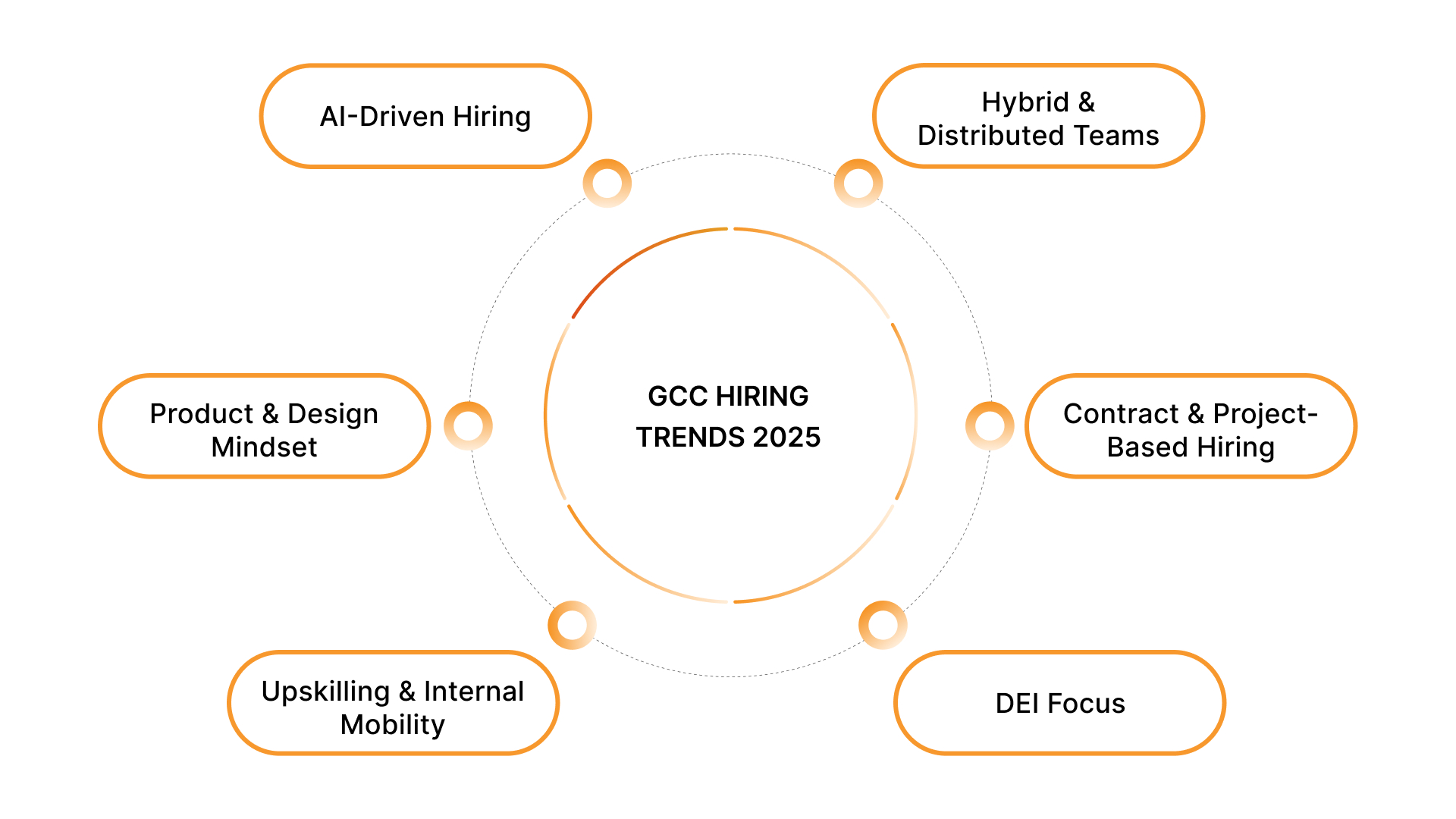
The hiring ecosystem of India’s GCCs is being reshaped by technology, workforce diversity, and changing expectations from employers and employees alike.
Below are the most influential trends reshaping recruitment strategies for 2025.
1. Rise of AI-Driven Recruitment and Skills Assessment
Artificial intelligence is transforming how GCCs identify and evaluate talent. By integrating machine learning and analytics, hiring teams make faster, data-driven decisions with reduced bias and greater accuracy.
- Smart Candidate Matching: AI tools analyse CVs, online profiles, and skill data to match candidates with suitable roles, minimising bias and human error.
- Predictive Hiring Models: Machine learning helps forecast candidate success and retention, allowing HR teams to prioritise long-term fits.
- Automated Skills Testing: Advanced tools simulate real-world coding and problem-solving challenges, helping assess practical expertise rather than theoretical knowledge.
In 2025, GCCs will use AI as an enabler that strengthens precision and transparency in hiring, not as a replacement for human judgment.
2. Hybrid and Distributed Workforces
The post-pandemic evolution has normalised hybrid models, and GCCs are now formalising distributed work as a permanent structure. Cities such as Pune and Chennai are witnessing the rise of satellite offices and flexible workspace clusters to support this shift.
- Talent Access Across Regions: Hybrid setups help GCCs tap into talent beyond Tier-1 hubs, attracting professionals from emerging tech corridors in Tier-2 cities.
- Increased Workforce Agility: Distributed teams improve project continuity, reducing dependence on a single office location during disruptions.
- Employee Retention and Flexibility: Hybrid models support employee well-being and work-life balance, reducing attrition in competitive skill segments.
The hybrid model is now a long-term strategy that helps GCCs stay competitive while balancing cost, talent availability, and productivity.
3. Product and Design Thinking Mindset Over Pure Coding Skills
GCCs are shifting focus from hiring purely technical talent to professionals who think like product owners. A strong emphasis on customer-centric innovation is driving this evolution.
- Cross-Functional Collaboration: Teams now bring together product strategists, UX designers, and software developers who work closely to align technology with business goals.
- Design Thinking Integration: Recruiters seek candidates who can identify user needs, prototype ideas, and deliver practical, scalable solutions.
- Outcome-Based Roles: The focus has moved from lines of code to measurable business impact, such as user adoption and customer satisfaction.
In essence, the GCC workforce of 2025 combines creativity and technical precision, strengthening India’s position as a global innovation hub.
4. Rise of Contractual and Project-Based Hiring
GCCs in India are diversifying their hiring structures by adding more contractual and project-based roles. This trend is especially visible in fast-moving technology domains like data analytics, cloud migration, and cybersecurity.
- Agile Workforce Deployment: Short-term contracts enable GCCs to quickly scale up teams for specific client or product needs.
- Cost and Risk Optimisation: Contractual hiring reduces long-term payroll commitments while providing access to niche expertise.
- Faster Project Turnarounds: Project-based roles help sustain momentum in innovation cycles without lengthy recruitment processes.
As global operations become more dynamic, this flexible hiring model keeps GCCs agile while maintaining innovation and delivery speed.
5. Upskilling and Internal Mobility as Retention Strategies
Rather than relying solely on external hiring, GCCs are investing heavily in employee development and internal mobility. In-house academies and digital learning platforms are becoming standard in organisations across Bengaluru, Chennai, and Pune.
- Continuous Learning Culture: GCCs encourage employees to upgrade skills in emerging tech domains like AI, cybersecurity, and cloud architecture.
- Structured Career Pathways: Transparent internal mobility programs motivate employees to explore new roles within the same organisation.
- Retention Through Growth: Employees with access to learning and career progression opportunities show greater loyalty and engagement.
By nurturing in-house expertise, GCCs build resilient, future-ready teams that adapt to constant technological change.
6. Focus on Diversity, Equity, and Inclusion (DEI)
Diversity has evolved from a compliance metric to a strategic business priority. India’s GCCs are actively creating inclusive workplaces that reflect global cultural standards and local social realities.
- Gender-Inclusive Hiring: Companies are creating women-centric leadership programmes, particularly in tech hubs like Pune and Bengaluru.
- Neurodiversity Awareness: GCCs are hiring neurodivergent professionals for their unique problem-solving perspectives.
- Equal Growth Opportunities: Transparent promotion policies and mentorship frameworks are helping level the playing field across roles and hierarchies.
DEI isn’t just about representation; it’s about building a culture that attracts the best minds, drives innovation, and strengthens global competitiveness.
Challenges in the 2025 GCC Tech Hiring Environment
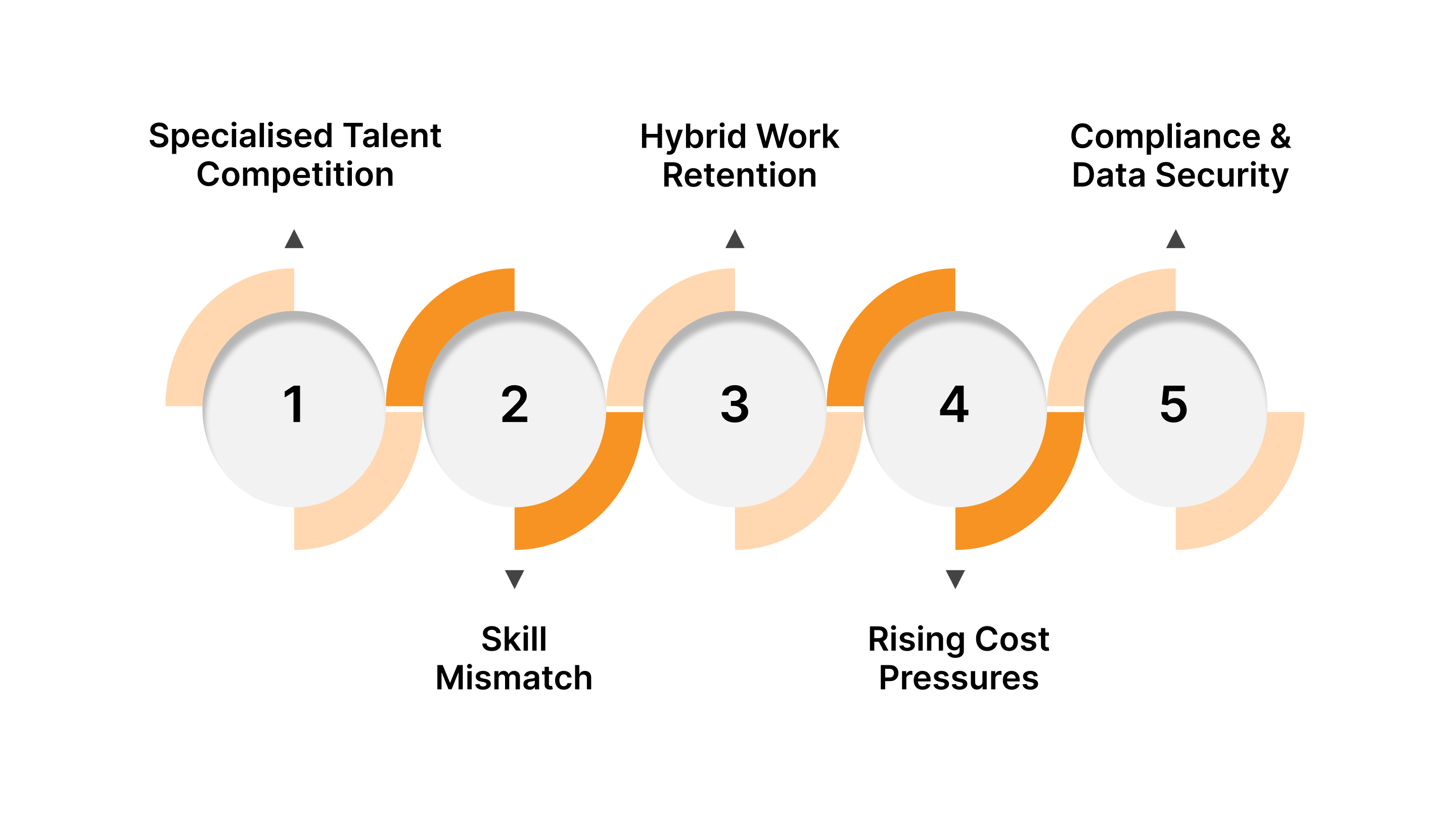
While India remains a global hub for tech talent, GCCs face several challenges in sustaining growth and competitiveness. Some common challenges include:
- High Competition for Specialised Talent: With AI, cybersecurity, and cloud skills in short supply, GCCs across Bengaluru, Hyderabad, and Pune are facing intense competition for qualified professionals, which drives salaries higher and raises attrition risks.
- Evolving Skill Mismatch: The rapid pace of digital transformation often outpaces upskilling efforts. Many candidates still hold legacy technology skills that do not match the current demand for AI, data analytics, and digital product engineering.
- Retention Amid Hybrid Work Models: As companies implement hybrid setups across Chennai, Mumbai, and Delhi NCR, maintaining team engagement and fostering a cohesive work culture is becoming increasingly challenging, particularly for younger, distributed teams.
- Rising Cost Pressures: Global economic uncertainty and fluctuating operational costs make it difficult for GCCs to maintain competitive compensation packages while ensuring profitability, especially during large-scale hiring.
- Compliance and Data Security Concerns: As more international companies set up GCCs in India, navigating both Indian and global data protection regulations adds new layers of complexity to workforce management and onboarding processes.
Overcoming these challenges requires more than recruitment tools; it demands domain expertise, agile processes, and a clear understanding of India’s evolving talent landscape.

How V3 Staffing Helps GCCs Build Next-Gen Tech Teams?
V3 Staffing is among India’s leading recruitment and workforce solutions providers.. With a deep understanding of the Indian GCC ecosystem, V3 Staffing helps companies attract, engage, and retain skilled professionals who can drive digital transformation.
Here’s how we can support you:
- Permanent Recruitment: V3 Staffing helps GCCs build stable, future-ready tech teams by sourcing top talent for niche roles across engineering, AI, data science, and product management.
- IT Staffing: Through a strong talent network across India’s leading IT corridors, V3 Staffing offers access for short- and long-term projects, enabling flexibility while maintaining productivity and quality.
- Temporary & Contract Staffing: V3 Staffing provides on-demand access to skilled professionals for short-term and contract assignments, enabling organisations to adapt to evolving project timelines without compromising on quality.
- Recruitment Process Outsourcing (RPO): Manages end-to-end recruitment operations, from candidate sourcing to onboarding, ensuring consistency, compliance, and speed across multiple tech verticals.
- Executive Search: V3 Staffing connects GCCs with experienced leadership talent who can drive innovation, operational excellence, and digital growth within complex tech ecosystems.
Whether you’re scaling new teams in Hyderabad, Bengaluru, Pune, Chennai, Mumbai, or Delhi NCR, or looking to optimise hiring cycles, V3 Staffing can help you find the right people to power your growth.
Conclusion
India’s tech sector in the GCC is at the forefront of global transformation. With more than 1,900 centres projected by 2025, the country has established itself as the nucleus of digital innovation and high-value technology operations.
The hiring trends shaping this ecosystem reflect a shift towards AI-led recruitment, hybrid work models, design-led innovation, and skill-centric hiring. However, challenges such as niche skill shortages, rising competition, and evolving workforce expectations require strategic recruitment partnerships.
This is where V3 Staffing plays a crucial role, combining industry expertise, agility, and scalability to help GCCs attract and retain the right talent across India’s top technology hubs.
Contact us today to discuss your hiring goals and explore how our tailored recruitment solutions can support your organisation’s growth.
FAQs
Which Indian cities and Tier-2 hubs are seeing the fastest growth in GCC tech hiring?
Bengaluru, Hyderabad, and Pune remain leading GCC hiring hubs, while Tier-2 cities like Coimbatore, Kochi, and Chandigarh are gaining traction. These locations offer strong talent pipelines, lower operational costs, and improved infrastructure, making them attractive for expanding tech and innovation centres.
What industry sectors are driving the highest demand for tech talent within GCCs?
Banking, financial services, healthcare, retail, and manufacturing sectors are driving the strongest demand. With digital transformation, GCCs in these industries are hiring for roles in AI, cloud computing, data engineering, cybersecurity, and automation to enhance efficiency and customer experience.
How are salary trends and compensation packages evolving for GCC tech employees?
GCC tech salaries are seeing steady increases, especially for AI, cybersecurity, and data roles. Companies are offering competitive packages that include flexible work models, performance bonuses, and upskilling opportunities to attract and retain top talent amid rising demand.
What measures are GCCs taking to address algorithmic bias and data privacy when using AI-based recruitment tools?
GCCs are adopting ethical AI frameworks, conducting regular audits, and using anonymised candidate data to minimise bias. They’re also aligning hiring tools with data protection laws and ensuring transparency in algorithms to promote fair, inclusive, and compliant recruitment practices.
What are the most common barriers faced by GCCs in scaling tech and digital talent pools?
Key barriers include talent shortages in niche skills, intense competition from startups, and challenges to employee retention. Additionally, evolving technology demands and limited local training infrastructure make it difficult for GCCs to scale digital capabilities at the required pace.
